 Michelle
 Every city has a surface and a depth, a face it shows to the world and a foundation on which that face rests. In most cities, the relationship between the two is largely metaphorical. In Venice, it is a physical, geological and architectural fact of the most concrete and literal kind. Beneath the churches and the palaces and the canals lies another Venice entirely: a city of flooded crypts where columns a thousand years old stand in perpetual reflection, of hidden corridors connecting the machinery of state power to the instruments of its enforcement, of millions of wooden piles driven into the lagoon bed and transformed over centuries into something harder than stone. To understand Venice fully, you must go down as well as across. What you find below is not merely interesting. It is, in several respects, more extraordinary than anything visible above.
The Submerged Crypts: Where Water Becomes Architecture
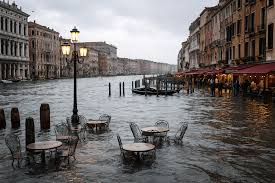
Venice sits at sea level, and the phenomenon of acqua alta, the periodic flooding caused by the combination of tidal forces, atmospheric pressure and, increasingly, the long-term effects of climate change on the northern Adriatic, affects the city's lowest-lying spaces with a regularity that ranges from the merely inconvenient to the genuinely dramatic. For the street-level piazzas and the ground floors of palaces, acqua alta is a problem to be managed, a nuisance with wooden walkways and rubber boots. For the crypts of Venice's oldest churches, it is something else: a permanent condition, a geological fait accompli, and, inadvertently, the source of some of the most visually astonishing spaces in the entire city.
The crypts of Venice were not designed to be flooded. They were built, in the ninth, tenth and eleventh centuries, as sacred spaces for the veneration of relics and the burial of important persons, following the tradition of the early Christian church, which located its holiest objects below the level of the nave in a deliberate invocation of the underground chambers of the Roman catacombs where the first Christians had buried their dead and celebrated their faith. The builders could not have foreseen that the gradual subsidence of the lagoon floor, combined with the rising level of the Adriatic, would eventually bring the water table into permanent contact with these underground sanctuaries. What they built as spaces of contemplation and devotion, the centuries have transformed into something simultaneously ruinous and sublime.
The Crypt of San Zaccaria: Venice's Most Spectral Space
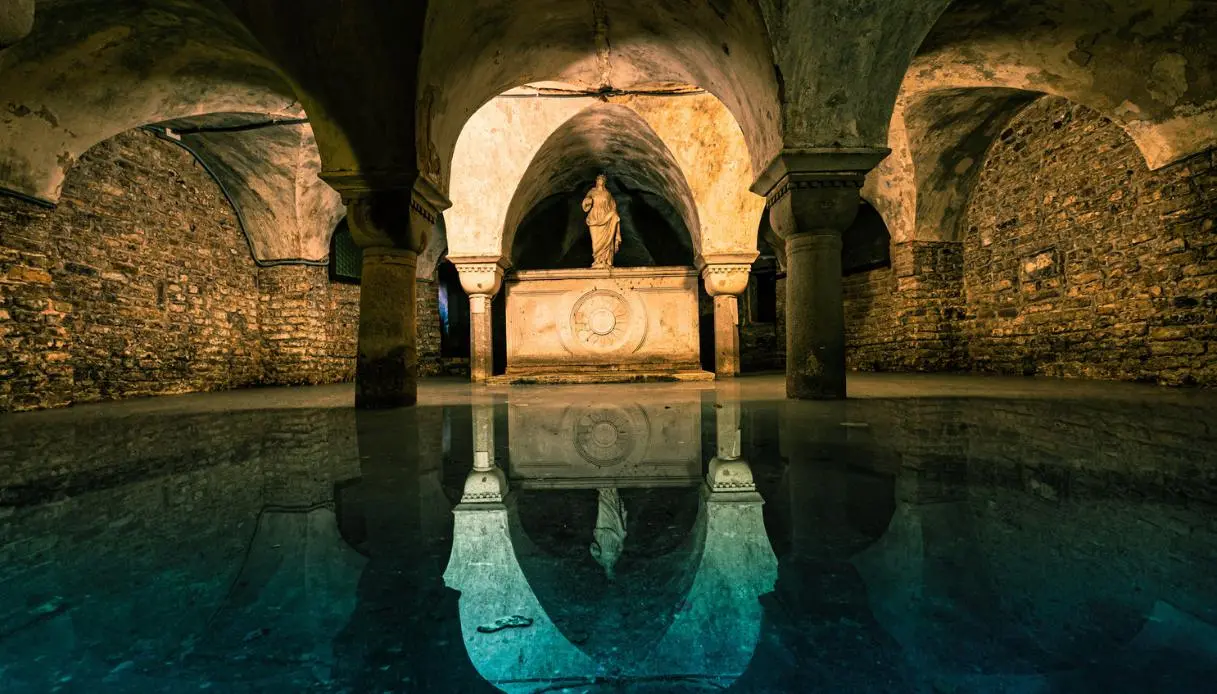
Of all the underground spaces accessible to visitors in Venice, the crypt of San Zaccaria is the one that most powerfully arrests the imagination. It lies beneath the church of the same name in the Castello sestiere, a short walk from Piazza San Marco through a neighbourhood that was already ancient when the present church was built in the fifteenth century. The church above is itself exceptional, a Renaissance facade of considerable beauty sheltering an interior whose side chapels contain works of such quality, including Giovanni Bellini's extraordinary altarpiece of the Virgin and Child with Saints, considered by many critics to be the finest painting in Venice, that the crypt beneath it is routinely overlooked by visitors who have run out of time or attention.
This is a mistake worth correcting. The crypt of San Zaccaria is almost permanently flooded, the water standing typically between twenty and forty centimetres above the floor depending on the season and the tidal conditions. It entered this state some centuries ago and has never fully recovered, and the restoration efforts that have kept the space structurally stable have wisely made no attempt to drain it, recognising that the water has become as much a part of the space's character as the columns and the vaulted ceiling above them. What you see when you descend the narrow staircase and your eyes adjust to the dim light is one of the most genuinely strange and genuinely beautiful sights in all of Italy: a low forest of tenth-century columns, their Istrian stone capitals still precise and legible after a thousand years, standing in perfectly still water whose surface acts as a flawless mirror, doubling the apparent height of the space and creating a visual ambiguity between the real columns and their reflections that the eye takes some time to resolve. The effect is not merely decorative. It produces a quality of unreality, of suspended time, that is unlike anything achievable by any deliberate architectural strategy. This was not designed. It happened. And what happened is more powerful than almost anything that could have been planned.
The crypt is accessible through the church during visiting hours, and there is a small charge for entry to the underground level. Go when the church first opens in the morning, before other visitors arrive, and bring a torch if you have one: the artificial lighting, necessarily limited, does not fully illuminate the furthest recesses of the space, and the darker corners reward investigation.
San Simeon Piccolo: Twenty-One Chambers and a Painted Underworld
The church of San Simeon Piccolo stands directly opposite the railway station of Santa Lucia, its green copper dome and Corinthian portico the first ecclesiastical sight that greets visitors arriving in Venice by train: an improbably grand baroque structure in a position of supreme civic visibility, announcing the city's ambitions to anyone approaching from the mainland. Most of those visitors pass it without entering, drawn immediately by the vaporetto stops and the first views of the Grand Canal. This is unfortunate, because beneath San Simeon Piccolo lies one of the most unusual and least-visited underground spaces in Venice.
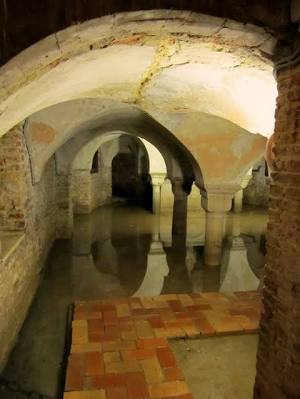
The crypt beneath the church is a vast subterranean cemetery occupying a footprint approximately equal to that of the church above. It is divided into twenty-one chambers, each one a low, barrel-vaulted space whose walls are covered entirely in frescoes depicting the Stations of the Cross, the Via Crucis, painted with a devotional intensity that owes more to the popular religious art of the Counter-Reformation than to any academic tradition but achieves, in the compressed and dimly lit space of the underground chamber, an emotional directness that more sophisticated works sometimes lack. The frescoes were intended to be seen by mourners processing through the chambers in the performance of a funeral liturgy that moved from chamber to chamber, the sequence of the Passion unfolding around the walls as the coffin passed through the space. To walk through the chambers today, in the order in which they were intended to be experienced, is to participate in a funeral ritual designed five centuries ago for a congregation that no longer exists, and the experience is more affecting than you might expect.
Access to the crypt of San Simeon Piccolo is restricted and typically requires advance arrangement with the parish or through a specialist guided tour. Several Venetian cultural organisations offer underground tours that include this space, and the effort required to access it is thoroughly repaid by what you find inside.
The Crypt of San Marco: The City's Oldest Secret
Beneath the nave of the Basilica di San Marco, below the celebrated mosaic floors and the forest of marble columns that support the great Byzantine superstructure above, there is a crypt of a different character from those of San Zaccaria and San Simeon. It is not flooded and it is not frescoed. What it is, or rather what it was, is the original repository of the most sacred object in the Venetian Republic: the body of Saint Mark the Evangelist himself, transported from Alexandria in 828 by two Venetian merchants who concealed it under layers of pork and cabbage to prevent its confiscation at the port and brought it to Venice as the foundational act of civic and spiritual identity on which the entire mythology of the Republic was subsequently built.
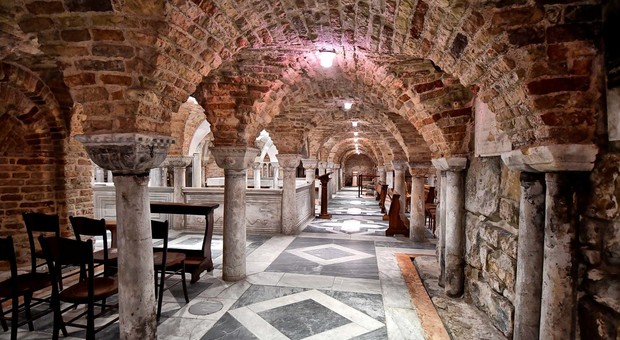
The crypt is a low, vaulted labyrinth of interlocking bays supported by stubby, thick-set columns of considerable antiquity, some of them incorporating materials reused from even older structures, a palimpsest of stone that takes you back, layer by layer, to the earliest phases of Venice's existence as a city. The proportions are deliberately humble: this is not a space designed to impress with scale or grandeur, but to concentrate the visitor's attention on the sacred presence it was built to house. The body of Saint Mark rested here for centuries before being translated to the high altar above, and the space retains, in its compressed gravity and its silence, something of the atmosphere of a reliquary: a container whose importance derives entirely from what it once held.
Visiting the crypts: a practical note. None of the three crypts described above is included in the standard tourist circuit of Venice. All three require specific intention and, in the cases of San Simeon Piccolo and San Marco, advance arrangement or a guided tour. The crypt of San Zaccaria is the most straightforwardly accessible, open during church visiting hours with a small entry charge. Give yourself at least half a day for a serious exploration of Venice's underground religious spaces, and book any guided tours at least two weeks in advance, as places are limited.
The Secret Passages of the Doge's Palace: Power, Surveillance and Casanova
The Doge's Palace, the Palazzo Ducale, presents to the world a facade of extraordinary Gothic elegance: the white Istrian stone loggia, the pink Verona marble of the upper walls, the magnificent entrance portals leading to the courtyard. This is Venice's public face of power, designed to impress and to reassure, to project the image of a government both magnificent and legitimate. Behind this facade, within the labyrinthine interior of the building itself, the Venetian state conducted a different kind of business entirely, one that it preferred to keep as invisible as the architecture allowed.
The Venetian Republic was, by the standards of its age, a sophisticated and in many respects remarkably stable system of government. It was also, when it felt its authority threatened, a system of government capable of considerable ruthlessness, and it housed that ruthlessness in the same building where it conducted its most ceremonial functions. The relationship between the Doge's Palace as a place of ceremony and the Doge's Palace as a place of detention, interrogation and punishment was not a contradiction in the Venetian mind: it was an expression of the same logic, the logic of a state that understood power as inseparable from the capacity to enforce it.
The Pozzi: Cells Below the Water Line
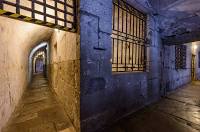
The Pozzi, meaning wells or pits, were the ground-floor prison cells of the Doge's Palace, and their name referred both to their shape (low, narrow, and dark, with ceilings so low in some cells that a tall man could not stand fully upright) and to their condition. Positioned at the base of the palace, at or below the level of the canal water on the other side of the outer wall, they were perpetually damp, frequently flooded during periods of acqua alta, and entirely without natural light. The prisoners held here were not the political detainees and high-profile suspects managed by the Council of Ten: they were the common criminals of the Republic, the thieves and debtors and minor offenders whose cases were processed by the lower courts, and whose experience of Venetian justice was as unpleasant as the architecture of their confinement was designed to make it.
The cells are accessible today as part of the standard Doge's Palace tour and are among the most sobering spaces in the entire building, a necessary corrective to the splendour of the rooms above. The walls of some cells still bear graffiti carved by prisoners over the centuries: names, dates, prayers, curses, small drawings of ships and crosses and the faces of people remembered from another life. These marks, carved into the stone by men who had no other means of leaving a trace of their existence, are the most immediate and most humanly affecting documents anywhere in the palace.
The Piombi and the Hidden Corridors of State Power
The counterpart to the Pozzi, in the geography of Venetian incarceration, were the Piombi: the lead-roofed cells directly beneath the palace roof, named for the sheets of lead cladding that covered the exterior surface of the roof and conducted the heat of the Venetian summer and the cold of its winters with equal and merciless efficiency into the cells beneath. The Piombi were reserved for a different class of prisoner: political detainees, suspected traitors and individuals whose cases were handled directly by the Council of Ten or the State Inquisition rather than by the regular courts. The conditions in the Piombi were better than those in the Pozzi in terms of space and light but worse in terms of temperature, the cells becoming furnaces in July and August and ice chambers in January.
The most celebrated occupant of the Piombi was Giacomo Casanova, who was imprisoned there in 1755 on charges of libertinage, impiety and association with forbidden books, and who escaped in October 1756 in what is the most celebrated prison break in Venetian history and one of the most remarkable in European history generally. Casanova's escape, which involved months of preparation, the acquisition of a metal bar that he concealed under his mattress, the boring of a hole through the floor of his cell, an aborted initial attempt, and a final successful exit through the roof of the palace on the night of 31 October, was subsequently described by Casanova himself in his memoirs with a combination of technical precision and narrative flair that makes it one of the most compelling pieces of autobiographical writing in the Italian language. The cell from which he escaped is accessible on the Secret Itineraries tour.
The Secret Itineraries, the Itinerari Segreti, are a separately ticketed guided tour of the Doge's Palace that takes small groups through the sections of the building concealed from standard visitors. These include the offices of the State Inquisitors, the torture chamber where suspects were subjected to the strappado (a form of suspension by the arms bound behind the back that dislocated the shoulders without leaving visible marks), the hidden corridors connecting these rooms to the formal assembly halls through doors concealed behind bookcases and painted panels, and the attic space that housed the administrative offices of the Republic's vast bureaucracy. The tour is guided, available in several languages, and must be booked through the official Palazzo Ducale website. It is one of the finest guided experiences in all of Venice, and the contrast between the gilded grandeur of the ceremonial rooms and the austere functionality of the spaces immediately behind and above them is among the most instructive and most unsettling things the city has to offer.
The Buried Forest: Venice's Most Astonishing Secret
Of all the hidden realities of Venice, the one that most reliably produces a response of pure astonishment in those who encounter it for the first time is not a flooded crypt or a torture chamber. It is a simple, verifiable, quantifiable engineering fact: beneath every street, every campo, every church and every palace in Venice, the ground is full of trees. Millions of them, driven vertically into the lagoon bed, standing there still in the darkness and the mud, holding the entire city above the water with a reliability that no concrete or steel foundation has yet been asked to match.
The builders of early Venice faced a problem that had no precedent in the history of European city-making. They wished to construct permanent stone buildings on a surface that was, in geological terms, the accumulation of centuries of river-borne sediment deposited at the mouths of the rivers draining the Alps: a deep bed of soft, waterlogged silt and sand that would no more support the weight of a stone church than a beach would support a cathedral. The solution they arrived at, through a process of trial and error whose early failures are no longer visible, was as simple in concept as it was extraordinary in execution: drive wooden piles through the soft upper layers of the lagoon bed until they reach a stratum of compressed clay, called the caranto, that is hard enough to distribute and support the load of whatever is built above.
The Mechanics of an Impossible Foundation
The piles were cut, with extraordinary logistical effort, from the forests of the Alps and the Dolomites to the north of Venice: primarily alder, oak and larch, species chosen for their density and their resistance to the particular conditions they were to meet in the lagoon. They were transported to Venice by river and barge, a supply chain of remarkable complexity given the scale of the enterprise, trimmed to uniform lengths, and driven into the lagoon bed by teams of workers using pile-driving equipment whose essential mechanics have not changed substantially in a thousand years: a heavy weight dropped from a height onto the head of the pile, repeated hundreds of times until the pile reached the caranto and refused to descend further.
The numbers involved defy easy comprehension. The Rialto Bridge alone, a structure of pink Istrian stone that appears to rest on the water as lightly as a paper boat, is supported by more than 12,000 wooden piles. The church of Santa Maria della Salute, the great baroque rotunda that anchors the eastern end of the Grand Canal, rests on approximately 1.2 million piles. The entire city of Venice, across all its islands, is estimated to stand on somewhere between ten and twenty million individual wooden piles, depending on which calculation and which boundaries you apply. This is not a metaphor. These trees are there, below the city, right now, as you read this.
Petrification: When Wood Becomes Stone
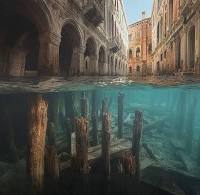
The most counterintuitive aspect of this entire system is what happens to the wood once it is in place. Common sense suggests that wood submerged in water rots, and that a foundation of submerged timber must therefore be a foundation in the process of slow decay, a structural time bomb accumulating quietly beneath the city's feet. The reality is the opposite, and it is one of the most remarkable accidental discoveries in the history of construction. The lagoon bed into which the piles are driven is anaerobic: it contains no oxygen. In the absence of oxygen, the bacteria that cause wood to decay cannot function. The wood does not rot. Instead, over decades and centuries of immersion in mineral-rich water under pressure, the cellular structure of the wood undergoes a process of gradual mineralisation, as calcium, silica and other dissolved minerals from the lagoon water replace the organic compounds in the wood fibre, molecule by molecule, until what was once a flexible, organic material becomes a substance as hard, as dense and as durable as stone.
When engineers and archaeologists have occasion to remove or examine piles from beneath Venetian buildings, what they find is not the soft, punky, compressed wood they might expect to find after a thousand years in wet ground. They find material that must be cut with metal saws, that resists drilling, that has a weight and a density closer to petrified fossil wood than to anything that came out of a living forest. The buried trees of Venice have been in the process of becoming stone since the moment they were driven into the mud, and many of them are now closer to the geological category of rock than to the biological category of wood. They have been transformed by the very element they were intended to resist.
The Caranto: The Clay That Holds the World
At the base of every pile, at depths ranging from three to eight metres below the surface of the lagoon, lies the layer that makes everything possible. The caranto is a stratum of extremely dense, compacted grey clay, laid down approximately eighteen thousand years ago during the last Ice Age, when the area now occupied by the Venice lagoon was dry land traversed by rivers carrying sediment from the Alps. The clay was compacted over thousands of years by the weight of the ice and the sediment above it, reaching a density and a shear strength considerably greater than the waterlogged silts that overlie it.
The builders of Venice did not know the geological history of the caranto. They did not need to. What they knew, through the empirical evidence of driving piles into the ground until they stopped, was that below a certain depth the ground was hard enough to bear weight, and that structures founded on piles driven to this depth did not sink. This was sufficient knowledge. The caranto, which geologists did not describe and name until the nineteenth century, had been doing its job as the bedrock of one of the world's great cities for eight hundred years before anyone knew what to call it.
Every stone in Venice rests on wood. Every piece of wood rests on clay. The clay was laid down by rivers that have not existed for eighteen thousand years, in a landscape that was dry land when the ancestors of the people who built this city were still living in caves. Venice is not built on water. It is built on deep time.
How to Visit the Underground Venice: Practical Guide
Exploring the hidden and underground Venice requires more planning than a standard tourist visit, but the effort is very precisely rewarded. The following is a practical guide to the most important and most accessible underground experiences the city offers.
The crypt of San Zaccaria is the starting point and the single most unmissable underground experience in Venice. The church is open to visitors from 10am to 12 noon and from 4pm to 6pm on most days, with reduced hours on Sundays and religious feast days. The crypt is accessed through the main body of the church, and the small entry charge, typically a few euros, is payable to the custodian. Arrive in the first fifteen minutes of opening to have the space to yourself. Bring a small torch or use the light on your phone to illuminate the darker recesses of the space: the artificial lighting installed for visitors does not reach the furthest bays, and what you will find there in the additional darkness is worth the effort of looking.
The Secret Itineraries of the Doge's Palace are booked through the official Palazzo Ducale website at visitmuve.it, and it is worth noting that the tours run in multiple languages and have limited capacity, typically fifteen to twenty participants per tour. The tour lasts approximately seventy-five minutes and covers areas of the palace that are completely inaccessible on the standard self-guided visit. It is, without qualification, the finest guided experience available in Venice, and booking two to three weeks in advance is advisable in spring, summer and autumn.
The underground context of the wooden piles is not visible from ground level, but it can be intellectually experienced at any moment simply by looking at the buildings around you and understanding what is beneath them. Several of the museums and cultural institutions of Venice have permanent displays explaining the engineering of the city's foundations, including the Museo di Palazzo Mocenigo and the Museo della Navigazione. The Arsenale, the great medieval shipyard that occupies the eastern part of the Castello sestiere, provides the most direct material connection to the maritime and engineering culture that made Venice's foundations possible: the same craftsmanship and the same command of wood, rope and the physical properties of water that built the Republic's fleet also built the city it sailed from.
Common Mistakes and Tips for the Underground Venice
Assuming the underground Venice is a tourist attraction. It is not, in any conventional sense. The flooded crypts are active religious spaces that happen to be open to respectful visitors. The Secret Itineraries tour is a serious historical and architectural experience, not an entertainment product. The engineering reality of the wooden piles is an intellectual encounter that requires you to bring your own imagination. None of these things is packaged for passive consumption, and they reward exactly the kind of engaged, curious attention that most tourist attractions are designed to bypass.
Visiting the crypt of San Zaccaria after it has been busy for hours. The crypt is a small space, and on popular summer days it can hold more visitors than its atmosphere was designed to accommodate. The solution is simple: go first thing in the morning, when the church opens at 10am, and you will almost certainly have the flooded space to yourself or nearly so. The silence and the solitude are not optional extras: they are part of the experience.
Underestimating the physical conditions. The crypt of San Zaccaria is flooded. You will need waterproof footwear, at minimum waterproof boots or shoes, to enter the water and walk across the flooded floor to examine the columns and the further reaches of the space. Visitors who arrive in sandals or unsuitable footwear are turned away or restricted to the entrance steps, which provide a partial but inadequate view of what lies further in. Pack accordingly.
The best season for the underground Venice: The flooded crypts are most atmospherically visited in autumn and winter, when the acqua alta is at its highest and most frequent, and the water in the crypt of San Zaccaria accordingly deepest and most mirror-like. November in particular, with its famous fogs and cold grey light filtering down the staircase into the underground space, is the finest month for this experience. Bring the right clothing for a cool and damp environment and allow your eyes to adjust slowly to the darkness: what Venice has buried deserves to be seen properly.

Comments
No comments yet. Be the first to share your thoughts!
Leave a Comment
Your comment will appear after moderation.