 Michelle
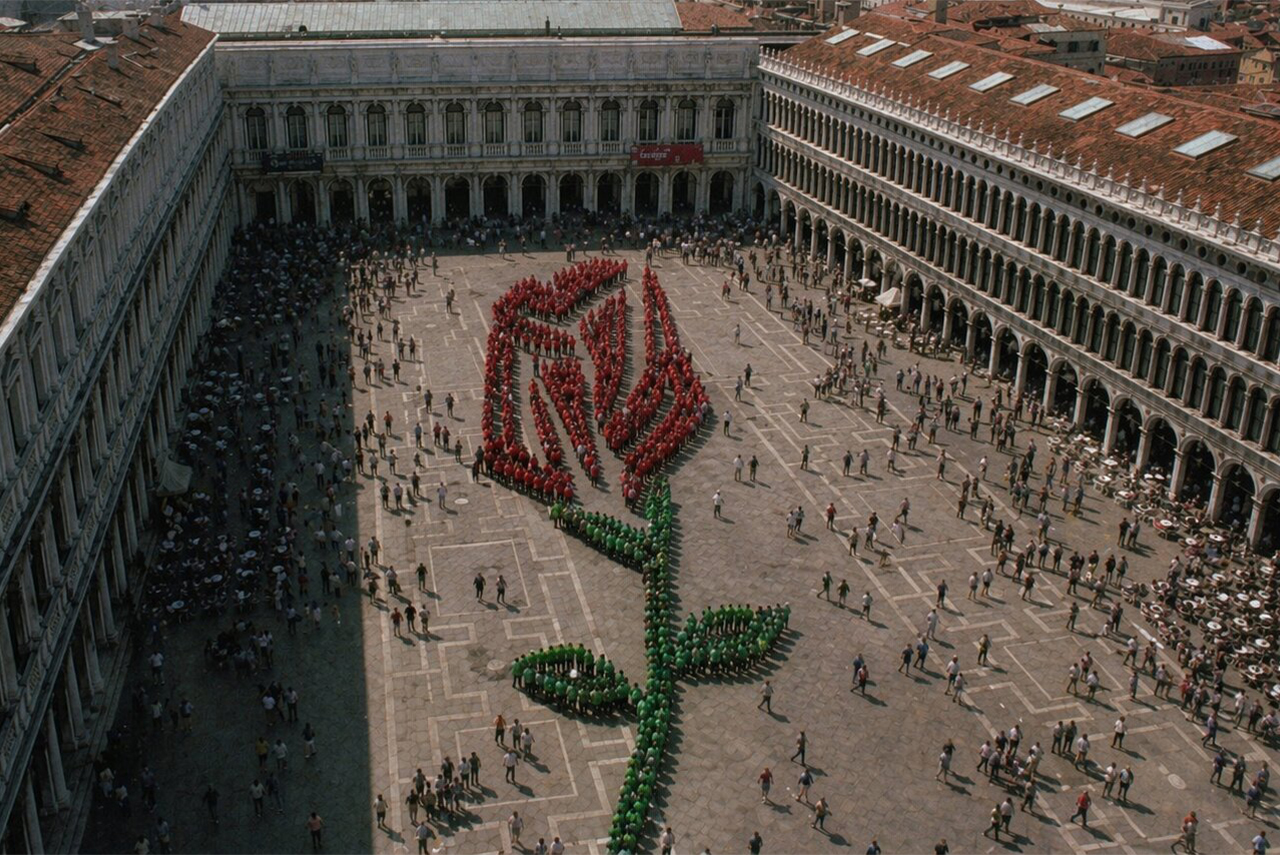
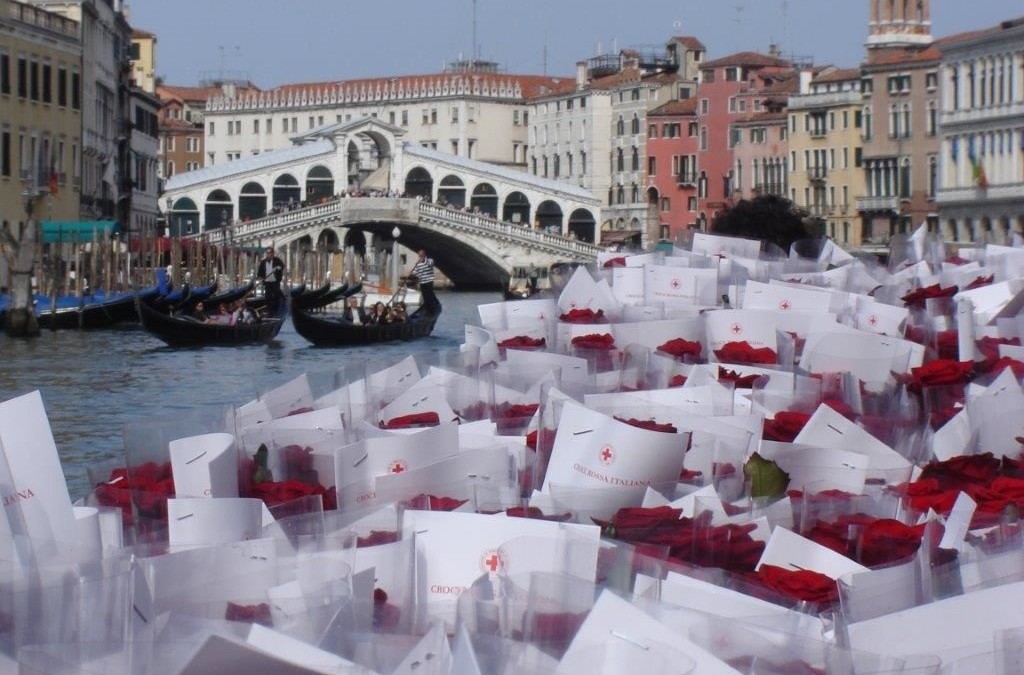
 Every year, on the twenty-fifth of April, the rose sellers of Venice set up their stalls at the corners of the calli and the campi long before the rest of the city is awake. By the time the first light falls across the lagoon, the buckets are full: hundreds and hundreds of dark red rose buds, not yet open, each one a tight spiral of crimson petals that the Venetians call, in their own dialect, a bocolo. By midday, almost every man in the city will have given one to a woman he loves. The gesture is quiet, specific and entirely Venetian, and it has been performed on this exact date for longer than anyone can say with certainty. Behind it lies one of the most extraordinary love stories in the long history of a city that has never lacked for stories. It predates Shakespeare's Romeo and Juliet by at least six centuries. It is less famous. It is, perhaps, more true.
Venice in the Ninth Century: The World the Legend Was Born Into
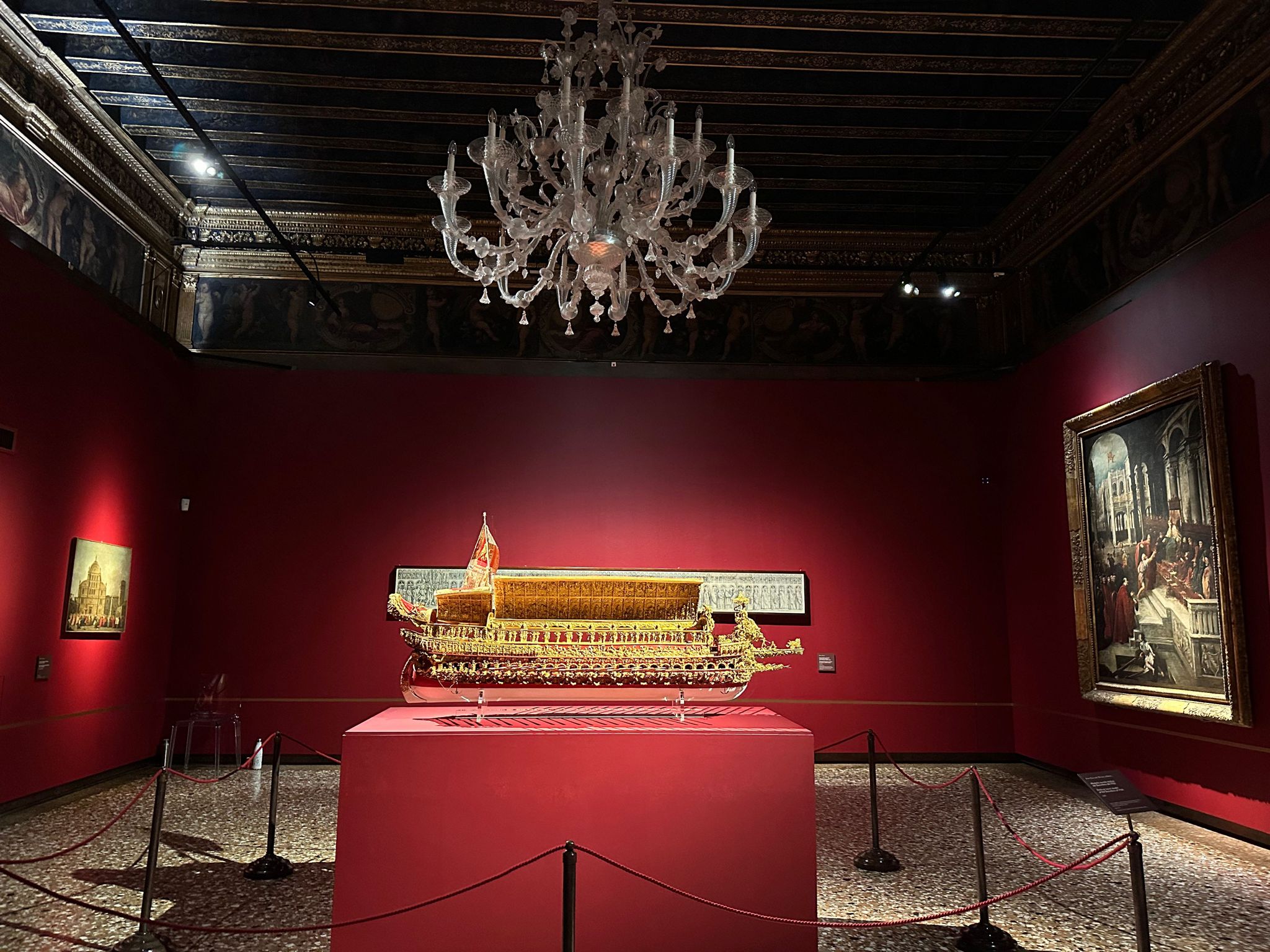
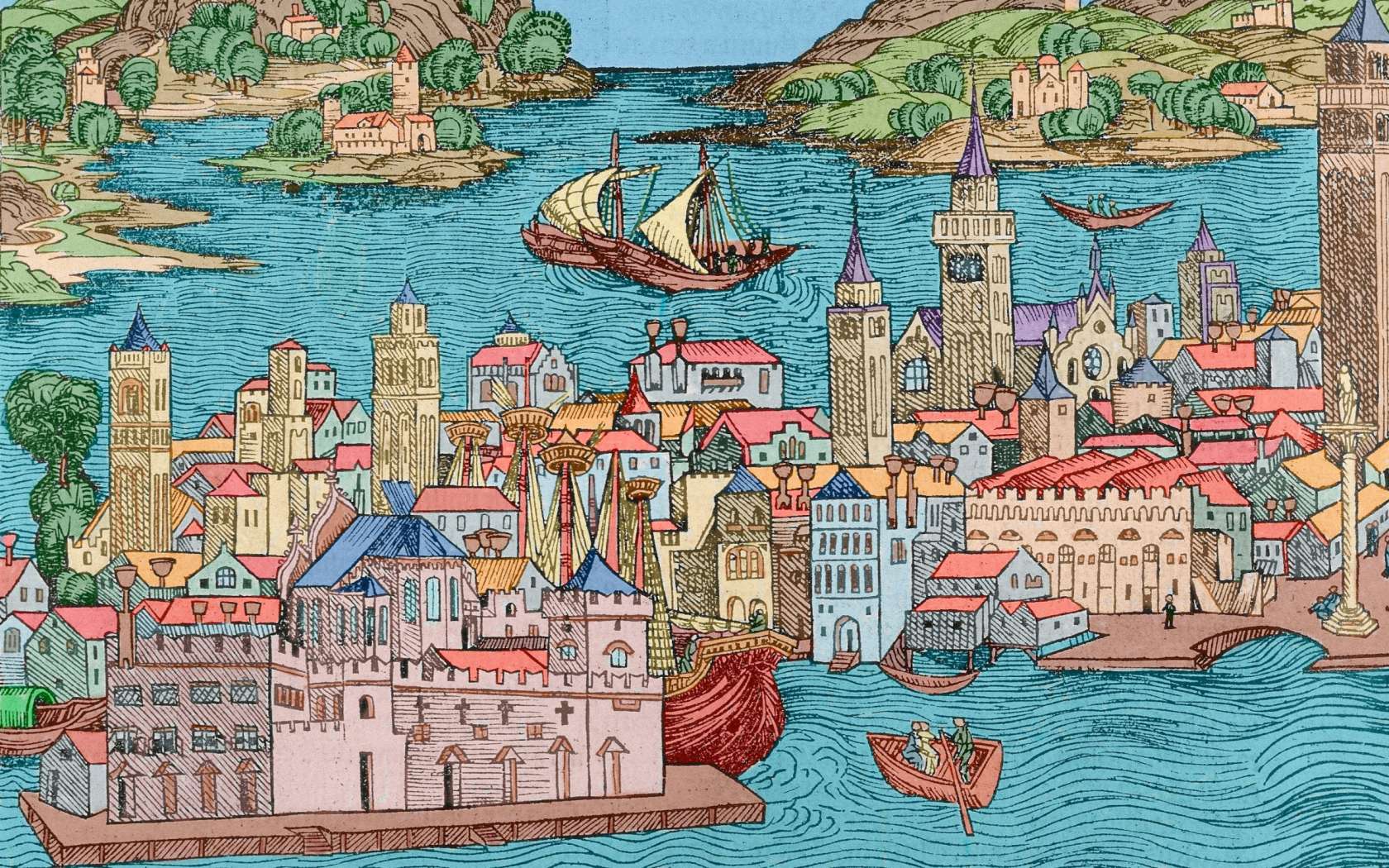
To understand the legend of Maria and Tancredi, you need first to understand the Venice of the ninth century, a world so remote from the gleaming tourist city of today that it requires a conscious act of historical imagination to bring it into focus. The Venice of the 800s was not yet the maritime empire that would dominate Mediterranean trade for the following five hundred years. It was a cluster of islands in a lagoon, governed by a succession of elected Doges whose authority rested on the consent of a fractious noble class, perpetually navigating the competing pressures of its Byzantine overlords to the east and the Carolingian empire expanding across the western European mainland.
The Doge at the centre of this legend was Orso Partecipazio, one of the most significant figures in the early history of the Venetian Republic. The Partecipazio family, also rendered in the historical record as Participazio or Badoer, supplied Venice with no fewer than four Doges across the ninth century, making them among the most powerful dynasties of the nascent Republic. Orso Partecipazio ruled from approximately 864 to 881, a period of considerable diplomatic and military complexity: Venice was simultaneously maintaining its formal ties to the Byzantine Emperor and managing its increasingly important commercial relationships with the Frankish kingdoms to the north and west. It was a world of carefully calibrated alliances, of marriages arranged to seal political compacts, of social hierarchies whose rigidity was understood to be essential to the stability of the state.
Into this world, the legend places a young woman of extraordinary beauty and spirit, the daughter of the Doge himself, and a young man with nothing to offer her but his voice, his courage and his love. The collision between these two realities, one born to power and one born to obscurity, is the engine of a story that Venice has been telling ever since.
Historical note: The name "Vulcana" as an epithet for Maria does not appear in the ninth-century chronicles. It belongs to the later oral tradition that shaped and embellished the story across the medieval and Renaissance periods, most likely drawing on the Latin word for fire, vulcanus, to describe her passionate and unconventional character. This is how legends work: the historical seed is real, but the flowering is the work of centuries of imaginative labour by the people who needed the story to mean something.
Maria Vulcana: The Daughter of the Doge
Maria Partecipazio, called Vulcana, was the daughter of the most powerful man in Venice. She grew up in the world of the Ducal court, surrounded by the protocols and expectations of the highest rank the Republic could confer. Her life was mapped out for her in the way that the lives of noble daughters were mapped out across the medieval world: she would be married to a man chosen for political utility, her beauty and her birth deployed as instruments of dynastic strategy. That this arrangement satisfied neither her temperament nor her heart was, within the moral framework of ninth-century Venice, essentially irrelevant.
What the tradition preserves with particular clarity is the quality of her feeling. The Venetian accounts of her story, embroidered across the centuries but consistent in their emotional core, describe a woman of absolute conviction, one who experienced love not as a pleasant distraction but as a total and irrevocable commitment of the self. This is why the epithet Vulcana clung to her: not because she was violent or dangerous, but because she burned. The medieval imagination understood this kind of love as a force of nature, something closer to divine fire than to human sentiment, and it treated the people it consumed with the mixture of awe and pity that is the proper response to those who are visited by powers beyond their management.
The object of this consuming love was, by the standards of the court in which Maria moved, spectacularly inappropriate. He was a minstrel, a giullare, one of the wandering musicians and storytellers whose social position in the medieval world was not much higher than that of a skilled artisan. He had no family, no property, no prospects that the Doge could reasonably evaluate. He had only his art and, according to the legend, a voice and a moral character of such quality that even the daughter of the most powerful man in Venice recognised them for what they were. His name was Tancredi.
Tancredi: The Minstrel Who Went to War for Love
The name Tancredi is itself significant. It is a Norman name, suggesting origins outside Venice, outside Italy, in the Germanic or French-influenced culture of the Carolingian world. A wandering minstrel of this name in ninth-century Venice would have been precisely the kind of cosmopolitan figure that the city's position as a crossroads of cultures made possible: someone who had moved through the courts and market towns of a wider world, carrying songs and stories from one language into another, belonging everywhere and nowhere.
What drew Maria to him, the tradition is consistent on this point, was not merely his art but his goodness. The medieval chronicles, and the Venetian oral tradition that outlasted them, preserve a portrait of Tancredi as a man of exceptional moral seriousness: generous, loyal, honest in his dealings with the world, and possessed of a kind of dignity that had nothing to do with birth or wealth and everything to do with character. It is this quality, the legend insists, that made him worthy of Maria's love, even if the Venetian court could not recognise it.
He understood, of course, the impossibility of his situation. The daughter of the Doge did not marry wandering minstrels. The social architecture of the Republic was designed precisely to prevent such ruptures, and the Doge's power to enforce those boundaries was absolute. Tancredi could have accepted this and moved on, taking his love with him into the next city, the next court, the next song. Instead, he made a decision that the legend presents as both entirely logical and entirely heroic: he would make himself worthy of her by the only means available to a man without wealth or title in the ninth century. He would go to war.
The war in question was part of the long and complex military engagement between the forces of Charlemagne's empire and the various peoples they described collectively as the Moors, the Muslim powers of the Mediterranean world whose northward pressure into Europe had been one of the defining geopolitical facts of the eighth and ninth centuries. Venice, despite its Byzantine orientation, had complex relationships with the Carolingian world, and Venetian soldiers and adventurers did find their way into the armies and campaigns of the Frankish kings. Tancredi's enlistment, in this context, is historically plausible even if the specific circumstances are legendary. He went because it was the only door open to him. He went for Maria.
The courtly love tradition: The legend of Maria and Tancredi belongs to the broad tradition of fin'amor, or courtly love, that flourished in medieval European culture from the twelfth century onwards. The conventions of this tradition, the noble lady, the devoted but socially inferior lover, the quest to prove worthiness through heroic action, were the shared language of medieval romance across France, Italy and the Germanic world. What gives the Venetian legend its particular power is the detail of the rose bud stained with blood: a symbol of such concentrated emotional force that it transcends the conventional apparatus of the courtly love narrative and arrives at something more raw and more final.
The Rose in the Garden: The Legend's Tragic Climax
The legend does not linger over the campaign itself. Years pass, in the way that legend compresses time, and Tancredi distinguishes himself in battle with the kind of conspicuous valour that was the medieval equivalent of social mobility: you could not give a man a title for being born to the wrong family, but you could not very well deny one to a man who had saved the life of a lord, or turned the tide of a battle, or held a position alone against overwhelming odds. Tancredi did all of these things, or the legend says he did, and he did them all with the same thought: Maria, and the life they might yet build together.
The catastrophe, when it comes, arrives with the terrible suddenness that distinguishes a true tragedy from merely sad events. Tancredi is wounded, mortally, in a garden of roses. The detail of the garden is the legend's most carefully chosen image. Roses, in medieval symbolic vocabulary, carried an almost inexhaustible weight of meaning: they signified love, obviously, but also martyrdom, suffering, the beauty that exists on the edge of pain and cannot be separated from it. A rose garden as the site of Tancredi's death is not an accident of narrative geography. It is the legend's central statement, compressed into a single image.
He is found by Orlando, the great paladin of Carolingian legend, the same Roland who would die at Roncesvalles and whose story would become the foundation of the great French epic the Chanson de Roland. The choice of Orlando as the witness and messenger is itself significant: by placing one of the most celebrated heroes of medieval Europe at this scene, the legend elevates Tancredi's story into something mythic, something that belongs not merely to Venice but to the broader world of chivalric narrative. Orlando finds Tancredi dying among the roses and kneels beside him. Tancredi's final act is one of extraordinary deliberateness and love. He reaches to the rosebush beside him, breaks off a single bud, a white rose, still closed, still perfect, and holds it against the wound in his chest until it is entirely stained with his blood. Then he gives it to Orlando and speaks his last request: take this to Maria. Let her know that I held her name in my mind until the end.
Orlando kept his word. He carried the rose back to Venice, and on the twenty-fifth of April, the feast day of Saint Mark and the most important date in the Venetian calendar, he placed the blood-red bud into Maria's hands. She understood immediately what it meant. She held it for a long time, the tradition says, and said nothing. She died the following day, of a grief so absolute that the medieval imagination could only describe it as a failure of the will to continue. She had chosen to follow him.
The bocolo she received was white when it left the garden. It arrived in Venice the colour of blood. Every rose bud given in Venice on the twenty-fifth of April since then has been red: a colour it did not begin with, a colour that had to be earned.
The Festa del Bocolo: A Living Tradition
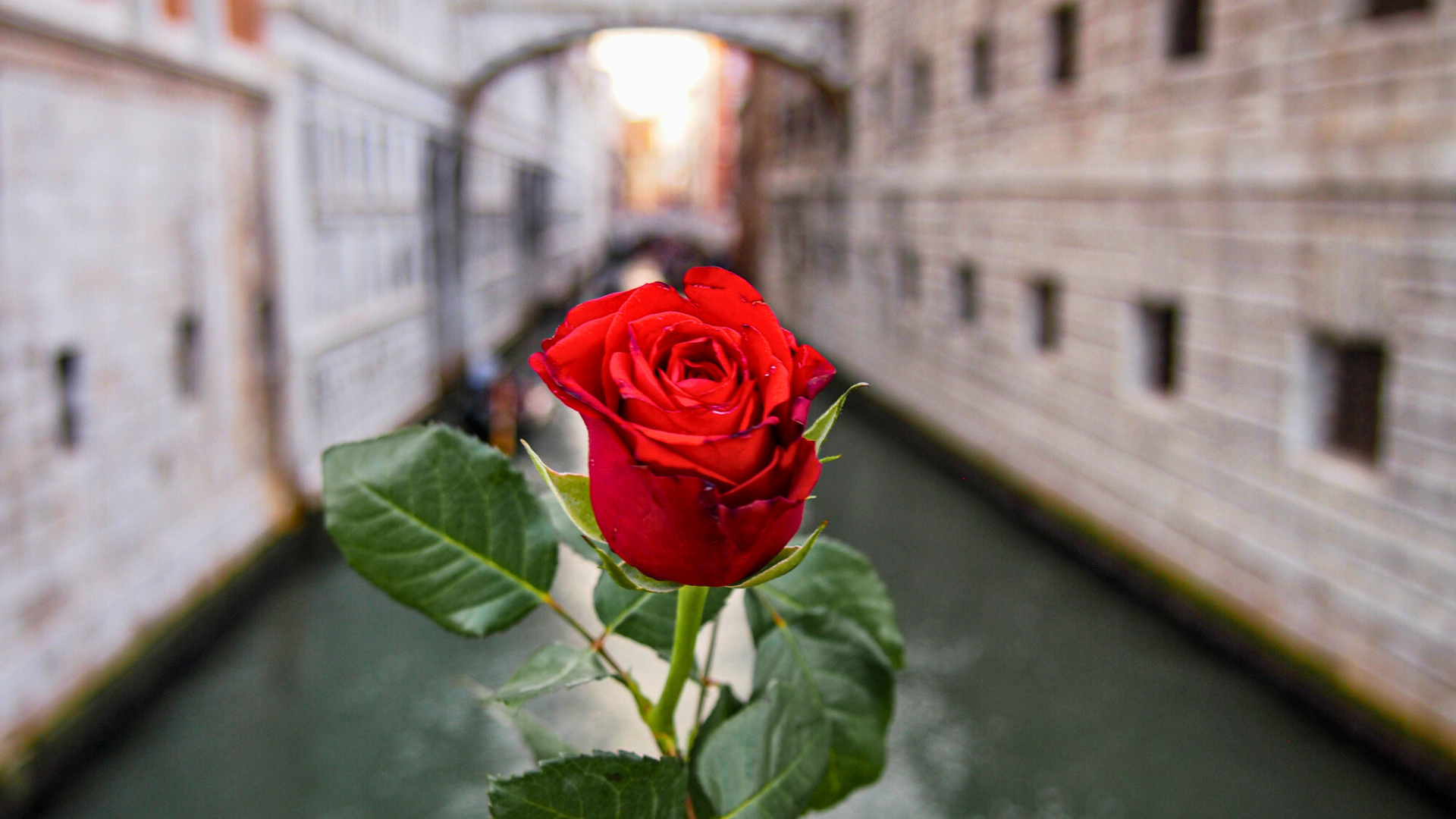
What makes the legend of Maria and Tancredi remarkable, beyond its emotional power and its literary quality, is what it produced: not a memorial, not a museum exhibit, not a historical commemoration that requires effort and intention to engage with, but a living daily practice embedded in the rhythms of ordinary Venetian life. The Festa del Bocolo is not a tourist event. It is not organised by a cultural institution or sponsored by a commercial enterprise. It is simply what Venetian men do on the twenty-fifth of April: they buy a red rose bud, a bocolo, and they give it to the woman or women they love.
The scale of this is worth pausing over. Venice on the twenty-fifth of April is transformed by roses in a way that no other European city is transformed by any comparable gesture. The stalls appear at every corner. The florists work through the night. The numbers sold across the city on a single morning run into the hundreds of thousands. A tourist who arrives in Venice on the twenty-fourth of April and leaves on the twenty-sixth will witness something that has no parallel in the rest of Italy and very few parallels anywhere in the world: a city performing, with complete collective seriousness, an act of romantic symbolism rooted in a medieval legend that most of the participants would struggle to recount in full detail, but whose emotional logic they have absorbed so completely that it requires no explanation.
The bocolo given today is always red, always a bud rather than an open flower, and always given in the morning. These details are not arbitrary. The red colour recalls the transformation of the white rose in Tancredi's dying hands. The closed bud, not yet fully open, suggests a love still in its promise, still capable of further flowering. The morning timing echoes the urgency of Orlando's delivery, the pressing need to place the rose in Maria's hands while it still carried the warmth of what it represented. Tradition, when it is alive rather than merely preserved, retains these specificities with a fidelity that formal ceremonies rarely achieve.
A note on the dialect: The word bocolo is Venetian dialect for bocciolo, the standard Italian word for a flower bud. Venetian dialect, which is a distinct Romance language with its own grammar, vocabulary and literary tradition rather than merely a regional accent of Italian, has preserved this word in daily use for centuries. When a Venetian man says he is going to buy a bocolo for his beloved, he is using a word that his great-great-great-grandfather used, in the same context, in the same city, for the same reason.
The Twenty-Fifth of April in Venice: Two Celebrations in One
The twenty-fifth of April carries a double weight in the modern Italian calendar. It is, simultaneously, the feast day of Saint Mark the Evangelist, the patron saint of Venice, and Italy's National Liberation Day, the anniversary of the end of the German occupation of Italy in 1945, one of the most significant dates in the country's post-war civic identity. In most Italian cities, the twenty-fifth of April is primarily a political holiday, marked by official ceremonies, partisan marches and the ceremonial depositing of wreaths at war memorials. In Venice, it is all of these things and something else entirely: the day of the bocolo, a day that belongs simultaneously to civic pride, national memory and the most intimate emotional register of personal love.
The feast of Saint Mark has been the central date of the Venetian year since at least the ninth century, when the relics of the Evangelist were brought to Venice from Alexandria in 828 by two Venetian merchants who concealed them under layers of pork and salt cabbage to prevent their confiscation by the Muslim authorities who controlled the city. The theft, which Venetian tradition celebrates without irony as an act of pious devotion, gave Venice its patron saint and its defining symbol: the winged lion of Saint Mark, which appears on the banner of the Republic, on the columns of the Piazzetta, on the facades of buildings across the city and on the covers of every guidebook to Venice ever printed.
The choice of the twenty-fifth of April as the date of the bocolo therefore places the legend of Maria and Tancredi at the absolute centre of Venetian civic and sacred identity. The rose bud given on this day is not merely a romantic gesture: it is an act of Venetian self-definition, a participation in the deepest layer of the city's self-understanding. To give a bocolo on the twenty-fifth of April is to be Venetian in the fullest sense, to inhabit the city's history as a living rather than a historical fact.
Before Shakespeare: The Venetian Prototype
It is impossible, in any serious discussion of the legend of Maria and Tancredi, to avoid the comparison with Romeo and Juliet. Shakespeare's play was written around 1594 and 1595, drawing on an Italian novella by Matteo Bandello published in 1554, which was itself based on earlier Italian sources going back to Luigi da Porto's Historia novellamente ritrovata di due nobili amanti of 1530, which was set in Verona and featured two lovers separated by a family feud. The chain of literary transmission that produced Shakespeare's play is well documented and entirely different from the Venetian tradition of the bocolo.
But the structural parallels between the two stories are striking and worth examining. In both, a young woman of noble birth loves a man her family cannot accept. In both, the man attempts to make himself worthy of her through a form of self-sacrifice that ultimately costs him his life. In both, the woman cannot survive the news of his death. And in both, the tragedy produces a social transformation: not an end to the family feud in one case, or the rigid class hierarchy in the other, but a change in the way the city understands love, in what love is understood to be capable of demanding from a person and what it is understood to offer in return.
What the Venetian legend has that Shakespeare's play does not is a physical object: the rose bud, the bocolo, the thing that Tancredi sent instead of himself and that has been sent, as a proxy for the impossible and the irreplaceable, every year since. Romeo and Juliet left behind a bronze statue in Verona that tourists queue to photograph. Maria and Tancredi left behind a gesture that Venetians still perform, collectively and privately, every year on the same day, with the same object, for the same reason. The statue is a memorial. The bocolo is a continuation.
The literary tradition: The legend of Maria and Tancredi appears in several Venetian historical and literary sources from the medieval and Renaissance periods, though the earliest surviving written versions date from considerably later than the events they describe. This is characteristic of oral traditions: the story exists in the practice before it is committed to writing, and the practice, in this case, predates the text by centuries. The bocolo is the document. The giving of it is the archive.
How to Experience This Tradition as a Visitor
If you are fortunate enough to be in Venice on the twenty-fifth of April, here is what you should do. Wake early and walk to the nearest flower stall, which will not be difficult to find: they are everywhere, and they are full. Buy a bocolo. Give it to whoever deserves it. Then walk to Piazza San Marco, which on this day is dressed with the flags of the Republic (the golden lion of Saint Mark on a red background) and of the Italian state, and stand in it for a while and think about what it means to be in a city that has been telling the same story, performing the same gesture, on the same day, for over a thousand years. This is not a museum experience. It is not a heritage event with costumed actors and audio guides. It is a city being itself, in the deepest and most ordinary sense, and you are welcome to participate.
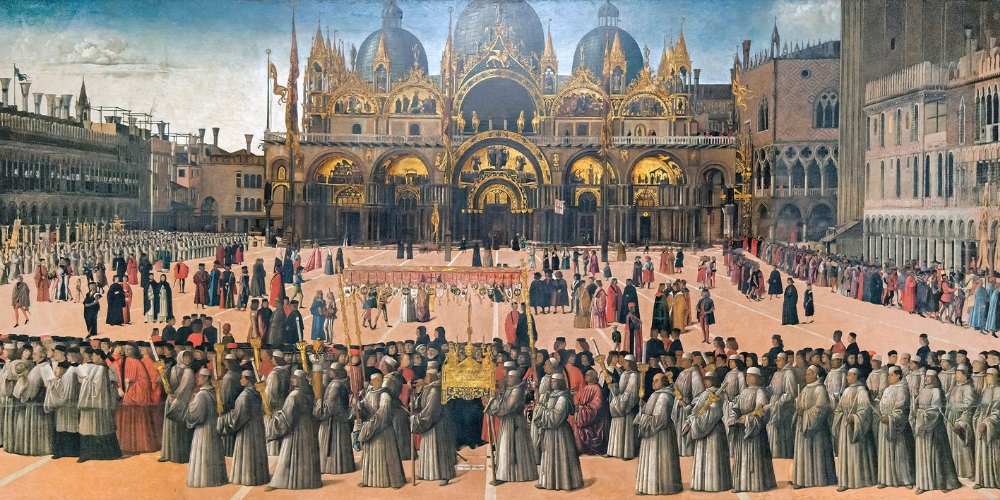
The day also brings other ceremonies worth witnessing. The official Festa di San Marco includes a solemn procession and Mass in the Basilica di San Marco, one of the most beautiful and least crowded religious ceremonies in Venice (most tourists, arriving without prior knowledge of the feast, do not realise that the Basilica is functioning as an active place of worship on this day rather than merely as an attraction). The doors of the Basilica open early, and the interior in the morning light, with the Byzantine mosaics glowing gold above the congregation, is a more powerful experience than at almost any other time of year.
In the afternoon, the political dimension of the date asserts itself alongside the romantic and the sacred. The city holds ceremonies at the war memorials, and the partisan organisations that participated in the liberation of Venice in April 1945 march through the historic centre with a dignity and an emotion that is genuinely moving to witness. To be in Venice on the twenty-fifth of April is to experience three layers of Italian and Venetian identity simultaneously: the ancient, the sacred and the modern, all present in the same streets on the same day.
Best Time to Visit Venice and Common Tourist Mistakes
If you are planning your visit to Venice around the Festa del Bocolo, the twenty-fifth of April falls in the finest period of the Venetian year: late spring, when the weather is mild and the light on the lagoon has reached the quality that painters from across Europe have been coming to capture for five centuries. The city is not yet at the peak of its summer crowding, and the days are long enough to allow the kind of unhurried exploration that Venice demands and rewards.
Book your accommodation well in advance for the twenty-fifth of April specifically, as the date is a national holiday in Italy and Venetians themselves travel less than usual, filling the city's hotels alongside the international visitors. A private airport transfer from Marco Polo Airport to Piazzale Roma, booked in advance with a fixed price, is the most comfortable way to begin the visit, particularly if you are arriving in the evening of the twenty-fourth to be in position for the early morning rose sellers.
The most common mistake that visitors to Venice make on the twenty-fifth of April is treating it as an ordinary tourist day: visiting the same attractions, following the same routes, eating at the same restaurants. The day rewards a different kind of attention. Walk slowly. Watch the Venetians, who are celebrating something personal and something collective simultaneously. Notice the roses: who is carrying them, who is receiving them, how the gesture is performed in different neighbourhoods and different social registers. The bocolo in the hand of an elderly man buying one for his wife of fifty years is the same object as the one clutched by a young man clearly nervous about giving it to someone for the first time. They are both participating in the same story.
Do not buy a cheap commercially produced rose bud from a supermarket or a tourist shop. The bocolo deserves to come from a proper florist or a market stall, a real rose that has been grown and cut and prepared with the seriousness appropriate to what it represents. The price difference is negligible. The difference in what you are participating in is not.
Eating on the twenty-fifth of April: Many of Venice's smaller restaurants and bacari close on public holidays in Italy, while others open with reduced hours. Plan your meals in advance and make reservations where possible. The traditional Venetian lunch for a feast day leans toward the more elaborate end of the local repertoire: a risotto, a whole grilled fish, the local wine. The bacari that remain open on feast day mornings are worth seeking out for the atmosphere: Venetians celebrating among themselves, the bocolo on every table, the day carrying its full weight of meaning in the simplest of settings.

Comments
No comments yet. Be the first to share your thoughts!
Leave a Comment
Your comment will appear after moderation.