 Michelle
 There are cities that accumulate stories like sediment, each century depositing a new layer of legend over the old. Venice is such a city. And among its many spectral inhabitants — the weeping widow of Ca' Dario, the condemned monk of the Ponte dei Sospiri, the child who wanders the Poveglia asylum — one figure stands apart for her gentleness and her mystery. She is the ghost of Palazzo Grassi, a veiled lady who, according to those who work in the palace, does not terrify but whispers. She does not harm but protects. And for nearly two centuries, she has refused to give up her real name.
The Legend — A Spectre Who Whispers and Protects
The oral tradition surrounding Palazzo Grassi is remarkably consistent, especially for a story that has never been fixed in writing by any authoritative chronicler. According to the accounts of former museum employees, night watchmen, and administrative staff — many of whom speak of their encounters with a matter-of-factness that suggests genuine conviction — the ghost is that of a young woman who died by suicide in the early years of the 20th century. She threw herself from an internal balcony, or perhaps from a balustrade overlooking the central courtyard, after having suffered an act of violence whose precise nature the legend never specifies.
The most commonly reported phenomenon is auditory. Female employees, in particular, describe a sensation of having their name whispered directly into their ear when no one else is present. The whisper is not menacing. It is described as a soft breath, a barely audible sibilant sound, like the expiratory sigh of someone who has been holding their breath for a very long time. Some interpret this as the ghost attempting to make contact. Others believe she is searching for someone — a specific person she lost, or a specific person she failed to save.
The testimony of the night watchman, circa 1985. During the extensive restoration of Palazzo Grassi commissioned by the Fiat Group in the 1980s, a night guard was making his usual rounds when a woman's voice suddenly commanded him to stop. He froze. When he turned on his torch, he discovered that the floor immediately ahead of him had been removed, leaving an unmarked drop into the darkness below. A fall would have been fatal. The guard could not identify any rational source for the voice. He told the story to colleagues, and the story has never been forgotten.
Unlike the malevolent or melancholic phantoms that populate Venetian folklore — spirits trapped in Purgatory, suicides condemned to restless wandering, victims of plague and assassination — the ghost of Palazzo Grassi is consistently described as benevolent. She is protective. She guards the building, and by extension, the people who work within its walls. This benign character has earned her the unofficial title of the "gentle soul" of the palace, a figure more guardian than ghost, more caretaker than curse.
Visitors to the Palazzo Grassi today — now home to the Pinault Collection, one of the world's most significant private assemblages of contemporary art — rarely encounter her directly. Her appearances, if they occur at all, are reserved for those who spend their nights in the building, who walk its corridors after closing time, who are quiet enough and still enough to hear the soft exhalation of a name against the ear. She does not perform for tourists. She is not a spectacle. She is, if the legend is to be believed, a presence.
The Historical Truth — Archives, Evidence, and Elegiac Silence
The legend is beautiful. It is also, as far as the documentary record is concerned, entirely without foundation. To understand the gap between story and fact, one must first understand who the Grassi family were, how they came to build one of the largest palaces on the Grand Canal, and why their name disappeared from Venetian history within a single generation.
The Grassi Family — From Chioggia to the Patriciate
The Grassi were not originally Venetian nobles. Their origins lay in Chioggia, the fishing port at the southern entrance of the Venetian Lagoon, where the family first appears in records around the year 1230. For four centuries, they built a modest fortune through commerce, gradually expanding their social connections and ecclesiastical influence. Three Grassi served as bishops of Chioggia during the 17th century, and a fourth, Francesco Andrea Grassi, ascended to the diocese of Caorle in the early 1700s.
The transformation of the Grassi from provincial merchants to Venetian patricians occurred in 1718, at a heavy price: one hundred thousand ducats paid into the treasury of the Serenissima Republic. This sum, enormous for the period, purchased the family's inscription in the Libro d'Oro, the Golden Book of Venetian nobility. The Grassi were not the first family to purchase their status, nor would they be the last. But the transaction placed them in a precarious social position — newly ennobled, lacking the ancient lineages of the Corner, the Contarini, or the Dandolo, and perpetually vulnerable to the disdain of older families.
Angelo Grassi — The Builder (circa 1680–1758)
The man who conceived Palazzo Grassi was Angelo Grassi, a shrewd and ambitious figure who understood that a magnificent house was not merely a residence but a political statement. In 1740, he purchased a strategically located but irregularly shaped plot of land on the Grand Canal, directly opposite the Ca' Rezzonico, which was then still under construction. The site was not large, but its position was prestigious, with a generous facade facing the water.
Construction began in 1748 under the direction of Giorgio Massari, one of the most gifted architects of the Venetian 18th century. Massari was already at work on the Ca' Rezzonico, and he brought to Palazzo Grassi the same refined neoclassical vocabulary that would define his mature style. The facade, executed in white Istrian stone, deliberately rejected the ornate Byzantine and Baroque flourishes of neighbouring palaces. It was sober, balanced, mathematically proportioned — a declaration of cultural aspiration rather than mere wealth.
Angelo Grassi did not live to see his palace completed. He died in 1758, leaving the project to his son, Paolo.
Paolo Grassi — The Completer (circa 1715–1772)
Paolo Grassi inherited not only his father's fortune but also his determination to see the palace finished. Under his supervision, Massari brought the building to completion in 1772. Palazzo Grassi was the last great palace to be constructed on the Grand Canal before the fall of the Venetian Republic in 1797. It was also, by certain measurements, the largest.
Paolo died in the same year his palace was finished. He left no direct heir capable of sustaining the family's status. The Grassi line, within a single generation, began its slow decline.
The Fall of the Republic — 1797
On May 12, 1797, the Grand Council of Venice voted to dissolve the Republic that had existed for more than a thousand years. Napoleon Bonaparte's troops entered the city, and the Venetian patriciate — the Grassi among them — suddenly found themselves subjects of the Austrian Empire. Their political power evaporated. Their wealth, always dependent on trade and maritime access, began to erode under the new continental priorities of the Habsburg administration.
The Austrian imperial government confirmed the Grassi brothers, Angelo Antonio Gaetano and Domenico Maria Gaetano, as nobles in 1817. But confirmation meant little without money. By the 1830s, the family was in irreversible decline. In 1834, Angelo sold the family's ancestral residence in Chioggia. The proceeds were insufficient to sustain the Grand Canal palace.
The Sale — 1840
In 1840, the Grassi family sold Palazzo Grassi to Spiridione Papadopoli, a wealthy Greek-born merchant and the owner of the Società Veneta Commerciale. The price was substantial, but the transaction marked the end of the Grassi presence on the Grand Canal. Angelo Antonio Gaetano Grassi, the last male of the direct line, having no heirs, bequeathed the remainder of his estate to Giovanni Battista Tornielli, the son of family friends. The Grassi name, inscribed in the Golden Book only 122 years earlier, disappeared from the Venetian nobility as quietly as it had arrived.
There is a particular kind of tragedy in families who purchase what they cannot inherit. The Grassi bought their nobility, built their palace, and vanished. They are a lesson written in Istrian stone: status is a rental, not a possession.
The Silence of the Archives
Nowhere in this genealogical record — not in the Venetian state archives, not in the Grassi family papers preserved at the Museo Correr, not in the notarial acts of the 18th or 19th centuries — does a young woman appear as a suicide victim. No daughter. No sister. No niece. No documented fall from a balcony. No record of violence, of trauma, of a family covering up a scandal.
The archives are entirely silent.
This silence is profoundly significant. The Venetian aristocracy kept meticulous records: births, marriages, deaths, property transfers, legal disputes, and criminal proceedings. A suicide among the nobility — especially a young woman — would have produced documentation. The Church would have been involved. The magistrates would have been notified. There would be a death certificate, a burial note, perhaps a dispensation from ecclesiastical authorities permitting interment in consecrated ground (since suicide was, in Catholic doctrine, a mortal sin).
There is nothing. No trace. No whisper from the archives to match the whisper in the corridors.
What the archives do not contain. The Venetian State Archives hold approximately 70 kilometres of shelving containing over a thousand years of continuous documentation. Among those documents — the Senate's deliberations, the Council of Ten's secret proceedings, the notarial protocols, the parish registers of San Samuele where the Grassi would have worshipped — there is no death certificate for a Grassi daughter who died by suicide. Her absence from the record is the only verifiable fact about her.
What does this mean? The ghost of Palazzo Grassi, if she exists as a specific individual, cannot be identified. No archive will give you her name. No baptismal register, no marriage contract, no testamentary disposition, no chronicle. She lives only in the stories people tell — changing, adapting, surviving across decades, perhaps centuries. She is whoever the listener needs her to be.
But perhaps this is the deeper truth. Perhaps the ghost is not a single woman at all. Perhaps she is the personification of the Grassi family's collective fate — the sudden rise, the desperate expenditure, the magnificent but hollow palace built just before the Republic's collapse, the financial ruin, the sale of everything, the extinction of the name. The ghost may be Venice itself, mourning its own vanished glory, whispering the names of those who remember what was lost.
A Dedicated Day Tour of Palazzo Grassi
For travellers who wish to experience Palazzo Grassi not merely as a museum but as a historical and spectral presence, a dedicated day tour is the most rewarding approach. Unlike the rushed itineraries that attempt to compress all of Venice into forty-eight hours, a single day devoted entirely to this palace allows for a contemplative immersion in its architecture, its art, and its atmosphere. What follows is a suggested itinerary — unhurried, carefully paced, and designed to leave room for the kind of quiet attention that the building deserves.
Morning — Arrival and First Impressions
Begin your day by arriving at Palazzo Grassi before the crowds. The palace opens at 10:00 AM, and the first hour of visitation is invariably the most serene. Arriving from your accommodation without stress is essential, and the most comfortable way to achieve this is by pre-booking a private transfer with Airport Connection — whether from Marco Polo Airport, Treviso Airport, or Santa Lucia Station. A private water taxi delivers you directly to the palace's water entrance on the Grand Canal, eliminating the anxiety of dragging luggage across bridges or navigating crowded vaporetti. Door to door, no connections, no compromises.
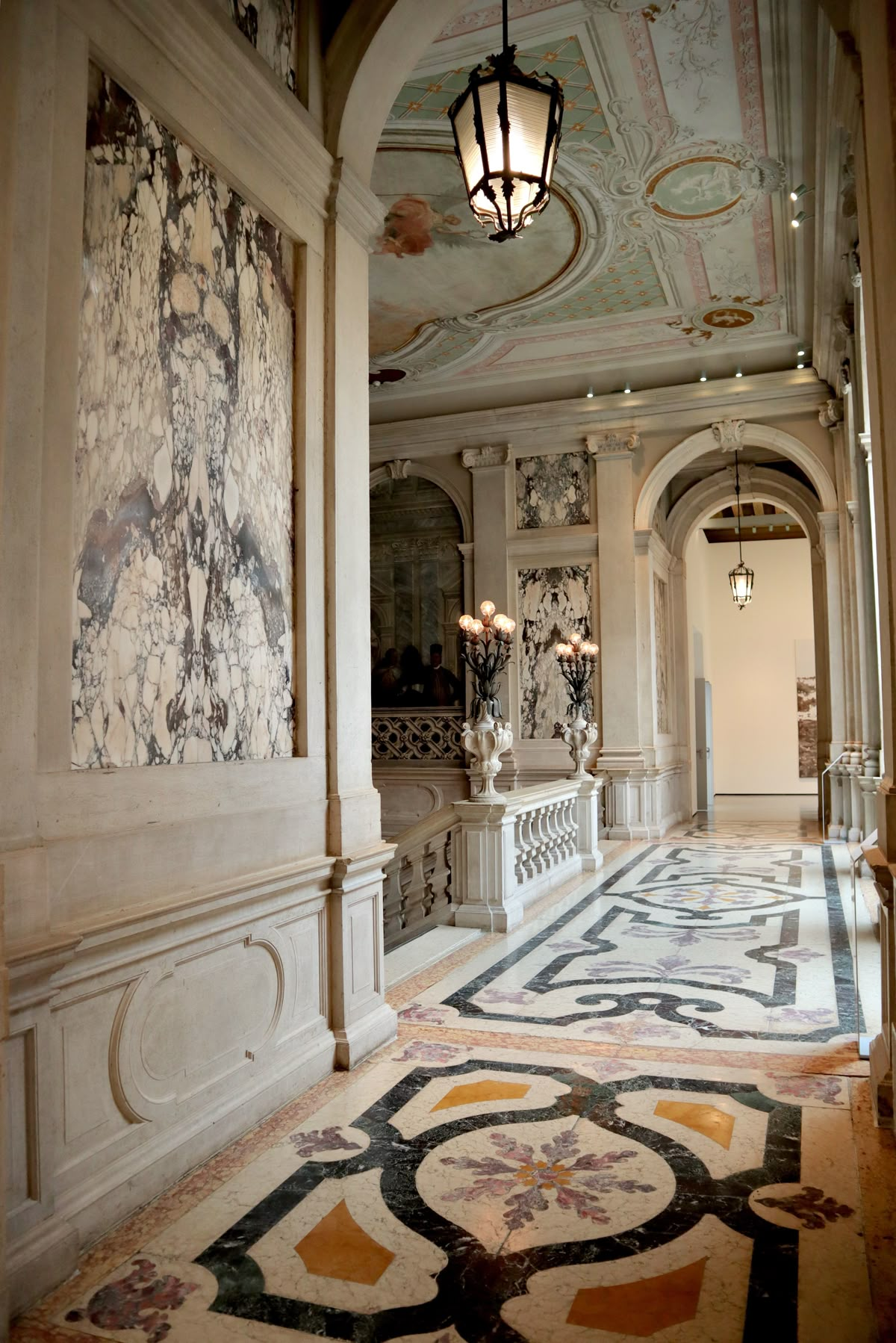
Upon entering, take at least thirty minutes simply to inhabit the ground floor. Look up. The ceilings are extraordinary, the proportions deliberately classical, the light filtered through large windows that face the canal. Do not rush toward the contemporary art installations on the upper floors. The building itself is the primary exhibit.
Late Morning — The Pinault Collection
The upper floors of Palazzo Grassi house the Pinault Collection — the personal art collection of François Pinault, the French billionaire and founder of Kering. The collection is not permanent; exhibitions rotate approximately every eighteen months, and each installation is curated specifically for the building's unique spatial qualities. Past exhibitions have included works by Rudolf Stingel, Sigmar Polke, Luc Tuymans, and Damien Hirst. The quality is consistently extraordinary, and the integration of contemporary art with 18th-century architecture creates a productive tension between centuries.
Allow at least two hours for the collection, but do not attempt to see everything. Select the works that speak to you and spend time with them. The building rewards slowness.
Lunch — A Break Within Walking Distance
The immediate neighbourhood of Palazzo Grassi — the area around Campo San Samuele — contains several excellent options for a midday meal. The choice is yours, but allow at least an hour to rest before returning to the palace for the afternoon.
Early Afternoon — The Rooftop Terrace
Do not, under any circumstances, leave Palazzo Grassi without visiting the rooftop terrace. The view from this elevation is one of the most astonishing in Venice — a panoramic sweep of the Grand Canal from the Ca' Rezzonico to the Salute, with the domes of St. Mark's Basilica visible in the distance. The terrace is accessible to all ticket holders, but visitor numbers are limited to preserve the experience. If the weather is clear, plan your visit for early afternoon when the light is optimal for photography.
Stand at the parapet and look down at the canal. Consider the Grassi family standing here in 1772, surveying the Republic at its twilight, unaware that their palace would outlast their name and that a ghost they never mentioned would become their most enduring legacy.
Late Afternoon — Punta della Dogana
Your Palazzo Grassi ticket includes access to Punta della Dogana, the second venue of the Pinault Collection, located at the triangular tip of the Dorsoduro peninsula where the Grand Canal meets the Giudecca Canal. A complimentary boat transfers visitors between the two museums — a short but charming journey across the water. Punta della Dogana is smaller than Palazzo Grassi but equally spectacular in its architectural setting, housed within a former customs house designed by Giuseppe Benoni in the late 17th century and remodelled by Tadao Ando in 2009.
Allow one to two hours for Punta della Dogana. The juxtaposition of contemporary art with the building's industrial past — massive wooden beams, raw brick, the iconic bronze statues of Atlas and Telamon on the roof — is not to be missed.
Evening — Departure
As the museum closes and the light fades over the Grand Canal, consider the question with which you arrived: who is the veiled lady? You have now spent a day in the palace she is said to haunt. You have walked her corridors, stood on her balconies, looked out at her view. You may not have heard a whisper. But you have felt something — the weight of history, the melancholy of a family that spent everything and vanished, the strange affection Venetians hold for a spectre who protects rather than terrifies.
That feeling is the closest you will come to an answer. And perhaps that is enough.
Transport Tips — Arriving at Palazzo Grassi Without Stress
Venice is a city without roads. Its transport system is unique and, for first-time visitors, potentially bewildering. Arriving at Palazzo Grassi requires a clear strategy, especially if you are carrying luggage or travelling with family members who cannot walk long distances over uneven paving and bridges. The following recommendations are based on years of experience helping travellers reach Venice's most significant destinations with minimal friction.
From Marco Polo Airport (VCE) — The Most Comfortable Option
Venice Marco Polo Airport is located approximately 12 kilometres north of the city. From the airport, you have three options. The private water taxi is the most luxurious and flexible — a dedicated boat that takes you directly to the Palazzo Grassi water entrance. The journey takes approximately 35 minutes, and the cost is fixed regardless of passenger number within a reasonable group size. This is the recommended choice for travellers who value comfort and wish to arrive at their destination without multiple transfers.
The Public Transportation water bus is a more economical alternative, with a dedicated line (Linea Rossa) that stops at San Marco and Rialto. From either stop, Palazzo Grassi is a ten to fifteen minute walk. The luggage storage on public water buses is limited, so this option is best for light packers.
The private land transfer to Piazzale Roma, followed by a public vaporetto, is the least efficient option and is not recommended for those whose primary destination is Palazzo Grassi. The extra steps — transferring from car to boat, navigating ticket lines, managing luggage on crowded vaporetti — add unnecessary stress to the arrival experience.
From Treviso Airport (TSF) — Low-Cost Carriers
Treviso Airport receives many low-cost flights and is located approximately 40 kilometres from Venice. A private transfer from Treviso to the water's edge at Piazzale Roma takes approximately 45 minutes, after which you must switch to a water taxi or vaporetto to reach Palazzo Grassi. The most streamlined option is to book a private door-to-door service that includes both land and water components, coordinated seamlessly so that you do not have to handle your own luggage between vehicles.
From Santa Lucia Train Station
If you arrive by train at Venezia Santa Lucia, the station is located directly on the Grand Canal. A private water taxi from the station's water entrance to Palazzo Grassi takes approximately fifteen minutes — a beautiful journey that passes under the Rialto Bridge and along the most scenic section of the canal. Alternatively, the vaporetto lines 1 and 2 stop at San Samuele, which is directly in front of Palazzo Grassi. The San Samuele stop is conveniently located and serviced frequently.
A Note on Walking
Palazzo Grassi is located in the San Marco district, approximately a ten minute walk from Piazza San Marco and fifteen minutes from the Rialto Bridge. If you are already in central Venice, walking is entirely feasible. However, be aware that the route includes several bridges (with steps) and the characteristic narrow, busy streets of the sestiere. For travellers with mobility concerns, a water taxi is strongly recommended.
How to book your transfer with Airport Connection. The process is simple and designed for travellers who value efficiency. Select your pickup location (Marco Polo Airport, Treviso Airport, or Santa Lucia Station). Enter Palazzo Grassi as your destination. Specify the number of passengers and luggage. The system will calculate a fixed price instantly, with no hidden fees or surprises. Confirm your booking online, and you will receive a confirmation email with precise meeting instructions and your driver or water taxi contact information. Book at least 48 hours in advance for the best availability.
Book Your Transfer →
Conclusion — The Ghost We Cannot Name
She is not in the archives. She may never have been. But the story persists because the story is needed. Every city requires its guardian spirits, its gentle souls who watch over the dark hours, its unexplained voices that, for no rational reason, save a night watchman from falling to his death. The ghost of Palazzo Grassi is not a person whom history forgot. She is a longing — for protection, for continuity, for the consolation of believing that someone is still there when everyone else has gone home.
The Grassi family built one of the most beautiful palaces on the Grand Canal and then vanished into the silence of the archives. Their ghost — whether a real woman, a collective memory, or simply a story that refuses to die — has outlived them. That is her true identity. She is what remains when everything else has been sold, lost, or forgotten. And perhaps that is more powerful than a name.
Comments
No comments yet. Be the first to share your thoughts!
Leave a Comment
Your comment will appear after moderation.