 Michelle
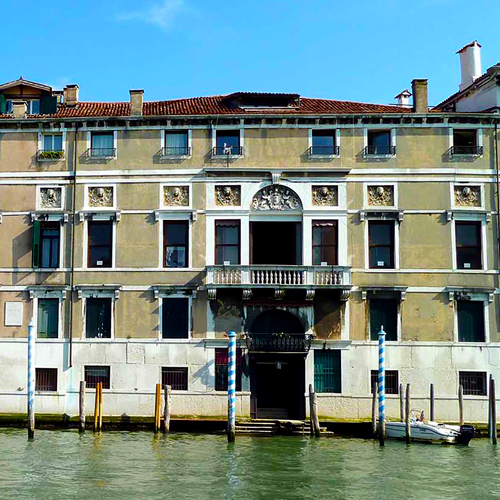
 There are betrayals that stain a building forever, as if the walls themselves absorb the shame and refuse to release it. Palazzo Mocenigo on the Grand Canal is such a place. Its name is woven into the history of Venice through centuries of political power and noble privilege. But it is not a doge or a general who haunts its corridors. It is a philosopher. A Dominican friar who dreamed of infinite worlds. A man who was burned alive in Rome for thinking thoughts that the Church could not tolerate. His name was Giordano Bruno, and every year on the anniversary of his death, his ghost is said to wander the halls of Palazzo Mocenigo, searching for the nobleman who betrayed him.
The Legend — A Philosopher Who Refuses to Rest
The ghost of Giordano Bruno is not a restless spirit in the conventional sense. He does not terrify. He does not break objects or emit mournful cries. According to the Venetian tradition, his appearance is quiet, almost scholarly. On the night of February 17, the anniversary of his execution in Rome's Campo de' Fiori, a shadow is said to pass through the rooms of Palazzo Mocenigo. Those who have claimed to see him describe a figure in a Dominican habit, his face obscured, moving with purpose from one room to the next. He is searching. He is looking for Giovanni Mocenigo, the man who invited him to Venice, who posed as his student, who fed him and housed him for months, and who then denounced him to the Inquisition out of spite and fear.
The legend is insistent on one detail: Bruno does not find what he seeks. He wanders the palace from dusk until dawn, and when the first light of February 18 touches the Grand Canal, he vanishes without a trace. The betrayal is never avenged. The search never concludes. He is, in this sense, a ghost of perpetual disappointment rather than anger. A man who was condemned for his ideas and who returns each year to question the man who condemned him. But the question is never asked. The encounter never occurs.
The date is not accidental. February 17, 1600, is one of the most notorious dates in the history of Western thought. On that morning, Giordano Bruno was led to the stake in Rome's Campo de' Fiori. According to eyewitness accounts, he turned his face away from the crucifix that was offered to him and died in silence. The Church did not revoke his condemnation for four centuries. He remains, for many, a martyr of free thought.
What makes the legend of Palazzo Mocenigo particularly evocative is not the ghost itself but the location of his haunting. Bruno did not die in Venice. He was arrested there, but he was tried in Rome. He did not suffer in the palace. He suffered in the prisons of the Inquisition. And yet the Venetian imagination has fixed him to the palazzo where he was betrayed, not to the city where he was executed. The ghost, in other words, is not a death haunting. It is a betrayal haunting. It is the betrayal that will not fade, not the fire that will not cool.
The Historical Facts — 1591, 1592, and the Road to the Stake
The legend is compelling, but the documented history is even more disturbing. Unlike many ghost stories that float free of evidence, the betrayal of Giordano Bruno is recorded in the archives of the Venetian Inquisition, in the letters of the philosophers of the period, and in the meticulous trial records of the Holy Office in Rome. We know exactly what happened, and we know exactly who was responsible.
The Invitation — 1591
In 1591, Giordano Bruno was living in Frankfurt, Germany, having fled the intellectual persecution that followed him across Europe. He had already been a Dominican friar, a fugitive from heresy accusations, a lecturer in Paris, Oxford, and Wittenberg, and the author of radical cosmological works that proposed an infinite universe without a centre. He was, by any measure, one of the most original and dangerous minds of his century.
The invitation came from Venice, from a nobleman named Giovanni Mocenigo. Mocenigo was a wealthy but intellectually insecure member of one of Venice's most powerful families. He had heard of Bruno's reputation as a master of the art of memory, a mnemonic system that promised to unlock extraordinary cognitive powers. Mocenigo wanted these secrets for himself. He wrote to Bruno, offered him room and board in Palazzo Mocenigo, and promised generous compensation for his teachings.
Bruno accepted. He arrived in Venice in the spring of 1591 and took up residence in the palazzo. For nearly a year, he taught Mocenigo the principles of memory training.
The Disappointment — 1592
Giovanni Mocenigo proved to be a poor student. He lacked the intellectual foundation to grasp Bruno's techniques, and he grew increasingly frustrated. Instead of blaming his own limitations, he began to suspect that Bruno was holding back secrets, that he was being cheated, and that the philosopher might soon leave Venice without delivering the promised knowledge.
In May of 1592, Mocenigo made a fateful decision. He locked Bruno in a room of the palazzo and then went to the Venetian Inquisition to denounce him. His accusations were precise and devastating. He claimed that Bruno had mocked the Catholic faith, denied the divinity of Christ, questioned the doctrine of transubstantiation, and asserted the existence of multiple worlds. Each of these was a capital heresy.
The Arrest — May 1592
The Venetian Inquisition acted swiftly. On May 23, 1592, they arrested Giordano Bruno in Palazzo Mocenigo. He was taken to the prisons of the Inquisition in Venice, where he remained for nearly a year. During this time, he defended himself with extraordinary intellectual courage. He did not recant. He did not beg for mercy. He explained his ideas, clarified his positions, and waited.
Venice, however, was not the final destination. The Papal Inquisition in Rome wanted Bruno. They claimed jurisdiction because Bruno's heresies were theological rather than purely political. After months of negotiation, the Venetian authorities agreed to extradite him. In February 1593, Bruno was taken to Rome. He would never see freedom again.
The Trial and Execution — 1593 to 1600
The Roman trial lasted eight years. Eight years of imprisonment, questioning, and theological debate. Bruno was given multiple opportunities to recant. He refused. On February 8, 1600, the Inquisition pronounced him a heretic and handed him over to the secular authorities for punishment. The sentence was death by burning.
According to tradition, Giordano Bruno responded to his sentence with the words: "You who pronounce my sentence feel more fear than I who receive it." He was burned at the stake in Campo de' Fiori on February 17, 1600. His ashes were thrown into the Tiber River. The Church forbade any monument to his memory.
The trial of Giordano Bruno is not merely a religious condemnation. It is the collision of two worlds: the medieval universe of fixed spheres and divine authority, and the modern universe of infinite possibilities and human reason. Bruno chose the infinite. It cost him his life.
Who Was Giovanni Mocenigo?
Giovanni Mocenigo died in 1598, two years before Bruno's execution. He never saw the final outcome of his betrayal. He lived the remainder of his life in Palazzo Mocenigo, presumably untroubled by the ghost that would later be said to haunt him. The Mocenigo family, however, did not escape history's judgment. Their name is forever attached to the philosopher's arrest. In Venice, the story is still told not as a tale of noble virtue but as a parable of intellectual mediocrity betraying genius out of petty resentment.
The Mocenigo were one of the most powerful families of the Venetian Republic. They produced seven doges, numerous ambassadors, and military commanders. Their palace on the Grand Canal was not a single building but a complex of adjacent palazzos, a visible symbol of their wealth and influence. But all the doges in the world cannot erase the stain of May 1592. In the popular imagination, the Mocenigo name means betrayal.
What the archives contain. The trial documents of Giordano Bruno are preserved in the Vatican Secret Archives and have been studied extensively by historians. They reveal a man of extraordinary intellectual consistency who refused to abandon his cosmological vision even under the threat of death. His rejection of the geocentric model and his insistence on an infinite universe were the primary grounds for his condemnation.
A Dedicated Day Tour of Palazzo Mocenigo and Giordano Bruno's Venice
For travellers who wish to follow the footsteps of Giordano Bruno through Venice, a dedicated day tour is the most rewarding approach. The following itinerary is designed to be contemplative rather than rushed, allowing time for reflection at each significant location.
Morning — Arrival and Palazzo Mocenigo Exterior
Begin your day by arriving in Venice without stress. The most comfortable way to reach the city from Marco Polo Airport (VCE) or Treviso Airport (TSF) is by pre-booking a private transfer with Airport Connection. A private water taxi delivers you directly to a landing near Palazzo Mocenigo, allowing you to step from the boat onto the Grand Canal without dragging luggage across bridges or waiting for vaporetti.
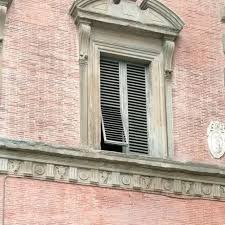
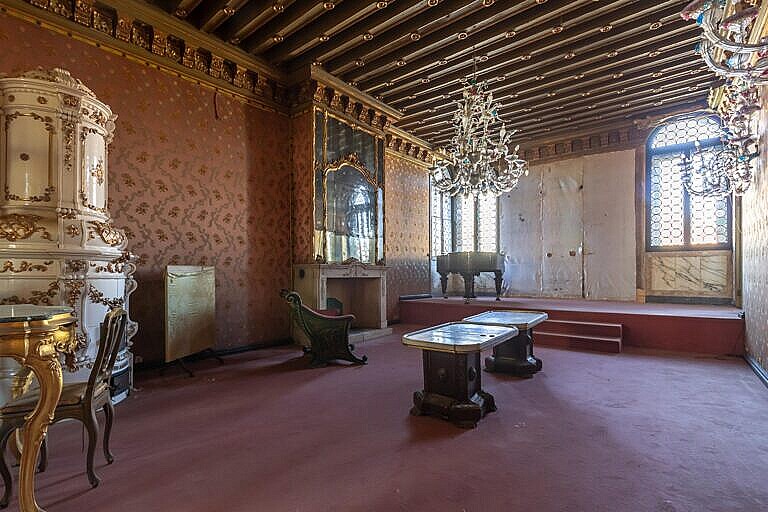
Palazzo Mocenigo is not generally open to the public. It remains a private residence and is occasionally used for cultural events. However, the exterior can be viewed from the Grand Canal, and the building is easily identified by its imposing facade and its location in the San Marco district. Take time to observe the architecture. Imagine Bruno arriving here in 1591, full of hope and intellectual ambition, unaware that his host would become his betrayer.
Late Morning — The Mocenigo Family
After viewing the palace, walk through the surrounding neighbourhood of San Marco. The Mocenigo family is woven into the fabric of this district. Their influence extended across the city. Consider visiting the Basilica di San Marco itself, where generations of Mocenigo doges are commemorated. The juxtaposition of ecclesiastical splendour and intellectual persecution is a theme that defines Bruno's story.
Allow at least an hour for quiet reflection. Bruno's ghost, according to legend, does not perform for tourists. He wanders alone, and the appropriate response is not excitement but meditation. What would you have done in Bruno's position? What would you have said to the Inquisition?
Lunch — A Break Within Walking Distance
The San Marco district contains numerous cafes and restaurants. Choose a quiet place away from the crowded Piazza. Use the time to read passages from Bruno's works — his "On the Infinite Universe and Worlds" is a good starting point. Consider how radical his ideas were in 1591 and how long it took the Church to admit that he might have been right about the stars.
Early Afternoon — The Prisons of the Inquisition
After lunch, make your way to the area near the Ponte della Paglia, where the prisons of the Venetian Inquisition were once located. Bruno was held here for nearly a year before his extradition to Rome. The original buildings have been absorbed into later structures, but the atmosphere remains. Stand in the narrow streets. Imagine the philosopher, aged nearly forty-five, looking out through barred windows at the water he would never sail again.
Late Afternoon — Campo de' Fiori in Memory
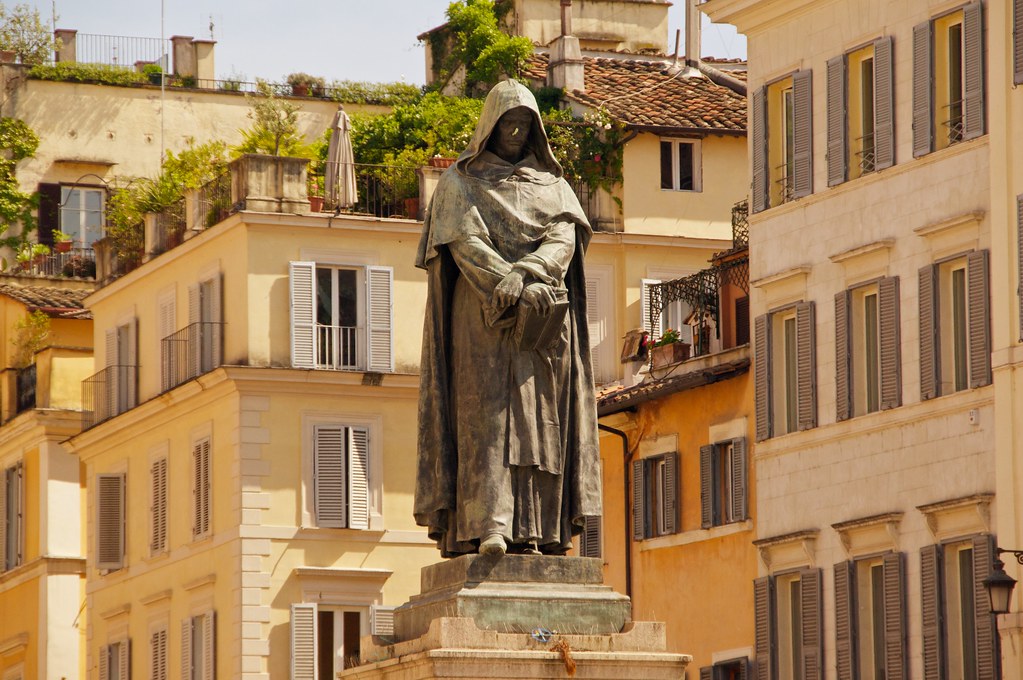
Although Campo de' Fiori is in Rome, the Venetian observer can honour Bruno's memory from a distance. Consider his last words as reported by witnesses: "You who pronounce my sentence feel more fear than I who receive it." He died not in despair but in defiance. A statue now stands in Campo de' Fiori, erected in 1889 after the Church finally permitted public commemoration. The statue's hooded figure looks down at the market square where he was burned. It is a powerful image of intellectual courage.
Evening — Departure
As the light fades over the Grand Canal, consider the question with which you arrived: does Giordano Bruno haunt Palazzo Mocenigo? The historical answer is no. The philosophical answer is more complicated. A man who was betrayed for his ideas, who refused to recant, who died in silence for a vision of an infinite universe — such a man does not need to haunt a building. His ideas are his haunting. His books are his ghost. And they appear not once a year but every time a reader opens a page.
Transport Tips — Arriving at Palazzo Mocenigo Without Stress
Venice requires a different approach to arrival than any other Italian city. The absence of roads and the presence of canals mean that your first moments in the city define your entire experience. The following recommendations are designed to minimise friction and maximise tranquillity.
From Marco Polo Airport (VCE)
Venice Marco Polo Airport is the main international gateway. From the airport, a private water taxi is the most comfortable option. The journey takes approximately thirty-five minutes and delivers you directly to a landing point near Palazzo Mocenigo. The cost is fixed regardless of passenger number within a reasonable group size. This is strongly recommended for travellers who value comfort and wish to avoid the stress of public transport with luggage.
From Treviso Airport (TSF)
Treviso Airport receives many low-cost flights. A private transfer from Treviso to the water's edge at Piazzale Roma takes approximately forty-five minutes, after which you switch to a water taxi for the final leg to Palazzo Mocenigo. The combined journey is seamless if booked through a single operator. Airport Connection offers integrated land and water transfers that eliminate the need to handle your own luggage between vehicles.
From Santa Lucia Train Station
If you arrive by train, the station is located on the Grand Canal. A private water taxi from the station's water entrance to Palazzo Mocenigo takes approximately fifteen minutes. Alternatively, the vaporetto lines 1 and 2 stop at San Samuele, which is within walking distance of the palace. The water taxi is recommended for those who wish to arrive with elegance rather than efficiency.
How to book your transfer with Airport Connection. The process is designed for travellers who appreciate simplicity. Select your pickup location — Marco Polo Airport, Treviso Airport, or Santa Lucia Station. Enter Palazzo Mocenigo as your destination. Specify the number of passengers and luggage. The system calculates a fixed price instantly. Confirm your booking online, and you will receive a confirmation email with precise meeting instructions and your driver or water taxi contact information. Book at least forty-eight hours in advance for the best availability.
Book Your Transfer →
Conclusion — The Ghost That Does Not Need to Walk
Giordano Bruno was not a ghost when he lived. He was a man of flesh and blood, a thinker of extraordinary courage, a prisoner who refused to recant. The legend of his apparition at Palazzo Mocenigo is a beautiful fiction, but the truth is more powerful. The truth is that a man who dreams of infinite worlds does not need to return from death to haunt his betrayer. His books haunt the centuries. His ideas haunt the Church that condemned him. His face, cast in bronze in Campo de' Fiori, haunts the market square where the fire consumed him.
Giovanni Mocenigo is forgotten except as a footnote to Bruno's trial. The palace that bears his family name endures as a beautiful building on the Grand Canal. But the philosopher who was betrayed within its walls is remembered everywhere. That is the true haunting. Not the ghost that walks once a year, but the memory that refuses to die. And that memory, unlike the apparition, is real.
Comments
No comments yet. Be the first to share your thoughts!
Leave a Comment
Your comment will appear after moderation.