 Michelle
 Most visitors to Rome spend their days in the same magnetic circuit: the Colosseum, the Vatican, the Trevi Fountain, the Pantheon, the Spanish Steps. All extraordinary. All entirely worth your time. But thirty kilometres southwest of the city, where the Tiber once met the sea, lies something that relatively few of those visitors ever discover, and that almost every single one of them who does discover it immediately declares to be the highlight of their entire trip. Ostia Antica is the ancient port city of Rome, buried by centuries of silt and time, and excavated over the last hundred and fifty years into a state of preservation that the Colosseum and the Roman Forum can only dream of. Walking its ancient streets is not an exercise in imagination. It is a walk through a city that is, in all the ways that matter most, still there.
Why Ostia Antica Is One of Italy's Great Hidden Gems
To understand why Ostia Antica is so remarkable, it helps to understand what it actually is and how it survived. Founded in the seventh century BC, according to tradition by Romulus himself, Ostia grew from a small military outpost at the mouth of the Tiber into the great commercial harbour of the Roman Empire. At its peak, in the second century AD, it was home to between fifty thousand and one hundred thousand people: merchants, sailors, slaves, craftsmen, shopkeepers, priests and bureaucrats who kept the vast machinery of Roman trade in motion. Grain arrived from Egypt and North Africa. Wine came from Spain and Gaul. Marble was unloaded from quarries across the Mediterranean. Everything that fed, clothed and sustained the city of Rome passed through Ostia.
The city began to decline in the third century AD, as the silting of the river mouth made navigation increasingly difficult and the centre of commercial gravity shifted to the new imperial harbour at Portus, a short distance to the north. By the medieval period, Ostia had been more or less abandoned, and the rising water table and accumulating river sediment did the rest: the city was buried, gradually and completely, preserved beneath the earth in a state that was, when excavations began in earnest in the nineteenth century and then dramatically accelerated under Mussolini in the 1930s, nothing short of miraculous.
What makes Ostia fundamentally different from Pompeii, the other great preserved Roman city that most visitors have heard of, is the nature of its architecture. Pompeii was a prosperous provincial town of modest size, and its buildings are largely low-rise domestic structures. Ostia was a major urban centre, and its architecture reflects that fact. It contains genuine multi-storey apartment buildings, the insulae, that in some cases survive to the height of three full storeys. It has an entire neighbourhood of commercial warehouses, a theatre that still seats three thousand people, elaborate public baths on a civic scale, a forum with its temples intact, and a fire station. It is, in the most literal possible sense, a Roman city. Not the idea of one. Not the ruins of one. A Roman city, still recognisably itself after two thousand years.
The Pompeii comparison: Many visitors who have been to Pompeii are surprised to find Ostia Antica even more impressive in some respects. The key difference is verticality: Ostia preserves multi-storey buildings that give you a genuine sense of urban life, while Pompeii's structures are largely single-storey. Ostia also has far fewer tourists, which means you can absorb the atmosphere without the distraction of large tour groups.
1. What to See: the Highlights of the Archaeological Park
The archaeological park of Ostia Antica covers approximately 150 hectares and contains several kilometres of paved ancient streets, hundreds of individual buildings and an on-site museum that houses the best of the moveable finds. You genuinely need a full day. Here are the essential highlights, organised roughly in the order in which you encounter them walking along the main road, the Decumanus Maximus, from the entrance.
The Necropolis and the Via Ostiensis
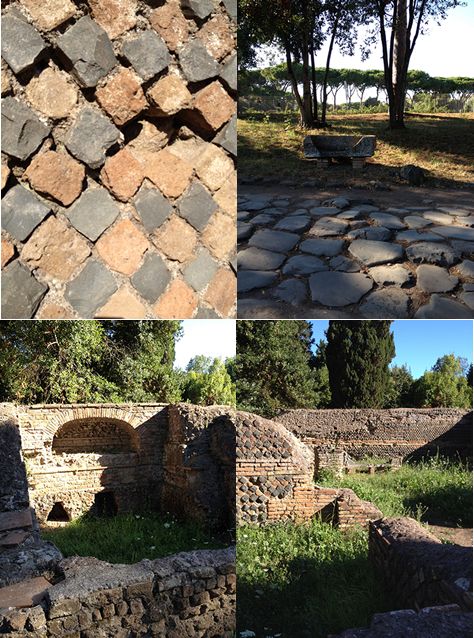
Roman custom required that the dead be buried outside the city walls, and so every Roman city approached by road was entered through its necropolis. The road into Ostia from Rome is no different: you walk for several minutes through a long corridor of tombs, some still bearing their original inscriptions, before passing through the city gate. It is a genuinely affecting introduction, a reminder before you have even entered the city that Ostia was inhabited by real people who lived and died here over the course of many centuries.
The Baths of Neptune
Just inside the city entrance, to the left of the main street, the Baths of Neptune contain one of the most spectacular mosaic floors in the entire Roman world. The central image, covering hundreds of square metres, depicts Neptune driving a chariot pulled by seahorses, surrounded by sea creatures, tritons and nereids rendered in extraordinary detail. You view the mosaic from a raised walkway above, which gives you the full scale of the composition and the opportunity to photograph it without obstruction. It is one of the first things you encounter at Ostia, and it sets the standard for everything that follows.
The Theatre of Ostia
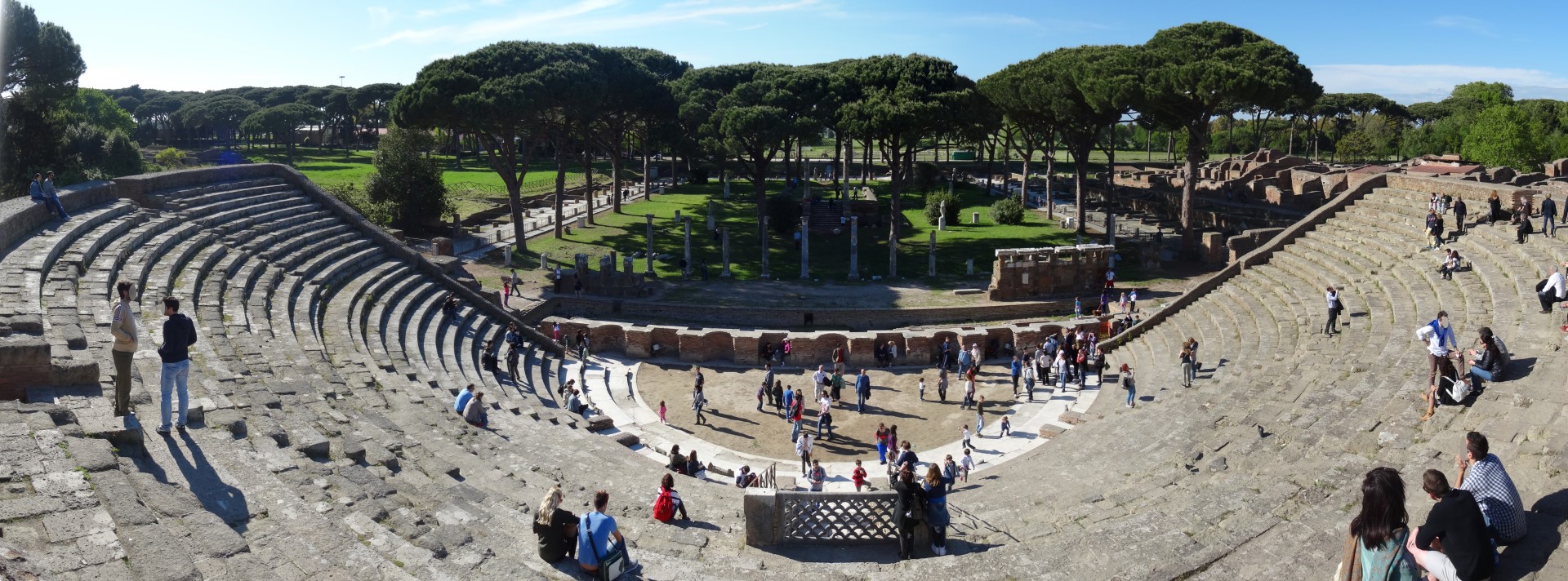
The Theatre of Ostia, built in the first century BC and enlarged several times over the following two centuries, is one of the best-preserved ancient theatres in Italy. It originally seated between four thousand and five thousand spectators, and although later modifications have reduced its capacity, the structure remains substantially intact, with the curved cavea of seating rising in elegant tiers above the stage. During summer, the theatre returns to its original purpose and hosts evening performances of classical music and theatre as part of the annual Ostia Antica Festival, an experience that, if your dates coincide, you should make every possible effort to attend.
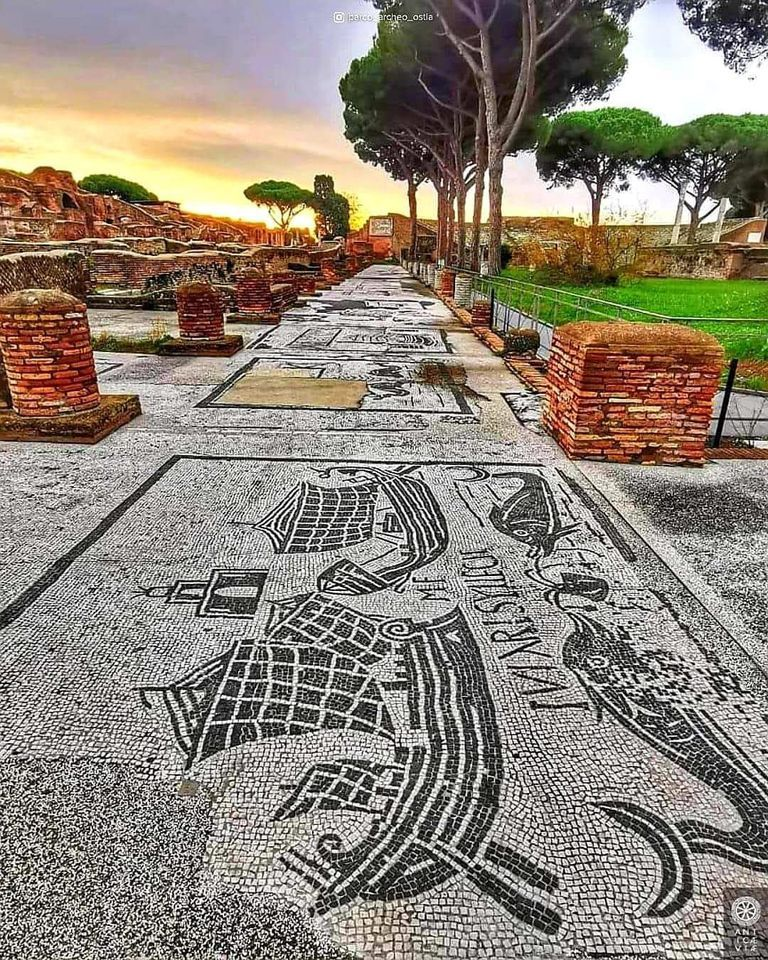
Behind the theatre, the Piazzale delle Corporazioni, or Square of the Guilds, is one of Ostia's most extraordinary spaces: a large porticoed square that once housed the offices of the commercial agents who represented trading companies from across the Mediterranean. The floor of the portico is covered in mosaics depicting the trade or origin of each guild, and they are still largely intact. You can see an elephant from Africa, a lighthouse from Alexandria, a merchant ship from Carthage. It is, in essence, a map of the Roman world in mosaic.
The Forum and the Capitolium
At the heart of Ostia stands its Forum, the central civic space of every Roman city, flanked by the Capitolium, the great temple dedicated to the Capitoline triad of Jupiter, Juno and Minerva. The Capitolium at Ostia is the best-preserved example of this temple type outside of Rome itself: its massive brick podium rises to a height of several metres, and the grand staircase that once led up to the entrance columns still survives. Standing in front of it, looking down the length of the Forum towards the Temple of Rome and Augustus at the far end, with pines rising behind the ruins on either side, is one of those moments of pure, unmediated connection with the ancient world that makes a visit to Ostia genuinely unforgettable.
The Insulae and the Thermopolium
Among the most extraordinary buildings at Ostia are the insulae, the multi-storey apartment blocks that housed the majority of Ostia's working population. The House of Diana is the most complete example: a three-storey structure built around a central courtyard with a cistern, its ground-floor rooms still opening directly onto the street, precisely as they did two thousand years ago. Walking through it, past the worn thresholds and up the ancient stairs, gives you an understanding of Roman urban life that no museum exhibit could replicate.
Nearby, the Thermopolium of Via Diana is essentially a Roman bar and fast-food counter. Its stone serving counter, with the circular holes that once held ceramic vessels of hot food, is still perfectly intact. The painted menu on the back wall has partially survived. The marble basin where customers could wash their hands is still in place. It is one of those details at Ostia that stops you mid-stride: the recognition that this is not a ruin in the traditional sense, but a place where people ate lunch on an ordinary working day in the second century AD.
2. How to Get There from Rome, and from the Airport
Getting to Ostia Antica from Rome is significantly easier than most visitors expect. The archaeological site is served directly by the Roma-Lido commuter train, which departs from Roma Porta San Paolo station, located immediately adjacent to the Piramide stop on Metro Line B. Trains run every 15 minutes throughout the day, and the journey to the Ostia Antica stop takes approximately 30 minutes. The station is a short, pleasant walk across a bridge and along a tree-lined path to the entrance of the park. Your standard metro/bus ticket or travel pass covers the Roma-Lido service, which makes this one of the most affordable day trips you can make from Rome.
If you are travelling by car, Ostia Antica is accessible via the Via del Mare or the Via Ostiense, both of which lead directly from the Rome ring road (the Grande Raccordo Anulare) towards the coast. Parking is available close to the entrance of the archaeological park. The drive from central Rome takes between 30 and 45 minutes depending on traffic, and it is worth noting that the road along the Via del Mare passes through some genuinely attractive Lazio countryside once it clears the outer suburbs of Rome.
If you are arriving directly from Fiumicino Airport (FCO), Ostia Antica is in fact closer to the airport than it is to central Rome: the two sites are separated by only a few kilometres. A private transfer from Fiumicino to Ostia Antica takes as little as 20 minutes. If you are arriving on an early morning flight and want to make the most of your first day in the Rome area without fighting city centre traffic, heading directly to Ostia Antica from the airport and then continuing to Rome in the late afternoon is a genuinely excellent plan. Few travel itineraries reward forward thinking as generously as this one.
From the airport directly to Ostia Antica: Fiumicino Airport and Ostia Antica are both southwest of Rome, just a short distance apart. If your flight lands in the morning, consider booking a private transfer directly from the airport to the archaeological site. You arrive fresh, you have the ruins largely to yourself in the morning light, and you can continue to your Rome hotel in the late afternoon by train. It is one of the smartest ways to begin a Rome trip.
3. Best Time to Visit and How Long You Need
Ostia Antica is a genuinely year-round destination, but the best times to visit are April through June and September through October. In spring, the site is lush and green, the light is exceptional, the temperatures are comfortable for walking several kilometres on uneven ancient surfaces, and the crowds are manageable. In early autumn, the same conditions apply, with the added benefit that the summer heat has broken and the park feels quiet and intimate after the busiest months.
July and August are the most challenging months: the site is largely unshaded, and temperatures above 35 degrees Celsius make extensive walking genuinely exhausting and potentially dangerous for those not accustomed to southern Italian summer heat. If summer is your only option, go very early in the morning when the gates open, carry plenty of water, wear a hat and high-SPF sunscreen, and plan to leave by midday. The site has limited shade and virtually no indoor space to escape the heat.
Winter visits, from November through March, offer an entirely different quality of experience. The light in the low winter sun on the ancient brick and marble can be extraordinarily beautiful, and the site is at its quietest. Bring layers and waterproof shoes: the site can be muddy after rain, and the paved ancient streets become slippery in wet conditions. But a winter morning at Ostia, with no one else around and the pines casting long shadows across the empty Forum, is one of those travel experiences that is genuinely difficult to find anywhere else in Europe.
As for duration, do not underestimate this. A minimum of four to five hours is needed to cover the main highlights. Six to seven hours allows a thorough visit that includes the museum, some of the secondary streets and buildings off the main routes, and a proper lunch break. If you are genuinely interested in Roman history and archaeology, an entire day is not excessive. The site rewards slow, attentive exploration far more than a hurried circuit of the main points.
Common tourist mistakes at Ostia Antica: Trying to see it in two hours as a quick add-on to a Rome day. Arriving without water or food; the on-site cafe is limited and there are no restaurants inside the park. Wearing fashionable shoes or sandals on uneven ancient stone surfaces. Forgetting sunscreen and a hat in spring and summer. Not picking up a site map at the entrance, which is essential since the park has no internal signage beyond basic arrows. And, most significantly of all, not going at all, which is the mistake that the majority of Rome visitors make and that many of them regret when they hear about it afterwards.
Ostia Antica is what the Roman Forum would look like if someone had simply pressed pause two thousand years ago and walked away. The city is not reconstructed. It is not interpreted. It is simply there, waiting, and it is more extraordinary for having required so little imagination to bring back to life.
4. Food, Practical Tips and What to Bring
The food situation at Ostia Antica is one of the few areas where the site falls short of its extraordinary archaeological content. The on-site cafe near the entrance offers limited options, and there are no restaurants inside the park. The sensible approach is to bring your own lunch. A good Roman alimentari (deli) near your hotel will make you a panino that will survive the journey; add fruit, water and something sweet, and you have everything you need for a comfortable break in the shade of one of the pines that grow throughout the site.
The nearest restaurants of real quality are in the modern town of Ostia, about three kilometres from the archaeological park, accessible by continuing on the Roma-Lido train one stop further to Lido Centro. If you are visiting in summer, finishing your archaeological exploration by midday and continuing to Ostia Lido for lunch by the sea and a few hours on the beach is a genuinely excellent plan. The beach at Ostia is the closest seaside resort to Rome, and while it is not the most glamorous beach in Italy, it has a distinctly Roman character and personality that is worth experiencing.
What to bring: comfortable shoes with good grip, a hat, sunscreen, at least one litre of water per person, a light layer for cooler mornings, a camera with fully charged battery, and the site map that you collect at the entrance. A pair of binoculars is useful for examining the upper portions of buildings and the detail of decorative elements that are not always at eye level. If you have a genuine interest in the archaeology, the site guidebook sold at the entrance shop is thorough and well-illustrated.
The Museo di Ostia Antica, located within the park, is included in the entrance ticket and should not be skipped. It houses sculpture, mosaics, architectural fragments and everyday objects recovered during excavations, including an extraordinary collection of marble portraits that bring the inhabitants of the ancient city vividly to life. Allow at least 45 minutes to an hour for the museum in addition to your time in the park itself.
Comments
No comments yet. Be the first to share your thoughts!
Leave a Comment
Your comment will appear after moderation.