 Michelle
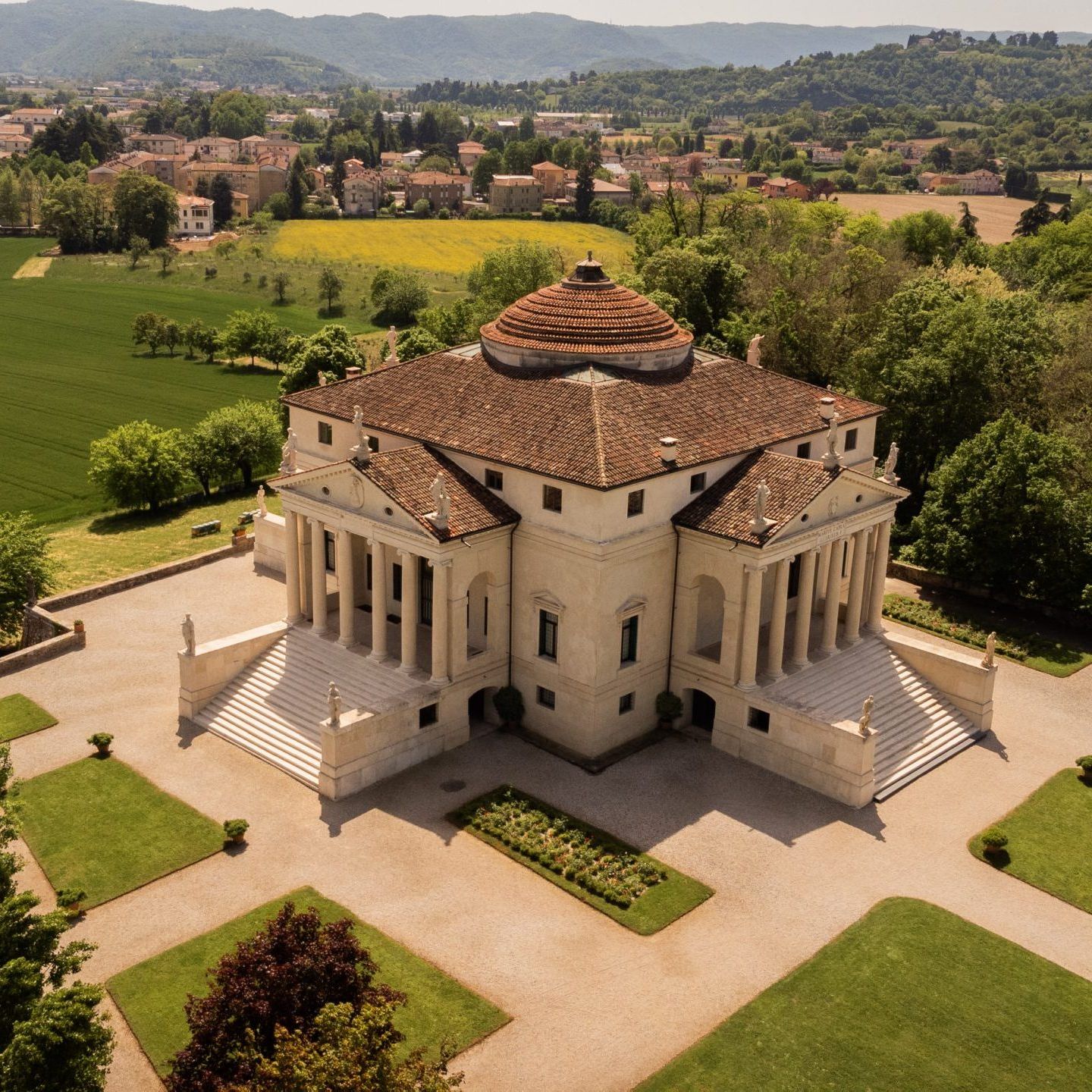
 There are buildings that merely house their occupants, and then there are buildings that embody an idea so perfectly, so completely, that they transcend their original purpose to become monuments of human thought. Villa Rotonda, standing on a gentle hilltop just outside Vicenza in the Veneto region of northern Italy, belongs to the second category. Designed by Andrea Palladio in the 1560s and completed in the 1590s, this villa is widely regarded as the absolute icon of Palladian architecture — a building of such mathematical clarity, such serene symmetry, and such profound harmony with its landscape that it has inspired architects across five centuries and three continents [citation:1].
The Commission — A Retired Prelate's Country Dream
The story of Villa Rotonda begins not with an architect but with a priest. Paolo Almerico was a native of Vicenza who had spent his career in Rome as a referendary apostolic — a senior papal official — serving first Pope Pius IV and subsequently Pope Pius V [citation:1]. In 1565, upon his retirement from the Vatican, Almerico chose to return to his homeland rather than remain in the Eternal City. He acquired a hilltop site just outside the walls of Vicenza, a location that offered unobstructed views of the surrounding countryside and the city itself, and he commissioned Andrea Palladio to design a country residence that would serve not as a working farm but as a suburban retreat [citation:4].
This distinction is crucial. Unlike the majority of Venetian villas, which were designed as agricultural estates with barns, stables, and workers' quarters integrated into the complex, Villa Rotonda was conceived purely as a place of leisure and contemplation [citation:1]. Palladio himself classified the building not as a villa in the conventional sense but as a palazzo — an urban residence transplanted to the countryside [citation:4]. Almerico had no interest in farming. His ambition was to create a place where he could enjoy the pleasures of the country without sacrificing the sophistication of the city.
The religious dimension. Almerico's ecclesiastical career left a profound mark on the villa. The vibrant interior frescoes, which contrast dramatically with the sober exterior, celebrate religious values and Christian virtues such as temperance and chastity. Many of the paintings make explicit reference to Almerico's life as a papal prelate, and the building's temple-like facade evokes ancient Roman sacred architecture, including the Pantheon in Rome and the Sanctuary of Fortuna Primigenia in Palestrina [citation:4]. The villa is, in essence, a secular space infused with sacred overtones.
Neither Paolo Almerico nor Andrea Palladio would live to see the villa completed. Almerico died in 1589, Palladio in 1580 [citation:1]. The building passed to the Capra brothers — Girolamo, Odorico, and Marcantonio — who acquired the property in 1591 and commissioned Vincenzo Scamozzi, Palladio's most gifted pupil, to finish what his master had begun [citation:2]. It is thanks to the Capra brothers that the villa stands today as Palladio intended, though with some significant modifications to the central hall and dome.
Andrea Palladio — The Stone Mason Who Became a Master
To understand Villa Rotonda, one must first understand the man who conceived it. Andrea Palladio was born in Padua in 1508, the son of a miller. He began his career as a stone mason, a humble trade that gave him an intimate knowledge of building materials and construction techniques [citation:9]. At the age of thirty, he came under the patronage of the humanist scholar Gian Giorgio Trissino, who recognised the young mason's prodigious talent and gave him the name Palladio — an allusion to Pallas Athena, the Greek goddess of wisdom — as well as an education in classical architecture and literature.
Trissino took Palladio to Rome, where the young architect studied the ruins of ancient temples, baths, and basilicas. The influence of this pilgrimage is visible throughout Palladio's work, but nowhere more clearly than at Villa Rotonda. The building's central domed hall is a direct homage to the Pantheon in Rome, while the four porticos recall the temple fronts of the Roman Forum. Palladio did not merely copy ancient forms, however. He translated them into a new architectural language — rigorous, mathematical, and profoundly concerned with the relationship between building and landscape [citation:4].
Palladio codified his principles in "I Quattro Libri dell'Architettura" (The Four Books of Architecture), a treatise first published in 1570 that would become one of the most influential architectural texts in Western history [citation:1]. In these volumes, Palladio set forth his rules for proportion, harmony, and the correct use of classical orders. The books were illustrated with woodcuts of his own designs, including Villa Rotonda, which he presented as the ideal realisation of his architectural philosophy. For centuries afterward, architects from England to Russia to America would carry copies of Palladio's treatise as a bible of correct building.
The Architecture of Perfection — Geometry, Symmetry, and the Circle
Villa Rotonda is not a large building. Its compact square plan measures approximately twenty-five metres on each side, and the building rises only two storeys from the ground — the piano nobile, or principal floor, sits above a half-basement that contains service rooms and kitchens [citation:1]. Yet within this modest volume, Palladio achieved an architectural complexity that has been celebrated by every generation since.
The Four Facades
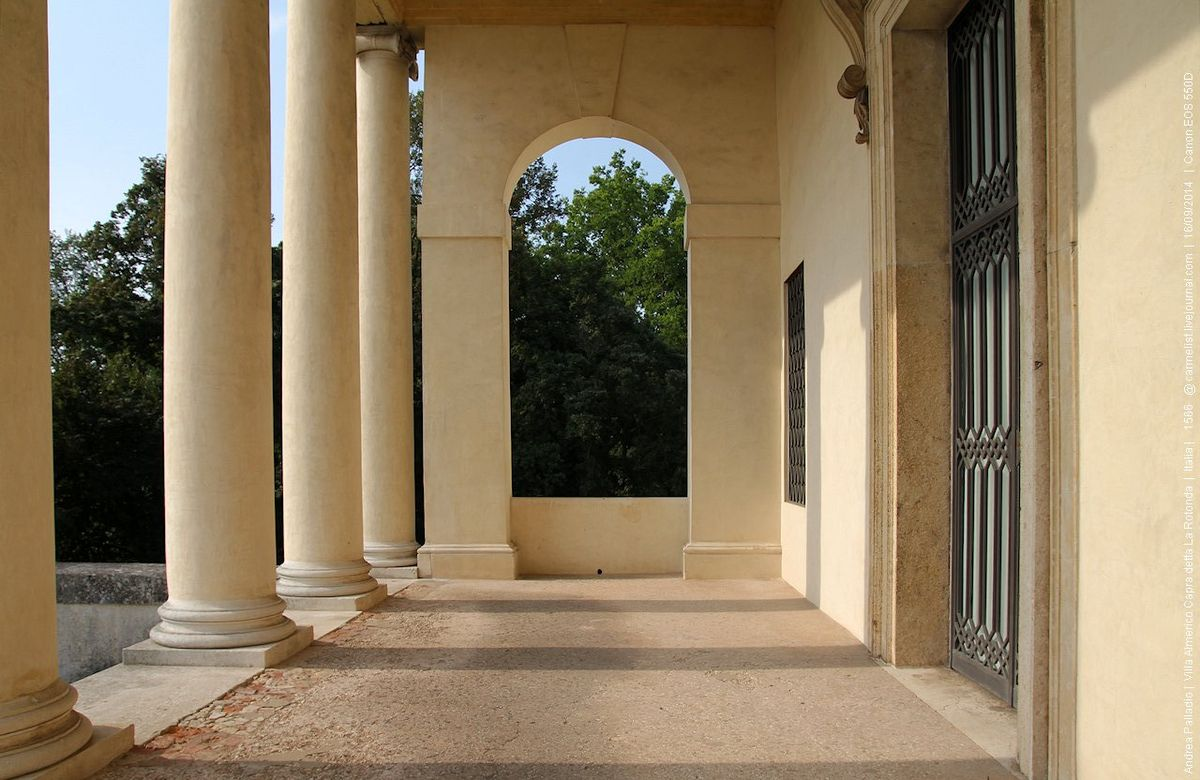
The villa's most immediately striking feature is its complete symmetry. Unlike traditional villas, which present one principal facade to the street or the garden and relegate the other elevations to secondary status, Villa Rotonda treats all four sides as equally important. Each facade is identical: a projecting portico supported by six Ionic columns, surmounted by a pediment adorned with statues of classical deities, and flanked by a single window on each side [citation:1][citation:4].
Palladio's decision to give the villa four identical facades was unprecedented. As the architectural historian Jimena Berzal de Dios has observed, "a building with four facades could have easily ended up being bizarre, but Palladio was able to design a serene, sophisticated construction by emphasizing balance, visual clarity, and uniformity" [citation:4]. The viewer who walks around the villa never encounters an unfavourable angle; a beautiful facade is always visible.
The four porticos are not merely decorative; they serve a functional purpose. Each portico provides a shaded outdoor room from which to contemplate the landscape. Because the villa is rotated forty-five degrees from the cardinal points of the compass, each portico receives sunlight at a different time of day, and each offers a distinct view of the surrounding countryside — the city of Vicenza, the hills of the Veneto, the valley below [citation:1].
The Central Hall
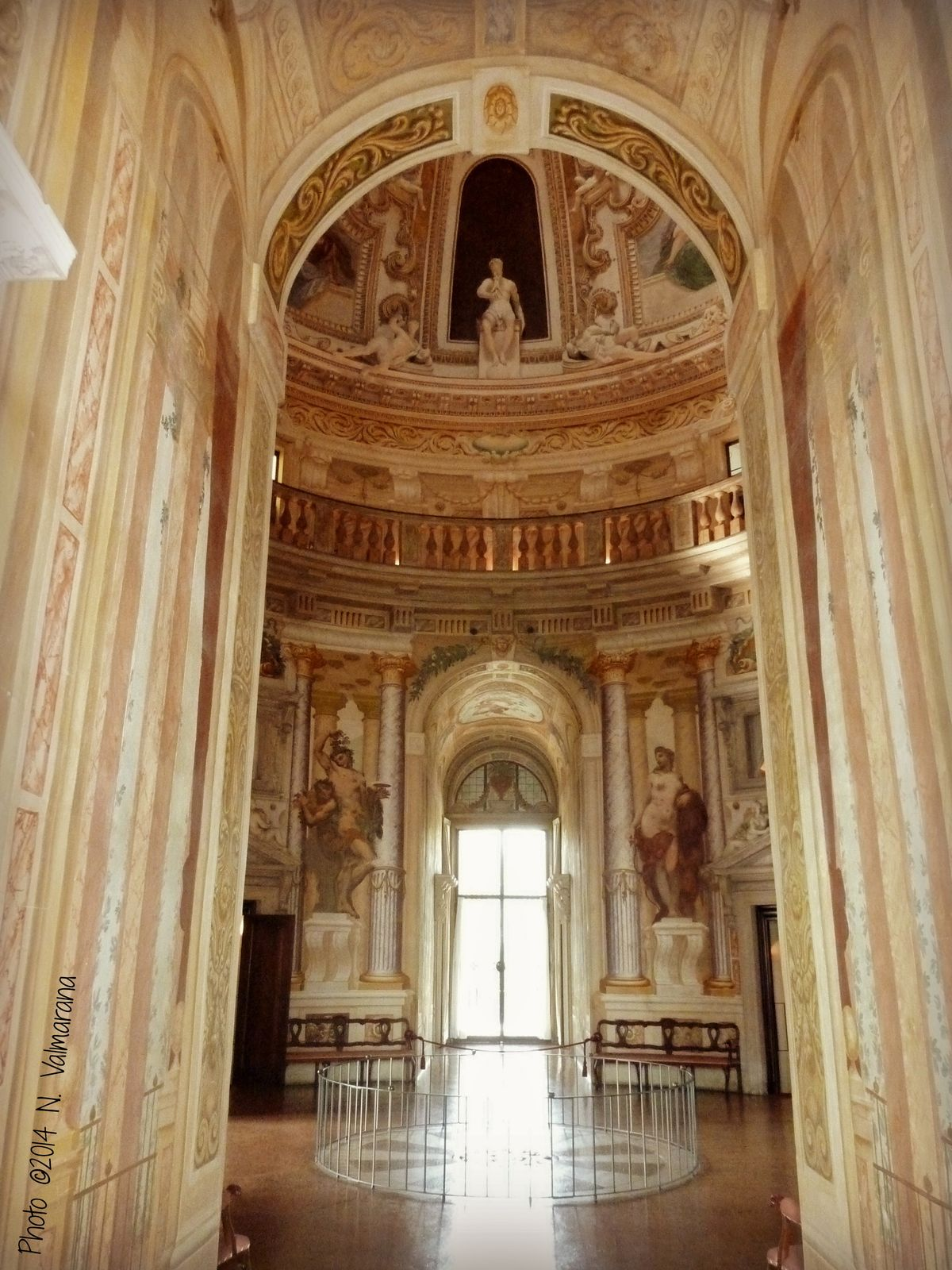
The name "Rotonda" refers not to the building as a whole — which is square, not circular — but to the central hall at its heart. This space, a perfect circle inscribed within the square of the building, is the villa's organising principle. From this central hall, four corridors radiate outward to the four porticos, creating a Greek cross plan. The hall soars the full height of the building, from the piano nobile up through the dome, and is surrounded by a balcony that allows visitors on the upper level to look down into the space [citation:1].
Palladio had originally intended to cap the central hall with a high semicircular dome, like the Pantheon in Rome. However, after his death, Vincenzo Scamozzi modified the design, creating a lower dome with an oculus — an opening to the sky — also inspired by the Pantheon [citation:1]. The dome was ultimately finished with a cupola. The walls of the central hall are decorated with trompe-l'oeil frescoes, creating an atmosphere that has been compared to a cathedral rather than a domestic interior [citation:1].
"The loveliest hills are arranged around it, which afford a view into an immense theatre." — Andrea Palladio, describing the landscape surrounding Villa Rotonda [citation:4]
The Landscape
Palladio understood that a great building does not exist in isolation; it enters into a dialogue with its environment. Villa Rotonda was sited on a low hill with gentle approaches, a location that Palladio described as offering a view into an immense theatre [citation:4]. From the porticos, the surrounding countryside — the trees, meadows, woods, and the city of Vicenza on the horizon — becomes part of the architectural experience. Conversely, the villa itself becomes a stage that can be contemplated from the landscape. This integration of building and nature was revolutionary in the sixteenth century and remains one of the villa's most celebrated qualities [citation:5].
The Interior Frescoes
The exterior of Villa Rotonda is sober, restrained, almost monastic in its whiteness. Palladio believed that "the most beautiful and most regular forms are the circle and the square" and that "among all colours, the most suitable for temples is white, because purity of colour, like purity of life, is most pleasing to God" [citation:9]. The interior, by contrast, is a riot of colour and allegory.
The frescoes were executed by Alessandro and Giovanni Battista Maganza and Anselmo Canera, three of the most accomplished painters of the late Venetian Renaissance [citation:1]. The principal salons on the piano nobile include the West Salon, known as the Holy Room for the religious nature of its frescoes and ceiling, and the East Salon, which contains an allegorical narrative of Paolo Almerico's life, portraying his many admirable qualities in vivid, celebratory images [citation:1]. The contrast between the severe white exterior and the vibrant interior is deliberate: it reflects the humanist ideal of inner richness and outer restraint.
Vincenzo Scamozzi — The Faithful Disciple
When Andrea Palladio died in 1580, Villa Rotonda was still far from finished. The walls were up, and the basic form was discernible, but much of the interior detailing and the crucial central dome remained incomplete. The new owners, the Capra brothers, might have turned to any architect in the Veneto. They chose Vincenzo Scamozzi, Palladio's most gifted student and the man who would carry his master's legacy into the seventeenth century.
Scamozzi treated the commission with profound respect. He did not attempt to impose his own style on Palladio's design; instead, he worked to realise the building as his master had conceived it. The most significant change Scamozzi made was to the dome. Palladio had envisioned a high, semicircular dome reminiscent of the Pantheon in Rome. Scamozzi designed a lower dome with an oculus, also inspired by the Pantheon but shallower and less sacred in appearance [citation:1]. Some scholars believe that Scamozzi's modification made the building more habitable and structurally sound; others lament the departure from Palladio's original vision. Regardless, the dome was finished with a cupola, and the villa was finally completed in the 1590s, more than a decade after Palladio's death [citation:2].
Scamozzi also designed the service buildings that flank the approach to the villa — a carriage drive lined with agricultural and staff structures that screen the main house from the road and heighten the drama of arrival [citation:1]. These additions, while secondary to the villa itself, demonstrate Scamozzi's deep understanding of Palladian principles, including the integration of building and landscape.
The Palladian Legacy — From Vicenza to the White House
No building by Andrea Palladio has been more imitated than Villa Rotonda. Its influence can be traced across the Western world, from the grand country houses of 18th-century England to the plantation homes of the American South, from the public buildings of Washington, D.C., to the private residences of tsarist Russia. The story of this influence is, in large part, the story of a single devoted reader of Palladio's treatise: Thomas Jefferson.
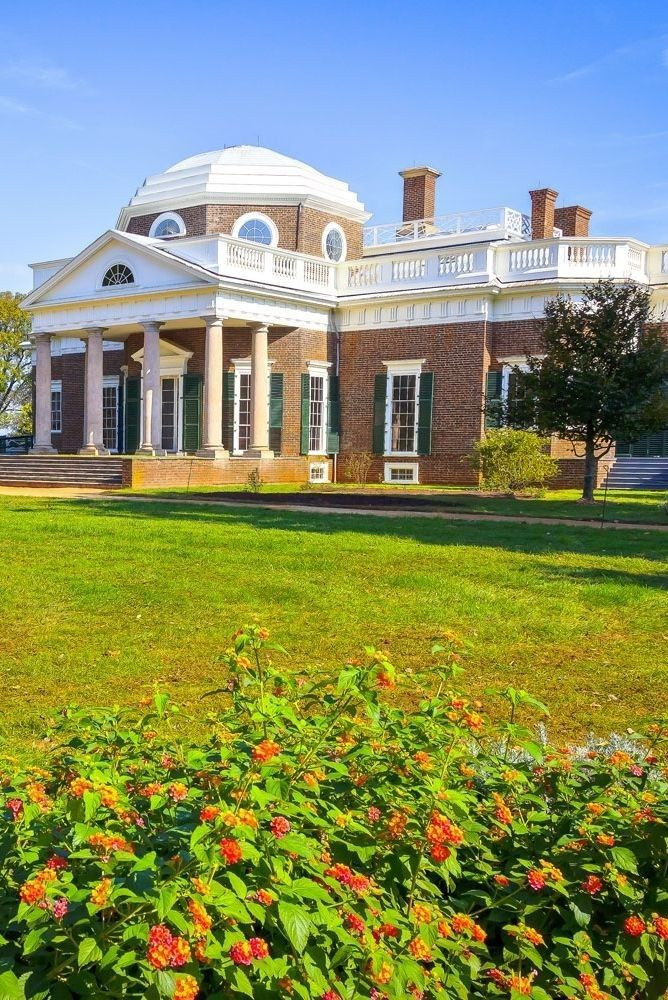
Jefferson owned several copies of "I Quattro Libri dell'Architettura" and considered the volume his architectural bible [citation:3]. He was introduced to Palladio during his time as a student at the College of William & Mary, and he never lost his enthusiasm for the Renaissance master's mathematical clarity and classical restraint. Jefferson's own home at Monticello, his retreat at Poplar Forest, and the Rotunda at the University of Virginia all bear the unmistakable stamp of Palladio's influence — as filtered through Jefferson's uniquely American sensibility.
But the most direct connection between Villa Rotonda and American architecture involves not an existing building but a design that was never built. In 1792, an anonymous entry was submitted to the competition for the design of the President's House in Washington, D.C. The design was a version of Palladio's Villa Rotonda: a central domed pavilion with four identical facades, intended to sit on a hill overlooking the Potomac River. The entry was submitted by Thomas Jefferson. The commission was ultimately awarded to James Hoban, whose more modest and flexible design became the White House we know today [citation:7].
Yet Jefferson's vision was not entirely rejected. The Rotunda at the University of Virginia, completed to Jefferson's design, is a modified half-scale interpretation of the Pantheon in Rome that also draws heavily on Palladio's Villa Rotonda [citation:3]. Jefferson placed a library — a "temple to knowledge" representing "the authority of nature and the power of reason" — at the centre of the Academical Village, just as Palladio placed a domed central hall at the heart of his villa. The parallel is not accidental. Jefferson was not merely imitating Palladio; he was translating Palladio's architectural philosophy into the language of American democracy.
Beyond the White House. The influence of Villa Rotonda extends far beyond Jefferson. Lord Burlington's Chiswick House in London, Mereworth Castle in Kent, and numerous country houses across England and Ireland are direct adaptations of Palladio's design. In Russia, the architect Charles Cameron incorporated Palladian elements into the palaces of Tsarskoye Selo. The Palladian revival of the 18th and 19th centuries, also known as Neoclassicism, made Villa Rotonda the most influential domestic building in architectural history.
Today, Villa Rotonda is protected as a UNESCO World Heritage Site, inscribed in 1994 as part of the serial nomination "City of Vicenza and the Palladian Villas of the Veneto" [citation:1]. The villa is owned by the Valmarana family — Count Nicolò Valmarana is the current custodian — and is open to the public. The interior is accessible from Friday through Sunday, while the grounds are open every day [citation:1]. Visitors from around the world make the pilgrimage to this modest hilltop to stand before a building that, more than any other, embodies the Renaissance dream of harmony between humanity, architecture, and nature.
A Dedicated Day Tour of Villa Rotonda and Vicenza
For travellers who wish to experience Villa Rotonda in its full historical and architectural context, a dedicated day tour is essential. The following itinerary is designed to be unhurried and contemplative, allowing time to absorb the building's serene atmosphere and the landscape that surrounds it.
Morning — Arrival and First Views
Begin your day by arriving at the villa before opening time. The most comfortable way to reach the site from Venice Marco Polo Airport (VCE), Treviso Airport (TSF), or Vicenza train station is by pre-booking a private transfer with Airport Connection. A door-to-door service eliminates the stress of navigating unfamiliar train schedules or waiting for buses. Your driver will deliver you directly to the villa's entrance.
Enter the grounds and approach the villa from the northwest, the principal carriage drive that Scamozzi designed. This approach, flanked by service buildings, builds anticipation. Then, as you emerge from the avenue, the villa reveals itself in its entirety: four identical porticos, a central dome, and a building that seems to float above the landscape. Take at least thirty minutes simply to walk around the exterior. Because all four facades are identical, the experience of encircling the villa is unique in architecture — a continuous revelation of perfect symmetry.
Late Morning — The Interior and the Central Hall
Enter the villa through any portico — they are identical — and step into the central circular hall. Look up. The dome, completed by Scamozzi, rises above you, and the oculus opens to the sky. The frescoes that cover the walls and ceiling create an atmosphere that is at once sacred and domestic, overwhelming and intimate.
Explore the four principal salons on the piano nobile. The West Salon, or Holy Room, contains frescoes of religious subjects that reflect Paolo Almerico's ecclesiastical career. The East Salon presents an allegorical life story of Almerico himself, celebrating his virtues in the visual language of Renaissance humanism. The remaining salons contain frescoes of classical mythology, including scenes from Ovid's "Metamorphoses" and the lives of the Roman gods.
Climb the hidden staircases that are tucked inside the walls of the central hall — Palladio's ingenious solution for allowing servants to move through the building without disturbing the residents. These narrow passageways lead to the upper balcony, from which you can look down into the central hall and up to the dome. The perspective from above is unforgettable.
Lunch — A Break in Vicenza
After your visit, descend from the villa and travel the short distance into the historic centre of Vicenza. The city is a UNESCO World Heritage site in its own right, filled with Palladio's other masterpieces, including the Basilica Palladiana, the Teatro Olimpico, and the Palazzo Chiericati. Enjoy a leisurely lunch at one of the local trattorias, where the cuisine of the Veneto region — baccalà alla vicentina (salt cod), risotto with asparagus, and asiago cheese — provides a fitting complement to the afternoon's architectural exploration.
Early Afternoon — Andrea Palladio's Vicenza
After lunch, explore the Palladian monuments of Vicenza. The Basilica Palladiana, with its famous loggias, is Palladio's first major public work and established his reputation. The Teatro Olimpico, his final project, is the oldest surviving enclosed theatre in the world, its stage designed to create the illusion of a classical city street. The Palazzo Chiericati, now the Museo Civico, contains a collection of Venetian paintings and an exhibition on Palladio's life and work.
Consider the contrast between the public, civic architecture of Palladio's urban works and the private, contemplative architecture of Villa Rotonda. Together, they represent the full range of Palladio's genius: the ability to design buildings of immense public grandeur and buildings of intimate domestic perfection, all informed by the same principles of proportion, harmony, and classical correctness.
Late Afternoon — Return to the Villa for Sunset
If time permits, return to Villa Rotonda in the late afternoon to experience the building in the changing light. Palladio's orientation of the villa — rotated forty-five degrees from the cardinal points — ensures that each portico receives direct sunlight at a different hour. At sunset, one portico glows with warm golden light while the others remain in shadow. Stand in the portico that faces the setting sun and look out over the landscape that Palladio called an "immense theatre." It is a moment of pure architectural poetry.
Transport Tips — Arriving at Villa Rotonda Without Stress
Villa Rotonda is located approximately three kilometres from the centre of Vicenza, which is itself an hour by train from Venice. For travellers arriving from Venice Marco Polo Airport (VCE), Treviso Airport (TSF), or Venice city centre, careful planning of the transport leg will greatly enhance the experience.
From Venice Marco Polo Airport (VCE)
Marco Polo Airport is the main international gateway to the Veneto region. The journey from the airport to Villa Rotonda takes approximately one hour and fifteen minutes by private vehicle. A private transfer with Airport Connection is the most comfortable option: your driver will meet you at the arrivals hall, assist with luggage, and deliver you directly to the villa's entrance. No train changes, no waiting for buses, and no navigating unfamiliar roads.
From Treviso Airport (TSF)
Treviso Airport, which serves many low-cost carriers, is located approximately sixty kilometres from Vicenza. A private transfer from Treviso to Villa Rotonda takes approximately fifty minutes. This option is strongly recommended for travellers with luggage or those who value efficiency.
From Vicenza Train Station
If you arrive by train — either from Venice (one hour), Verona (thirty minutes), or Milan (two hours) — the station is located in the city centre. From the station, a local taxi to Villa Rotonda takes approximately ten to fifteen minutes. The journey is short, but taxis are not always immediately available, so it is wise to pre-book if you are on a tight schedule.
How to book your transfer with Airport Connection. The process is simple and designed for travellers who appreciate clarity. Select your pickup location — Marco Polo Airport (VCE), Treviso Airport (TSF), or Vicenza station. Enter "Villa Rotonda, Vicenza" as your destination. Specify the number of passengers and luggage. The system will calculate a fixed price instantly, with no hidden fees or surprises. Confirm your booking online, and you will receive a confirmation email with precise meeting instructions and your driver's contact information. Book at least forty-eight hours in advance for the best availability.
Book Your Transfer →
Conclusion — The Building That Conquered the World
Villa Rotonda is not a museum piece, preserved in amber for the admiration of architectural historians. It is a living building, a working residence, and a source of inspiration for architects who have never visited Vicenza and who speak languages that Palladio could not have imagined. Its influence can be seen in the town halls of New England, the plantations of the American South, the museums of St Petersburg, and the country houses of England. It is, quite simply, the most influential domestic building ever designed.
Standing on its hilltop, looking out over the landscape that Palladio loved, one understands why. The villa does not dominate the landscape; it completes it. The building does not impose itself upon the viewer; it invites the viewer into a dialogue. The perfect symmetry is not cold or mathematical but warm and welcoming, a celebration of order without rigidity, of harmony without monotony. Villa Rotonda is not merely a building. It is an architectural ideal made visible, a dream of perfection built in stone.
Comments
No comments yet. Be the first to share your thoughts!
Leave a Comment
Your comment will appear after moderation.