 Michelle
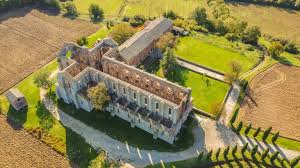
 There are places in Tuscany that belong to the familiar postcard: the cypress-lined driveway, the hilltop town, the vineyard stretching toward a medieval tower. And then there is San Galgano. This is a place that belongs to a different register entirely, one of silence, mystery, and a beauty so stark it feels almost confrontational. A massive Gothic abbey without a roof, its nave open to the sky, stands in quiet solitude among the woods and wheat fields of the Colline Metallifere. And on a hill just above it, inside a small circular chapel, a sword remains embedded in solid rock where a knight drove it more than eight centuries ago, not to claim a throne, but to renounce one. This is the real story behind the Sword in the Stone, and it is far stranger and more moving than any legend ever told.
Why San Galgano Is Unlike Any Other Place in Tuscany
The valley of the river Merse, about thirty kilometres southwest of Siena, is not the Tuscany of the glossy magazines. There are no crowds here, no souvenir stalls, no queues. The landscape is wilder, older, more reticent. The Colline Metallifere, or Metal-Bearing Hills, were once mined for copper, silver, and iron, but they have now returned to forest and pasture. And in this valley, almost hidden from view until you are nearly upon it, rises the ghost of an architectural ambition so audacious that it still takes your breath away, even in ruins.
San Galgano is actually two sacred sites in one. On the hilltop stands the Rotonda di Montesiepi, a small circular chapel built in 1185 to mark the hermitage and tomb of a man who chose holiness over violence. In the valley below sprawls the immense skeleton of what was meant to be one of the most magnificent Cistercian abbeys in Italy, begun around 1220, consecrated in 1288, and now reduced to soaring walls, pointed arches, and a vault that exists only in the imagination. The contrast between the two, the intimate, mysterious rotunda and the vast, sky-roofed abbey, is part of what makes this place so unforgettable.
Pro tip: Visit in the late afternoon, when the sun is low in the west. The light streams through the abbey's lancet windows at an angle that transforms the interior into a cathedral of shadows and gold. Photographers should arrive at least an hour before sunset. The abbey is open daily from 9:00 AM to 6:45 PM.
The True Story of the Knight Who Abandoned His Sword
His name was Galgano Guidotti, and he was born in 1148 in the small town of Chiusdino, the son of a feudal lord. In his youth, he was everything a knight was supposed to be: proud, skilled with a blade, fond of fine clothes and good company. His biographers do not mince words. They describe his early life as "disorderly" and "dissolute," the behaviour of a young nobleman who took what he wanted and answered to no one.
But something changed in him. According to the legend preserved in the canonisation records, and Galgano's was the first formal canonisation process conducted by the Roman Church, completed in 1185 just four years after his death, the Archangel Michael appeared to him in two visions. The first vision showed him a path to salvation. The second, more insistent, seemed to break something open inside the proud knight. He resolved to renounce his former life and withdraw from the world entirely.
His family was horrified. His mother begged him to reconsider. His friends mocked him. But Galgano was unmoved. On Christmas Day of the year 1180, he climbed the hill of Montesiepi, overlooking the valley where he had spent his wild youth. According to the most enduring version of the story, an angel appeared to him and urged him to repent. Galgano protested that such a conversion was as impossible as splitting solid rock with a sword. To prove his point, or perhaps to test himself, he drew his blade and drove it with all his strength into the stone at his feet.
The sword did not break. It did not shatter. It slid into the living rock as if the stone were butter and remained there, the hilt forming a cross, the blade held fast by some force the knight could never have anticipated. Galgano fell to his knees. He never left that hill again.
For the remaining months of his life, Galgano lived as a hermit in a simple shelter near the rock where his sword stood. He befriended the wild animals of the forest, prayed, and performed penance with the same intensity he had once devoted to pleasure. He died in 1181 at the age of just thirty-three. Pilgrims began to visit almost immediately, and miracles were reported at his tomb. In 1185, Pope Lucius III declared Galgano Guidotti a saint, one of the fastest canonisations in the history of the Church.
The Rotonda di Montesiepi and the Sword in the Stone
Within a few years of Galgano's death, a chapel was built above his tomb on the summit of Montesiepi. The structure, known as the Rotonda, is an architectural curiosity: a circular Romanesque chapel with a conical roof, resembling the ancient mausoleums of the Roman Empire more than any traditional church. It is small, intimate, and deliberately mysterious. The walls are thick, the windows few, and the interior is dim even on the sunniest days, as if the builders intended to preserve a sense of sacred enclosure separate from the bright Tuscan countryside outside.
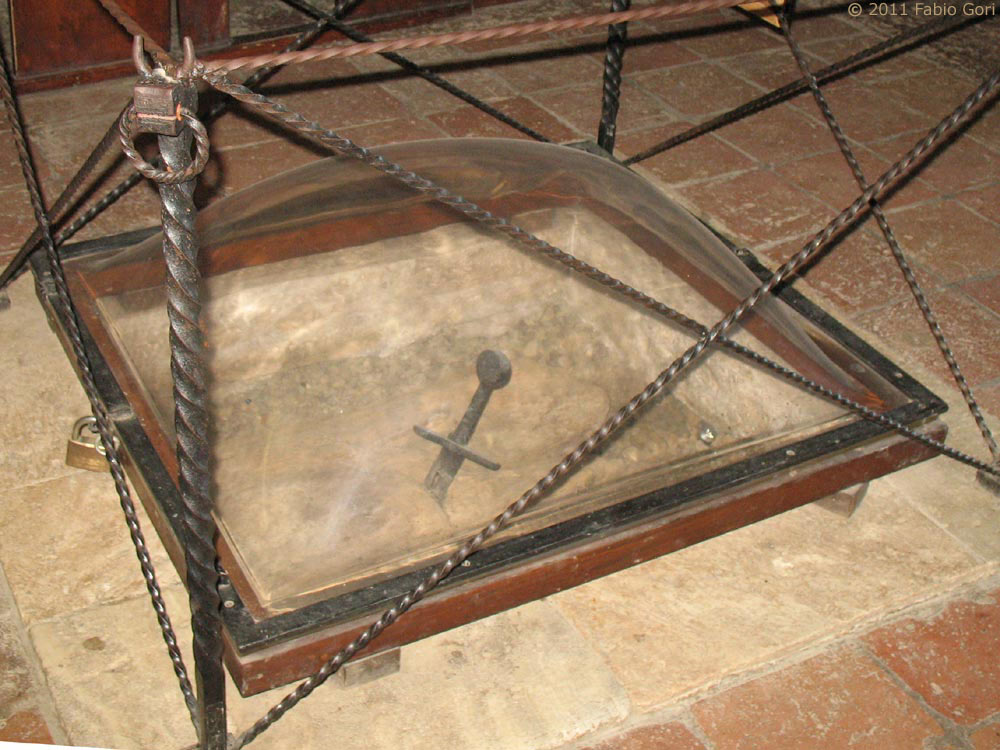
And there, in the centre of the chapel, beneath the conical vault, you will see it: a weathered stone block, and protruding from its upper surface, a sword hilt and the first few centimetres of a blade. The metal is dark with age and rust. The hilt is simple and functional, the tool of a warrior, not an ornament. The sword is enclosed in a modern plexiglass case to protect it from the thousands of hands that once reached out to touch it, and from the humidity and dust that would accelerate its decay. But even behind the glass, even after nearly 850 years, the sword in the stone of Montesiepi exerts a strange and undeniable power over those who stand before it.
Is it authentic? For centuries, sceptics claimed it was a medieval forgery, perhaps a cleverly inserted metal rod, perhaps a later addition to attract pilgrims. But in 2001, a team led by Luigi Garlaschelli, a chemist and researcher at the University of Pavia, subjected the sword to scientific analysis. The results were remarkable. The composition of the metal and the style of the hilt were fully compatible with the late 12th century, the precise era of Galgano Guidotti's life. Moreover, the analysis confirmed that the visible upper portion and the invisible lower section, still embedded in the rock, belong to a single, authentic artifact. The sword in the stone at Montesiepi is not a legend. It is real.
The Roofless Gothic Abbey: Architecture and Atmosphere
After Galgano's death and canonisation, the Cistercian order, the austere reform movement of Benedictine monasticism, took charge of the site. The order's rules were strict: abbeys were to be built in humble locations, far from cities, near running water, on land that could be reclaimed for agriculture. The valley of the Merse met all these conditions. Construction of the great abbey church began around 1220 and continued for nearly seven decades.
The result, completed in 1288, was the first fully Gothic building in Tuscany, a statement of ambition and faith that must have astonished the local population. The church followed the classic Cistercian plan: a Latin cross, three naves, a transept, and an apse oriented toward the east. The architects, including a master known as Donnus Johannes who had previously worked at the Abbey of Casamari in Lazio, brought the new Gothic language of pointed arches and ribbed vaults to a region still dominated by Romanesque traditions.
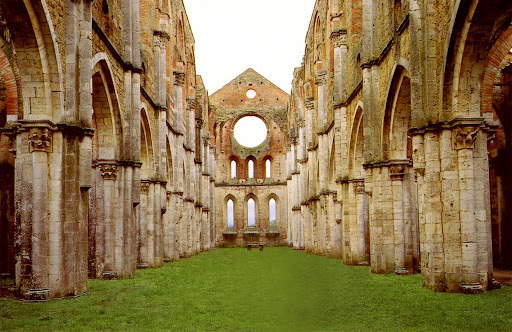
Today, the abbey is a ruin, one of the most evocative in all of Italy. The roof disappeared in 1786 when lightning struck the bell tower, causing it to collapse and take the vaults with it. Five years later, in 1791, a second lightning strike finished what the first had begun. In 1789, the church was deconsecrated. For much of the 19th century, the magnificent space was used as a stable, a strange and melancholy fate for a building intended to echo the glories of Citeaux and Clairvaux.
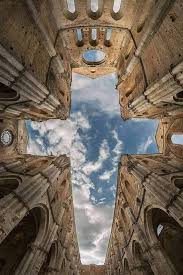
But there is a strange beauty in the ruin that no intact church could ever possess. The lack of a roof reveals the architectural skeleton of the building with a clarity that is almost educational. You can see how the pointed arches channel weight downward, how the flying buttresses, though here less dramatic than at Chartres, stabilise the tall walls, and how the apse with its three tiers of lancet windows was designed to flood the altar with morning light. And above everything, the great rose window of the facade still stands, framing fragments of sky and cloud like a living painting that changes with every passing hour.
On screen: You may recognise the abbey from the cinema. Anthony Minghella filmed key scenes of his Oscar-winning masterpiece The English Patient (1996) among these ruins. More recently, the abbey appeared in Checco Zalone's Sole a catinelle (2013). The location has also been explored in television documentaries, including the History Channel's Ancient X-Files, which examined the connections between San Galgano, Excalibur, and the Arthurian legends.
The Connection to King Arthur and Excalibur
No discussion of San Galgano can avoid the obvious question: is this the original Sword in the Stone? Did the legend of King Arthur draw inspiration from a real event that took place in the Tuscan hills?
The parallels are certainly striking. In the Arthurian legends, Excalibur, or in some versions the Sword in the Stone that proves Arthur's right to rule, is embedded in an anvil atop a stone, and only the true king can withdraw it. At Montesiepi, a sword is embedded directly in stone, and it was placed there deliberately by its owner as an act of renunciation, not a test of kingship. The gesture is almost the mirror image of the Arthurian story. One man inserts the sword to claim a throne; another inserts it to abandon the world.
But there may be a deeper connection. Some scholars have noted the similarity between the name "Galgano" and "Gawain", the nephew of King Arthur and one of the most prominent knights of the Round Table. The French poet Chrétien de Troyes, who wrote the first surviving Arthurian romances, including Perceval, the Story of the Grail, was active in the late 12th century, exactly the period of Galgano's life and legend. It is not impossible that Chrétien or his sources heard stories of the Tuscan knight who drove his sword into stone and adapted the image for a very different purpose. Some historians have even speculated that Saint Galgano might have served as a direct model for Gawain.
We will never know for certain. But standing in the Rotonda, looking at that ancient sword, you do not need scholarly certainty to feel the resonance. The Arthurian legends are stories about power, destiny, and the right to rule. The story of San Galgano is a story about something else entirely: the rejection of power, the refusal of violence, and the acceptance of a different kind of destiny. It is, in its quiet way, a far more radical tale.
Ambrogio Lorenzetti's Frescoes and Artistic Treasures
The Rotonda di Montesiepi contains not only the sword but also one of the most remarkable fresco cycles of the 14th century. The artist was Ambrogio Lorenzetti, one of the giants of the Sienese school, a contemporary of Simone Martini and his brother Pietro Lorenzetti. Ambrogio is best known for his monumental Allegory of Good and Bad Government in Siena's Palazzo Pubblico, one of the first secular narrative cycles in Western art. But his frescoes at Montesiepi, painted around 1335, are something different: intimate, devotional, and suffused with the same luminous colour that distinguishes his Sienese masterpieces.
The surviving frescoes include a Madonna and Child with Saints, scenes from the life of San Galgano, and a remarkable Last Supper painted in the apse of the rotunda. The colours, the deep blues, the warm pinks, the gold leaf that once flickered in candlelight, are still vivid despite centuries of exposure. The faces of the saints and the Madonna express a tenderness that feels genuinely moving, not merely conventional. These are not images of distant, unapproachable holiness. They are images of recognition: a humanity transfigured but still recognisably human.
Lorenzetti did not live long after completing these frescoes. He and his brother Pietro are believed to have died in the great plague of 1348 that devastated Siena. The fact that his work survives at all in this remote chapel is something of a miracle, and a reminder of how much the art of the 14th century has been lost. Take your time here. The rotunda is small, but the frescoes reward patient looking.
Practical Tips for Visiting San Galgano Abbey
Best time to visit: The abbey is magnificent at any time of year, but autumn offers the most dramatic light and the quietest experience. October and November bring golden light, cool temperatures perfect for walking, and the vineyards of nearby Montalcino at their most beautiful. Spring, from April to June, is also lovely, with wildflowers in the meadows around the abbey. Avoid July and August if possible. The heat can be intense, and the site is at its busiest, though it never approaches the crowds of Florence or Siena.
Common tourist mistakes: The most common mistake is underestimating how much time you will want to spend here. Many visitors allocate an hour and find themselves staying for three. Do not rush. The abbey and rotunda deserve a slow visit. A second mistake is skipping the walk from the abbey up to the rotunda. It is a gentle climb of about ten minutes through woods and open fields, and the views back down to the abbey are among the best photographs you will take. A third mistake is wearing inappropriate footwear. The ground within the abbey is uneven grass and gravel; the path to the rotunda is dirt and stone. Wear sturdy walking shoes.
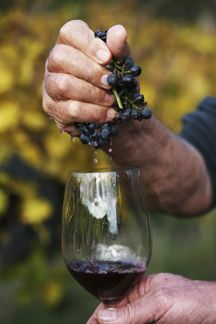
Food tips: There is a small bar and restaurant near the abbey car park, but the food is basic and aimed at tour groups. For a proper meal, drive to the nearby town of Monticiano, about ten minutes away, or continue to Montalcino, about thirty minutes away, where you will find exceptional Tuscan cooking. In Montalcino, look for pici cacio e pepe, thick hand-rolled pasta with cheese and pepper, and cinghiale in umido, wild boar stew. These are perfect autumn dishes. And of course, do not leave the area without tasting Brunello di Montalcino, one of Italy's greatest red wines.
Tips for avoiding queues: Unlike Florence's Duomo or the Uffizi, San Galgano rarely has significant queues. The site is still relatively undiscovered by mass tourism. However, the rotunda can become crowded on weekends in spring and autumn, especially between 11:00 AM and 2:00 PM. Arrive either at opening time, 9:00 AM, or after 3:00 PM for the quietest experience. Sunset visits, the abbey closes at 6:45 PM, are particularly magical and far less crowded.
Getting there: The abbey is located at Strada Comunale di San Galgano, 53012 Chiusdino SI. The most comfortable option is a private transfer from Rome, approximately 2.5 hours, or from Florence, approximately 1.5 hours. If you are driving, the abbey has a large free car park. From Siena, take the SS73 towards Grosseto and follow signs to Chiusdino and then San Galgano. Public bus service from Siena is limited. There are a few direct buses per day, but service is reduced on Sundays. A taxi from Siena costs approximately €50 to €70 each way.
What to bring: A camera with a wide-angle lens is essential, as the scale of the abbey is difficult to capture without one. Binoculars will allow you to see the details of the capitals and the remains of the frescoes in the abbey. Bring water, especially in summer, as there is no drinking fountain inside the abbey grounds. Bring cash for the small ticket office and any purchases from the bar; cards are accepted, but the system is not always reliable.
Comments
No comments yet. Be the first to share your thoughts!
Leave a Comment
Your comment will appear after moderation.