 Michelle
 There is a moment, standing at the edge of an Etruscan necropolis in the Tuscan hills at dusk, when the extraordinary persistence of this civilisation becomes suddenly and viscerally real. The tombs are here. The walls of the cities are here. The bronzes and urns and painted chambers are here. The people who made them have been gone for more than two thousand years, absorbed into the Roman world that succeeded and largely erased them. And yet they are not gone at all. The Etruscans are the deepest root of Italian culture, the layer beneath the Roman layer, the civilisation that taught Rome its alphabet, its religious rites, its architectural ambitions and much of its art. To travel through Etruscan Tuscany is to encounter something that most visitors to Italy never find: the world before Rome.
When Is the Best Time to Explore Etruscan Tuscany?
Tuscany is magnificent in every season, but for a journey focused on archaeology and ancient history, the timing of your visit matters more than most guides acknowledge. The Etruscan sites of Tuscany fall into two broad categories: the great museums of the cities, which are accessible and rewarding year-round, and the outdoor necropolises, rock-cut tomb complexes and ruined city walls, which are best explored in comfortable weather with good light.
The ideal windows are late April through June and September through October. In spring, the Tuscan countryside that surrounds so many of the archaeological sites is at its most vivid: the rolling hills are intensely green, the wild flowers are out, and the combination of ancient stone and living landscape creates an atmosphere of extraordinary beauty. Autumn brings a softer, golden light that is perhaps even more atmospheric for photography, and the tourist crowds of summer have departed. The outdoor necropolises at Populonia, Vetulonia and Sovana are at their most accessible and most evocative in these shoulder seasons.
Summer, particularly July and August, is not recommended for outdoor archaeological exploration. Temperatures regularly exceed 35 degrees Celsius in the Maremma and the Metalliferous Hills, and the exposed rock-cut sites offer little shade. The museums of Volterra, Arezzo and Florence are excellent options for summer visits, but plan outdoor site visits for early morning.
Visitor tip: Many of the smaller Etruscan sites in Tuscany have limited opening hours and require advance booking, particularly for guided tours of closed tomb chambers. Always check current opening times on the official museum or site websites before travelling, especially for sites in the Maremma and the Colline Metallifere. A dedicated guide is strongly recommended at sites such as Populonia and Vetulonia, where the full significance of what you are seeing becomes apparent only with expert explanation.
1. Who Were the Etruscans? A Civilisation Unlike Any Other
The ancient Greek historian Dionysius of Halicarnassus, writing in Rome in the first century BC, made one of the most celebrated observations in all of ancient historiography: the Etruscans, he wrote, were unlike any other people. Their language was their own. Their customs were their own. Their art bore no clear relationship to that of their neighbours. They had, in his assessment, arrived in Italy from nowhere identifiable and become themselves with a completeness that defied the usual processes of cultural derivation. He was, modern archaeology has confirmed, largely right.
The term Etrusci (from which we derive Etruscans) was the Latin name for the people who called themselves Rasenna in their own tongue, and Tyrsenoi or Tyrrhenos in Greek, giving their name to the Tyrrhenian Sea that washes the western coast of Italy. They first appear in the historical and archaeological record in the ninth century BC, emerging from the Villanovan culture of central Italy with an increasing sophistication in metalwork, urban organisation and social complexity that, by the seventh century BC, had produced some of the most refined art and architecture anywhere in the ancient Mediterranean world.
At the peak of their power, between approximately 700 and 500 BC, Etruscan civilisation controlled a vast territory. To the north, Etruscan settlements extended into the Po Valley and the foothills of the Alps, founding cities including Felsina (modern Bologna), Marzabotto and Spina. To the south, Etruscan influence reached deep into Lazio and Campania, where the cities of Capua and Nola were Etruscan foundations. At sea, the Etruscans were a dominant maritime force, trading extensively with the Greek colonies of southern Italy and Sicily, with Carthage, with the Phoenicians and with the civilisations of the eastern Mediterranean.
Their legacy to Rome was incalculable. The Romans absorbed the Etruscan alphabet (itself derived from the Greek alphabet but adapted with the modifications that became Latin script), the Etruscan system of augury and divination, the fasces as a symbol of civic authority, the triumphal procession, the gladiatorial combat, the engineering tradition of the arch and the vault, and entire bodies of religious and ceremonial practice. Rome did not simply conquer the Etruscans: Rome was in many fundamental ways the continuation of Etruscan civilisation under a different name.
Fascinating historical note: Three of the seven kings of early Rome, according to Roman tradition, were Etruscans. Tarquinius Priscus (616 to 579 BC), Servius Tullius (578 to 535 BC) and Tarquinius Superbus (535 to 509 BC) ruled Rome during the period of its greatest early development, building the Circus Maximus, draining the Forum, constructing the first temple on the Capitoline Hill and creating the infrastructure of what would become the dominant civilisation of the ancient world. Rome, in its formative period, was effectively an Etruscan city.
2. The Etruscan League: Twelve Cities, One Identity
Etruria was never a unified state. Unlike the contemporary Persian Empire or the later Roman Republic, there was no Etruscan king who ruled a single territory, no single law code that applied across the whole of Etruscan land, no standing army that fought for a unified Etruscan nation. Each Etruscan city, the lucumonie, was a fully autonomous political entity governed by its own institutions and accountable ultimately to its own population and its own aristocracy.
What held these independent cities together was not political union but cultural and religious community. The most important institution of Etruscan collective identity was the Etruscan League, a confederation of twelve major cities that met annually at a sacred site known as the Fanum Voltumnae, the Shrine of Voltumna, the supreme deity of the Etruscan religious world. At these annual gatherings, the representatives of the twelve cities conducted religious ceremonies, conducted business, resolved disputes and renewed the bonds of shared identity that made them Etruscan rather than merely Veientan or Tarquinian.
The twelve cities of the league are known to us primarily through later Roman sources and are generally identified as: Veio, Cerveteri, Tarquinia, Vulci, Orvieto (Velzna), Chiusi (Clevsin), Vetulonia, Volterra (Velathri), Perugia (Perusia), Cortona, Arezzo (Arretium) and Fiesole (Faesulae). The list varies slightly between ancient sources, and the identity and location of some member cities remains debated among modern scholars. What is consistent is the sacred number twelve, which had deep religious significance in Etruscan cosmology.
The location of the Fanum Voltumnae itself has never been conclusively identified, despite centuries of scholarly interest and numerous archaeological campaigns. The most widely accepted hypothesis places it in the territory of Volsinii, near modern Orvieto or Bolsena, but no site has yet produced the kind of definitive archaeological evidence that would settle the question. It remains one of the most tantalising unsolved mysteries of Italian archaeology.
3. Language, Religion and the Art of the Afterlife
The Etruscan language is one of the most debated subjects in all of classical scholarship, and the difficulty of understanding it has contributed enormously to the air of mystery that still surrounds this civilisation. Etruscan is not an Indo-European language, which means it is fundamentally unrelated to Latin, Greek, Celtic, Germanic, Sanskrit and all the other language families that dominate the ancient and modern world. It stands apart, a linguistic isolate in the ancient Mediterranean, with no confirmed relatives anywhere.
We can read Etruscan in the sense that we can reproduce its sounds: the alphabet, adapted from the Greek, is well understood, and we know how the letters correspond to sounds. But understanding Etruscan is another matter. The total corpus of Etruscan texts runs to approximately 13,000 inscriptions, but the vast majority are very short, formulaic funerary texts giving little more than a name, a lineage and an age. The longest surviving Etruscan text, the Liber Linteus Zagrabiensis (the Zagreb Mummy Wrappings, linen strips used to wrap an Egyptian mummy that were somehow acquired by the Etruscans and inscribed with a religious calendar), contains approximately 1,200 words but has never been fully translated. Scholars can identify certain recurring phrases and words, but the full meaning of much Etruscan writing remains inaccessible.
Etruscan religion was a complex and highly systematised affair, governed by a sacred body of texts known as the Disciplina Etrusca, the Etruscan Discipline. This was a collection of doctrines attributed to divine or semi-divine revelation that prescribed in meticulous detail the correct methods of divination, the proper interpretation of lightning bolts and other celestial phenomena, the reading of animal entrails, the organisation of sacred space and the ritual requirements of city-founding. The Romans adopted much of this system wholesale, and Etruscan haruspices (diviners who read the livers of sacrificed animals) remained important figures in Roman religious life long after the Etruscan cities had lost their political independence.
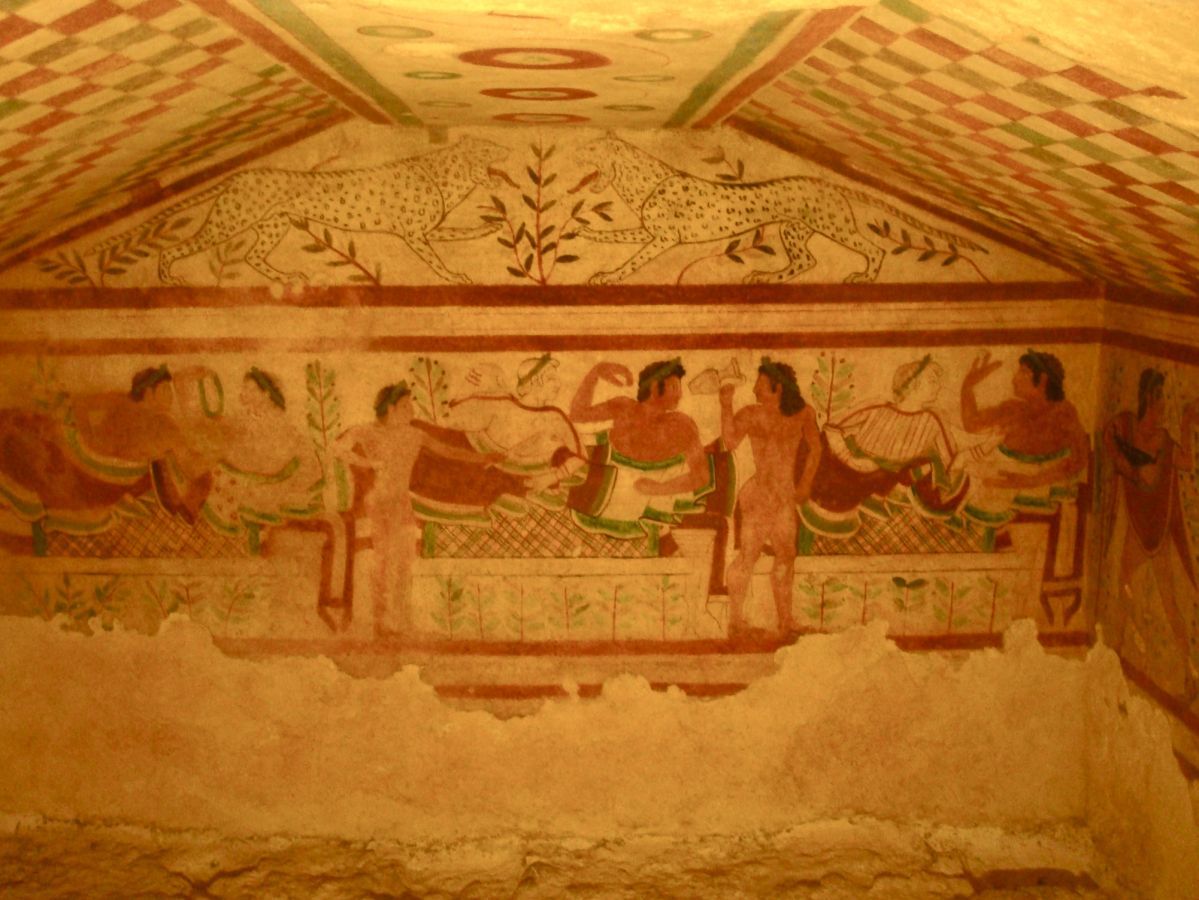
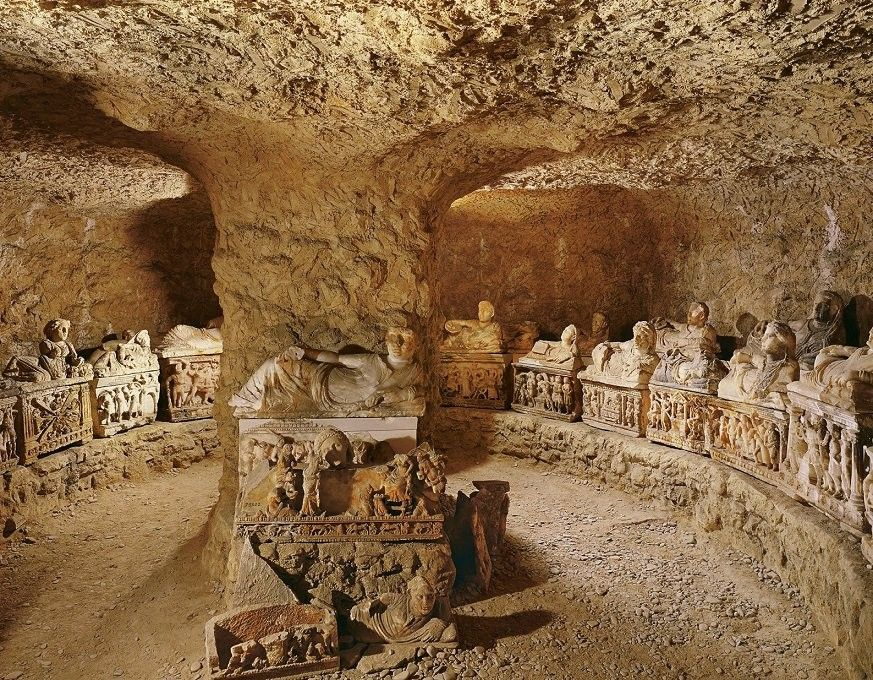
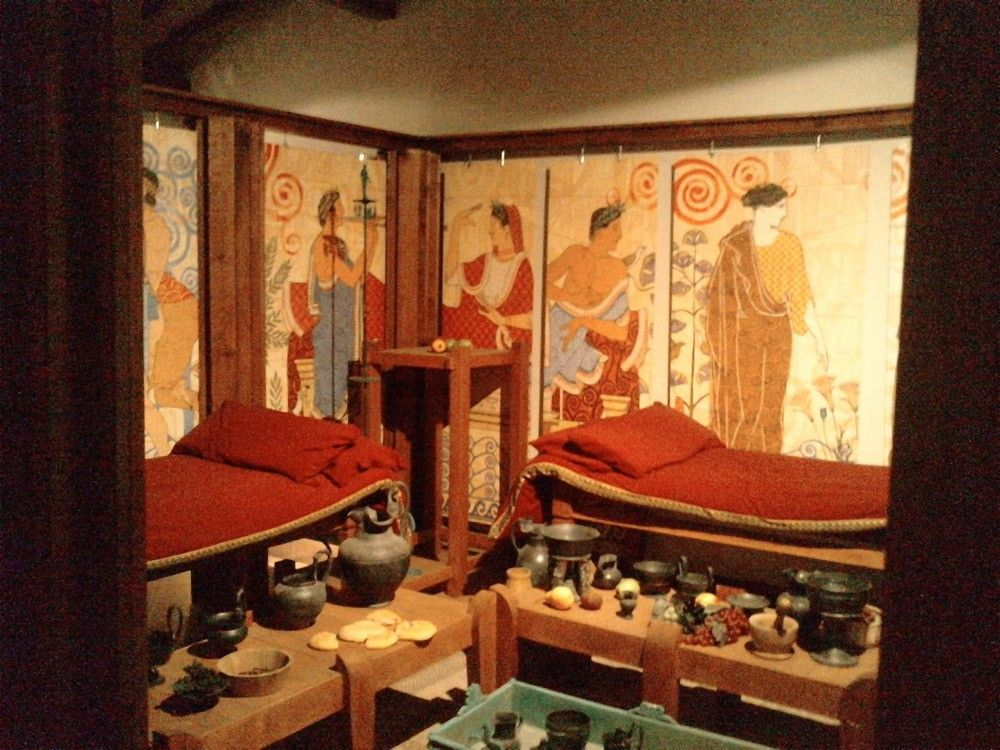
The Etruscan attitude to death and the afterlife is the subject most fully documented in the archaeological record, for the simple reason that the Etruscans built their tombs to last. Etruscan necropolises are cities of the dead that mirror the cities of the living in their organisation, their architectural sophistication and their contents. The great tombs of the aristocracy were furnished with extraordinary quantities of fine goods: imported Greek painted pottery, Etruscan bronzework of the highest quality, gold and silver jewellery, carved ivory, amber from the Baltic, glass from Egypt and Syria. The painted tombs of Tarquinia (the finest concentration of Etruscan wall painting anywhere, now a UNESCO World Heritage Site) show us the banquets, athletic contests, hunting scenes and musical performances that the Etruscans considered the proper activities of a happy afterlife.
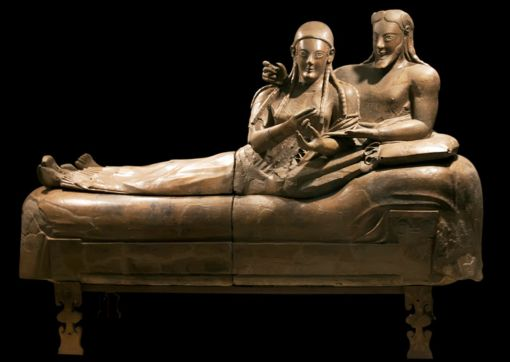
Art note: The Etruscan artistic tradition is remarkable for its vitality and humanity. Unlike the formal, hierarchical conventions of Egyptian or Assyrian art, Etruscan art is characterised by movement, expression and an evident delight in the physical world. The famous Sarcophagus of the Spouses from Cerveteri (now in the Villa Giulia Museum in Rome), showing a husband and wife reclining together on a banquet couch with expressions of animated conversation, is one of the most moving and humanly immediate works of sculpture from the entire ancient world.
4. Volterra: The Finest Etruscan Museum in Italy
Of all the Etruscan cities of Tuscany, Volterra makes the strongest and most immediately accessible case for the extraordinary refinement of this civilisation. The town itself is one of the most dramatically situated in all of Italy: a walled medieval city perched on a high ridge of volcanic tufa at 531 metres above sea level, its walls dropping sheer into the deeply eroded valleys below on every side. The Etruscan walls that preceded and in many places underlie the medieval fortifications date from the fourth and third centuries BC and are among the best-preserved examples of Etruscan urban fortification anywhere in the ancient world.
The centrepiece of any visit to Volterra is the Museo Etrusco Guarnacci, one of the oldest civic museums in Europe, founded in 1761 and housing one of the most important collections of Etruscan artefacts in existence. The collection contains over 600 funerary urns in alabaster, terracotta and stone, spanning several centuries of Etruscan mortuary art and providing an unparalleled document of the development of Etruscan iconography and belief.
Among the collection's most celebrated objects are the Urna degli Sposi (the Urn of the Married Couple), a terracotta funerary urn whose lid is decorated with a remarkably tender depiction of an elderly couple embracing; and the extraordinary bronze statuette known as the Ombra della Sera (Shadow of the Evening), a tall, impossibly elongated male figure of the third century BC whose modern appearance caused Gabriele D'Annunzio, seeing it for the first time in the early twentieth century, to give it its poetic name. The figure, with its stretched limbs and simplified facial features, looks for all the world like an anticipation of Giacometti's twentieth-century bronzes, and stands as remarkable evidence of the sculptural experimentation and formal boldness of Etruscan artists.
Beyond the museum, Volterra repays careful exploration on foot. The Arco Etrusco (Etruscan Arch), at the southern edge of the old town, is one of the finest surviving examples of Etruscan monumental architecture: a great gateway with three sculpted heads on its archivolt, worn by two millennia of wind and rain to the point where their features are barely distinguishable, but retaining a presence and authority that is deeply impressive. The necropolis areas surrounding the town, the Portone and Badia necropolises, are partially accessible and give a sense of the enormous scale of the ancient Etruscan city that once surrounded the hilltop.
Best time to visit Volterra: Arrive in the morning when the Guarnacci Museum opens at 9 am, and allow a minimum of two hours. The museum is not large but the density and quality of the collection rewards slow looking. Then spend the afternoon walking the Etruscan walls and exploring the old town. If you visit in August, Volterra hosts the Volterra AD 1398 medieval festival, which transforms the town into a living tableau of the Middle Ages and creates an atmosphere unlike anything else in Tuscany.
5. Populonia and the Metalliferous Coast: Iron, Power and the Sea
Populonia occupies a unique position in the catalogue of Etruscan cities: it is the only major Etruscan urban centre built directly on the sea. All other Etruscan cities sit inland, on defensible hilltops or commanding ridges above their ports, which functioned as separate entities. Populonia chose the headland itself, the promontory of Piombino that juts into the Tyrrhenian Sea opposite the island of Elba, and built its city where the sea was visible from every corner.
The reason was iron. The island of Elba, visible from the Populonia promontory on any clear day, contained the richest iron ore deposits in the ancient Mediterranean world. From as early as the seventh century BC, Populonia was the smelting centre for this ore, producing iron and bronze objects of extraordinary quality that were traded across the entire ancient world. The slag heaps from Populonian iron production were so enormous that they were still being profitably re-smelted by modern industrial operations in the twentieth century. Traces of the smelting activity can still be seen in the landscape around the modern town of Piombino.
The Populonia necropolis is one of the most extensive and varied Etruscan burial complexes in Italy. The cemetery contains examples of virtually every type of Etruscan burial practice, from the earliest cremation urns of the Villanovan period (ninth to eighth century BC) through the great tumuli (monumental circular mound tombs) of the aristocratic period to the later rock-cut chamber tombs of the Hellenistic era. The most impressive structures are the tumulus tombs, which survive to heights of up to twelve metres and represent the burial monuments of the most powerful families of Populonian society. Inside, the corridor-like entrance passages (called dromos) lead to circular burial chambers that were originally furnished with the finest goods the city's wealth could provide.
The Acropolis of Populonia, occupying the highest point of the promontory, contains the ruins of temples and public buildings of the fourth and third centuries BC and offers views over the Tuscan Archipelago, with Elba, Giglio and Capraia visible on clear days, that are among the most beautiful in coastal Tuscany. The Museo Archaeologico del Territorio di Populonia in the castle at the top of the old village provides excellent context for the site, with well-presented finds from the necropolis and the acropolis.
6. The Maremma: Sovana, Pitigliano and the Via Cave
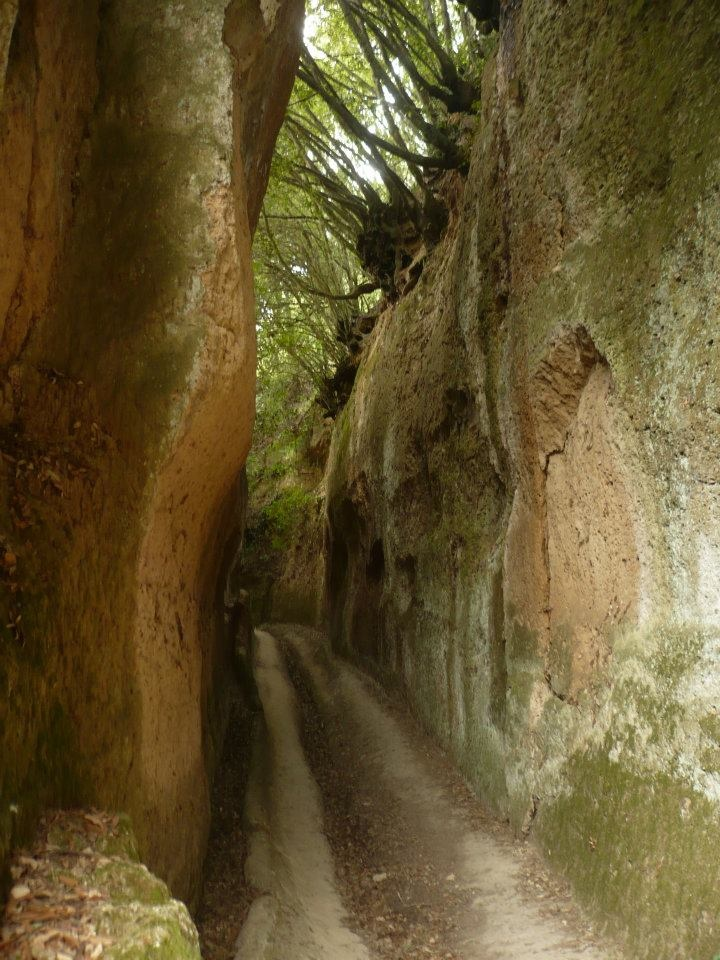
The southern part of Tuscany, the Maremma Grossetana and the Colline di Pitigliano, is the area of the region richest in Etruscan landscape. Here, the soft volcanic rock known as tufa that underlies much of this territory allowed the Etruscans to create something entirely unique in the ancient world: the vie cave (singular: via cava), deeply sunken roads cut directly into the living rock, sometimes to depths of twenty metres or more, connecting settlements, necropolises and agricultural areas across the landscape in a network that still functions today and still awes those who walk through it.
The via cava is one of the most extraordinary physical presences in all of Italian antiquity. Walking through one, the walls rising sheer on either side to heights that block all sky, the rock covered in moss and fern, the light reduced to a green twilight, the silence absolute, is an experience that produces a genuine awareness of the depth of human time in this landscape. These roads were cut, stone by stone, by Etruscan workers who had no iron tools and no explosives: only bronze chisels, wooden mallets, physical endurance and an organisational capacity of remarkable sophistication. They served multiple purposes: practical routes between settlements, ceremonial processional ways to the necropolises, defensive barriers and possibly drainage channels in a landscape prone to flooding.
The town of Sovana, one of the most beautifully preserved medieval villages in Tuscany, sits at the centre of the richest concentration of Etruscan rock-cut tombs in the region. The surrounding countryside is riddled with tombs of extraordinary variety and ambition: the Tomba Ildebranda, a monumental temple-fronted tomb of the third century BC that represents one of the most architecturally sophisticated Etruscan funerary monuments anywhere, is an experience that produces genuine astonishment. Its columned facade, carved from the living rock with a precision and scale that rivals contemporary Hellenistic architecture, demonstrates the degree to which Etruscan funerary culture had absorbed and transformed Greek architectural vocabulary.
Nearby Pitigliano, the spectacular tufa-perched town known as Little Jerusalem for its historic Jewish community, is surrounded by vie cave and tomb complexes that have been partially restored and opened to visitors as the Parco Archeologico Città del Tufo. This is the finest organised Etruscan archaeological park in Tuscany, combining well-marked walking routes through the vie cave with access to numerous tomb chambers and excellent interpretive signage. Allow a minimum of three hours, wear comfortable shoes with grip, and bring a torch even if the park provides lighting: the deeper sections of the vie cave are dramatically atmospheric in partial darkness.
Tips for the via cave: The via cave are at their most atmospheric in spring and autumn, when the vegetation on the walls is at its most vivid and the light filtering through the canopy above creates extraordinary photographic conditions. In wet weather they can be slippery: waterproof footwear with a good sole is essential. The best time of day is morning, before tour groups arrive. If you visit Sovana and Pitigliano, combine the two in a single day: they are only 12 kilometres apart and the landscape between them is extraordinarily beautiful.
7. Arezzo, Cortona, Fiesole and Chianciano Terme
The northern and eastern arc of Etruscan Tuscany, centred on the cities of the inland plain and the hills above the Arno and Tiber valleys, contains some of the most important individual objects and sites of Etruscan civilisation, even if the landscape is less dramatically archaeological than the Maremma.
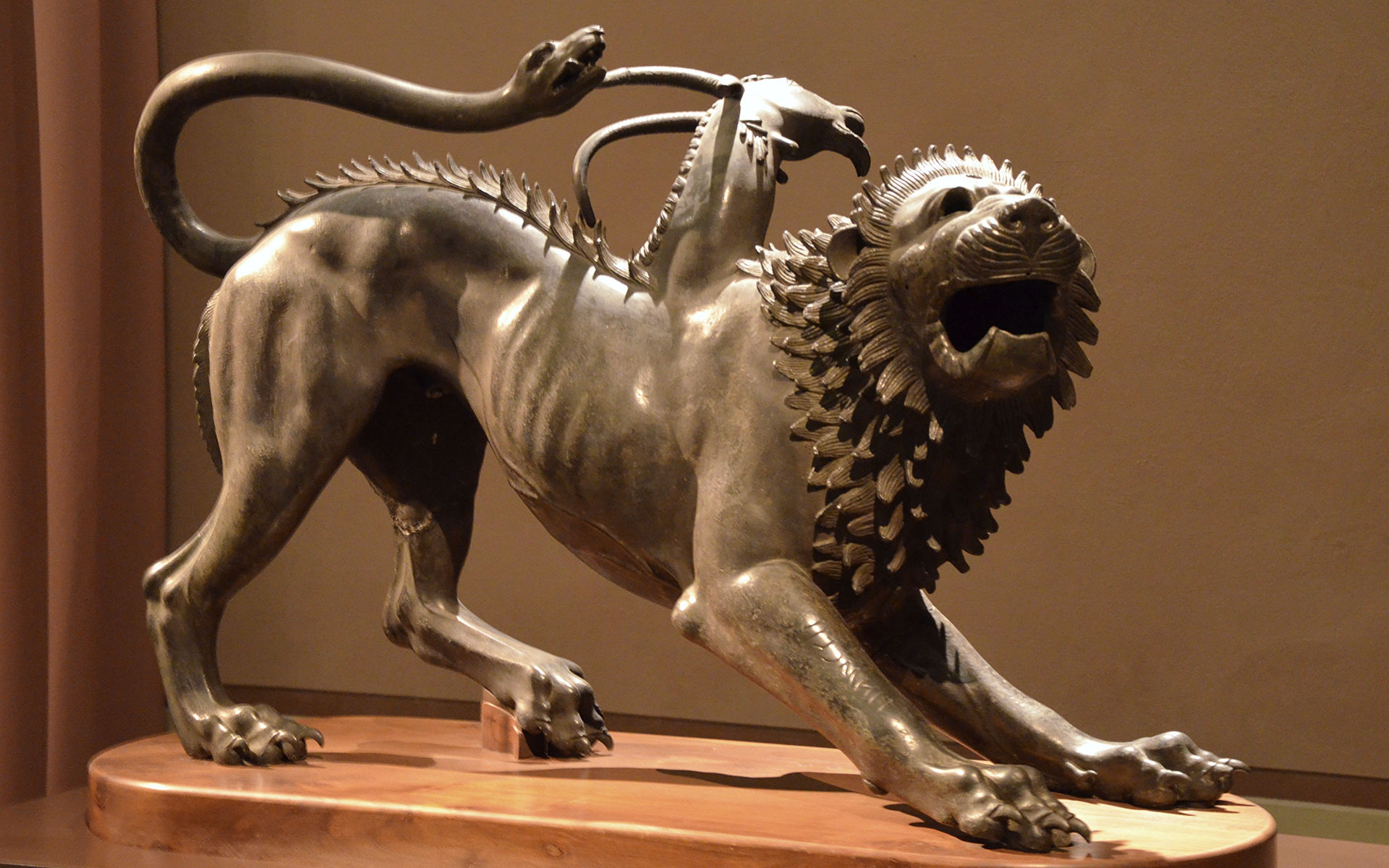
Arezzo is home to one of the most famous objects in all of ancient art: the Chimera di Arezzo, a bronze sculpture of the fifth century BC depicting the mythological fire-breathing monster of lion, goat and serpent that represents the absolute pinnacle of Etruscan metalwork. The Chimera, discovered in a field near Arezzo in 1553 and immediately recognised as a masterpiece by Cosimo I de' Medici, who had it placed in his personal collection, is now housed in the National Archaeological Museum in Florence (the Museo Nazionale Archeologico), where it occupies its own gallery and draws visitors from across the world. The combination of anatomical accuracy, dynamic movement and the extraordinary technical achievement of the casting makes it one of the most astonishing works of ancient sculpture anywhere, and a journey to Florence specifically to see it is entirely justified.
Cortona, the hilltop city above the Val di Chiana that has become one of the most visited small towns in Tuscany (partly through the fame of Frances Mayes' memoir Under the Tuscan Sun), was an important Etruscan city and retains substantial sections of its massive Etruscan walls, far larger than the medieval city that succeeded it. The Museo dell'Accademia Etrusca e della Città di Cortona (MAEC) contains an exceptional collection, most notably the famous Lampadario di Cortona, a large bronze chandelier of the fifth century BC decorated with sixteen masks alternating between male and female faces, Gorgon heads and figures of deities, that is one of the finest and most complex examples of Etruscan bronze casting in existence.
Fiesole, the small hilltop town above Florence that predates the Arno city by many centuries, offers some of the most easily accessible Etruscan remains in the region. The Area Archaeologica di Fiesole contains well-preserved sections of Etruscan city wall dating from the fourth century BC, along with the remains of a Roman theatre, Roman baths and Etruscan and Roman temples, all within a single excavated area that can be visited in a morning. The views from the terrace over Florence and the Arno valley, framed by cypress trees, are among the finest in the region.
Chianciano Terme, in the Siena province, is the site of one of the most important Etruscan religious sanctuaries in Tuscany: the Tempio di Fucoli, a healing sanctuary associated with a sacred spring that attracted worshippers from across the Etruscan world. The Museo Civico Archeologico delle Acque in the town contains an outstanding collection of finds from the sanctuary and the surrounding necropolises, including some of the finest painted Etruscan funerary urns and the remarkable series of canopic jars (funerary vessels shaped as human heads) that are among the most haunting objects in all of Etruscan art.
The areas of Vetulonia and Roselle in the Grosseto plain, the Poggio Buco necropolis near Pitigliano, and the remains of Marsili and Saturnia complete the extraordinary catalogue of Etruscan presence in southern Tuscany. The thermal springs of Saturnia, still flowing with the same sulphurous waters that the Etruscans considered sacred and restorative, are a remarkable living connection to the ancient world and can be visited today in the natural cascade pools that form below the main spa complex.
The Etruscans were not simply a prehistoric people who happened to live in Italy before Rome. They were a sophisticated civilisation that shaped the world that came after them with a thoroughness and a depth that Rome itself acknowledged, even as it absorbed and eventually obscured them. To know the Etruscans is to understand Italy at a level that most visitors never reach.
Food in Etruscan Tuscany: What to Eat Along the Way
A journey through Etruscan Tuscany passes through some of the finest food landscapes in Italy, and the cuisine of the areas that were the heartland of Etruscan civilisation retains, in certain dishes and ingredients, a directness and simplicity that feels ancient in the best possible sense.
The food of the Maremma, the area of southern Tuscany richest in Etruscan sites, is one of the great underrated regional cuisines of Italy. Acquacotta, literally "cooked water", a peasant soup of wild herbs, stale bread and a poached egg, was already being made in the Maremma marshlands for centuries before the modern era and almost certainly has ancient roots. Cinghiale (wild boar), which still roams the Maremma countryside in considerable numbers, appears in every form: as a pasta sauce (pappardelle al cinghiale), as a slow-braised stew, as a cured salami of extraordinary flavour. The pecorino cheeses of the Grosseto province, particularly the aged Pecorino di Pienza, are among the finest sheep's milk cheeses in Italy.
In Volterra, the local cuisine reflects the austerity and self-sufficiency of its hilltop isolation: dishes made with what the surrounding hills provide. Truffles (both black and white varieties are found in the Volterra area), local wild mushrooms, chickpea soups, and the local pasta called pici, a thick hand-rolled spaghetti served with a simple tomato and garlic sauce, are the foundations of the local table. The white truffle season, from October through December, brings some of the most extraordinary and expensive eating in all of Tuscany to the restaurants of the region.
Food tips for Etruscan Tuscany: In the Maremma, eat at the smaller family-run restaurants in the villages rather than the establishments on the main tourist routes. In Sorano, Pitigliano and Sovana, you will find trattorias serving the genuine local cuisine at prices that belong to another era. Order the acquacotta, order the wild boar, order the local pecorino with local honey and chestnut jam. These are the flavours of a landscape that has been inhabited and farmed for three thousand years.
Common Tourist Mistakes When Exploring Etruscan Tuscany
Treating Etruscan Tuscany as a single day trip from Florence. The Etruscan sites of Tuscany are spread across an enormous territory, from Fiesole in the north to Sovana in the south (a distance of over 200 kilometres). Attempting to see more than two or three sites in a single day produces rushed, superficial visits that do not do justice to the depth and quality of what is there. Allow at least three days for a meaningful Etruscan itinerary, with a base in different areas of the region.
Visiting the Chimera only in reproduction. Many Tuscany itineraries mention the Chimera di Arezzo as an Etruscan highlight of Arezzo itself, but the original is in the National Archaeological Museum in Florence, not in Arezzo. If the Chimera is on your list, which it should be, go to Florence specifically. The Archaeological Museum is often overlooked by visitors focused on the Uffizi and the Accademia, which means you can see the Chimera and the extraordinary collection of Etruscan artefacts around it in relative peace even in peak season.
Ignoring the smaller museums. The great Etruscan collections of the Villa Giulia in Rome and the Archaeological Museum in Florence are justifiably famous, but some of the most rewarding Etruscan museum experiences in Tuscany are in the smaller civic museums: the Guarnacci in Volterra, the MAEC in Cortona, the Museo delle Acque in Chianciano Terme. These institutions are less crowded, often less expensive, and contain objects of exceptional quality in an intimate setting that allows real looking.
Not renting a car. Many of the finest Etruscan sites in Tuscany, particularly in the Maremma and around Populonia, are accessible only by private vehicle. The public transport connections to Sovana, Vetulonia, Populonia and the via cave areas are infrequent or nonexistent. A rental car, collected in Florence or Pisa after arrival by private airport transfer, gives you the freedom to move through the landscape at your own pace and reach the sites that most reward an unhurried visit.
Practical Information for Your Visit
Getting there: Tuscany is served by two main airports. Florence Peretola Airport (FLR) is the smaller and more centrally located, handling domestic and European routes. Pisa International Airport (PSA), about 80 kilometres from Florence, is the main gateway for international visitors, with extensive connections across Europe and seasonal long-haul services. A private transfer from either airport to Florence city centre takes 20 to 30 minutes and is the most comfortable way to begin a Tuscan itinerary. From Florence, a rental car gives access to the entire Etruscan circuit.
Getting around: A car is essential for visiting the Maremma, Populonia and the via cave areas. Florence, Siena, Arezzo, Cortona and Fiesole are all accessible by train. Volterra requires either a car or a combination of train and local bus. The driving in Tuscany is generally pleasant, with well-maintained roads and spectacular scenery, though the hill roads near Pitigliano and Sovana can be narrow and winding.
Accommodation: The agriturismo, farm stays, is the quintessential Tuscan accommodation experience and is particularly well-suited to an Etruscan itinerary. Staying on a working farm in the Maremma or the Colline Metallifere puts you in the landscape where the Etruscans lived, surrounded by the hills and valleys that shaped their civilisation. Many agriturismi offer excellent dinners using their own produce, which adds a further dimension to the food experience.
Comments
No comments yet. Be the first to share your thoughts!
Leave a Comment
Your comment will appear after moderation.