 Michelle
 Every serious traveller in Italy eventually discovers Bologna, usually by accident, usually en route to somewhere considered more obviously important, and almost always with a feeling that can only be described as sheepishness: how did it take this long? How did Rome and Florence and Venice absorb so many visits while this extraordinary city, forty kilometres of medieval porticoes, two tilting medieval towers, the oldest university in the world, the finest food culture in the entire country, sat quietly underrated in the centre of the peninsula waiting to be noticed? Bologna rewards the traveller who arrives without expectations by exceeding every one of them.
Why Bologna Is Italy's Most Underrated City
Bologna has three nicknames in Italian, each of which captures something essential about its character. It is called La Rossa, the Red One, for the colour of its terracotta buildings and for its political tradition as a stronghold of the Italian left. It is called La Dotta, the Learned One, for its university, the oldest in the Western world, founded in 1088 and still one of the most distinguished academic institutions in Italy. And it is called La Grassa, the Fat One, for the extraordinary richness and abundance of its food culture, which even in a country of obsessive food culture stands apart as something exceptional.
The city sits at the base of the Apennine hills at the point where the great Po plain meets the first serious ridge of the mountains, a position that has made it a commercial and political crossroads for two thousand years. The Romans founded a colony here in 189 BC. The medieval city that grew from those foundations became one of the most prosperous and intellectually dynamic in Europe. The university attracted students from across the continent who came to study law, medicine and philosophy under teachers whose reputation extended from England to the Ottoman Empire. The porticoes that define the visual character of the city, the continuous covered walkways that extend for over forty kilometres through the centro storico and beyond, were built over centuries to shelter students, merchants and ordinary citizens from the rain and the summer sun, and they give Bologna a quality of sheltered, continuous urban life that is unique in Italy and genuinely addictive.
Bologna is not a small city: it has a population of approximately 400,000 and its historic centre is one of the largest and best-preserved in Italy. But it has none of the overwhelming tourist density that makes visits to Rome, Florence and Venice sometimes feel like an exercise in crowd management. The Bolognesi are warm, direct and entirely unapologetic about the greatness of their city and its food, which is one of the most endearing qualities of any population in Italy. Come here, eat well, walk slowly, and you will leave feeling that you have discovered something that most people you know have not yet found. This is both true and getting less true every year, which is a reason to go now.
Best time to visit Bologna: April and May and September and October are the finest months, offering mild weather, the full range of seasonal produce in the markets, and the student population in residence which gives the city its particular energy and sociability. July and August are hot but manageable in Bologna, and the city does not empty out as completely as Rome or Florence: many Bolognese remain, the restaurants stay open, and the covered porticoes make walking comfortable even in high summer. Christmas markets in December are excellent and the city has a particular atmospheric warmth in the colder months.
1. Piazza Maggiore and the Heart of Medieval Bologna
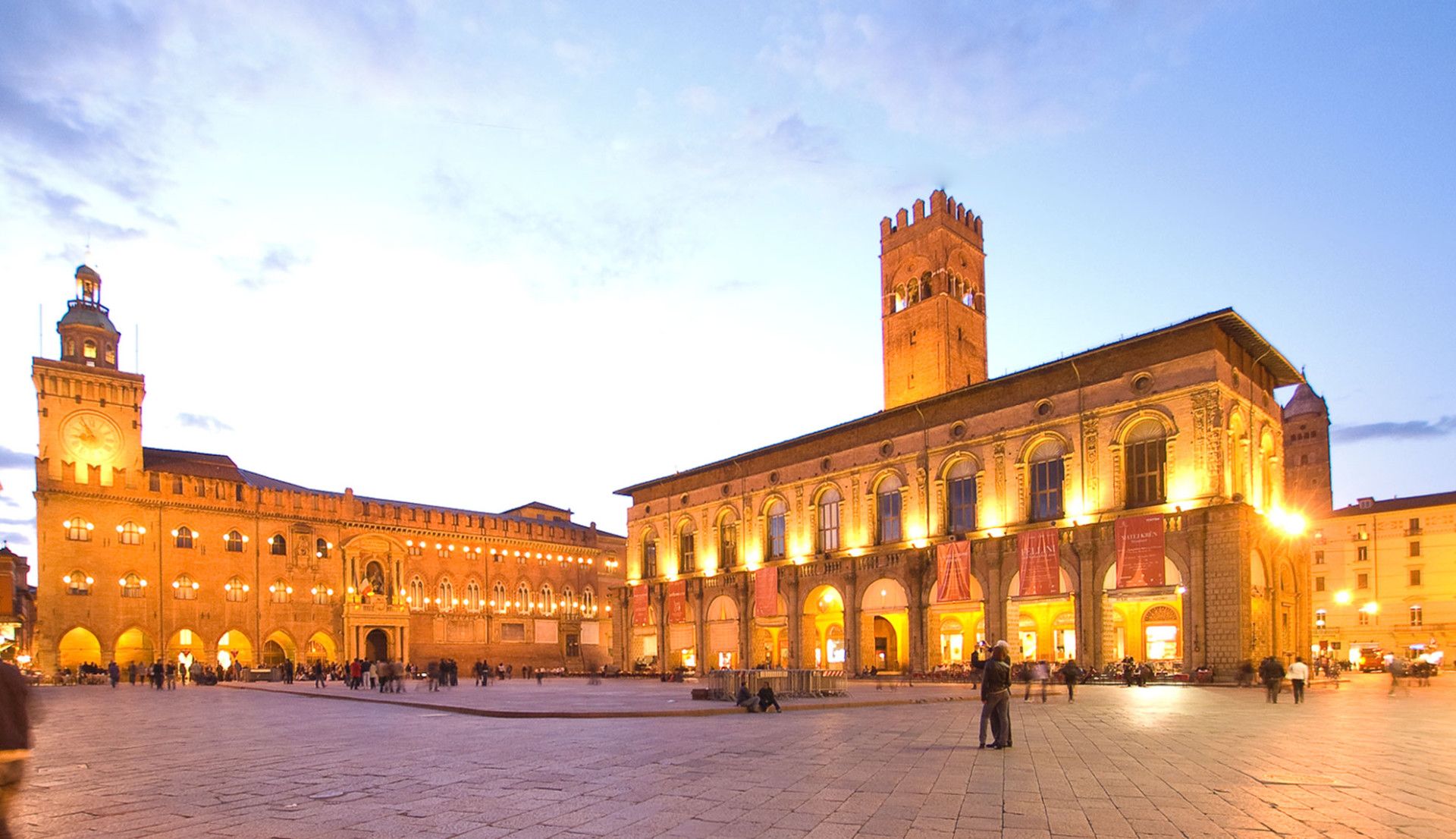
The Piazza Maggiore is the civic heart of Bologna and one of the finest medieval squares in Italy: a large, uncluttered space surrounded on three sides by the most significant civic and religious buildings of the medieval city, with a quality of spaciousness and formal grandeur that few Italian piazzas can match. Unlike many of Italy's celebrated squares, the Piazza Maggiore has no fountain at its centre, no obvious focal point other than the space itself and the buildings that define it, and this emptiness is one of its most compelling qualities. It invites you to look, slowly and carefully, at everything around it.
The dominant presence on the square is the Basilica di San Petronio, the great Gothic church dedicated to the patron saint of Bologna that occupies the entire southern flank of the piazza. Begun in 1390 and still, in a technical sense, unfinished, it was intended at its conception to be the largest church in the world, a project of such ambition that the papacy, alarmed by its scale, intervened to prevent its completion and redirect funds towards the construction of a university instead. What was built is still extraordinary: the facade, partially faced with pink and white marble on its lower sections and bare brick above where the facing was never added, is one of the most distinctive and most honestly incomplete architectural facades in Italy, and its incompleteness is part of its character. The interior, vast and austere in the northern Italian Gothic manner, contains a remarkable collection of chapels, frescoes and altarpieces, and the famous meridian line inlaid in the floor, the longest in the world when it was constructed in 1655 by the astronomer Giovanni Domenico Cassini, which tracks the position of the sun through a hole in the wall above with a precision that made it the world's most accurate astronomical instrument for over a century.
On the northern side of the piazza, the Palazzo del Podestà and the adjacent Palazzo Re Enzo, named for the King of Sardinia who was imprisoned here by the Bolognese for twenty-three years following his capture in the Battle of Fossalta in 1249, form the civic architecture of the medieval commune. On the western side, the Palazzo dei Banchi, an elegant Renaissance building designed by Jacopo Barozzi da Vignola and completed in 1568, closes the square with a long arcade of arches behind which the money changers and merchants of medieval Bologna conducted their business. Walking around the periphery of the Piazza Maggiore, understanding what each building was and what happened within it, is one of the finest ways to begin understanding the character of the city that produced them.
Adjacent to the Piazza Maggiore, connected through an archway, the smaller Piazza del Nettuno contains the famous Fountain of Neptune (Fontana del Nettuno), created by the Flemish sculptor Jean de Boulogne (known in Italy as Giambologna) and completed in 1566. The bronze Neptune dominates the composition with a physical presence and dynamic authority that is entirely characteristic of Giambologna's style, and the surrounding figures, particularly the four sirens whose breasts spout water, caused sufficient controversy at the time of their creation that the papal legate reportedly required modifications before the fountain was permitted to be installed in its current form. It is one of the most beautiful Renaissance fountains in Italy, and it is entirely free to stand in front of.
2. The Asinelli Tower: 97 Metres Above the Terracotta City
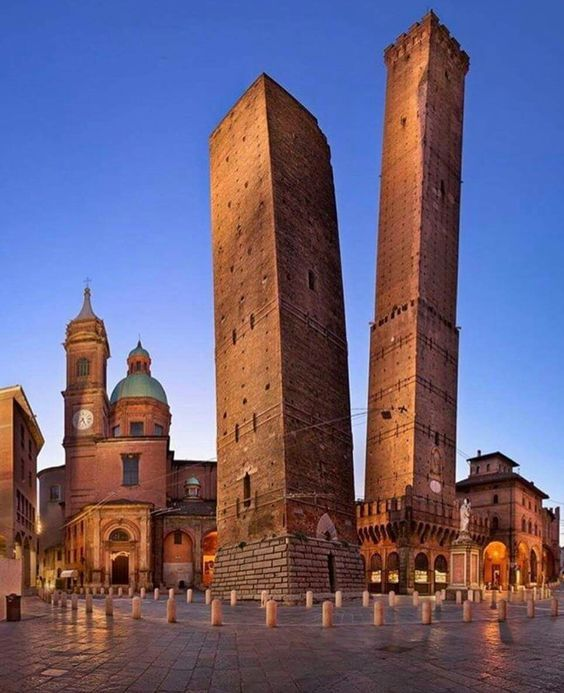
Bologna was once a city of towers. Between the twelfth and fourteenth centuries, the rival noble families of the city competed to build the tallest tower as a demonstration of their wealth, power and social ambition, in a dynamic that was repeated across the wealthy Italian communes of the medieval period: in Florence, in San Gimignano, in Pavia. At the peak of this architectural competition, Bologna had approximately one hundred towers. Today, twenty survive in various states of completeness, and two of them stand together in the centre of the city in a pairing so distinctive and so famous that they have become the most recognisable symbol of Bologna in the world.
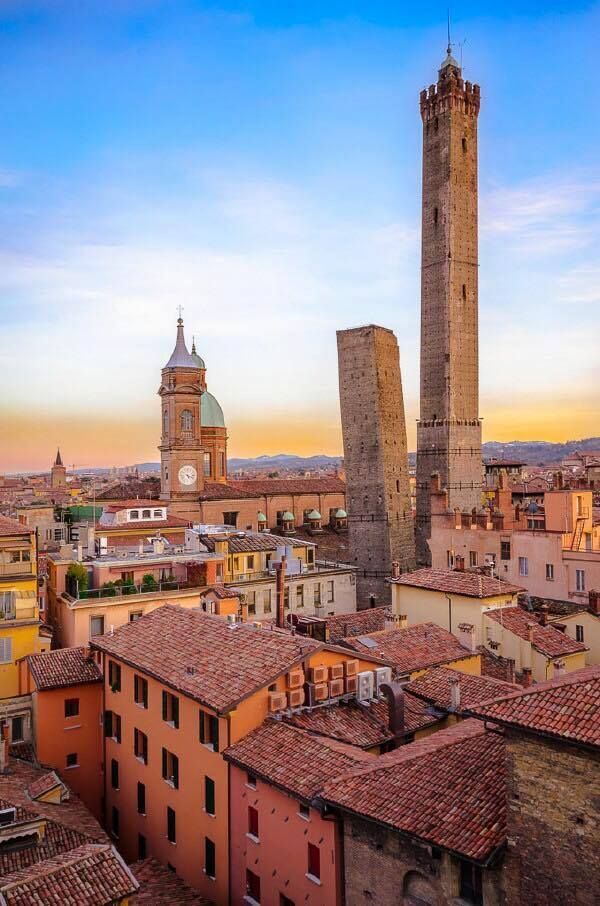
The Torre degli Asinelli and the Torre della Garisenda stand side by side at the junction of the Via Rizzoli and the Via Santo Stefano, visible from all over the centro storico and from the surrounding hills on clear days. The Asinelli, at 97.2 metres, is the taller of the two and is the tallest medieval tower in Italy to be open to the public. The Garisenda, at 48 metres, was truncated in the fourteenth century when its foundations began to subside, and it leans at an angle of 3.2 degrees, slightly more than the famous tower of Pisa. Dante, who saw it during his exile in Bologna, described it in the Inferno as the giant Antaeus leaning forward to look at something below, which remains one of the finest verbal evocations of a physical structure in Italian literature.
Climbing the Asinelli is one of the genuinely essential experiences of a visit to Bologna. The ascent is made via a wooden staircase of 498 steps that winds up the interior of the tower in a series of increasingly vertiginous sections, with the walls of the tower pressing close and the light filtering in through narrow medieval windows at intervals. The climb takes between 15 and 20 minutes for a person of average fitness, and the view from the top is one of the finest in northern Italy. Looking out over the terracotta ocean of Bologna's rooftops, the dome of San Luca's basilica visible on its hilltop to the southwest, the flat Po plain extending northward to the horizon and the Apennine ridgeline rising to the south, you understand immediately and viscerally why this city was built here, and why it has been important for so long. Book your ticket in advance online, particularly in the summer months when queues at the base of the tower can be significant.
Common tourist mistakes in Bologna: Visiting Bologna as a half-day stopover between Florence and Venice, which gives you time to eat one meal and see the Piazza Maggiore and nothing else. Eating at restaurants near the train station rather than in the centro storico or the student quartiers. Missing the Quadrilatero market district entirely, which is one of the finest concentrated food experiences in Italy. Not attempting the Asinelli Tower because the 498 steps seem daunting. And leaving without trying at least one bowl of tortellini in brodo, which is not the cream-laden version of the Bolognese recipe that has somehow become standard outside Italy, but the original: tiny pasta parcels in a clear, golden, deeply flavoured capon broth that is one of the most quietly magnificent dishes in the entire Italian canon.
3. The Quadrilatero: Bologna's Extraordinary Food Market District
In the immediate vicinity of the Piazza Maggiore, enclosed within the ancient street pattern of the Roman city grid that still defines the heart of Bologna, lies the Quadrilatero: a dense, compressed network of narrow streets entirely given over to food. This is not a market in the sense of a single building or a single square: it is an entire neighbourhood whose function is the production, sale and consumption of the finest food in Italy, conducted with a seriousness and a pride of craft that makes every visit both a shopping trip and a cultural experience of considerable depth.
The streets of the Quadrilatero, principally the Via Drapperie, the Via Pescherie Vecchie, the Via dei Gigli and the Via Caprarie, are lined on both sides with specialist food shops, market stalls and small restaurants of a density and quality that is almost overwhelming. Salumerias displaying whole legs of Prosciutto di Parma and Culatello di Zibello, great wheels of Parmigiano-Reggiano stacked floor to ceiling, strings of mortadella the size of a person, loops of cotechino and zampone waiting for the winter. Fishmongers with the morning's catch from the Adriatic arranged on crushed ice. Cheesemongers with the full range of aged and fresh Italian cheese, from the three-year-old Parmigiano that crumbles into salt crystals to the creamy, just-made squacquerone of Romagna. Fresh pasta shops whose display cases contain the full vocabulary of Emilian pasta: tagliatelle, garganelli, tortellini, tortelloni, lasagne, passatelli, each made by hand from eggs and fine flour in the tradition that has been practised in this city for at least five hundred years.
The Quadrilatero is at its most alive in the morning, from around 7 until 1 in the afternoon, when the market stalls are fully open and the neighbourhood's particular quality of focused, purposeful commercial life is at its most concentrated. Walking through it in the early morning, when the deliveries are arriving and the shopkeepers are arranging their displays and the first customers of the day are already making their selections, is one of the finest food experiences Italy offers without requiring you to sit down or spend more than a few euros. Buy a piece of aged Parmigiano from a cheesemonger who knows their product. Buy a mortadella panino from one of the small bars. Eat both while walking, because this is what the people around you are doing, and because the act of eating these things in the place and in the manner in which they have always been eaten is part of what makes them taste the way they do.
What to eat in Bologna: a brief but essential guide
Bologna's food culture is so rich and so specific that it deserves a guide of its own, but the following are the dishes that no visitor should leave without having eaten at least once. Tagliatelle al ragu: the original Bolognese, made with fresh egg tagliatelle and a meat sauce of slow-braised beef, pork and sometimes chicken liver in a base of soffritto, wine and a minimal amount of tomato. The Bolognese sauce you know from restaurants elsewhere in the world is a distant relative of this dish, and the gap between them is so significant that eating the original for the first time can feel like encountering something entirely new. Tortellini in brodo: tiny pasta parcels of pork, Prosciutto di Parma, Parmigiano and nutmeg floating in a clear, golden capon broth. The original and correct version of this dish, served in broth rather than with cream, is one of the most quietly magnificent things in Italian cooking. Mortadella: the finest cured meat in the world, made only in Bologna and its surrounding area from the finest parts of the pig, slowly cooked to a specific internal temperature and embedded with cubes of fat and occasionally pistachios, it is nothing like the mass-produced equivalent sold elsewhere in the world and should be eaten thinly sliced at room temperature as an introduction to what cured meat can be at its best.
Bologna is not on the route that most travellers take through Italy, which is the main reason to go. The Bolognese are not accustomed to being performed for tourists: they cook and eat and live in their city as they always have, and the quality of what they produce is the natural consequence of a culture that has never felt the need to explain itself to anyone. This is the best kind of city to visit.
The Porticoes and the University: Why Bologna Is La Dotta
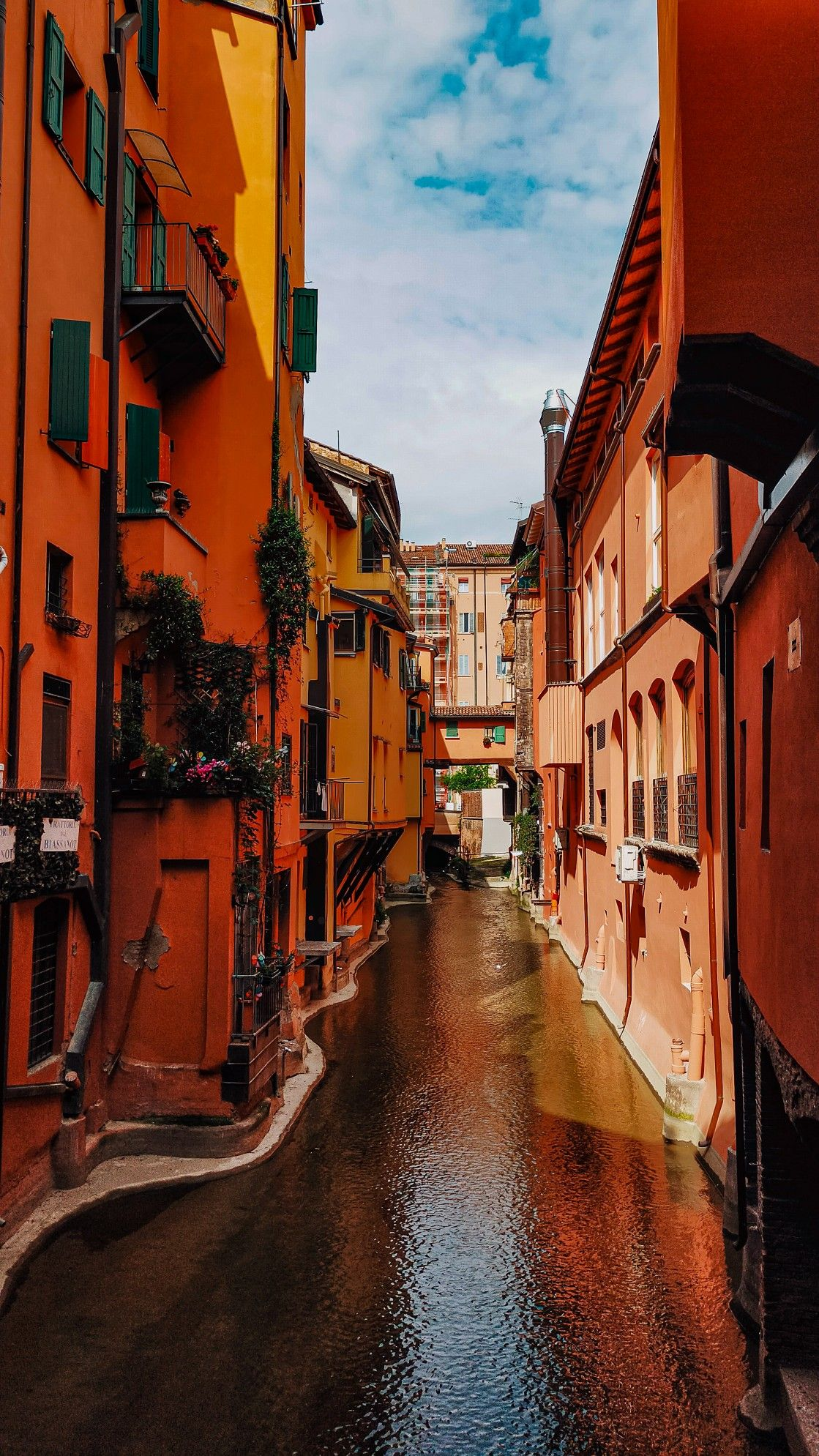
No account of Bologna is complete without the porticoes. The covered walkways that line the streets of the centro storico and extend for over forty kilometres through the city and its surrounding hills were inscribed as a UNESCO World Heritage Site in 2021, in recognition of their extraordinary historical significance and their architectural coherence as a continuous urban system developed over seven centuries. Walking under the porticoes of Bologna, sheltered from the rain in winter and the sun in summer, passing from the Roman-era grid of the Quadrilatero through the medieval streets around the Two Towers and out along the great processional portico that climbs the Colle della Guardia to the Basilica di San Luca, is one of the defining experiences of the city.
The portico of San Luca deserves particular mention. It is the longest porticoed walkway in the world, stretching for 3.8 kilometres and comprising 666 arches from the Porta Saragozza at the edge of the centro storico to the sanctuary of the Madonna di San Luca at the summit of the Colle della Guardia, 300 metres above the city. The walk takes approximately one hour in each direction and is one of the finest urban walks in Italy: the arches provide shelter and rhythm throughout, the views over the city and the plain become progressively more extraordinary as you ascend, and the sanctuary at the top, built around a Byzantine icon of the Madonna that is one of the most venerated in Italy, rewards the climb with a panoramic view and a genuine sense of arrival. On any given Sunday morning, the portico is shared with hundreds of Bolognesi of every age making the ascent as they have for centuries: as a pilgrimage, as a ritual walk, as a family outing, as a personal challenge.
The University of Bologna, founded in 1088 and the oldest in the world, is not a campus university but a city university: its faculties, laboratories and departments are distributed throughout the historic centre, woven into the urban fabric alongside everything else. The Archiginnasio, the historic university building completed in 1563 that served as the main seat of the institution until the nineteenth century, is one of the most remarkable buildings in Bologna: a double-storey porticoed palace whose walls and ceilings are entirely covered with the coats of arms and memorial tablets of students and professors from across five centuries, a visual record of intellectual life in Bologna from the Renaissance to the present. The famous anatomical theatre on the upper floor, a carved wood room of extraordinary beauty where public anatomical dissections were performed in the presence of students from 1637 onwards, is one of the finest rooms of its kind in Italy and entirely worth the modest entry fee.
Getting to Bologna: Arriving and Getting Around
Bologna Guglielmo Marconi Airport (BLQ) is one of Italy's most conveniently located regional airports: just 6 kilometres from the city centre, it is close enough that the transfer from the terminal to your hotel in the centro storico is one of the shortest of any major Italian city airport. The Marconi Express monorail, opened in 2022, connects the airport directly to Bologna Centrale station in approximately 7 minutes, running every 11 minutes throughout the day and making the airport exceptionally convenient for rail connections to the rest of Italy. The high-speed train network connects Bologna to Milan in approximately one hour, to Florence in 35 minutes and to Rome in just over two hours, making it one of the most accessible cities on the peninsula.
A private airport transfer from the airport to your hotel in the centro storico takes approximately 15 to 20 minutes at a fixed price and is the most comfortable option, particularly with luggage. Within the city, the historic centre of Bologna is compact and best explored on foot: the main sights, the Piazza Maggiore, the Two Towers, the Quadrilatero and the Archiginnasio are all within comfortable walking distance of one another, and the quality of the urban environment, the porticoes, the shops, the cafes and the constantly interesting street life, makes walking the only reasonable mode of transport for anyone with time to spare.
Comments
No comments yet. Be the first to share your thoughts!
Leave a Comment
Your comment will appear after moderation.