 Michelle
 Florence has a reputation, not entirely undeserved, as one of the most expensive cities in Italy for the cultural traveller. The Uffizi Gallery, the Accademia with Michelangelo's David, the Palazzo Pitti, the Boboli Gardens proper: entry to each of these costs money, and the combined ticket cost for a thorough engagement with Florence's paid attractions represents a significant investment. But Florence is also a city whose greatest public spaces, its finest natural viewpoints, many of its most important churches, and the quality of its street life and its urban beauty cost absolutely nothing to experience. The free Florence is not a consolation prize for those who cannot afford the paid version. It is, in many respects, the more authentic and the more personally rewarding version of the city, available to everyone willing to walk its streets with their eyes properly open. This is where to look.
Why Florence Rewards the Budget-Conscious Traveller
Florence was built for display. The Renaissance princes and merchants who commissioned the buildings, the sculptures and the paintings that fill the city understood that their patronage of art was simultaneously a private pleasure and a public statement, and they designed the city's most important public spaces with a theatrical ambition that meant much of the greatest art in Florence was always intended to be seen in the open, in public, without a ticket. The Piazza della Signoria is the most concentrated example of this tendency: a square that contains more great outdoor sculpture than any other public space in Europe, all of it visible without paying anything, all of it installed over centuries for precisely this purpose of public display and civic expression.
Florence also has an extraordinary tradition of the church as public cultural institution: the great basilicas of the city, Santa Croce, Santa Maria Novella, Santo Spirito, San Lorenzo, Ognissanti, were built with the wealth of the Florentine merchant families and decorated with works by Giotto, Masaccio, Ghirlandaio, Brunelleschi and the major figures of the Florentine Renaissance, and several of them are still either free or charge only a nominal fee that is entirely proportionate to what they contain. Understanding this history and making use of it is the key to experiencing Florence at its most authentic without spending more than necessary.
The free Sunday initiative: Under the Italian government's Domenica al Museo programme, all Italian state museums, including the Uffizi Gallery and the Accademia Gallery, offer free entry on the first Sunday of each month. This is a genuinely free offer with no booking fee, but it is not a secret and the queues, particularly at the Accademia where Michelangelo's David is the principal draw, begin forming well before opening time. If you plan your visit to Florence to include the first Sunday of the month and arrive at the museum 45 minutes before it opens, you can see either the Uffizi or the David, or both if you are extremely well organised and fast, at no cost whatsoever.
1. The Piazza della Signoria: the World's Greatest Free Outdoor Museum
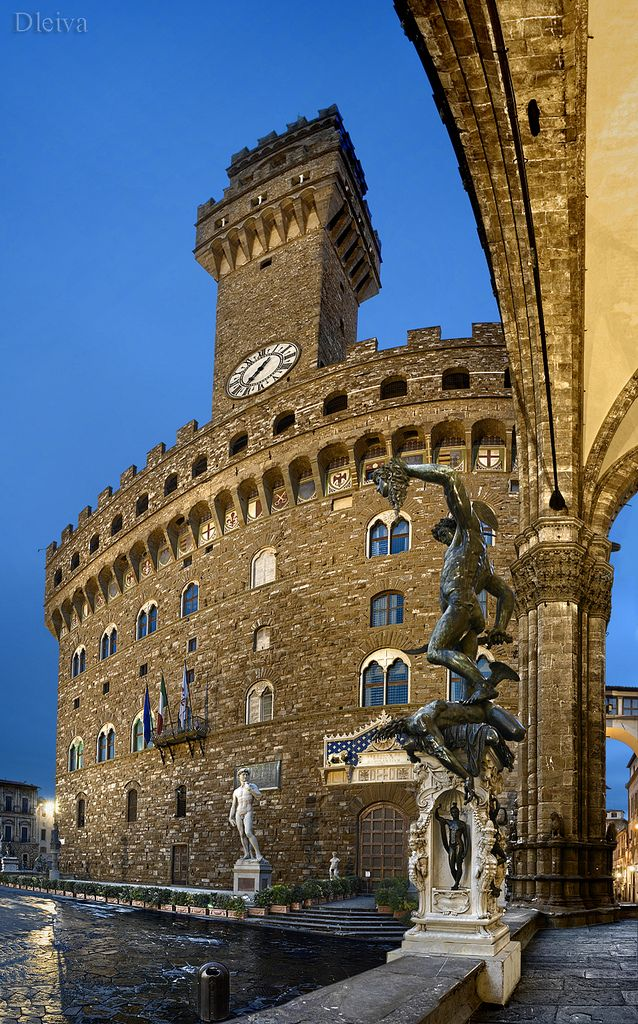
The Piazza della Signoria is the civic heart of Florence and one of the most extraordinary public spaces in Europe: a large, L-shaped square dominated by the medieval mass of the Palazzo Vecchio and its extraordinary 94-metre tower, lined on one side by the loggia dei Lanzi which serves as an open-air sculpture gallery of international significance, and containing in the open air some of the finest Renaissance and Mannerist sculpture ever produced. Entry to all of this costs absolutely nothing. You simply walk into the square and look.
The Loggia dei Lanzi, the three-arched open gallery on the south side of the square, contains works of extraordinary quality displayed in a setting that was specifically designed for public viewing in the open air. Benvenuto Cellini's Perseus with the Head of Medusa, cast in bronze in 1554 and still one of the most technically astonishing sculptures of the Renaissance period, stands under the left arch of the loggia in a state of permanent theatrical glory. The figure of Perseus holding aloft the severed head of Medusa while his foot rests on her body, all cast in a single pour of bronze of breathtaking technical ambition, is among the finest sculpture ever produced and costs nothing to stand in front of.
Adjacent to it, Giambologna's Rape of the Sabine Women, completed in 1582 and the first large-scale sculpture in European art to be designed to be viewed from multiple directions simultaneously, occupies the central arch of the loggia in a composition of extraordinary dynamic energy: three interlocking figures twisting in a spiral movement that produces a different and equally compelling image from every angle. Pio Fedi's Rape of Polyxena and several ancient Roman works complete the loggia's collection, which is collectively of a quality that would constitute the centrepiece of any major museum.
In the square itself, directly in front of the Palazzo Vecchio, a copy of Michelangelo's David stands in the exact position the original occupied from 1504 until 1873, when it was moved to the Accademia for protection. The copy is a faithful reproduction of the original in every detail, and standing in front of it in the open air in the square where Michelangelo intended it to be seen, rather than in the museum interior where the original now lives, gives a quality of understanding of the work's civic and political intention that the museum context cannot fully provide. The David was placed here not as an art object but as a political statement: the Republic of Florence asserting its defiance and its confidence against its enemies, embodied in the figure of a young man who faces an overwhelming adversary with intelligence and courage. Seeing it here, in the public square, free, is to see it as it was meant to be seen.
2. The Ponte Vecchio and the Arno Riverbanks
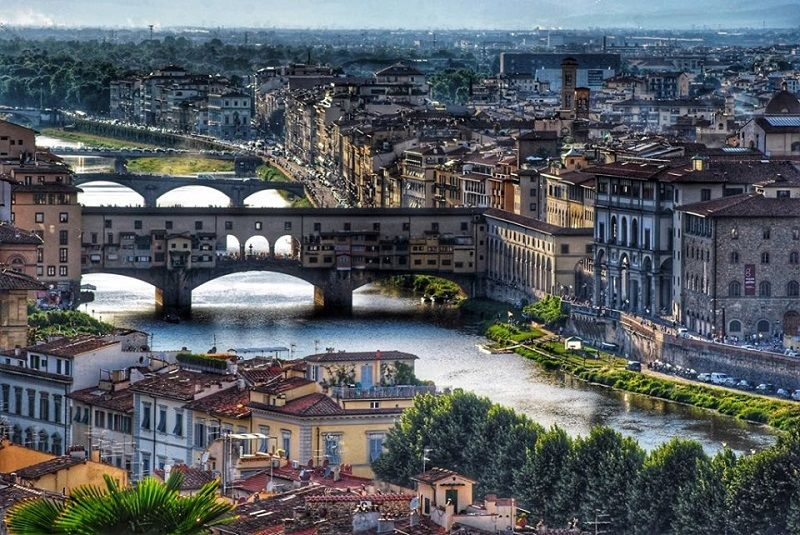
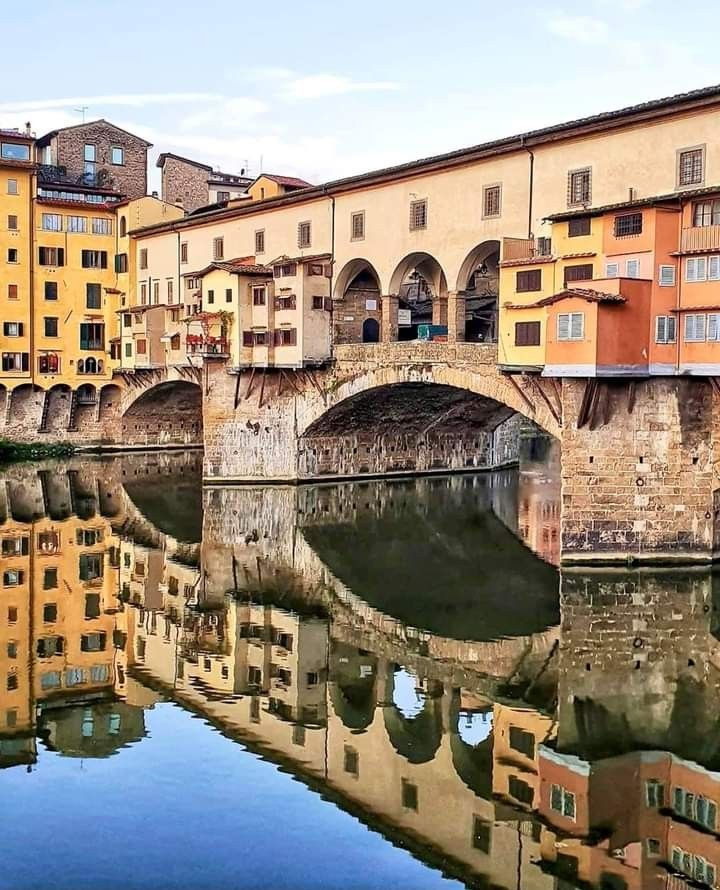
The Ponte Vecchio, the medieval bridge spanning the Arno in the centre of Florence, is one of the most recognisable and most photographed structures in Italy. It is entirely free to walk across, and the experience of crossing it, between the two rows of goldsmiths' and jewellers' shops that line both sides of the bridge and overhang the river on brackets below, is one of the defining experiences of any visit to Florence. The bridge dates in its current form to 1345, replacing an earlier bridge destroyed by flood, and the shops that line it have been associated with the goldsmithing trade since the sixteenth century, when Ferdinando I de' Medici expelled the butchers and tanners who had previously occupied it and reserved it exclusively for the jewellers and goldsmiths whose successors still trade there today.
Walking the Ponte Vecchio is free. The goods on sale in the shops are decidedly not, but looking at them is free and the combination of the medieval architecture, the overhanging wooden structures, the glittering display of gold and gems and the view from the bridge's open midpoint over the Arno in both directions is something that can be experienced at no cost and at great leisure. The best time to walk the bridge is very early in the morning, before 8am, when the shops are still shuttered and the bridge is quiet and the quality of the early light on the medieval stonework is at its most beautiful. This is the Ponte Vecchio that the Florentines themselves see on their way to work, before the crowds arrive.
The Arno riverbanks, the Lungarni on both sides of the river, provide one of the finest free walks in the city. Walking west from the Ponte Vecchio along the south bank, the Lungarno Torrigiani and the Lungarno Serristori, past the beautiful small houses and garden walls of the Oltrarno neighbourhood, with the view across the river to the north bank palaces and the Uffizi loggia reflected in the water, is one of those Florentine pleasures that feels entirely private even when it is shared with dozens of other walkers. The view back eastward towards the Ponte Vecchio from the Lungarno Pecori Giraldi, with the bridge and its overhanging buildings perfectly framed against the sky, is among the finest urban views in Italy and is completely free.
3. Piazzale Michelangelo: the Finest Free View in Tuscany
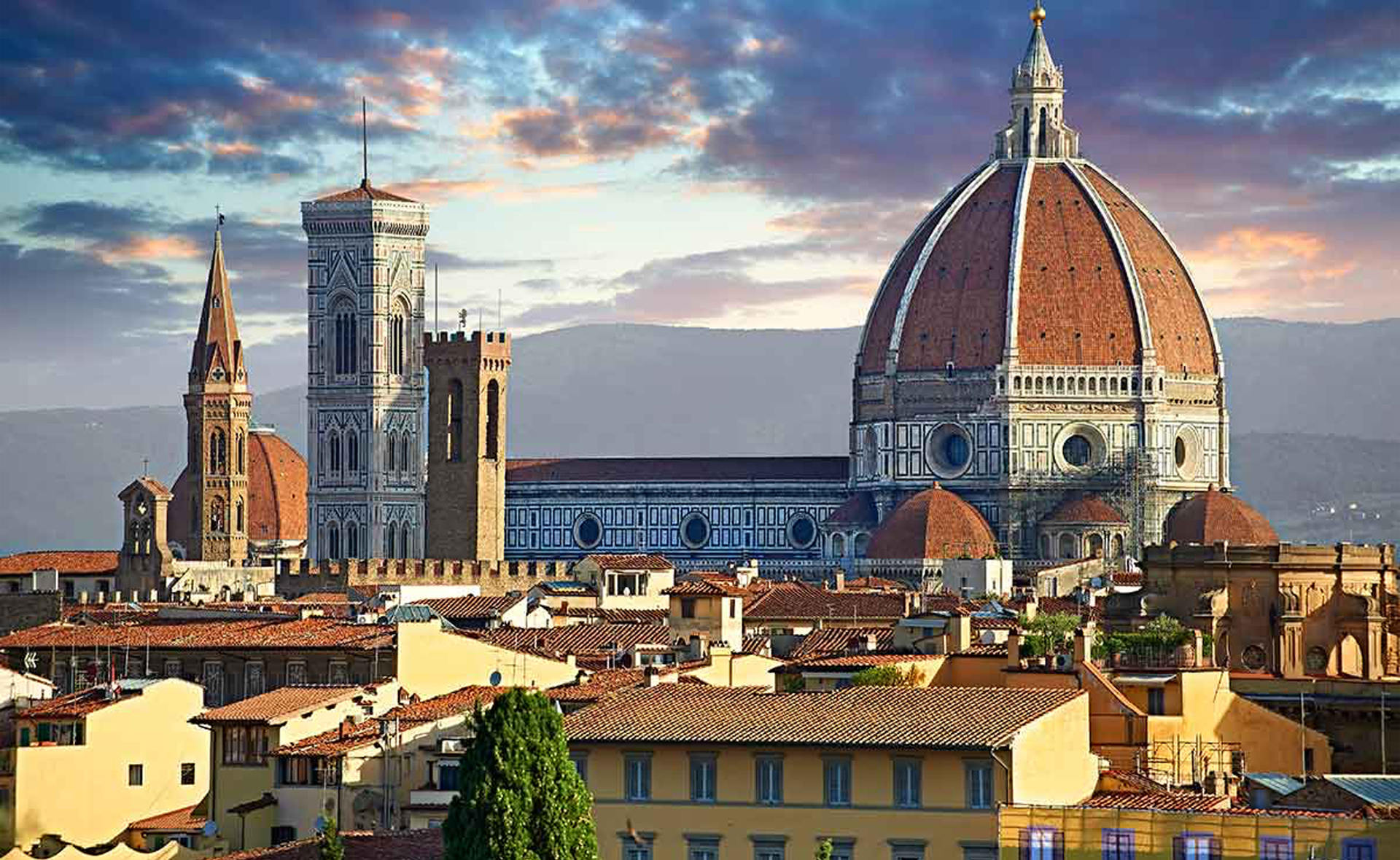
The Piazzale Michelangelo, the broad terrace on the south bank of the Arno reached by a flight of steps from the Oltrarno neighbourhood or by bus from the city centre, offers the most celebrated panoramic view over Florence and is entirely free. The view from the terrace is one of those experiences that stops people in their tracks regardless of how many photographs they have seen beforehand: the full sweep of the city from the Duomo and its dome to the Palazzo Vecchio tower, the red-tiled expanse of the Renaissance city between them, the Arno valley running east and west, and the Tuscan hills rolling away in every direction with their pattern of vineyards, olive groves and cypress trees constitute a panorama of extraordinary beauty that has been inspiring travellers, painters and writers for centuries.
At the centre of the Piazzale stands a bronze replica of Michelangelo's David, installed here in 1873 along with bronze copies of the four allegorical figures from the New Sacristy of San Lorenzo. The replica on the terrace is a reminder of what once stood in the Piazza della Signoria below, and its presence here, against the backdrop of the city it surveys, has a particular quality of civic appropriateness. Beside the David replica, the terrace contains several bars and restaurants with exceptional views, all of which charge premium prices for the privilege: the coffee at the bar inside the terrace costs approximately twice what the same coffee costs at a bar on the streets below, which is the standard Florentine view tax and is not unreasonable given the setting.
The best time to visit Piazzale Michelangelo is approximately one hour before sunset, when the light is falling from the west and the city below begins to glow in the golden afternoon. This is the time when the view is at its most dramatically beautiful, when the dome of the Duomo and the tower of the Palazzo Vecchio are lit in warm ochre and the river below catches the light in silver flashes, and when the crowds of the afternoon have begun to thin slightly. Sunset itself, when the sky behind the hills to the west turns amber and pink and the city below is silhouetted against it, is genuinely extraordinary and can be experienced entirely free, standing at the terrace railing with a coffee from the bar.
How to reach Piazzale Michelangelo: The most rewarding approach is on foot from the Oltrarno neighbourhood, climbing the stepped Via di San Salvatore al Monte through the gardens below the church of San Miniato al Monte. The walk takes approximately 20 to 25 minutes from the Ponte Vecchio and passes through gardens with intermediate viewpoints that are beautiful in their own right. Bus number 13 also connects the city centre to the Piazzale directly. The return downhill is considerably faster and can be done in 10 to 15 minutes via the steps.
4. The Oltrarno: the Neighbourhood Florence Kept for Itself
The Oltrarno, the district on the south bank of the Arno, is the most characterful and most genuinely local neighbourhood in Florence. The name means simply "beyond the Arno" and it reflects the historical reality that this area, which grew up outside the medieval city walls, was always slightly apart from the grander pretensions of the north bank: a place of artisans, craftsmen, smaller merchants and ordinary Florentine life that was less invested in the civic and commercial theatre of the city centre. Today the Oltrarno retains this character more completely than any other part of Florence: its streets of small workshops, antique dealers, picture restorers, bookbinders, leather workers and furniture makers are still largely in place, surrounded by a residential neighbourhood of considerable atmospheric quality that has so far resisted the full tourist-oriented gentrification that has consumed much of the north bank.
Walking the Oltrarno costs nothing and provides some of the finest neighbourhood experiences available in Florence. The Piazza Santo Spirito, the long, wide square in the heart of the neighbourhood dominated by the unfinished facade of Brunelleschi's Basilica di Santo Spirito, is one of the most charming and most lived-in public squares in Italy: ringed by small cafes, wine bars and restaurants, the haunt of artists, students and neighbourhood residents, it has a quality of relaxed, unselfconscious sociability that contrasts sharply with the more theatrical character of the major tourist squares on the north bank. On Saturday and Sunday mornings, a small market operates in the square. The basilica itself charges a nominal entrance fee to enter the interior, which contains several important artworks, but the square and the surrounding streets are free and constitute one of the most rewarding free walks in the city.
The Piazza dei Pitti, the enormous cobbled square in front of the Palazzo Pitti, is entirely free to stand in and provides an extraordinary frontal view of one of the largest palace facades in the world: 205 metres of rusticated stone in a composition of such imposing scale that it dwarfs any other urban context and reduces the individual viewer to appropriately Medicean proportions. The Palazzo Pitti's museums require tickets, but the square itself, and the first courtyard visible through the gate, can be appreciated at no cost. The view back north from the Piazza dei Pitti across the rooftops of the Oltrarno to the dome of the Duomo and the tower of the Palazzo Vecchio is another of those Florentine free panoramas that consistently exceeds expectations.
5. The Free and Low-Cost Churches of Florence
Florence's churches are among its greatest artistic repositories and several of them charge either no entrance fee or a very modest one that is entirely proportionate to what they contain. The following are essential free or near-free church experiences in the city.
The Cathedral and the Baptistery exterior
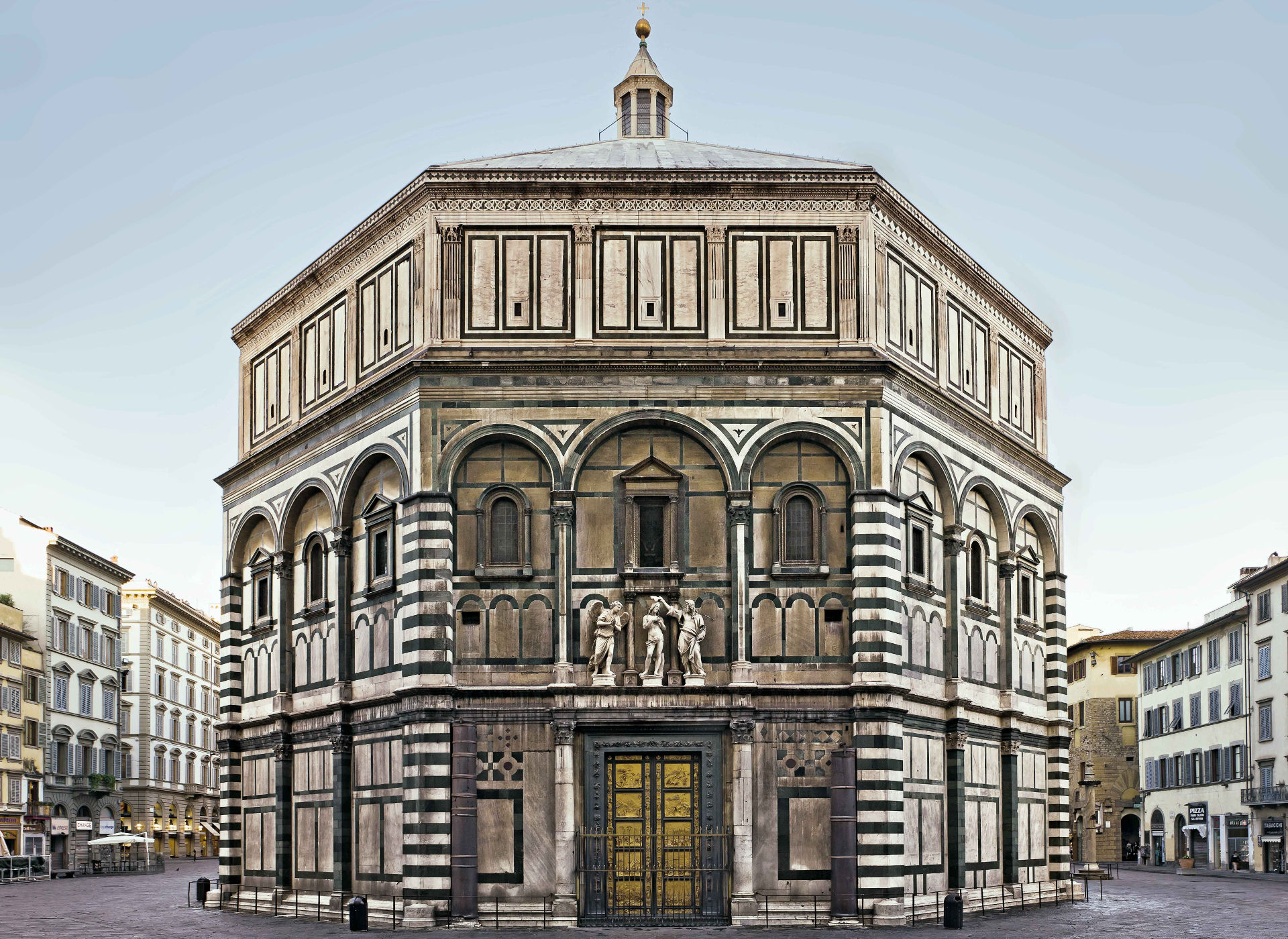
The Cathedral of Santa Maria del Fiore, Brunelleschi's dome and the Campanile of Giotto form the most recognisable ensemble in Florence and one of the most beautiful in the world. Entry to the cathedral nave itself is free (though donations are welcomed and appropriate). The exterior of the cathedral, the baptistery and the campanile can be admired at no cost from the surrounding piazza, and the quality of the pietra serena and white marble cladding of the exterior, particularly the green and white geometric patterns of the Baptistery and the campanile, is extraordinary at close quarters. The famous golden doors of the Baptistery, Lorenzo Ghiberti's Gates of Paradise, are copies, with the originals in the nearby Museo dell'Opera del Duomo, but they are magnificent copies and cost nothing to stand before.
The Basilica di Santa Croce forecourt
The interior of Santa Croce, the great Franciscan basilica that contains the tombs of Michelangelo, Galileo, Machiavelli and Dante's cenotaph, requires an entrance fee. But the exterior, the magnificent piazza in front of it with the facade of the church and the statue of Dante, is entirely free and provides one of the most architecturally dramatic forecourt experiences in Florence. The piazza is a favourite gathering place for students and young Florentines in the evenings and has a quality of informal sociability that is entirely characteristic of Florentine outdoor life.
The Basilica di Santo Spirito
The interior of Santo Spirito in the Oltrarno, Brunelleschi's finest church, charges only a nominal entrance fee and contains among its works a Crucifix attributed to Michelangelo and several important altarpieces. The church is less visited than the north bank basilicas and has a quality of unhurried contemplation that the more famous churches can rarely match on a busy day.
Ognissanti and the Last Supper of Ghirlandaio
The Basilica di Ognissanti on the Lungarno is free to enter and contains, in the refectory attached to the adjacent monastery (open only at specific hours, admission free), Domenico Ghirlandaio's extraordinary Last Supper fresco of 1480, one of the finest examples of the subject in Florence and significantly less visited than Leonardo's version in Milan. The church itself contains Botticelli's Saint Augustine fresco, and the tomb of Botticelli himself is in the chapel on the right side of the nave.
Common tourist mistakes in Florence: Eating lunch at restaurants in the immediate vicinity of the Duomo or the Uffizi, where price and tourist orientation is highest and quality most variable. Visiting the Bargello museum, one of the finest sculpture museums in Italy, on a day it is closed (it is typically closed on the second and fourth Sundays and the first and third Mondays of each month). Missing the Oltrarno entirely. Missing the Mercato Centrale covered market, which is free to walk through and contains some of the finest food shopping in Tuscany at street-level prices. And attempting to see the Uffizi, the Accademia, the Palazzo Pitti and the Bargello in a single day, which is physically possible but experientially counterproductive.
6. The Mercato Centrale and the Markets of Florence
The Mercato Centrale, the covered market in the San Lorenzo neighbourhood a few minutes' walk north of the Duomo, is free to enter and constitutes one of the finest food experiences in Tuscany at any price level. The ground floor of the market, open from the early morning until approximately 2pm, is a working food market of extraordinary quality: butchers with the full range of Florentine meat cuts including the famous lampredotto (the fourth stomach of the cow, slow-braised and served in a crusty roll that is the definitive Florentine street food), fishmongers with the catch from the Tyrrhenian coast, cheesemongers with the full range of Tuscan pecorino and ricotta, vegetable stalls with the seasonal produce of the Valdarno and the Mugello, and the pasta and fresh bread sellers whose products supply the neighbourhood restaurants.
The upper floor of the Mercato Centrale, remodelled in 2014 into a food hall, is a different and more expensive proposition aimed at visitors rather than residents, but the ground floor market remains entirely genuine and entirely worth the time spent walking through it, smelling it, watching it, and understanding that this is where Florentine cooking actually begins.
The Mercato di Sant'Ambrogio, a smaller and less touristed covered market in the Santa Croce neighbourhood on the eastern side of the historic centre, is in some respects a more authentic experience than the Mercato Centrale: a neighbourhood food market that serves the Florentines who live in its area with produce, meat, fish and flowers at prices that reflect local rather than tourist economics. The market is free to enter and is at its best between 7 and 11 in the morning.
The flea market at the Piazza dei Ciompi, held in the square adjacent to Sant'Ambrogio every day except Sunday, is a free outdoor antique and bric-a-brac market of the kind that has been a feature of Florentine commercial life for centuries. The quality ranges from genuine antique finds to ordinary secondhand goods, and the experience of browsing through it, with the neighbourhood going about its ordinary daily life around you, is one of those pleasurably time-consuming Florentine activities that costs nothing and can last as long as your curiosity sustains it.
Florence charges admission for many of its greatest treasures, and those charges are justified by what they contain. But the city that produced the Renaissance produced it in the open, in its streets and squares and public spaces, as an act of civic confidence and public generosity. Walk slowly, look carefully at everything above ground level, and spend as much time as possible in the Oltrarno and as little as possible in the tourist restaurants nearest the Uffizi. The free Florence will give you more than the paid version does on a rushed single day, and it will feel, when you leave, more like a city you have actually known than one you have simply visited.
Getting to Florence: Arriving and Getting Around
Florence Amerigo Vespucci Airport (FLR) is one of Italy's most conveniently located city airports: just 4 kilometres from the historic centre, it is close enough that the journey from the terminal to any hotel in the city takes between 15 and 25 minutes depending on traffic and the specific destination. The Vola in Bus shuttle service connects the airport to the Santa Maria Novella railway station in approximately 20 minutes and runs at frequent intervals throughout the day. A private airport transfer to your hotel takes 15 to 20 minutes at a fixed price, eliminates any navigation uncertainty and is the most comfortable option with luggage.
Within Florence, the historic centre is best explored entirely on foot. The city is compact, flat (with the exception of the climb to Piazzale Michelangelo and San Miniato), and the density of interesting streets, facades, courtyards and unexpected views makes walking the only reasonable mode of transport for anyone who wants to actually see the city rather than transit through it. The streets of the centre are largely closed to private vehicles, which means that Florence on foot has a quality of pedestrian calm rare in Italian cities of its size, and the experience of wandering without a fixed destination through the grid of the historic centre, finding unexpected details in churches and courtyards and on the upper facades of palaces, is one of the most reliable pleasures the city provides at no cost whatsoever.
Comments
No comments yet. Be the first to share your thoughts!
Leave a Comment
Your comment will appear after moderation.