 Michelle
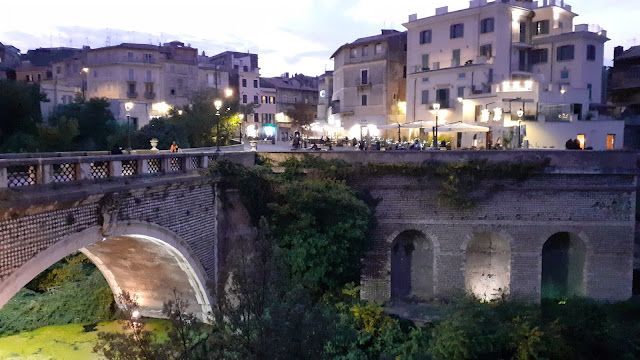
 Leave Rome in the morning, while the city is still gathering itself for the day, and drive east. Within thirty minutes the urban periphery releases you and the hills begin, the Tiburtine hills that fold gently upward from the plain of the Campagna toward the first serious ridges of the Apennines, and suddenly the air is different: cooler, greener, carrying a quality of freshness that the city, magnificent as it is, cannot provide. Ahead of you, on a spur of rock above the gorge of the Aniene river, the town of Tivoli perches with the composed self-assurance of a place that has been important for three thousand years and knows it. Below the town, in the olive groves and the cypress trees, two of the most extraordinary human creations ever committed to stone and water await your attention. You will need the whole day. You will wish you had two.
Tivoli and Its Place in the Roman Imagination
The Romans called it Tibur, and they loved it with the particular intensity that the wealthy and the literary reserve for a place that offers respite from the demands of the place where they actually live. Horace had a farm here, and wrote some of his most affecting poetry in its shade. Maecenas, the great patron of Augustan literature, built a villa on the hillside that was celebrated across the Roman world for its luxury. Catullus refers to Tibur as his own, a possessive that generations of classicists have argued about, some taking it literally and others as the conventional hyperbole of affection. The point, across all these references, is consistent: Tibur was the place you went to breathe, to think, to escape the noise and the ambition and the political danger of Rome, while remaining close enough to return at a moment's notice when ambition or obligation required it.
The Aniene, the river that cuts its spectacular gorge below the town and feeds the waterfalls that made Tivoli famous across Europe from the Renaissance onward, drains a watershed of considerable size in the hills to the east before joining the Tiber near Rome. In antiquity, its waters drove the mills that ground Roman flour. In the medieval period, the town that controlled its crossing controlled a significant portion of the overland trade between Rome and the eastern Apennines. In the eighteenth century, its waterfalls became one of the required stops on the Grand Tour, the subject of hundreds of paintings and the inspiration for a generation of English landscape gardeners who returned home determined to reproduce, in the more modest circumstances of the English countryside, something of the savage sublimity they had witnessed here. Claude Lorrain painted Tivoli. Turner painted Tivoli. Fragonard painted Tivoli. The town's capacity to provoke the painterly impulse has been, over four centuries, essentially inexhaustible.
How to get there: Tivoli is approximately 30 kilometres east of Rome via the A24 motorway, a journey of 45 to 60 minutes by car or private transfer depending on traffic. The two principal sites, Hadrian's Villa and Villa d'Este, are approximately 3 kilometres apart, and a private transfer for the day, with a driver who can move you between sites at your own pace, is by far the most efficient way to visit both. A private transfer from Rome with a fixed price and door-to-door service can be booked in advance and will collect you from your hotel and return you at any hour that suits.
Hadrian's Villa: The Emperor Who Built a World
Begin here, and begin early. Hadrian's Villa, the Villa Adriana, opens at nine in the morning, and the first hour, when the long shadows of the umbrella pines and the cypresses lie across the ancient stone and the only sounds are the birds in the trees and the distant murmur of the fountains, is the finest hour of the entire day. By eleven, the tour coaches will have arrived and the main pathways will be busy. By nine fifteen, in the right part of the site, you may be entirely alone with one of the most extraordinary landscapes in the world.
The Villa was built by the Emperor Hadrian between approximately 118 and 138 AD, the years of his reign, on a plateau below the town of Tivoli that he had selected with the eye of a man who understood both topography and aesthetics. Hadrian was, by any measure, the most artistically cultivated of all the Roman emperors: an architect, a poet, a painter and a philosopher-ruler of the kind that Plato had described as an ideal and history had rarely produced. He had travelled the entire empire, from Britain to Egypt, from the Rhine to the Euphrates, and he had absorbed the architecture and the art of every culture he encountered with the appetite of a man who understood that the world was larger and stranger and more beautiful than Rome alone could contain.
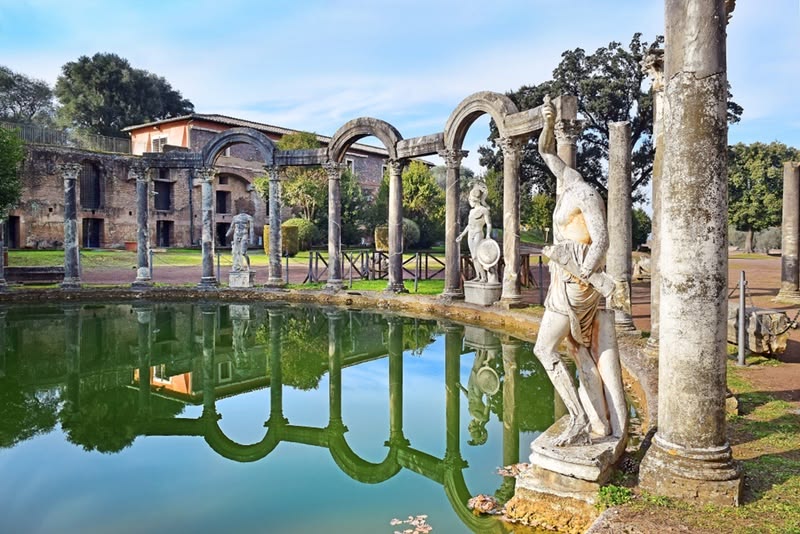
The Villa is his attempt to contain it anyway. Covering an area of approximately 120 hectares, it is not a single building but an entire city in miniature, a complex of palaces, theatres, libraries, temples, baths, gardens, service buildings and administrative structures connected by a network of pathways, colonnaded galleries and underground service corridors whose full extent has not yet been mapped. Named structures within the complex recall the places that had most impressed Hadrian in his travels: the Canopus evokes the sacred canal near Alexandria in Egypt; the Stoa Poikile, the Painted Porch, recalls the famous Athenian colonnade; the Academy takes its name from the grove outside Athens where Plato taught. The Villa is, in this reading, an act of imperial nostalgia for a world too large to be physically retained: a private museum of the places and cultures that had shaped the sensibility of the man who ordered it built.
Hadrian was also, it should be noted, dying. The construction of the Villa occupied the last twenty years of his life, a period during which he was increasingly ill and increasingly aware that his illness would prove fatal. The Villa he built was as much a meditation on mortality as it was a celebration of empire, and certain of its spaces have a quality of withdrawal, of deliberate seclusion from the demands of power, that speaks of a man using architecture to create what his position in the world denied him: privacy, solitude and the particular freedom of those who have set down their obligations.
What survives and what does not: The Villa was systematically plundered for building materials from the medieval period onward, and the most portable of its treasures, the sculpture, the mosaics, the bronzes, were removed beginning in the Renaissance by a succession of owners, including Cardinal Ippolito II d'Este, who stripped the site comprehensively to decorate his own villa above the town. The majority of the sculpture recovered from the Villa is now distributed across the museums of Rome and the great collections of Europe. What remains at the site itself is the architecture: the walls, the vaults, the columns, the pavements, the hydraulic systems, the geometric precision of the planning, and the extraordinary landscape quality of the ensemble as a whole.
The Rooms That No One Sees: The Underground Tivoli
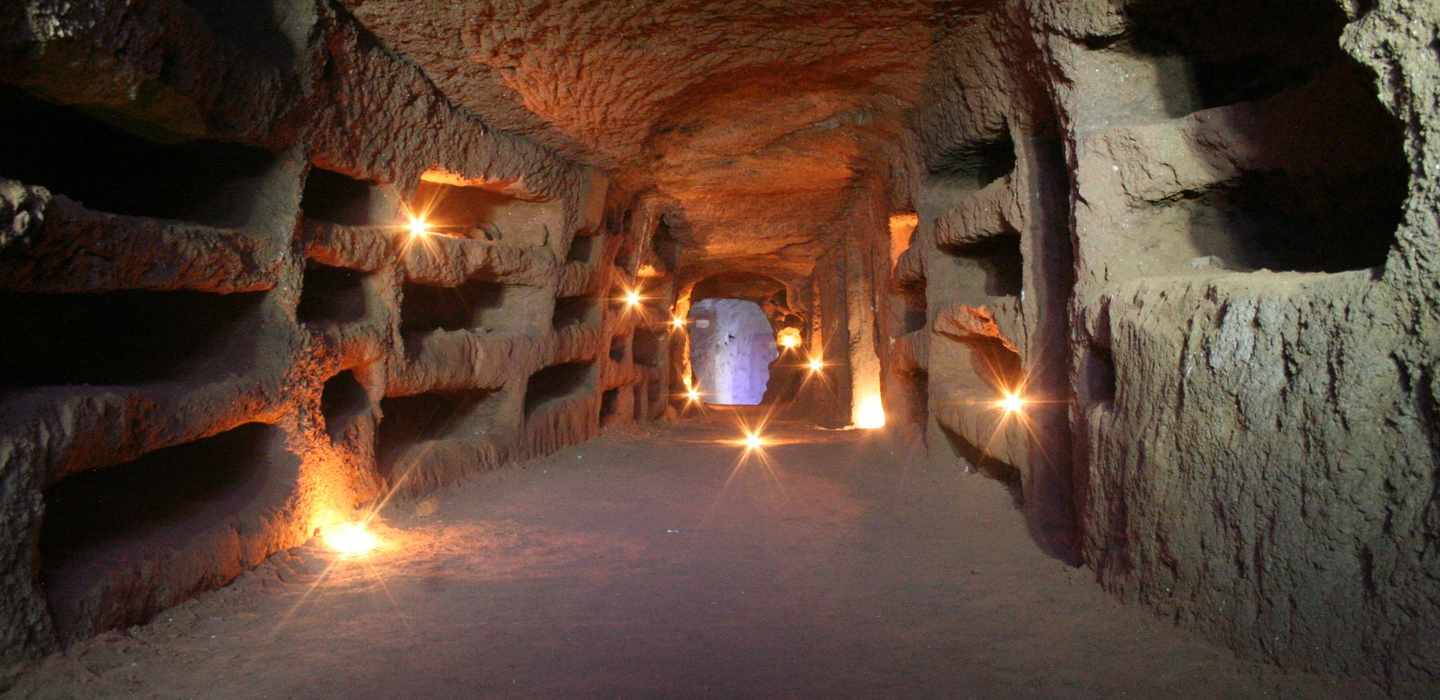
Below the visible landscape of the Villa, running beneath the pathways and the gardens and the buildings in a system of galleries and tunnels that mirrors in negative the organisation of the structures above, is a subterranean world of remarkable extent and equally remarkable obscurity. The cryptoporticoes of Hadrian's Villa are vaulted underground passages, lit by windows set high in the walls or by gratings in the ceiling, that connected different parts of the complex without requiring the servants, messengers and supply carts that kept a community of this size functioning to traverse the public spaces of the Villa and disrupt the quality of aristocratic life above. In a household of this ambition, the invisibility of the service infrastructure was as important as the quality of the architecture it served.
The longest of the surviving cryptoporticoes, accessible on the standard visitor circuit at the western end of the site, runs for approximately 150 metres and gives a compelling sense of the scale and the deliberateness of this underground planning. The tunnel is cool in summer and mild in winter, its walls still carrying traces of the plaster that once covered their entire surface, its floor formed from the same precise opus signinum that appears in the rooms above. Walking through it, one becomes aware of the Villa as a double structure: the world seen from above, of colonnaded terraces and reflecting pools and gardens arranged for the pleasure of the powerful, and the world experienced from below, of serviceable corridors and functional spaces in which the human machinery of the household moved with purposeful anonymity.
The areas of the Villa not currently accessible to visitors include several zones of active archaeological excavation, particularly in the eastern sections of the site where recent ground-penetrating radar surveys have identified structural remains not yet investigated. The most tantalising of these is a complex of rooms in the area identified as the emperor's private apartments, where survey data suggests the presence of a decorated space of considerable size whose surface has not yet been reached by the excavators. What it contains is, at the time of writing, unknown. The Villa, even after two centuries of systematic investigation, retains the capacity for fundamental surprise.
The Maritime Theatre: Hadrian's Island of Solitude
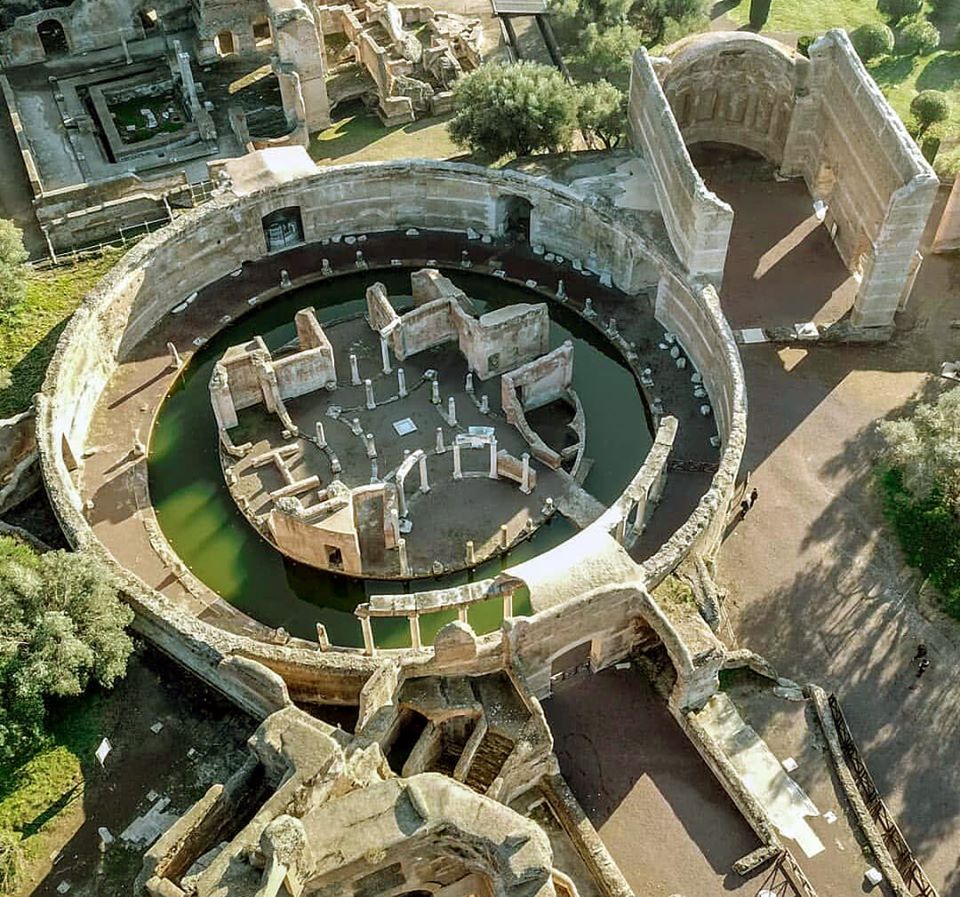
Of all the spaces within Hadrian's Villa, the one that most directly reveals the inner life of the man who built it is the Teatro Marittimo, the Maritime Theatre. The name is misleading in the way that the names of places in ancient Rome often are: there is no theatre here in the performative sense, and the maritime element is not the sea but a circular canal of navigable width that surrounds a small island on which a complete, self-contained miniature villa was constructed.
The island, approximately 45 metres in diameter, was connected to the outer ring by two small wooden bridges that could be raised or removed, converting the island into a space of genuine and deliberate isolation. On it, Hadrian built a private bath suite, a small library, a sleeping room, a dining space and a garden, all of them designed to the highest standard of luxury and all of them scaled for a single occupant or, at most, two or three. This was Hadrian's private retreat within his private retreat: the place he came when even the Villa, with its hundreds of residents, its constant administrative demands and its necessary social functions, became too much. The bridges drawn up, the canal separating him from the world by the width of navigable water, the emperor of Rome sat in his library or lay in his bath and was, for a brief interval, accountable to no one.
The plan of the Maritime Theatre is one of the most original in all of Roman architecture: a perfect circle of colonnade enclosing a circular canal enclosing a circular island whose own internal organization is a miniature of the larger Villa it contained within. It is architecture as concentric geometry, a series of rings of decreasing radius that focus the eye and the mind inward, toward the centre, toward the self. Whether Hadrian intended this reading is impossible to know. That the space produces it, in every visitor who takes the time to sit beside the canal and look inward rather than outward, is a matter of consistent experience.
Hadrian wrote, toward the end of his life, a poem to his own soul: Animula vagula blandula, little soul, wandering and tender, guest and companion of the body, into what places will you now depart, pale and naked and stiff, no longer able to play as you used to? The poem has been quoted so often that it risks becoming a cliche. Standing beside the canal of the Maritime Theatre, in the place where the man who wrote it withdrew from everything the world required of him, it recovers its full weight.
Villa d'Este: The Cardinal and His Water
After lunch in the town, we climb to Villa d'Este, and the transition from the horizontal, sunlit world of the ancient ruins to the steep, shaded, water-saturated world of the Renaissance garden is one of the most dramatic shifts of sensory register available on any single day trip in Italy. From the geological patience of the ancient Empire to the theatrical immediacy of the sixteenth-century papacy, in the space of three kilometres and a short ascent.
Cardinal Ippolito II d'Este was a man of formidable ambition and very considerable frustration. The son of Alfonso I d'Este, Duke of Ferrara, and Lucrezia Borgia, he had been raised to expect the papacy as a matter of dynastic right and had three times seen the prize go to someone else. Appointed governor of Tivoli in 1550 as a consolation by Pope Julius III, he resolved to transform his consolation prize into the most spectacular private residence in Italy, and to make of Tivoli a statement so overwhelming in its beauty and its ambition that the world would understand he had been unjustly passed over and that whoever had been elected pope instead of him was, at the very least, architecturally his inferior.
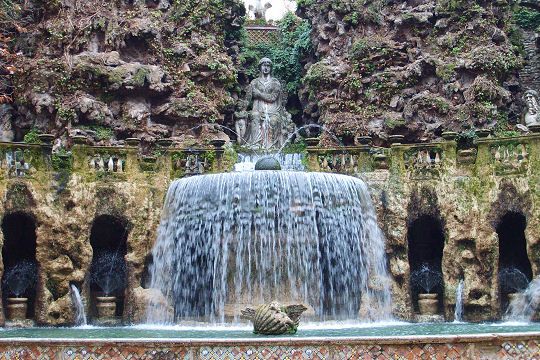
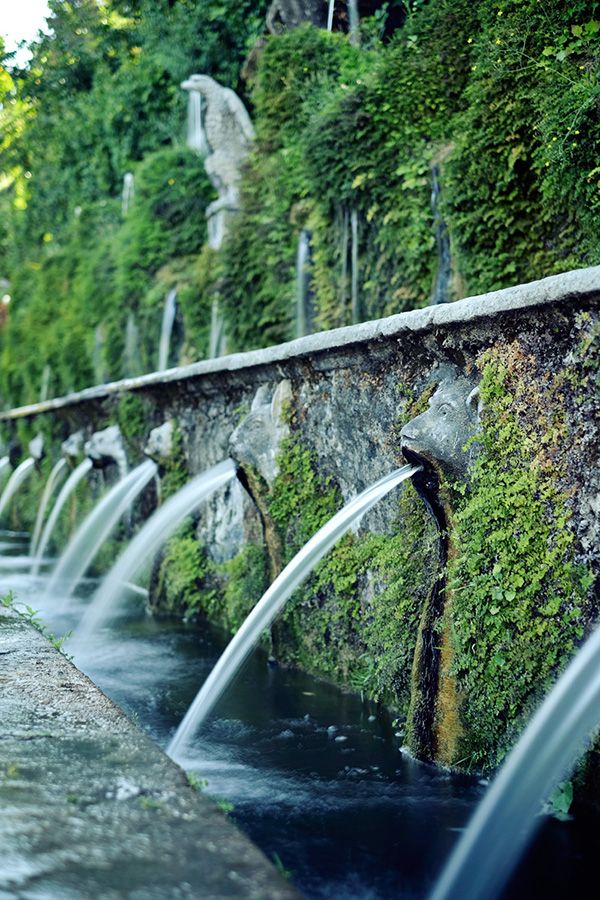
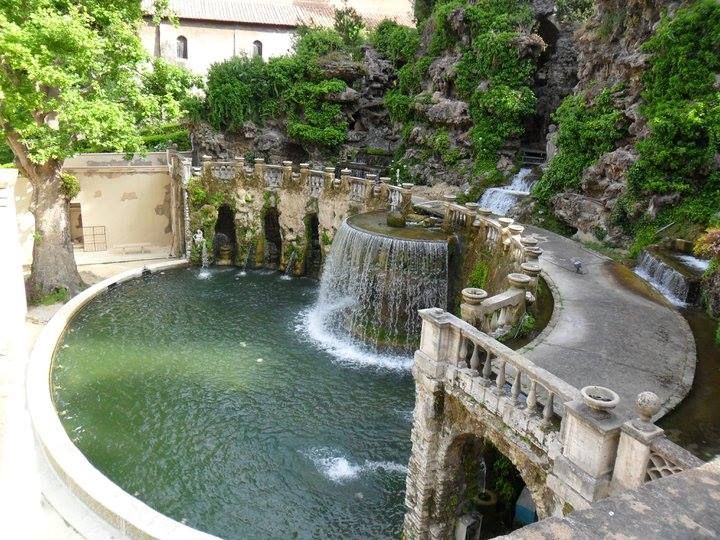
The instrument of this ambition was water. Tivoli had water in extraordinary quantities: the Aniene river and its tributaries, the springs of the hillside, the hydraulic energy of a landscape that fell steeply from the high hills to the plain. Cardinal Ippolito, working with his architect Pirro Ligorio, diverted a branch of the Aniene into an aqueduct that fed a system of fountains, cascades, grottos and water features of unparalleled complexity and theatrical power. The garden that resulted, built between 1550 and 1572, contains no fewer than 51 fountains, 364 water jets, 220 basins, 60 waterfalls, and 7 lakes. The entire hydraulic system, which in its original form operated entirely by gravity without any mechanical assistance, moves approximately 300 litres of water per second. The sound of this quantity of water in motion, in every part of the garden simultaneously, is one of the most extraordinary acoustic experiences available in any man-made landscape on Earth.
The best time in the garden: Villa d'Este faces west, and the afternoon light that falls across the fountains and the terraces in the hours between three and six in the evening transforms the garden from a spectacle of water and stone into something of almost hallucinatory beauty, the water catching the low sun at angles that produce a continuous prismatic display of light. The morning, by contrast, is shadier and cooler, better for the frescoed rooms of the palace and for the upper terraces. Visit the palace in the morning and the garden proper in the afternoon.
The Secret Apartments of Cardinal Ippolito
The palace building at Villa d'Este, the former Benedictine convent that Cardinal Ippolito converted into his residence, presents to visitors a ground floor of state rooms whose frescoed ceilings are among the finest examples of mid-sixteenth century illusionistic decoration in the Lazio region. The cycles painted by Livio Agresti, Federico Zuccari and their collaborators depict mythological and allegorical scenes of considerable elaboration, framing the cardinal's dynastic ambitions in the language of classical precedent with a confidence that suggests either genuine culture or very expensive cultural advice. The Room of the Hundred Fountains, the Salon of the Emperors, the Room of Glory and Virtue: each space is a statement of the cardinal's self-image, and each is worth the time required to read it carefully.
What most visitors never see are the upper floors of the palace, where the private apartments used by the cardinal and his household during their residencies at Tivoli contain rooms of a more intimate character: smaller, less formally decorated, furnished with the kind of comfortable elegance that private life in a Renaissance palace required but that official state rooms were not designed to provide. The private chapel of Cardinal Ippolito, its walls bearing devotional frescoes of concentrated quality, is on this upper level. A study, whose bookshelves bear the marks of the volumes that once rested on them, opens onto a loggia with a view over the garden that was, for the cardinal, the private and unremarked version of the theatrical panorama that the formal garden presented to his guests below. These rooms are not accessible on the standard visitor circuit and are opened only for special academic and cultural events. Enquiries to the site's administration occasionally produce access for groups with specific scholarly interests.
The original hydraulic organ of the garden, the Fontana dell'Organo, deserves particular attention. It was designed to use the force of the falling water to drive a mechanism that produced music, specifically the sound of an organ, from a structure built into the fountain itself. The effect, described by visitors in the sixteenth and seventeenth centuries with something approaching awe, was of a landscape that sang: a garden whose water did not merely fall and play and glitter but performed, filling the terraces below with the sound of an instrument that required no human player. The original mechanism was destroyed and replaced several times over the centuries; the current restoration uses a modern reconstruction of the original design and plays a cycle of music on the hour. Standing below the fountain when it begins is one of those moments that make the effort of the journey feel entirely inconsequential.
Franz Liszt at Villa d'Este: Music Born from Fountains
The Villa d'Este passed, after the death of Cardinal Ippolito in 1572, through a succession of owners and governors whose interest in its maintenance was intermittent at best, and by the eighteenth century the garden had reached a condition of romantic dilapidation that attracted artists and tourists in precisely the proportion that it repelled administrators. The Romantics loved a ruin, and Villa d'Este in its neglected state provided the combination of former grandeur and present decay that their aesthetic philosophy required. Fragonard painted there; Robert painted there; the garden's melancholy, overgrown state became as much a part of its appeal as its fountains.
The figure who transformed the Villa's meaning for the nineteenth century, and whose presence saturates it still for those who know the story, was Franz Liszt. The greatest pianist of his age, and by the 1860s a man whose inner life had undergone a thoroughgoing religious conversion, Liszt was given the use of rooms at Villa d'Este by his friend and patron Cardinal Gustavo Hohenlohe, who had been appointed to the Villa by Pope Pius IX. Between 1865 and 1886, Liszt returned repeatedly to Tivoli for extended periods of composition and contemplation, and the music he wrote at the Villa, particularly the two pieces from the Années de Pèlerinage titled Les Jeux d'eaux à la Villa d'Este (The Fountains of the Villa d'Este) and Les Cyprès de la Villa d'Este (The Cypresses of the Villa d'Este), represents both a high point of his late creative period and a direct sonic transcription of the place itself.
Les Jeux d'eaux is a piece of astonishing originality: a sustained evocation of water in motion that anticipated by several decades the impressionistic water music of Ravel and Debussy. Liszt himself acknowledged this, writing in a note appended to the score that the music sought to express not the appearance of the fountains but their spiritual meaning, the divine gift of water in the context of the scriptural verse he quoted: Sed aqua quam ego dabo ei, fiet in eo fons aquae salientis in vitam aeternam, but the water that I shall give him shall be in him a well of water springing up into everlasting life. The fountains of Villa d'Este, in Liszt's hearing, were not decorative hydraulics. They were a theological statement.
The rooms Liszt occupied at Villa d'Este are on the upper floor of the palace, overlooking the garden. A portrait of him, elderly and contemplative, hangs in one of the accessible rooms. If you stand at the window of the terrace at dusk, when the garden below is beginning to lose its colours and the sound of the water rises in the cooling air, you are standing where Liszt stood, hearing what Liszt heard. The piece he wrote is available on every streaming service. It is worth listening to it here, in this exact place, and understanding what he was doing.
Listen before you visit: I recommend, without reservation, that any visitor to Villa d'Este listen to Liszt's Les Jeux d'eaux à la Villa d'Este before arriving at the garden. Find a recording by a pianist whose touch is sensitive enough for the late Liszt (Alfred Brendel's recording is the one I have carried with me for twenty years), listen to it carefully, and then arrive at the garden. The experience of hearing the music and then entering the landscape that produced it, in that order, adds a layer to the day that is among the finest pleasures available to anyone who travels with both eyes and ears open.
The Town of Tivoli: Temples Above a Gorge
Tivoli town is more than a staging post between two famous sites, and any visitor who remains only for lunch and misses its own considerable attractions is making a mistake that the town's historic centre is designed by centuries of proud inhabitance to resist. The most dramatic feature of Tivoli is the gorge of the Aniene immediately below the historic centre, where the river falls in a series of cascades, the largest of which, the Grande Cascata, drops approximately 120 metres in a single fall that in the eighteenth century was one of the most visited natural spectacles in Europe and remains, at any season and in any light, a sight of commanding power.
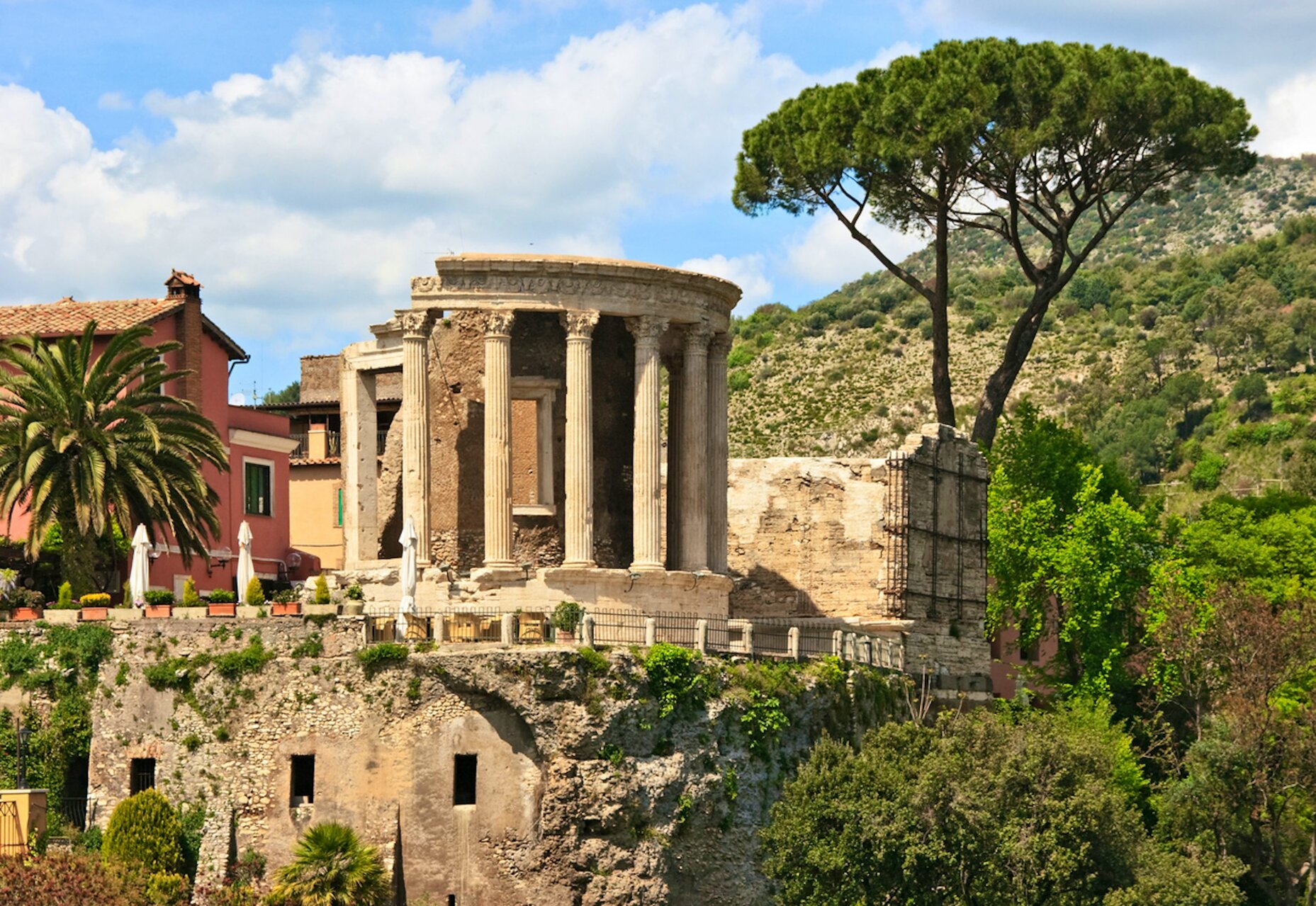
Above the gorge, on a terrace that projects over the void with the self-confidence of a building that has been standing here, in one form or another, since the first century BC, stand two of the most beautifully situated ancient temples in Italy. The circular Temple of Vesta, its twenty columns of travertine marble forming a ring above the precipice, is the building most often reproduced in the paintings of Tivoli from the seventeenth century onward, and it continues to justify every representation: the combination of the delicate Corinthian order, the circular plan and the vertiginous setting above the falling river is one of those combinations of architecture and landscape that justifies the word sublime in its original philosophical sense, the sense in which sublimity is distinguished from mere beauty by the presence of danger and of scale that overwhelms the human. The rectangular temple beside it, conventionally identified as the Temple of the Sibyl though this attribution is not certain, completes the terrace composition with a rougher, more austere presence that contrasts effectively with the circular temple's refined elegance.
Neither temple is open to visitors as a building. What you can do is stand on the terrace beside them and look down. The gorge drops away below with a sheer immediacy that always induces, in those who have not stood here before, a reflexive step backward. Then look up: the medieval tower of the Rocca Pia rises on the hillside above, and beyond it the tiles and campaniles of the town crowd toward the edge of the plateau with the compact energy of a settlement that has been filling this particular ridge for three thousand years without ever quite having enough space. The Romans were right to love this place. They were simply unable, with the instruments available to them, to fully explain why.
Villa Gregoriana: The gorge of the Aniene below Tivoli is the setting for the Villa Gregoriana, a romantic landscape garden created in 1835 by Pope Gregory XVI by diverting the Aniene through a tunnel cut in the rock to create the Grande Cascata and protect the town from flooding. The park, which descends steeply through the gorge on a network of paths and steps, contains extraordinary views of the waterfall, the ancient temples above and the Roman ruins along the valley walls. Managed by the FAI (Fondo per l'Ambiente Italiano), it is open to visitors with a separate ticket and deserves at least an hour if you have the energy for a descent and return climb. The energy will be repaid.
Where to Eat and What to Drink in Tivoli
Tivoli's restaurants operate at the intersection of two culinary traditions: the cucina romana of the capital thirty kilometres to the west, with its cacio e pepe and its coda alla vaccinara, and the more rural tradition of the Lazio hills, with its lamb, its porcini mushrooms in season and its particular relationship with the legumes and the vegetables of the volcanic soil. The combination produces a local table of considerable quality and complete unpretentiousness, and the best places to experience it are the trattorie in the streets behind the main piazza, away from the establishments that have adapted their menus for the coach-tour trade.
Look for agnello alla tivollese, lamb braised with white wine, rosemary and garlic in the method particular to this part of the hills, served on a bed of chicory or broad beans depending on the season. Look for supplì and fiori di zucca fritti as starters, both standard Roman antipasti that the Tivoli kitchens execute reliably. In autumn, when the porcini arrive from the surrounding hills, the pasta with mushrooms is worth seeking out specifically. The local white wine, produced in the Castelli Romani area to the south, is honest, cold and perfectly adequate for the purpose of washing down a lunch that you will remember not for its gastronomic ambition but for the completeness of the pleasure it provides: good food, good wine, shade from the midday sun, and the knowledge that you have spent the morning well.
For those who prefer to carry a picnic into Hadrian's Villa, the morning market in the centre of Tivoli supplies everything needed: bread from the bakeries on the Via Palatina, local cheese, cured meats and fruit. The Villa has adequate picnic areas, and eating in the shade of a pine tree above the ruins of the Maritime Theatre is one of the more quietly satisfying lunches available within thirty kilometres of Rome.
Best Time to Visit and Common Mistakes
The finest seasons for Tivoli are spring and early autumn, and within those seasons the finest months are April, May, September and October. In April and May, the gardens of Villa d'Este are in full flower, the wisteria along the upper terraces is in bloom and the light in the early morning at Hadrian's Villa has a clarity that the summer haze erases. In September and October, the harvest is under way in the surrounding hills, the tourist numbers have fallen from their August peak, and the quality of the afternoon light in the garden at Villa d'Este takes on the golden richness that is the Lazio autumn's particular gift to those who seek it.
The most common mistake that visitors make at Tivoli is attempting to see both major sites in half a day. They arrive at Hadrian's Villa at eleven, spend ninety minutes rushing through the standard circuit without going off-route, eat lunch at a restaurant near the car park, visit Villa d'Este for an hour and leave by four. This is not a visit to Tivoli. It is a record of having been in the vicinity. Hadrian's Villa requires at minimum three hours to experience rather than document. Villa d'Este requires two. The town of Tivoli itself, which most visitors never properly enter, deserves an additional hour. A full day is the correct allocation, and a half-day is an act of disrespect to one of the finest landscapes within reach of Rome.
The second common mistake is visiting Villa d'Este when the fountains are not running. The hydraulic system requires regular maintenance and is occasionally partially shut down for repairs. Always check the official website before your visit to confirm that the fountains are operational. A Villa d'Este without its fountains is architecturally interesting but experientially incomplete, and the anticipation of the water is too central a part of what makes the garden what it is to be easily substituted by imagination alone.
Comments
No comments yet. Be the first to share your thoughts!
Leave a Comment
Your comment will appear after moderation.