 Michelle
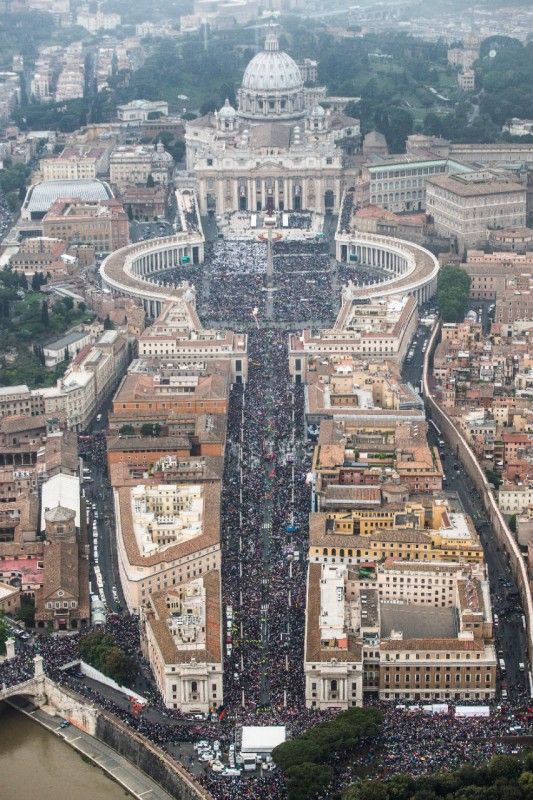
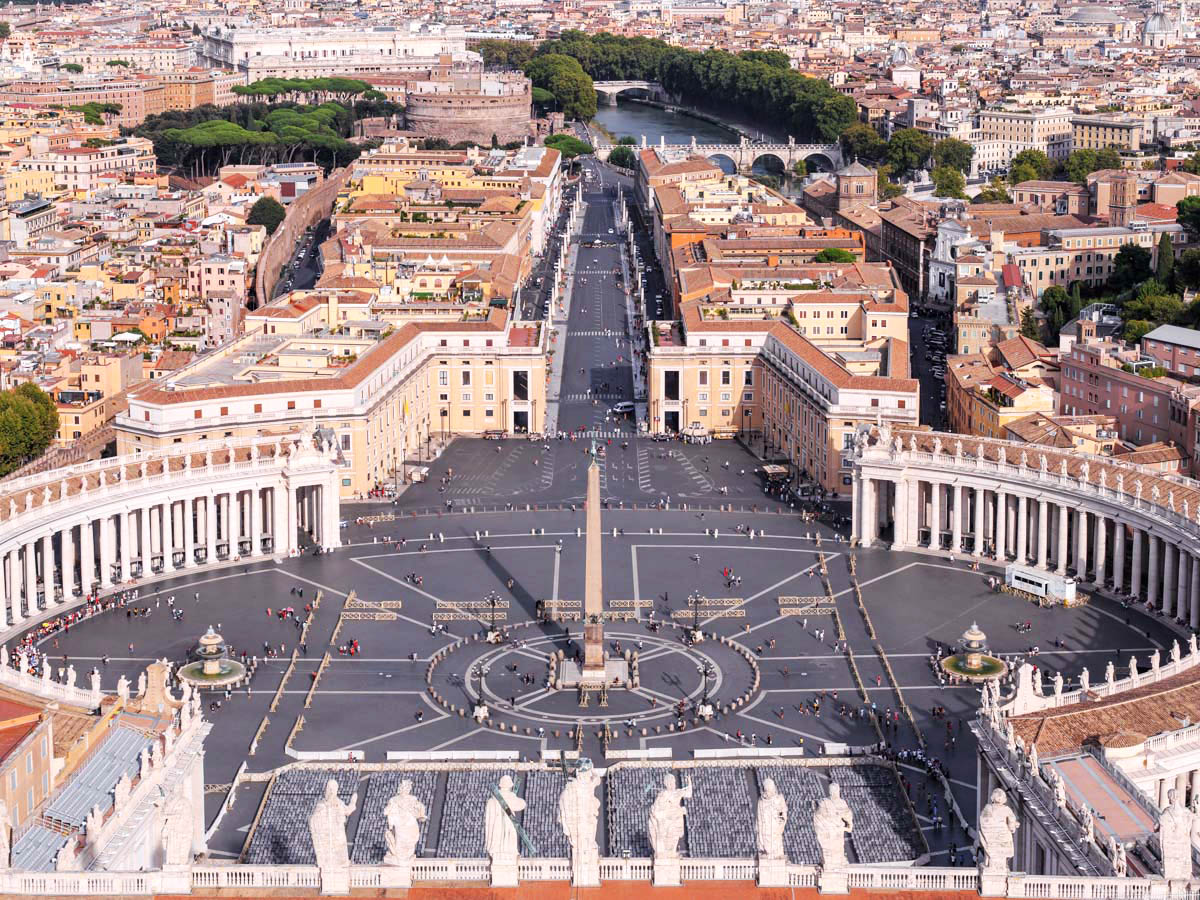
 Come with me. It is early morning, not yet eight o'clock, and the light that falls across the Via della Conciliazione is still the pale, hesitant light of a Roman dawn, not yet committed to warmth. The piazza, designed by Gian Lorenzo Bernini to receive the world and hold it in a civic embrace of colonnade and travertine, is nearly empty. A pair of Swiss Guards stand at their posts in their Renaissance finery, motionless as painted figures. A nun crosses the cobblestones with the rapid, purposeful step of someone with an appointment with God. We are going into Saint Peter's Basilica, and we are going in at the right hour, which is the hour before the rest of the world arrives. There is, I will tell you now, no other way to do this properly.
Before the Basilica: The Ground on Which It Stands
The hill on the right bank of the Tiber that we call the Vatican was not always holy ground. In the time of the early Republic, it was marshy, unhealthy and largely uninhabited: the Romans called it the ager Vaticanus and regarded it with a faint distaste that found expression in the slang word vaticinium, a prophecy of doubtful authenticity, as if even the etymological roots of the place were tinged with suspicion. The Emperor Caligula began the construction of a circus on the hill's southern slopes around 37 AD, and his successor Nero completed and enlarged it. This circus, the Circus of Nero, was the setting for the first organised persecutions of Christians in Rome, and it was here, according to the tradition that the Church has maintained with unwavering consistency since the earliest period, that the Apostle Peter was executed, probably by crucifixion, during the persecutions of Nero in approximately 64 or 67 AD.
The tradition holds further that Peter was buried in the cemetery that adjoined the circus, in the ordinary fashion of the time, in a simple grave marked by a small monument. This grave became, within a generation of Peter's death, a place of pilgrimage for the Roman Christian community, and the site around it gradually accumulated the character of a sacred precinct: not through any official declaration, which in the circumstances of the early Christian period would have been impossible, but through the accumulated devotion of those who came to pray at the place where the leader of the Apostles lay. In 324 AD, the Emperor Constantine, newly converted to Christianity and disposed to express his faith in the grandest architectural terms available to the ruler of the world's largest empire, ordered the construction of a basilica over the grave.
Constantine's basilica was a structure of considerable size and elaborate decoration, its nave flanked by double aisles and its apse positioned directly over the tomb of the Apostle. It stood for twelve centuries, accumulating the gifts and the embellishments of successive popes, emperors and pilgrims, until by the early fifteenth century it had become a building simultaneously magnificent in its historical associations and alarmingly decrepit in its physical condition. The walls leaned. The roof threatened. The decision to demolish it and begin again was, from any perspective other than that of sentiment, both inevitable and catastrophically bold: the Church was proposing to destroy the oldest and most sacred basilica in the Christian world in order to build a new one. The argument this decision provoked, and the hundred and twenty years of architectural competition it initiated, produced Saint Peter's as we know it today.
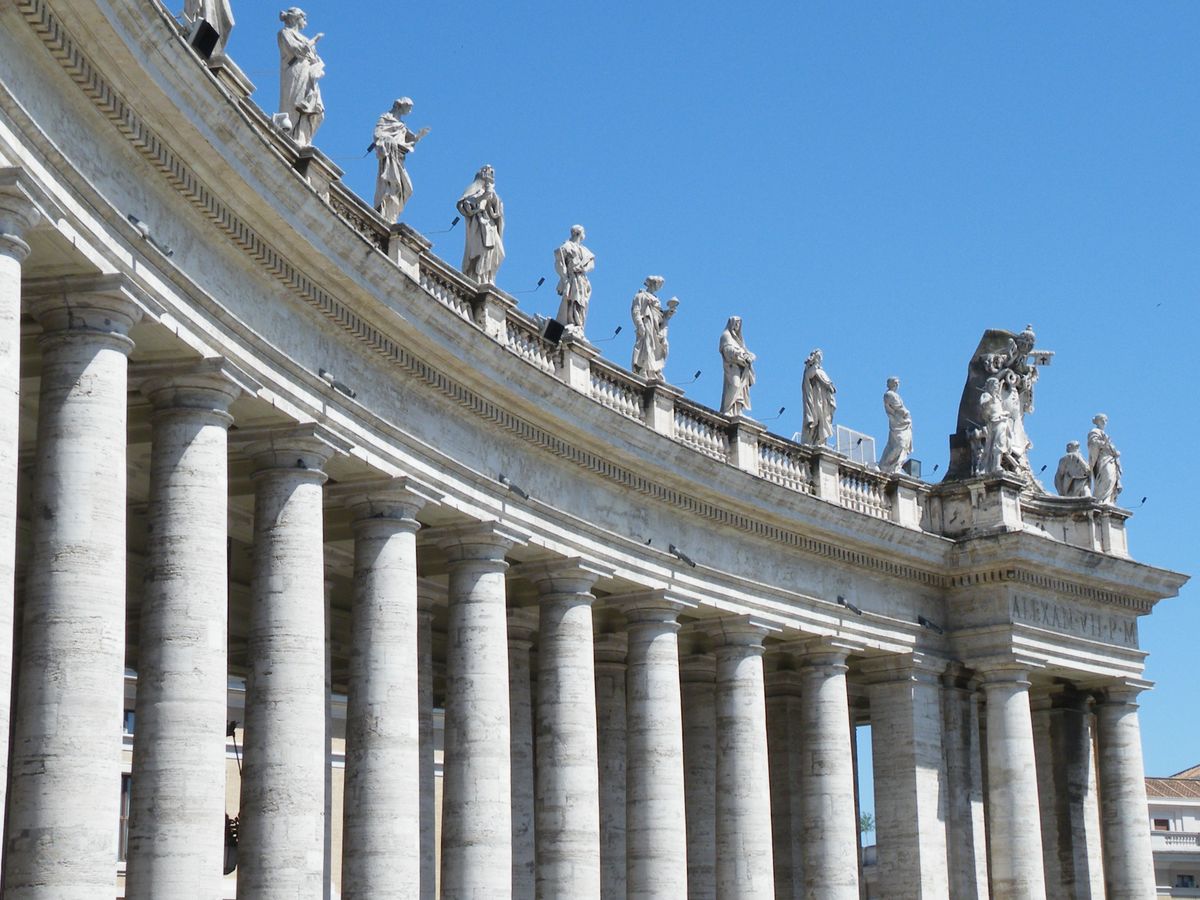
A curiosity most visitors miss: In the pavement of Saint Peter's Square, set into the stone of the right arm of Bernini's colonnade, there is a small circular disc marked with the word centro. Stand on this disc, and the four rows of Bernini's colonnade, which appear from any other point to be a confused forest of columns, resolve perfectly into a single line. It was designed so. Bernini arranged four hundred columns to produce a single theatrical effect, visible from precisely one point. That point is marked for you. Stand on it.
The Architects and Their Long Argument: Bramante to Michelangelo
Pope Julius II, one of the most formidable and least pious men ever to occupy the chair of Saint Peter, laid the first stone of the new basilica on 18 April 1506, to a design by Donato Bramante that called for a centrally planned building on a Greek cross plan, surmounted by a dome that Bramante himself described as the Pantheon placed on top of the Basilica of Maxentius. Julius was 62 years old when he laid that stone. He was dead within seven years, and Bramante was dead within eight. The building that rose from their combined ambition would not be completed for another century and a quarter, and would pass through the hands of Raphael, Antonio da Sangallo the Younger, Baldassare Peruzzi, Giacomo della Porta and, most consequentially of all, Michelangelo Buonarroti before it reached anything approaching its final form.
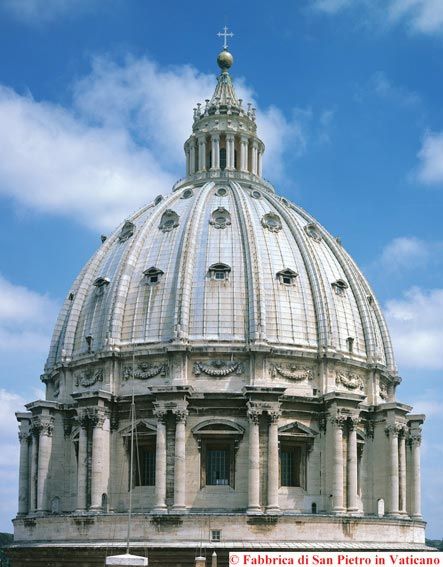
Michelangelo was seventy-one years old when Pope Paul III appointed him chief architect of Saint Peter's in 1546, four decades after Bramante had laid the foundation stone. He accepted the commission without payment, describing his willingness to serve as an act of devotion to God and the memory of the Apostle. He demolished much of what his predecessors had built, returned to something close to Bramante's original concept of a centralised plan, and designed the drum and dome that are the building's supreme architectural achievement. He worked on the basilica for seventeen years, until his death in 1564 at the age of eighty-eight, and he left the drum of the dome complete. His design for the dome itself was carried out, with some modifications, by Giacomo della Porta and Domenico Fontana, who completed it in 1590.
Carlo Maderno added the nave and the facade in the early seventeenth century, transforming the building from a centralised to a longitudinal plan and, in the judgement of many architects since, obscuring Michelangelo's dome from the view of anyone standing in the piazza below. The controversy this decision provoked has never entirely subsided. Gian Lorenzo Bernini, who redesigned the piazza and added the colonnade between 1656 and 1667, chose a low, sweeping design for his oval that was explicitly intended to open views of the facade and as much of the dome as the nave's addition permitted. The problem, in the end, is insoluble: the dome is best seen from a distance, and the building best experienced from within. Both propositions are correct. They are merely incompatible.
Morning in the Nave: What to Look at and Why
We pass through the bronze doors at the centre of the portico, which are the original doors of the old Constantinian basilica, cast between 1433 and 1445 by Antonio Filarete, and we stop. This is the essential moment, and I ask everyone I bring here to stop and be still for at least thirty seconds before moving further. The nave of Saint Peter's is 186 metres long, 46 metres wide and 46 metres high under the barrel vault. These numbers mean nothing until you are standing in it and looking forward toward the baldacchino and the apse, and the scale of the thing makes its own kind of demand on the nervous system. It is not the largest interior space in the world, but it gives the most powerful impression of size of any enclosed space I have entered in thirty years of visiting churches, and I believe I understand why.
The explanation lies in a quality of the building that is most apparent on a first visit and tends to diminish as familiarity increases: Saint Peter's is designed to deceive the eye about scale in a very specific direction. Everything in the building is proportioned to appear correctly sized from the entrance, which means that as you move forward and your perspective shifts, the objects that seemed correct at a distance reveal themselves to be very much larger than you assumed. The putti supporting the holy water stoups near the entrance doors appear, from the portico, to be approximately the size of children. As you approach them, you realise they are nearly one and a half metres tall. The lettering of the inscription that runs around the interior of the dome, in which Christ charges Peter with the keys to the Kingdom, appears from the nave floor to be of modest size. Each letter is two metres tall. This systematic calibration of expectation is not accidental. It is the accumulated wisdom of the greatest architectural minds of the High Renaissance, brought to bear on the problem of making a building feel both comprehensible and sublime.
Begin on the right side of the nave and work methodically. The first chapel on the right, the Cappella della Pieta, requires its own treatment and its own time. Beyond it, in the order of the right aisle, you will encounter the tomb monuments of Popes Innocent XII and Pius X; the Altar of Saint Sebastian with its mosaic after Domenichino; and the richly marbled Chapel of the Most Blessed Sacrament, the only space in the basilica reserved exclusively for prayer and closed to tourist circulation, its gilded bronze tabernacle designed by Bernini, its golden apse gleaming with the concentrated devotion of centuries. Even if you cannot enter, stand at the door for a moment. The atmosphere of a place where continuous adoration of the Blessed Sacrament has been maintained, without interruption, since the seventeenth century, is something that does not require religious conviction to perceive.
The markers in the floor: Set into the marble pavement of the nave are a series of inscriptions marking the lengths of the world's great churches in comparison to Saint Peter's. Salisbury Cathedral ends here. Saint Paul's Cathedral in London ends there. The Duomo of Milan, long considered the most ambitious Gothic building in Italy, falls short by a significant margin. These markers are a remarkable act of architectural self-confidence: a church that is so large it can afford to use the lengths of its rivals as interior decoration.
The Pieta: A Young Man's Perfect Work
The Pieta stands in the first chapel on the right, behind a wall of bulletproof glass installed after a Hungarian geologist named Laszlo Toth attacked the sculpture with a hammer in 1972, removing Mary's nose and damaging the left arm before he was pulled away by bystanders. The restoration, carried out by Vatican craftsmen who reassembled the fragments with extraordinary care, is essentially invisible to the naked eye. The glass is less satisfactory: it creates a reflective barrier between the viewer and the marble that softens the precise quality of Michelangelo's carving and removes the work from the physical world in which it was intended to exist. This is unfortunate but, given what happened in 1972, unavoidable.
The Pieta was carved between 1498 and 1499, when Michelangelo was twenty-three or twenty-four years old. It was commissioned by a French cardinal, Jean de Billhères, who wanted a funerary monument for his own tomb in the old Constantinian basilica. The commission specified a Virgin holding the body of Christ, a subject common in northern European art but relatively rare in Italian sculpture at the time, and Michelangelo produced from a single block of Carrara marble a work that has been described, in every century since its creation, in terms that struggle against the inadequacy of language when faced with the adequate of stone.
What strikes most visitors first is the apparent youth of the Virgin. Mary, holding the dead body of her adult son across her lap, looks younger than he does, younger by decades, a quality that troubled contemporaries enough to prompt Michelangelo to address the question directly. He is reported to have explained that a chaste woman retains her youth far longer than one who is not, and that the Virgin's purity had preserved her from the ravages of age. This is a theologically coherent answer that leaves the artistic problem exactly where it is: the Mary of the Pieta looks, by any naturalistic standard, impossibly young. What Michelangelo understood, and what the years of looking at this work confirm, is that the youth of the Virgin is not a naturalistic claim. It is a timeless quality. Mary is not depicted at a specific age in a specific year. She exists outside time, in the grief that does not pass and the beauty that does not decay.
Look, before you move on, at the left hand. Not the hand that supports Christ's body, which is concealed within the drapery, but the open left hand, extended slightly in a gesture that carries more emotional weight than almost any other gesture in Western art. It is not quite supplication, not quite offering, not quite despair. It is a hand in the presence of something it cannot hold and cannot release. I have been looking at that hand for thirty years and I have not finished with it yet.
Michelangelo's only signature: On the sash that crosses the Virgin's chest, Michelangelo carved his name in Latin: MICHAEL ANGELUS BONAROTUS FLORENTIN FACIEBAT, Michelangelo Buonarroti the Florentine made this. It is the only work he ever signed, and the tradition holds that he did so after overhearing a group of Lombard visitors attributing the sculpture to a Milanese master named Cristoforo Solari, at which point the young Florentine returned that night with his tools. Whether the story is true or invented, the signature is there, cut with a deliberateness that suggests something more than vanity. It is a claim of authorship in the most unambiguous form. This is mine. Remember my name.
Bernini's Baldacchino and the High Altar: Bronze from the Pantheon
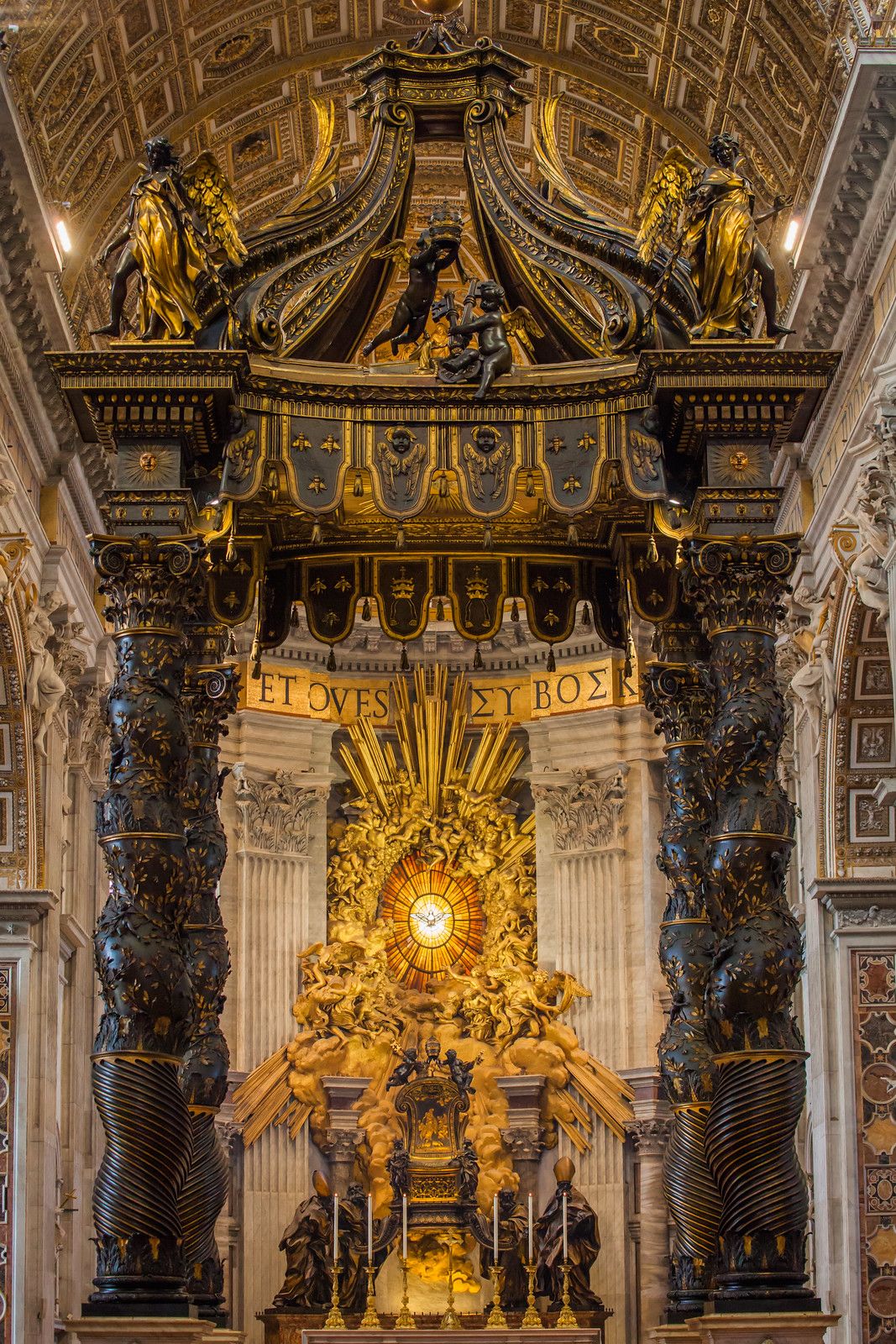
We move down the nave toward the crossing, where Michelangelo's dome rises above us and Bernini's baldacchino occupies the space beneath with a physical presence so overwhelming that it takes some time to adjust to its scale. The baldacchino, the great canopied structure of twisted bronze columns that marks the high altar directly above the tomb of the Apostle, was commissioned by Pope Urban VIII in 1623 and completed in 1634. It stands 29 metres tall, the height of a nine-storey building, and it was constructed from bronze stripped from the portico of the Pantheon, a decision so brutal in its pragmatism and so characteristic of baroque Rome's willingness to pillage the ancient world for its own glorification that it prompted the famous satirical epigram: Quod non fecerunt Barbari, fecerunt Barberini, what the Barbarians did not do, the Barberini did. Urban VIII was born Maffeo Barberini. His family's bees appear on the baldacchino's crowning canopy, a gesture of dynastic self-commemoration that would have struck the Apostle Peter, one imagines, as somewhat beside the point.
The twisted columns of the baldacchino are a baroque reimagining of the spiral columns that stood in Old Saint Peter's, which were themselves said to have been brought from the Temple of Solomon in Jerusalem. This genealogy is almost certainly legendary, but the legend is the point: the baldacchino situates itself within a chain of sacred architecture stretching from the Jerusalem of the Old Testament through the Rome of the Apostles to the Rome of the Counter-Reformation popes, and the twisted form of its columns is a deliberate act of continuity with the most venerable objects in the Christian architectural tradition.
The high altar beneath the baldacchino is used exclusively by the Pope for his liturgical functions. No other priest may celebrate Mass at this altar without a specific papal dispensation, a restriction that underlines the peculiar theological geography of the space: everything at the centre of Saint Peter's is ordered around a point of absolute specificity, the tomb of the Apostle, from which the Pope's authority is understood to derive, and to which every element of the building's design directs the eye and the mind.
The Throne of Saint Peter and the Chair of Unification
Before we descend beneath the floor, look to the apse at the far end of the basilica, where Bernini's gilded bronze Cattedra Petri, the Chair of Saint Peter, fills the entire western termination of the building with a theatrical intensity that is either the supreme achievement of baroque religious art or its most embarrassing excess, depending on your temperament and your theology. The Cattedra, completed in 1666, is an enormous reliquary enclosing what was believed in the seventeenth century to be the actual wooden chair from which Saint Peter taught the Roman Christian community: the throne of the first pope, the physical seat of apostolic authority.
The modern scholarly consensus holds that the wooden object inside the bronze reliquary is not of Roman date but Carolingian, probably a gift from Charles the Bald to Pope John VIII in 875 AD. The Chair of Peter that Bernini enclosed in his gilded casement is, in all likelihood, a medieval throne rather than an apostolic one. This discovery, which became widely known in the twentieth century, has not diminished the theological or the emotional significance of the Cattedra for those who come to it in faith, nor has it diminished its artistic importance for those who come to it in search of the supreme achievement of baroque decoration. Above the reliquary, a window of amber glass depicts the dove of the Holy Spirit in a blaze of gold and stucco light that, in the right conditions of morning illumination, produces an effect of gilded radiance that bathes the entire apse in the colour of spiritual gold. The right conditions arrive roughly between nine and ten in the morning, when the sun is at the correct angle to the window. We have timed our arrival accordingly.
The Rooms That Visitors Never See
Saint Peter's Basilica is not simply the building you walk through as a visitor. It is a complex of interconnected spaces, archives, sacristies, workshops, administrative offices and storage areas that constitute, in effect, a small city within the Vatican City, most of which is permanently closed to the public and known only to the Chapter of Saint Peter's, the body of canons responsible for the basilica's liturgical life and daily administration.
The Sacristy of Saint Peter's, the great neoclassical building attached to the left flank of the basilica and completed in 1784, is sometimes overlooked by visitors who do not realise it is accessible. It contains the Treasury of Saint Peter's, a small but remarkable museum of objects associated with the basilica's history: a fourth-century bronze rooster that served as a weathervane on the old Constantinian basilica; the Crux Vaticana, a sixth-century gold and jewelled cross presented to the basilica by the Emperor Justinian; Michelangelo's Pieta documentation; and a series of papal vestments and liturgical objects of outstanding quality. The Sacristy itself, its great circular hall lit by a lantern above, is one of the finest neoclassical interiors in Rome and is almost never mentioned in the standard guides.
The Chapter Archive, housed in rooms adjacent to the sacristy, contains the administrative records of the basilica from the medieval period onward, including documents related to the construction of the present building, the accounts of the Fabbrica di San Pietro, the construction office that managed the work, and a remarkable series of architectural drawings by the building's successive architects. This archive is not accessible to the general public and requires a specific scholarly application to consult, but its existence is worth knowing: the complete administrative history of the most important building project in the history of Western architecture is preserved here, from the first stone laid in 1506 to the present day.
The roof terrace of the basilica, the broad flat area above the nave that visitors reach on the way to the dome, is one of the most extraordinary urban landscapes in Rome and one of the least appreciated stops on the standard visitor's itinerary. From the roof, you stand among the giant apostles and saints whose statues line the balustrade of Maderno's facade, each one several metres tall, looking down at the piazza from a height of forty-five metres. Behind you, the drum of Michelangelo's dome rises from a forest of smaller domes and towers. In front of you, Rome spreads to every horizon. A coffee at the small bar on the terrace, if it is open, is one of the more refined refreshments available in the city.
The bells of Saint Peter's: The basilica has six bells, housed in the north tower of the facade. The largest, known as the Campanone, weighs approximately 8,900 kilograms and is rung only on special occasions: the death of a pope, the election of a new one, and a small number of the highest feast days. When the Campanone rings, its sound carries across the entire city of Rome with a resonance that penetrates walls and windows and the ordinary noise of urban life with an authority that is, whatever one's beliefs, genuinely arresting. If you are in Rome when it rings, stop what you are doing and listen.
Beneath the Floor: The Vatican Grottoes and the Papal Tombs
Behind the baldacchino, a staircase descends beneath the floor of the basilica to the Vatican Grottoes, a low, vaulted space that occupies the area between the floor of the present basilica and the floor of the old Constantinian basilica below it: an architectural sandwich of the most remarkable kind, in which the medieval floor level is preserved as an inhabited space, lined with papal tombs and chapels, immediately below the feet of the visitors above.
The Grottoes are the burial place of most modern popes, and the atmosphere of the space, cool and quiet and lit by the pale glow of devotional lamps, is unlike anything in the basilica above. Here is the tomb of John Paul II, simply marked with his name and his dates, perpetually surrounded by flowers and the presence of those who come to pray. Here is John Paul I, the smiling pope who died after thirty-three days in office in 1978, whose tomb is small and whose death remains, for those of a conspiratorial temperament, one of the unsolved mysteries of the modern Vatican. Here is Paul VI, who chose to be buried without a monument, his grave marked by a plain slab of white travertine. Here are the tombs of Boniface VIII, who made the extraordinary claim that submission to the Roman pontiff was necessary for salvation, and of Christina of Sweden, the warrior queen who abdicated her throne to convert to Catholicism and spent the rest of her life in Rome. The Grottoes are free to visit and open during basilica hours. Almost no queue forms. They are, in my experience, one of the most profoundly moving spaces in the entire Vatican complex.
Deeper Still: The Necropolis and the Tomb of the Apostle
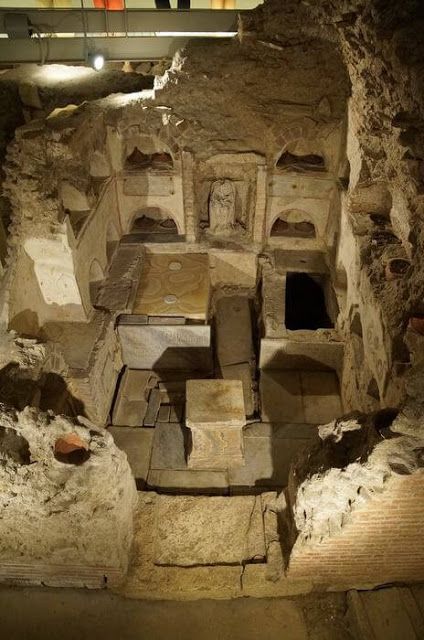
Below the Grottoes, accessible only by prior reservation and in small guided groups, lies the most sacred and the most archaeologically extraordinary space in all of Vatican City: the Necropolis, the ancient Roman cemetery whose excavation between 1939 and 1949, ordered by Pope Pius XII and conducted in secrecy beneath one of the most scrutinised buildings in the world, produced one of the most significant archaeological discoveries of the twentieth century.
The excavation was initiated by an apparently modest practical need: Pope Pius XI had requested burial in the Vatican Grottoes, and the available space was insufficient to accommodate him without lowering the floor. The workmen who began to lower the floor discovered, at a depth of approximately one metre, the brick wall of a Roman mausoleum. They kept digging. Within weeks, they had uncovered an entire street of mausoleums, some of them elaborately decorated with frescoes and mosaics, most of them dating to the second and third centuries AD, arranged in the orderly fashion of a prosperous urban necropolis. The street ran east to west, directly beneath the central nave of the basilica, and it terminated at a specific point: the point directly below the high altar, directly below the baldacchino, directly below the place that every pope from the fourth century onward had indicated as the burial site of the Apostle Peter.
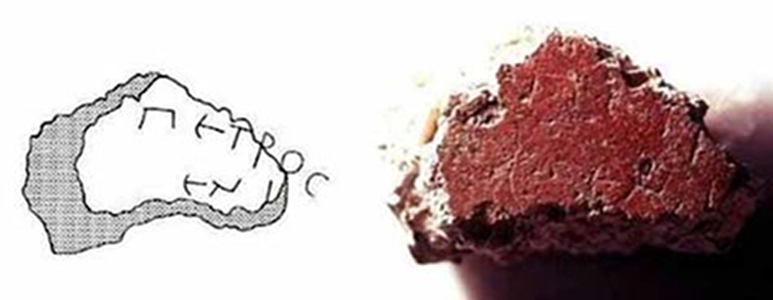
At that point, the excavators found a structure of particular significance: a small aedicula, a niche monument, built into the red plaster wall and dating, on the basis of the stratigraphic evidence and the associated material, to approximately 160 AD. This is the trophaion, the trophy or monument, mentioned by the Roman priest Gaius in a text dating to around 200 AD, when he wrote of being able to show the visitor the tropaia of the apostles who founded the Roman church: Peter's on the Vatican hill, Paul's on the Ostian Way. The excavators had found the monument that Gaius described. Beneath and around it, in the earth that had been disturbed and re-disturbed by centuries of veneration, they found human bones. The question of whether any of those bones belonged to the Apostle Peter was, and remains, one of the most intensely contested questions in the entire field of religious archaeology.
The guided tour of the Necropolis is one and a half hours long, covers approximately 300 metres of underground passage, and terminates at the area below the high altar where visitors can see the aedicula and the remains of the monument. It is the most extraordinary guided experience available anywhere in Rome, and the reservations required to access it are correspondingly difficult to obtain. Book as far in advance as possible through the Ufficio Scavi, the Vatican Excavations Office, accessible via the official Vatican website. No visit to Saint Peter's is complete without it, even if the logistical effort required to arrange it is considerable.
The bones in the wall: In 1950, during the original excavations, a Vatican archaeologist named Margherita Guarducci noticed that a repository in the red wall, near the aedicula, contained a collection of bones wrapped in purple and gold cloth. They had been removed from the repository sometime in the 1940s and placed in a storage box, then apparently forgotten. Guarducci had the bones examined, and the analysis suggested they belonged to a robust man of approximately sixty to seventy years of age, consistent with what ancient sources record of Peter's age at his death. In 1968, Pope Paul VI announced that the bones had been identified with "moral certainty" as those of the Apostle. The scholarly debate about this identification continues. The bones are in the repository in the red wall, where they have been, perhaps, for nearly two thousand years.
Climbing the Dome: Michelangelo's Engineering Examined from Within
In the afternoon, we climb. There are two options: the lift, which takes you to the drum level at the base of the dome and from which you complete the ascent on foot through the space between the inner and outer shells of the dome; and the staircase, which takes you all 551 steps on foot from the roof terrace to the summit of the lantern. I recommend the staircase on every occasion that the visitor's physical condition permits it, for a reason that has nothing to do with exercise and everything to do with architecture.
As you climb the internal staircase of the dome, you pass through the space between the two shells that Michelangelo designed as an engineering solution to the problem of stability. The dome is not one dome but two: an inner shell of brick, spherical in profile, and an outer shell of brick, pointed in profile, separated by a gap of approximately one metre and connected by a series of brick ribs that transfer the enormous lateral thrust of the dome's weight outward and downward into the drum and thence into the massive piers of the crossing. As you climb between the shells, you can see and touch this engineering: the ribs, the brickwork, the geometry of the construction, all exposed to inspection in the tight space of the ascending corridor. The staircase becomes progressively narrower and steeper as it approaches the lantern, and in the final section it follows the curvature of the inner shell closely enough that you must lean outward against the outer wall as you climb. This is Michelangelo's dome from the inside, and there is nowhere else in the world where you can have a comparable experience.
From the external gallery of the lantern, 136 metres above the piazza below, Rome presents itself in its full panoramic complexity: the Tiber making its slow bend through the city, the Castel Sant'Angelo on its right bank, the dome of the Pantheon just visible among the rooftops of the historic centre, the Victor Emmanuel monument gleaming white on the Capitoline Hill, Bernini's colonnade from above reduced to a geometric abstraction of oval and straight line. On a clear day, the Alban Hills are visible to the southeast, and the Apennines to the east, and the first pale glitter of the Tyrrhenian Sea to the west. You have earned this view. Take the time it deserves.
The inscription in the dome: The Latin text that runs around the interior of the dome, visible from the nave floor, reads in full: TV ES PETRVS ET SVPER HANC PETRAM AEDIFICABO ECCLESIAM MEAM ET TIBI DABO CLAVES REGNI CAELORVM. Thou art Peter, and upon this rock I will build my Church, and to thee I will give the keys of the Kingdom of Heaven. The text is from the Gospel of Matthew, chapter 16, verse 18, and it is the foundational scriptural text of the doctrine of papal primacy. Each letter of the inscription is two metres tall. Read from the gallery of the dome, the complete text occupies the full circumference of the interior. Michelangelo calculated the height and size of the letters so that they would read correctly from the floor of the nave, 42 metres below. He never saw the completed dome. He died in 1564, twenty-six years before it was finished.
Practical Information: Getting There and Planning Your Day
Saint Peter's Basilica is located in Vatican City, the world's smallest independent state, which occupies an enclave within the city of Rome on the right bank of the Tiber. The most convenient public transport connection is the Metro Line A, which stops at Ottaviano (San Pietro), from which the basilica is a ten-minute walk. Alternatively, numerous bus lines from across the city stop at the Lungotevere in Sassia, a short walk from the southern colonnade of the piazza.
From Rome's main airports, the most comfortable option is a private airport transfer directly to the Vatican area or to your hotel in the vicinity. From Fiumicino Airport, the journey takes approximately 30 to 45 minutes with a fixed price and door-to-door service. From Ciampino Airport, approximately 30 to 40 minutes. Both options eliminate the need to navigate the Leonardo Express and the Metro with luggage, and deliver you to the area around the basilica at any hour that your flight arrival requires.
Dress code is strictly enforced at Saint Peter's: shoulders and knees must be covered for both men and women. Visitors in shorts or with bare shoulders will be refused entry. Paper coverups are sometimes available at the entrance, but it is wiser and more dignified to plan ahead. The Blessed Sacrament Chapel is open for private prayer only: cameras, guided tours and tourist visits are not permitted inside.
Comments
No comments yet. Be the first to share your thoughts!
Leave a Comment
Your comment will appear after moderation.