 Michelle
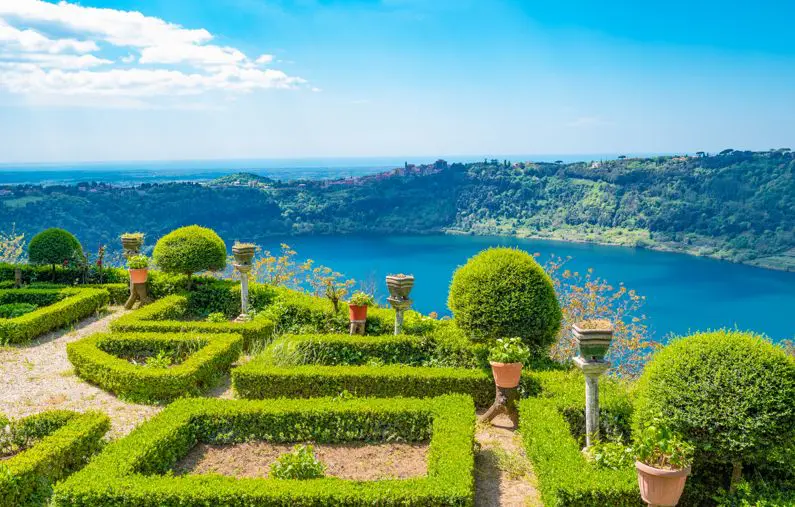
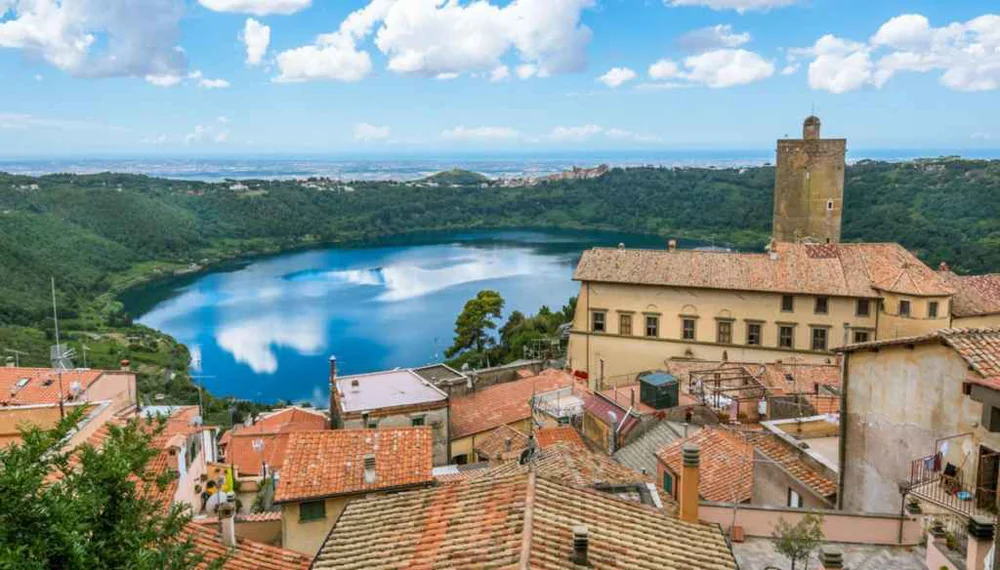
 There are festivals that celebrate wheat, wine, olive oil, cheese, truffles, fish, porchetta and a hundred other products of the Italian earth. But only one festival in Italy celebrates a fruit so small, so fragile, so intensely fragrant that it can scarcely be transported more than a few kilometres from where it grows. That festival is the Sagra della Fragola di Nemi, the Strawberry Festival of Nemi, and it is the oldest food festival in the country. Founded in 1922, the year before Mussolini marched on Rome, it has survived wars, floods, earthquakes, economic miracles and economic crises. It has never missed a single year. And at its heart is a tiny wild strawberry, the fragolina di Nemi, a berry the size of your thumb nail, red as a ruby, fragrant as a rose, and so delicate that it must be eaten within hours of being picked. Nemi itself is a village perched on the rim of a volcanic crater, overlooking a perfectly circular lake that the Romans believed was sacred to the goddess Diana. The view from the village square is one of the most beautiful in Lazio. The flavour of the strawberries is one of the most beautiful in Italy. This is the story of both.
The Fragolina di Nemi: A Wild Strawberry Unlike Any Other
The fragolina di Nemi is not the strawberry that you know from supermarkets. It is not large, bright red, uniformly shaped, or capable of surviving a week in a refrigerated lorry. It is Fragaria vesca, the wild strawberry, the woodland strawberry, the berry that grows in the forests and meadows of Europe and has been foraged by humans since the Neolithic period. The Nemi variety, however, is unique. It grows not in the forest but in the volcanic soil of the crater rim, where the ground is rich in potassium, phosphorus and trace minerals washed down from the slopes over millennia. The microclimate of the lake, with its cool nights and warm days, its constant humidity and its sheltered position, produces a strawberry of extraordinary fragrance, a flavour that is sweet, slightly musky, and intensely concentrated, and a texture so delicate that the berries are often stained by the dew that settles on them each morning.
The cultivation of wild strawberries in Nemi is not a modern invention. The Romans knew the strawberries of the Alban Hills. The naturalist Pliny the Elder, writing in the first century AD, described the fragaria of the region as being small but exquisitely flavoured, and he noted that they were gathered for the tables of the Roman nobility. After the fall of Rome, the tradition survived in the monasteries and in the gardens of the local farmers. By the 19th century, Nemi was already famous throughout the Papal States for its strawberries, and visitors from Rome would make the day trip into the hills to eat them fresh, with a dusting of sugar and a splash of the local white wine.
The taste cannot be described. The fragolina di Nemi has a flavour that defies easy description. It is sweet but not cloying. It is fragrant but not perfumed. It has a hint of wildness, a trace of the forest floor, a note of rose and a note of honey and a note of something else that you cannot name. The first time you taste one, you will understand why a festival was built around it. The second time, you will understand why the festival has lasted for more than a century.
The Sagra della Fragola: Italy's Oldest Food Festival
The first Sagra della Fragola was held in Nemi on June 4, 1922. Italy was still recovering from the First World War. Mussolini had not yet seized power. The lira was weak, unemployment was high, and the mood of the country was uncertain. The festival was the idea of a group of local farmers and merchants who saw in the strawberry not just a fruit but a symbol of the resilience and beauty of their village. They decorated the main street with flowers and banners, set up tables in the Piazza Roma, and invited the people of the Castelli Romani to come and taste the strawberries of Nemi, served with fresh cream and sugar. The response exceeded all expectations. Thousands of people came. The festival was declared a success, and the organisers decided to repeat it the following year.
They have repeated it every year since, with one exception: the flood of 1941, when the lake rose so high that the waterfront and the lower streets of the village were inundated, and the festival was postponed until August. It was not cancelled. The people of Nemi do not cancel the Sagra. They postpone it, they relocate it, they hold it indoors if necessary, but they do not cancel it. The festival has survived the Second World War, the German occupation, the Allied bombing, the post war economic crisis, the floods of 1941 and 1953, the earthquake of 1973, the coronavirus pandemic of 2020, and every other disaster that has struck the Castelli Romani in the past century. It is the oldest continuously running food festival in Italy, and the people of Nemi are quietly, deeply proud of this fact.
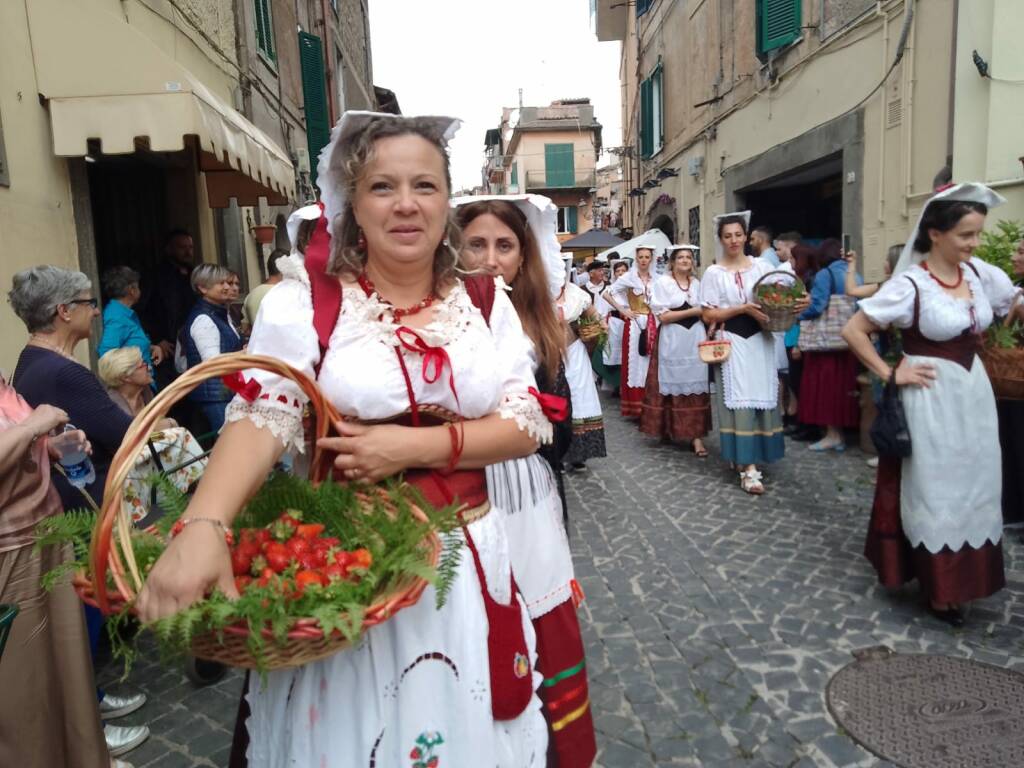
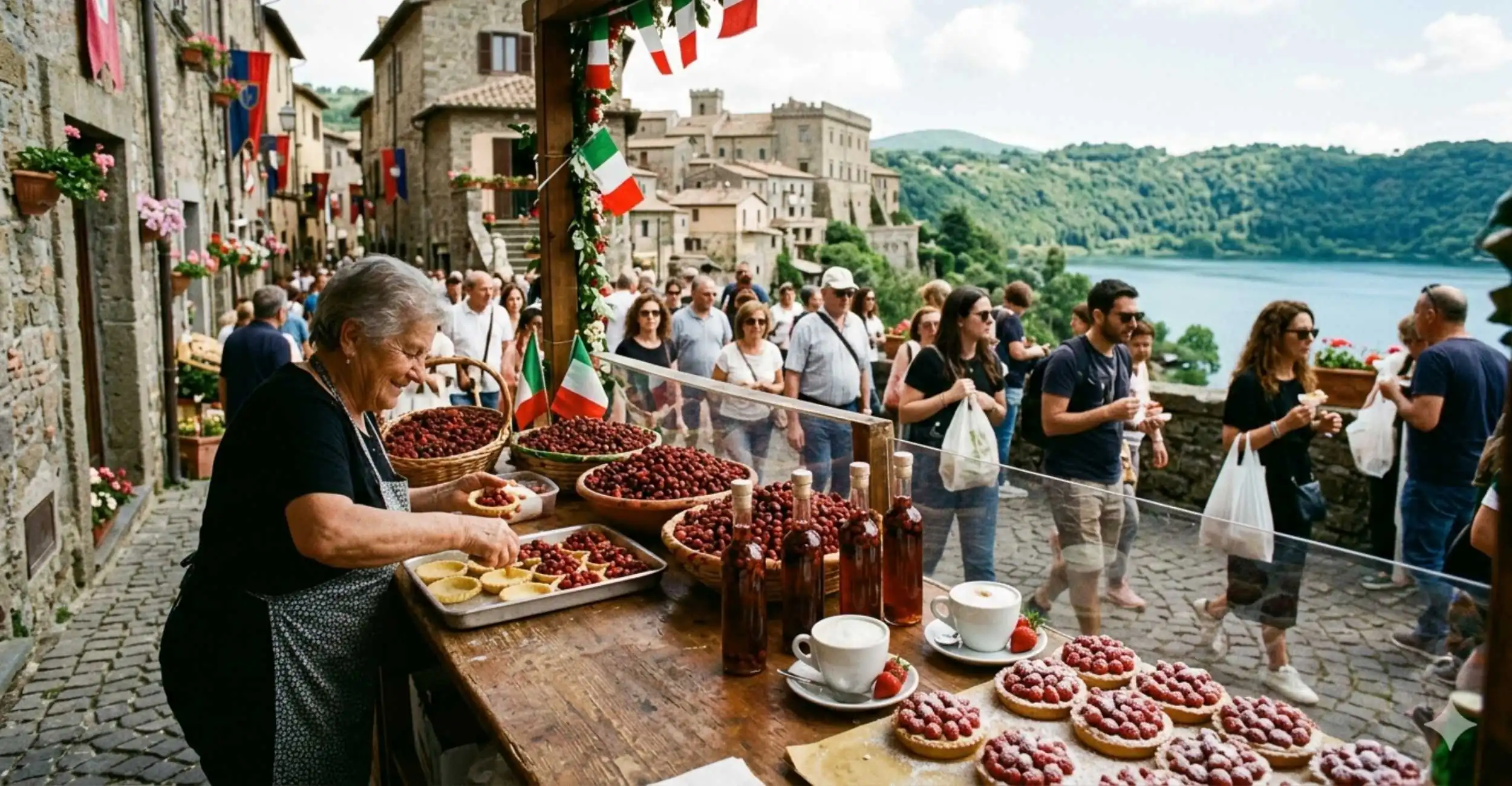
Today, the Sagra della Fragola takes place over three weekends in late May and early June, culminating on the first Sunday of June. The village is transformed: the main street, Via Roma, is lined with stalls selling not just fresh strawberries and strawberry tarts but also strawberry liqueurs, strawberry jams, strawberry gelato, strawberry infused white wine, strawberry chocolate, and a dozen other strawberry based products that the ingenuity of the local bakers and pastry chefs has invented over the years. The historic parade, which takes place on the final Sunday, features hundreds of people in traditional 19th century peasant costume, carrying baskets of strawberries on their heads, dancing to the music of the zampogna (the traditional Italian bagpipe) and the organetto (the small accordion of the Roman countryside). The atmosphere is one of joyful, unpretentious celebration. The strawberries are the stars, but the community is the soul.
The parade is not a performance. The people in the parade are not actors. They are the bakers, the farmers, the shopkeepers, the schoolteachers, the children and the grandparents of Nemi. The costumes are not rented from a theatrical supply company. They are sewn by the women of the village, preserved in wardrobes, and passed down from mother to daughter. When you watch the parade, you are not watching a tourist spectacle. You are watching a community celebrate itself. It is a very different thing.
The Legendary Strawberry Tarts and Other Sweet Traditions
The signature dessert of the Sagra della Fragola is the tortina di Nemi, a small tart made of shortcrust pastry, filled with a light vanilla custard, and topped with fresh fragoline that have been macerated for a few hours in sugar and a drop of strawberry liqueur. The tarts are baked in the morning of the festival day, arranged on trays, and sold at the stalls for a few euros each. They are eaten standing up, in the street, often before noon, often two or three in a row. The combination of the buttery, crumbly pastry, the smooth, not too sweet custard, and the fragrant, slightly macerated strawberries is one of the most perfect desserts in the Italian repertoire. It is simple. It is humble. It is unforgettable.
Other strawberry preparations abound during the festival. The fragoline con panna, fresh strawberries with whipped cream, are a classic, served in a paper cup with a plastic spoon. The fragole al vino bianco, strawberries macerated in a local white wine called Cannellino di Frascati, are a more adult variation, the wine adding a floral, honeyed note to the fruit. The gelato di fragole, made fresh in the gelaterie of the village, is intensely flavoured, almost purple in colour, and so rich that a small cup is enough. And the fragoline al cioccolato, strawberries dipped in dark chocolate from the Modica tradition, offer the contrast of bitter and sweet, crunchy and soft, that is the mark of a truly sophisticated dessert.
For those who wish to take a taste of Nemi home, the stalls sell jars of strawberry jam, bottles of strawberry liqueur (fragolino, a sweet, ruby red digestif), and small boxes of dried strawberries, which concentrate the flavour into a chewy, intensely sweet confection. The jam is particularly good, made with only strawberries, sugar and a squeeze of lemon, cooked in copper pots over wood fires, the traditional way. Spread it on a slice of fresh bread or, better, on a piece of the local sourdough, the pane casareccio di Genzano, and you will taste the summer of the Castelli Romani in every bite.
The Roman Ships of Lake Nemi and the Goddess Diana
The strawberries of Nemi are not the only reason to visit the village. Lake Nemi itself has a history that is as strange and fascinating as any in Italy. The lake is a volcanic crater, formed more than 100,000 years ago by an eruption that left a perfectly circular basin. The Romans, who believed that the lake was bottomless, associated it with the goddess Diana, the goddess of the hunt, the moon and the wilderness. On the shores of the lake, they built a sanctuary to Diana Nemorensis, Diana of the Wood, and the sanctuary became one of the most important religious sites in the region. The priest of Diana was a fugitive slave, the Rex Nemorensis, the King of the Wood, who held his position only as long as he could defeat any challenger in single combat. The legend of the Rex Nemorensis was described in detail by the anthropologist James George Frazer in his monumental work "The Golden Bough", and it continues to attract scholars and travellers to this day.
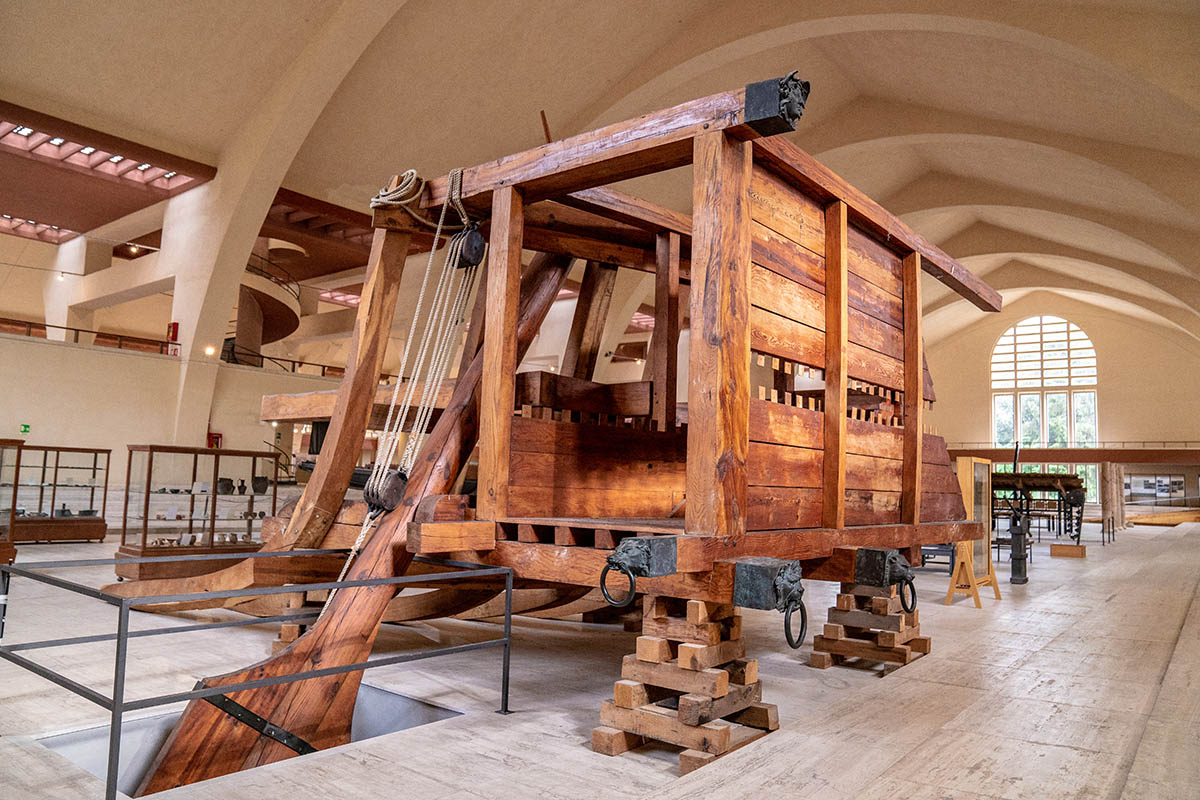
In the 1920s and 1930s, the Italian government, under Mussolini, drained the lake to recover two enormous Roman ships that had been sunk in the shallows. The ships, known as the Nemi Ships, were not ordinary vessels. They were huge, luxurious floating palaces, built by the Emperor Caligula in the first century AD, decorated with marble, mosaics, bronze fittings and silk awnings. They were not warships or cargo ships. They were pleasure boats, designed for the emperor's private use, and they contained hot water baths, heating systems, libraries, and even a rotating statue of the goddess Diana. The ships were raised in 1932 and housed in a specially built museum on the shores of the lake.
In 1944, as the German army retreated north through Italy, the museum was set on fire, probably by retreating troops, and the ships were destroyed. Only a few fragments survived: pieces of the bronze fittings, the marble flooring, the wooden beams. The museum was rebuilt in the 1950s, and today you can see the remnants of the ships, along with scale models and informative displays, in the Museo delle Navi Romane on the shore of the lake. It is a melancholy museum, a museum of loss, but it is also a museum of extraordinary beauty, and the story of the ships, of Caligula's madness, of Mussolini's vanity, and of the fire that destroyed what had survived for two millennia, is one of the strangest and most compelling stories in the Castelli Romani.
A note on the museum. The Museo delle Navi Romane is open daily except Mondays, from 9:00 AM to 6:00 PM. The entrance fee is approximately 5 euros. The museum is located on the western shore of the lake, a 10 minute walk from the village centre. Combine your visit with a walk along the lake shore, where the reflections of the crater rim in the water create one of the most peaceful landscapes in Lazio.
A Dedicated Day Trip from Rome to Nemi
Nemi is located approximately 30 kilometres southeast of Rome, in the heart of the Castelli Romani hills. The following itinerary is designed as a day trip from Rome, timed to coincide with the Sagra della Fragola in late May or early June.
Morning — Arrival in Nemi
Begin your day by departing from Rome without stress. The most comfortable way to reach Nemi from Rome city centre or from Rome Fiumicino Airport (FCO) is by pre-booking a private transfer with Airport Connection. Your driver will meet you at your hotel or at the airport arrivals hall and deliver you directly to Piazza Roma, the main square of Nemi. The journey from central Rome takes approximately one hour. The journey from the airport takes approximately 50 minutes. Door to door, no waiting, no dragging luggage onto trains or buses.
Arrive early, before 10:00 AM, to experience the village before the crowds. The stalls of the Sagra will already be open, and the smell of baking pastry and fresh strawberries fills the air. Walk through the main street, Via Roma, and admire the view from the balcony of the village, the Belvedere di Nemi, which offers a spectacular panorama of the lake and the crater rim.
Late Morning — The Strawberry Tarts and the Museum
Buy a tortina di Nemi from one of the stalls. Eat it standing in the square. Buy another. Drink a coffee at one of the cafes, a caffè corretto with a splash of fragolino, the strawberry liqueur. Then descend to the lake shore to visit the Museo delle Navi Romane. The walk down is steep but rewarding, and the museum itself will take approximately one hour to explore.
Lunch — A Meal in the Castelli Romani
For lunch, I recommend one of the traditional trattorias in the village or in the neighbouring town of Castel Gandolfo, the papal summer residence on the shore of Lake Albano. Order the porchetta di Ariccia, the famous roast pork of the Castelli Romani, seasoned with garlic, rosemary and wild fennel. Order the pasta e fagioli, the bean and pasta soup of the Roman countryside. Order the abbacchio scottadito, the grilled lamb chops that are so hot you burn your fingers trying to eat them. Drink a bottle of Frascati Superiore, the golden white wine of the Castelli, or a Cannellino di Frascati, the sweet, dessert version. The food of the Castelli Romani is not fancy. It is hearty, generous, and deeply satisfying, the perfect complement to the delicacy of the strawberries.
Early Afternoon — The Walk Around the Lake
After lunch, walk along the shore of Lake Nemi. The path is flat, shady and beautiful. The water is dark green, reflecting the trees and the sky. The silence is remarkable for a place so close to Rome. You will see fishermen in small boats, families picnicking on the grass, and, if you are lucky, the wild strawberries growing on the banks, tiny and red and fragrant.
Late Afternoon — The Sanctuary of Diana
The Sanctuary of Diana Nemorensis, the sacred site of the goddess, is located on the northern shore of the lake. The ruins are modest: some foundations, a stretch of wall, the outline of the temple. But the setting is extraordinary, and the atmosphere is one of deep, quiet peace. Stand where the ancient Romans stood, look out over the water, and think of the Rex Nemorensis, the fugitive slave who became a king, fighting for his life and his position on this very shore. It is a place that stays with you.
Evening — Return to Rome
As the light fades over the crater, your driver will return to collect you for the drive back to Rome. The journey takes less than an hour. You will arrive in the city in time for dinner, or perhaps you will be too full of strawberries and porchetta to eat anything more. That is acceptable. The memory of the day will be enough.
A note on driving in the Castelli Romani. If you choose to rent a car rather than book a transfer, be aware that the roads in the Castelli Romani are narrow, winding and heavily trafficked on festival weekends. Parking in Nemi is extremely limited. Your private transfer driver knows the shortcuts, knows where to park, and will save you the considerable stress of navigating the narrow streets of a medieval hill town. The difference in comfort is substantial. The difference in price is smaller than you think.
Where to Eat in Nemi and the Castelli Romani
The Castelli Romani is one of the great food regions of Lazio, and a day trip to Nemi can easily be extended into a longer exploration of the area. Here are a few recommendations for meals in the villages around the lakes.
In Nemi
Ristorante La Sosta, on Via Roma, serves traditional Roman and Castelli cuisine in a warm, rustic setting. The homemade pasta is excellent, particularly the fettuccine with porcini mushrooms and the gnocchi with tomato and basil. The grilled meats, sourced from local farms, are cooked over an open fire. The house wine is a Frascati Superiore from a small producer in the hills above the lake. The service is friendly, the prices are moderate, and the view from the terrace is of the lake far below.
In Castel Gandolfo
Antico Ristorante Pagnanelli, on the shore of Lake Albano, has been serving travellers since 1860. The restaurant is famous for its fish from the lake: coregone, the whitefish of the crater lakes, served grilled or fried, and anguilla, eel, cooked in tomato sauce with wild fennel. The pasta e fagioli con le cozze, bean and pasta soup with mussels, is a surprising and delicious fusion of sea and mountain. The terrace overlooks the lake, and on clear days you can see the dome of the Papal Palace and the gardens of the Vatican summer residence.
In Ariccia
La Locanda dei Castelli, just off the main square of Ariccia, serves the definitive porchetta of the Castelli Romani. The pork is roasted for hours in a wood fired oven, the skin crackling and crisp, the meat tender and fragrant with garlic, rosemary and wild fennel. Order it in a panino, the sandwich of the region, or as a secondo with roasted potatoes. Do not ask for ketchup. Do not ask for mustard. Eat it as it is. It needs nothing.
The wines of the Castelli Romani. Frascati Superiore is the classic white wine of the region, straw yellow with notes of almond and yellow fruit. Cannellino di Frascati is the sweet, dessert version, golden and honeyed, perfect with the strawberry tarts. Colli Albani is a lighter, fresher white, ideal for an aperitivo. The red wines of the Castelli, Cesanese and Merlot, are less famous but equally enjoyable, particularly with the roasted meats of the area. All of these wines are inexpensive in the local trattorias. Do not hesitate to order them.
The Best Time to Visit Nemi
The ideal time to visit Nemi is late May through early June, when the Sagra della Fragola takes place. The strawberries are at their peak, the weather is warm but not oppressive, and the atmosphere in the village is one of joyful celebration. For a quieter experience, visit in April or September, when the weather is still pleasant, the crowds are absent, and you can enjoy the view of the lake in near solitude. July and August are hot, and the village can be crowded with Romans escaping the heat of the city, but the lake offers a refreshing breeze, and the strawberries, though not at their peak, are still available in the local shops. Winter is quiet, almost silent, and the village has a melancholy beauty that is worth experiencing if you have the time. But the Sagra is the heart of Nemi, and the Sagra is in June.
Common Tourist Mistakes in Nemi
Visiting only for the strawberries and missing the lake. The strawberries are magnificent, but the lake is the soul of the village. Walk down to the shore. Visit the Roman ships museum. Walk the path around the water. The strawberries will still be there when you return.
Not carrying cash. The stalls of the Sagra, the small bakeries, the family run trattorias, and the wine bars of the village often do not accept credit cards. If you arrive in Nemi without cash, you will watch other people eat the strawberry tarts while you stand hungry and frustrated. There is an ATM in the village, but it is not always reliable on festival weekends. Bring cash.
Driving to Nemi on the festival weekend without a plan. The roads to Nemi are narrow, the parking is limited, and the traffic on the first Sunday of June can be overwhelming. Book a private transfer from Rome or take the train and bus. Your nerves will thank you.
Forgetting to look at the view. The Belvedere di Nemi, the balcony at the top of the village, offers one of the most beautiful views in Lazio. The lake, the crater, the forests, the mountains of the Apennines on the horizon. It is easy to focus on the strawberries and the tarts and the crowds. Do not forget to turn around. The view is free. It is also unforgettable.
Comments
No comments yet. Be the first to share your thoughts!
Leave a Comment
Your comment will appear after moderation.