 Michelle
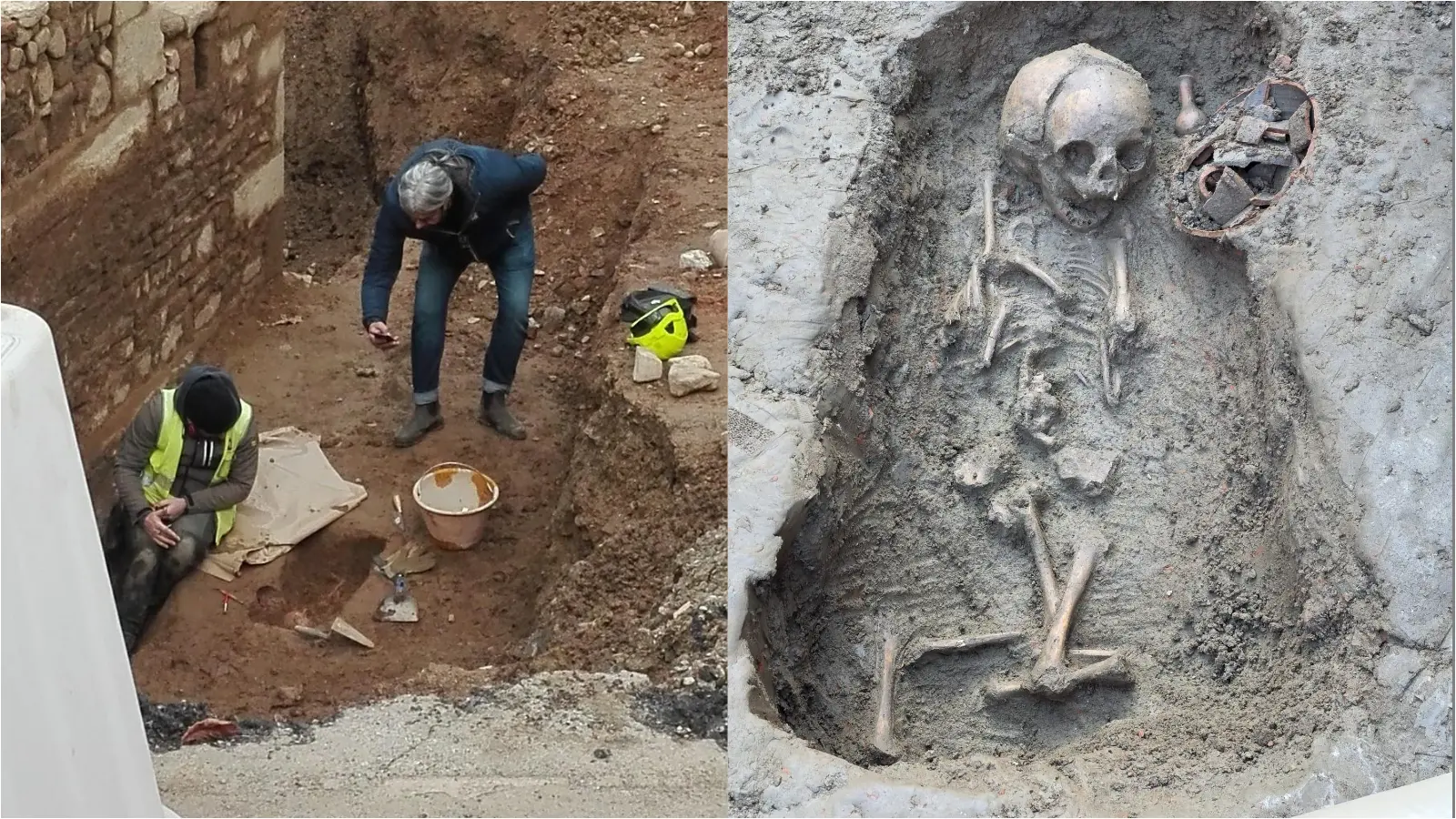
 Rome is not a city built upon soil. It is a city built upon itself. Layer after layer, century after century, the inhabited crust of the Eternal City has risen, so that the Rome of the twenty first century floats above the Rome of the Middle Ages, which in turn rests upon the Rome of the Empire, which itself was constructed over the huts of the Bronze Age. For decades, this stratification was an obstacle, a complication, a bureaucratic and archaeological nightmare that delayed infrastructure projects for years or cancelled them altogether. But the construction of Metro Line C, Rome’s third subway line, has transformed this obstacle into a revelation. Beneath the noisy intersections and the chaotic traffic, beneath the souvenir stalls and the tram tracks, an entire hidden city has emerged from the darkness. Military barracks where the emperor’s elite guard once slept. Auditoria where poets recited before Hadrian himself. Irrigation basins that fed the Roman countryside. And the crowded, multi-storey apartment blocks where ordinary citizens lived, loved and died, their stories written not in marble but in the modest remnants of their daily lives. What follows is an account of the most extraordinary archaeological discoveries of our century, unearthed not by pickaxes and trowels in some remote field, but by tunnel boring machines grinding their way through the viscera of the living city.
The Top-Down Revolution, Engineering Meets Archaeology
The challenge of building a subway beneath the historic centre of Rome is unique in the world. No other city requires its engineers to dig through three thousand years of continuous human habitation, where every cubic metre of earth contains pottery fragments, bone pins, mosaic tesserae or the foundations of forgotten buildings. The solution, developed specifically for the Metro C project, is a technique known as archaeological top-down excavation [citation:4]. In this method, the construction proceeds from the surface downward in controlled stages, with archaeologists following immediately behind the excavators. As each layer of soil is removed, the ancient structures it conceals are documented, conserved and, where possible, incorporated into the design of the station itself [citation:4].
The results of this method are visible today in three extraordinary museum stations that have already opened to the public. San Giovanni station, inaugurated in 2018, set the standard. Porta Metronia and Colosseo stations, opened together in December 2025 after more than a decade of excavation and construction, have raised that standard to an entirely new level [citation:1][citation:4]. And beneath the chaos of Piazza Venezia, the deepest and most complex excavation site of all, engineers and archaeologists continue their work, uncovering structures that have not seen the light of day for two thousand years. More than 500,000 artifacts have been recovered so far from the Metro C excavations, and the number continues to rise [citation:6].
San Giovanni, The Agricultural Heart of Ancient Rome
The first station to be transformed into an archaeological museum, San Giovanni remains one of the most remarkable examples of subterranean heritage preservation in Europe. The excavations, which covered an area of approximately 3,000 square metres and reached depths of between 15 and 18 metres, revealed the remains of a vast agricultural complex dating to the early Imperial period [citation:3]. The most impressive discovery was a massive irrigation basin, measuring 35 metres in width and 70 metres in length, a scale unmatched by any comparable structure in the Roman countryside [citation:3].
The basin, lined with hydraulic cocciopesto, a waterproof concrete made from crushed pottery and lime, was capable of storing more than four million litres of water. It was connected to a system of lifting and distribution structures that supplied water to an agricultural estate active from the 3rd century BC through the Imperial period [citation:3]. Above the basin, the excavation revealed the remains of the estate itself, including storage rooms, processing areas and the living quarters of the agricultural workers who cultivated the land that fed the city of Rome.
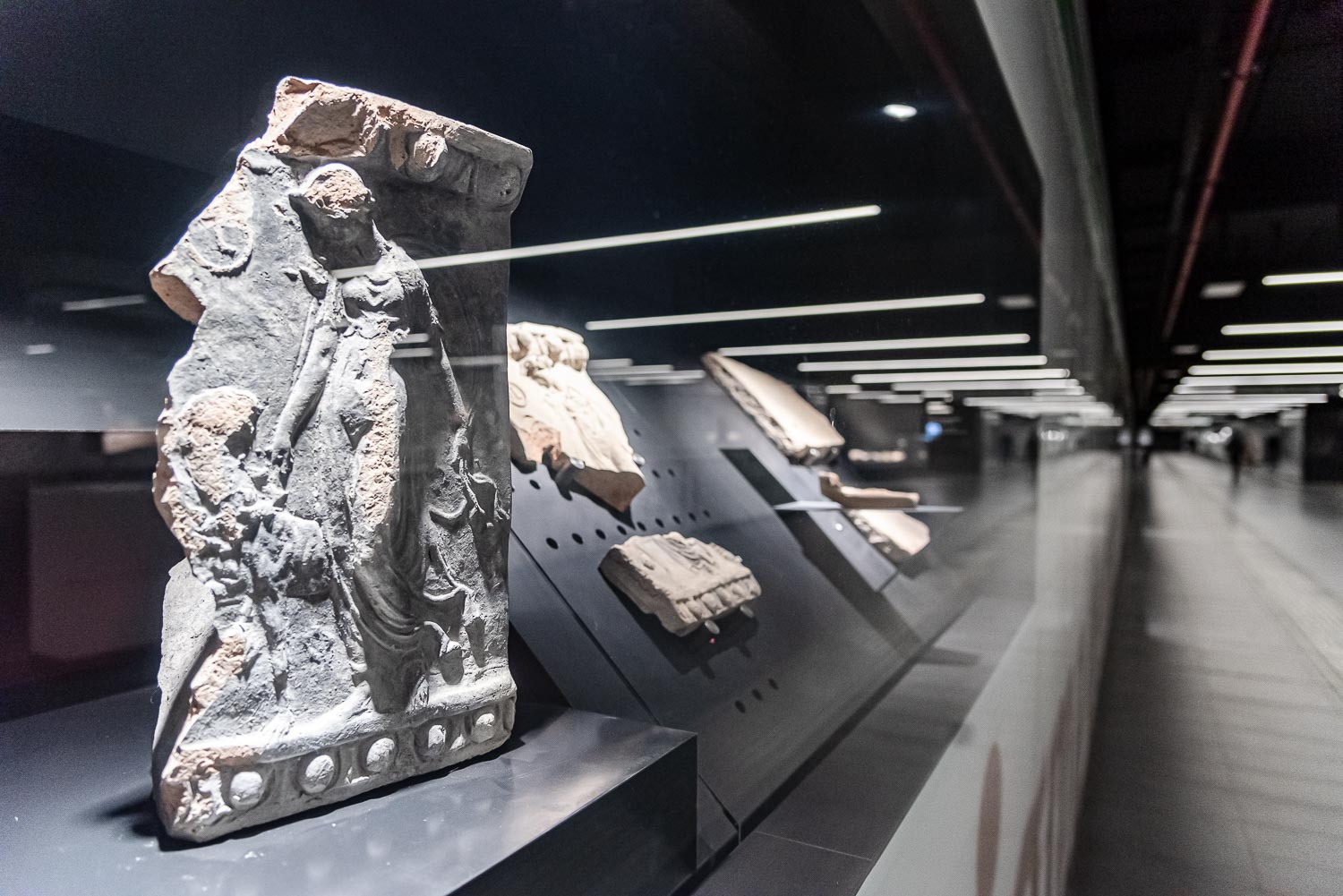
The museum installation at San Giovanni is a triumph of narrative design. A stratigraphic chart, repeated throughout the station, situates the visitor within the vertical sequence of history, showing the depth of each period relative to the modern street level above [citation:3]. Along the corridors, glass cases display artifacts recovered during the excavation: pottery fragments, tools, coins and personal objects that belonged to the people who lived and worked on this land. The most evocative feature, however, is the partial reconstruction of the irrigation basin itself, its traces marked on the station floor so that passengers can walk across the surface of the ancient reservoir as they make their way to the trains.
Porta Metronia, The Barracks of the Imperial Guard
If San Giovanni reveals the agricultural heart of ancient Rome, Porta Metronia reveals its military spine. The station, which opened in December 2025, lies at a depth of approximately 30 metres, but the archaeological structures it protects were found at a shallower level, between 7 and 12 metres below the modern street [citation:6]. What the excavators uncovered was a vast military barracks complex dating to the first half of the 2nd century AD, the period of the emperors Trajan and Hadrian [citation:1][citation:4].
The barracks, which extend nearly 80 metres in length, consist of a series of rooms arranged around a central courtyard [citation:6]. The identification of the building as military is confirmed by a subtle but telling architectural detail: the doors of the individual rooms are not aligned with one another. Instead, they are offset, so that soldiers leaving their quarters would automatically fall into a staggered formation in the corridor, ready to move without colliding with one another [citation:6]. The archaeologists who made the discovery, led by Simona Moretta, the scientific director of the excavation, noted that this design feature is a hallmark of Roman military architecture [citation:6].
The soldiers who inhabited this barracks were likely members of the emperor's personal guard, the Praetorians, or the urban cohorts responsible for maintaining public order in the city [citation:6]. The presence of such an elite unit in this area of Rome, close to the Lateran and the Caelian Hill, testifies to the strategic importance of the neighbourhood in the Imperial period. The barracks were not merely a sleeping quarters. They contained mess halls, administrative offices, armoury storage and a small bath suite for the soldiers' use.
The Domus del Comandante, A House for a Centurion
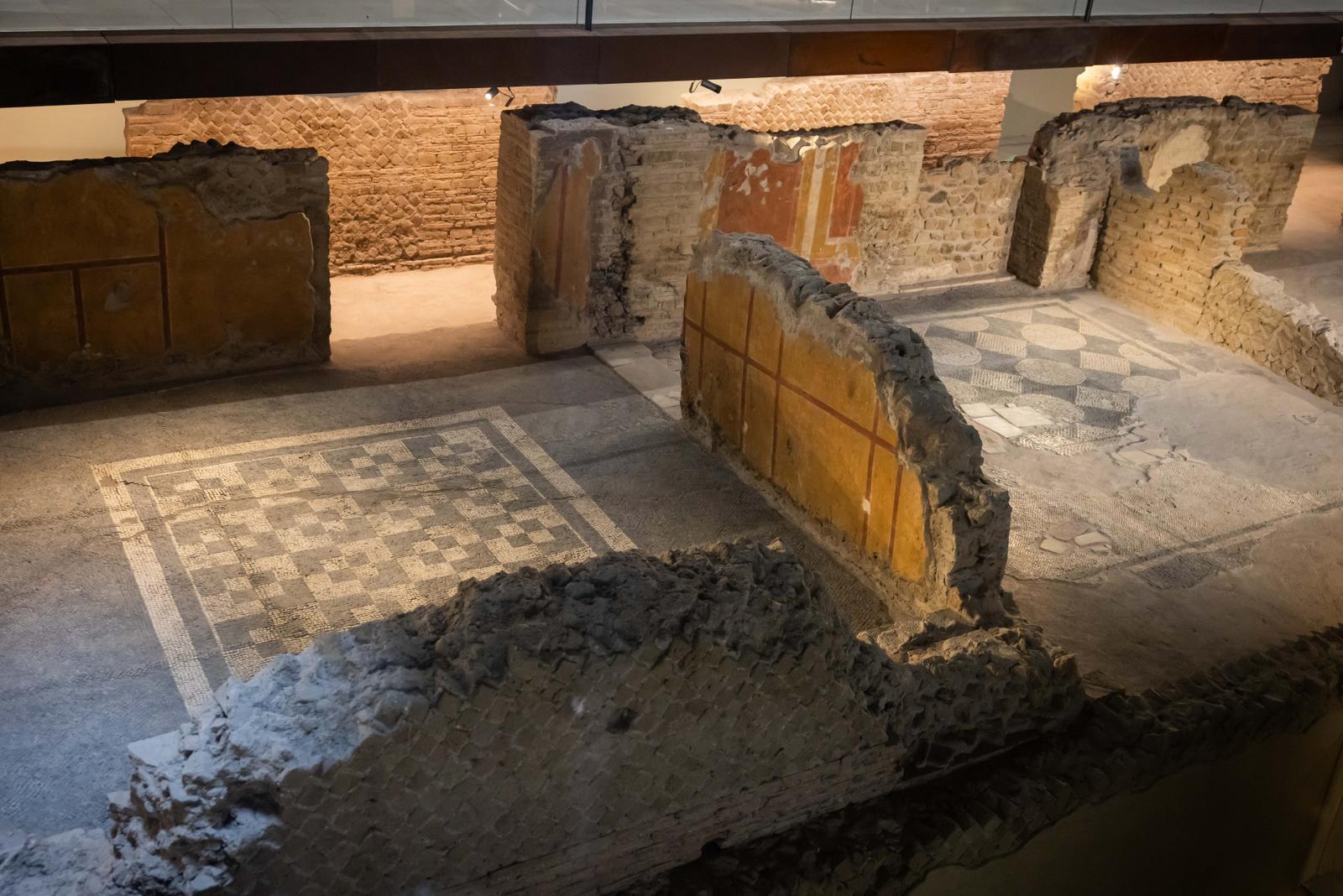
At the heart of the barracks complex lies the Domus del Comandante, the house of the commanding officer, a structure that has left archaeologists and visitors alike in a state of wonder [citation:1][citation:4]. While the soldiers slept in modest rooms arranged around the courtyard, the commander enjoyed a residence of considerable luxury, decorated with black and white mosaics of geometric patterns and walls covered in painted frescoes [citation:1]. The preservation of these decorative surfaces is extraordinary, all the more so because they were found at a depth that should have destroyed them through water infiltration and earth pressure.
The Domus comprises multiple rooms arranged around a small internal courtyard, a typical Roman atrium house. The reception room, the tablinum, still bears traces of its original wall paintings in shades of red, yellow and ochre. The dining room, the triclinium, contains the remains of the stone couches on which the commander and his guests would have reclined during meals. And the private bath suite, a rare luxury in a military installation, includes a cold plunge pool, a frigidarium, whose water supply was heated by a furnace located in the adjacent service corridor.
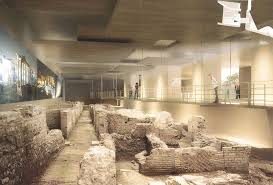
The military barracks complex at Porta Metronia is not merely displayed behind glass. It has been incorporated directly into the fabric of the station. The ancient walls rise from the station floor as they were found, their stones cleaned and consolidated but otherwise untouched. The visitor passes through the barracks as if walking through time, the electric light of the subway mingling with the shadowed recesses of a building that once echoed with the footsteps of Roman soldiers [citation:1]. It is an experience that no conventional museum can replicate.
The offset doorways of the barracks. The architectural detail that identifies the Porta Metronia structure as a military barracks is so subtle that it escaped notice for years after the initial discovery. The doors of the individual rooms are not aligned, meaning that a soldier leaving his quarters could not see directly into the room across the corridor. This arrangement prevented the rapid spread of fire, allowed for privacy, and, as the excavators observed, caused soldiers leaving their rooms to form an automatic staggered line. It is a reminder that the Romans applied engineering logic to every aspect of their lives, including the design of their dormitories.
Colosseo Station, The Path to the Imperial Forums
The Colosseo station, opened on the same day as Porta Metronia in December 2025, lies 20 metres beneath the Via dei Fori Imperiali, the grand avenue built by Benito Mussolini to connect Piazza Venezia to the Colosseum [citation:4]. The station is not merely a stop on the Metro C line; it is a point of interconnection with the existing Metro B line, which serves the Colosseum and the Circo Massimo. The engineering challenges of constructing this interchange beneath one of the most archaeologically sensitive areas of the city were formidable, but the results are spectacular.
The archaeological discoveries at Colosseo station span more than a thousand years of Roman history. The oldest finds are a series of 28 wells dating to the Republican period, the era when Rome was still a republic governed by the Senate rather than an empire ruled by emperors [citation:4]. These wells, some of them lined with stone, others dug directly into the volcanic tufa, provided fresh water to the inhabitants of the neighbourhood long before the construction of the great aqueducts.
Above the Republican wells, the excavators uncovered the remains of a domus, a private house, from the late Republican or early Imperial period. This house contained a balneum, a small bath suite, including a cold plunge pool, a frigidarium, and a heated room, a caldarium, whose floor was raised on pilae, small columns of brick that allowed hot air from the furnace to circulate beneath the bathers' feet [citation:4]. The decoration of the domus includes fragments of wall paintings in the Pompeian style, imitating coloured marble panels and architectural vistas, as well as a mosaic floor of black and white geometric patterns.
The station also contains displays of smaller artifacts recovered during the excavation, including ceramic plates and vases, stone wells and their suspended buckets, and the personal possessions of the people who lived in the neighbourhood before the construction of the Imperial Forums changed the face of this area forever [citation:6]. Video installations in the station document the excavation process, showing the archaeologists at work, the removal of the earth, and the conservation of the fragile structures that emerged from the darkness [citation:6].
Perhaps the most evocative feature of the Colosseo station is not the ancient architecture itself but the view it affords of the modern city. From the corridor that connects the Metro C platform to the existing Metro B line, passengers can look up through a transparent screen and see the Colosseum, the Flavian Amphitheatre, rising against the sky [citation:4]. The juxtaposition is almost too perfect: the ancient monument visible from the station built to relieve the traffic congestion that surrounds it, the past and the present separated by only a few metres of concrete and glass.
Piazza Venezia, The Greatest Challenge of All
The excavations at San Giovanni, Porta Metronia and Colosseo are already open to the public. The work at Piazza Venezia, by contrast, is still in progress, and it will be many years before the station opens, the current estimate is 2033, and that date depends on the continued cooperation of the archaeologists and the engineers [citation:9]. But the discoveries already made beneath the square are, in many ways, the most significant of the entire Metro C project.
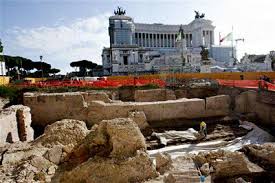
Piazza Venezia is the geographical heart of modern Rome. The vast white monument to Vittorio Emanuele II, known irreverently to Romans as the Wedding Cake or the Typewriter, dominates the square. Palazzo Venezia, the Renaissance palace from whose balcony Benito Mussolini delivered his most famous speeches, overlooks it. And beneath all of this, at depths that will eventually reach 48 metres below street level, the subway station is taking shape [citation:9]. The engineers have had to contend not only with the archaeological remains but also with the foundations of the surrounding palaces, the water table of the Tiber and the vibration caused by the traffic passing overhead.
The Auditoria of Hadrian, A University for Imperial Rome
The most celebrated discovery at Piazza Venezia is a complex of three large rectangular halls, known as the Auditoria of Hadrian, dating to 123 AD [citation:2]. The identification of the structure is based on both the architectural remains and the brick stamps found in the construction materials, which bear the imperial mark of the emperor Hadrian. The building was two storeys high, and its original function, according to the archaeologists who excavated it, was cultural rather than administrative or commercial [citation:2].
The best preserved of the three halls contains two parallel flights of marble steps, six steps on each side, facing one another across a central floor of rectangular white marble slabs interspersed with panels of yellow giallo antico stone [citation:2]. These are not seating for an audience in a theatre; they are risers for a specific kind of performance. The poets, the orators and the rhetoricians stood in the central space, the orchestra, and recited their works to an audience seated on the stepped benches. This was a place of culture, a venue for the recitationes, the public readings at which Roman authors presented their latest compositions to an invited audience of connoisseurs and critics [citation:2].
Many scholars identify this structure as the Athenaeum of Hadrian, a cultural centre described in ancient sources but never before located with certainty [citation:2]. The Athenaeum was named for the original school founded by the emperor Hadrian in Athens, and its Roman counterpart served a similar function: it was a place where poets competed for imperial favour, where philosophers debated the nature of the soul, where the literary culture of the Roman Empire was performed, judged and celebrated [citation:2]. The building remained in use for more than seven centuries, from its construction in 123 AD until its final destruction or abandonment in the 9th or 10th century [citation:2].
The later history of the structure is as fascinating as its original form. After the fall of the Roman Empire, the marble cladding of the Auditoria was stripped away for reuse in other buildings. In the 6th century, traces of furnaces suggest that the space was used as a Byzantine mint for the production of bronze coins [citation:2]. Later still, in the early Middle Ages, the ruins of the building were used as a cemetery, and tombs were cut into the rubble. Finally, in the late Renaissance, the structure was incorporated into the hospital of the Fornari confraternity, dedicated to the Madonna of Loreto, whose church still stands adjacent to the excavation site [citation:2].
The Insulae and the Via Flaminia, The City of the Ordinary
If the Auditoria represent the elite culture of imperial Rome, the other discoveries at Piazza Venezia speak to the lives of ordinary people. The excavations have revealed a complex of multi-storey residential buildings known as insulae, the apartment blocks in which the majority of the Roman population lived [citation:5][citation:7]. These insulae date to the late Republican and early Imperial periods, from the 6th century BC through the 5th century AD, and they represent a type of construction that is rarely preserved in the archaeological record [citation:5].
The insulae discovered beneath Piazza Venezia are not the luxurious villas of the wealthy, with their mosaic floors and painted walls. They are modest, cramped and practical. The ground floor rooms, facing the street, were shops and workshops. The upper floors, reached by narrow staircases, contained the living quarters, one or two rooms per family, with no running water and only the most basic cooking facilities. The density of occupation in these buildings was extraordinarily high, by some estimates, as many as five hundred people per hectare, and the living conditions were correspondingly grim. But it was in these insulae that the life of the city unfolded: the births, the deaths, the quarrels, the celebrations, the daily struggle for survival in a city of more than a million people.
Running alongside the insulae is the original course of the Via Flaminia, the ancient consular road that connected Rome to the Adriatic coast [citation:5]. The road, surfaced in multiple layers of beaten earth, gravel and stone, has been identified in its medieval form, the surface of which consists of packed earth rather than the large stone blocks of the Roman period [citation:5]. The Via Flaminia was one of the most important roads in the Roman Empire, the route by which the emperors travelled to the north and the armies marched to the frontier. To walk on its surface, as visitors to the future station will be able to do, is to walk on the same stones that felt the feet of Hadrian, of Marcus Aurelius, of Constantine the Great.
The poet's stage. The marble steps of the Auditoria are not intended for an audience in the conventional sense. They are risers facing one another across a central floor, creating a space of intimate confrontation between performer and spectator. The poet or orator stood in the centre, perhaps on a portable wooden stage, and the audience sat on the steps, close enough to see every gesture, to hear every nuance of the voice. This is not the impersonal space of a modern lecture hall; it is a space of performance, of competition, of judgment. One can imagine the young poets of the 2nd century AD trembling on that central floor as they recited their verses before the emperor himself.
The Future Station, A Museum at 85 Metres
The Piazza Venezia station, when it opens, will be the deepest in the entire Metro C line. The platforms will be located 48 metres below the square, and a planned underground museum will extend even deeper, to 85 metres below the surface [citation:7]. The station will be served by 27 escalators and six elevators, and it will be connected by underground passages to the surrounding monuments, including Palazzo Venezia, the Vittoriano and the ruins of the Roman Forum [citation:7].
The museum displays will incorporate the structural remains of the Auditoria, the insulae and the Via Flaminia, all preserved in situ, just as the barracks were preserved at Porta Metronia. But the Piazza Venezia museum will be on a different scale entirely. The excavations have revealed an entire urban quarter, a microcosm of the Roman city, with its public buildings, its private residences, its commercial spaces and its infrastructure. To walk through this museum will be to walk through the streets of ancient Rome as they were, not as they are imagined in film or painted on canvas.
The superintendent of archaeology for Rome, Daniela Porro, has described the discovery of the insulae at Piazza Venezia as an extraordinary opportunity to learn about the historical topography of central Rome [citation:7]. The archaeologist Marta Baumgartner, who has worked on the excavation, has called it an unprecedented window into the lives of the Roman working class, the ordinary citizens whose stories are too often overshadowed by the emperors and the generals [citation:7]. The Piazza Venezia station, when it finally opens, will not be merely a transportation hub. It will be a monument to the forgotten, a museum of the invisible city, a place where the underground and the above ground, the past and the present, the famous and the anonymous, finally meet.
A Dedicated Tour, Visiting Rome’s Underground Museums
The three museum stations currently open, San Giovanni, Porta Metronia and Colosseo, can be visited in a single morning or afternoon. They are connected by the Metro C line, and the journey from one station to the next takes no more than a few minutes. The following itinerary is designed for the visitor who wants to experience the full range of Rome’s archaeological discoveries, from the agricultural basin of San Giovanni to the military barracks of Porta Metronia to the Republican wells of Colosseo.
San Giovanni Station, The Agricultural Foundation
Begin your tour at San Giovanni station, located in Largo Brindisi. The station is accessible from the surface, and the museum displays are located in the ticket hall and along the corridors leading to the platforms. Take time to study the stratigraphic chart, which illustrates the vertical sequence of history from the present day down to the early Holocene. Then walk across the floor of the station, where the lines of the ancient irrigation basin have been traced, and imagine the reservoir as it was, filled with water from the aqueducts, the lifeblood of the Roman countryside. The agricultural complex of San Giovanni is a reminder that Rome was not only a city of marble and concrete but also a city of wheat, of wine, of oil, of the soil that sustained its million inhabitants.
Porta Metronia Station, The Military Barracks
Take the Metro C line one stop east to Porta Metronia. The station is a short ride, no more than two minutes, but the chronological distance between the agricultural complex of San Giovanni and the military barracks of Porta Metronia is measured in centuries. Emerge from the train, ascend into the station hall, and find yourself standing in the middle of a Roman military installation. The walls of the barracks rise around you, the doors of the soldiers' rooms offset as they were two thousand years ago. Walk to the Domus del Comandante, the commander's house, and look at the mosaics beneath your feet. The black and white patterns are not museum reproductions; they are the original floors, walked by Roman officers, preserved by the miracle of their burial and the care of their conservators.
Colosseo Station, The Path to the Forums
Continue one more stop to Colosseo station, the final station on the current Metro C extension. The station is located directly beneath the Via dei Fori Imperiali, and the archaeological displays are distributed throughout the station levels. Visit the 28 Republican wells, grouped in a cluster, their stone linings still intact. Walk past the remains of the balneum, the bath suite, and imagine the bathers, the Romans of the 1st century AD, relaxing in the warm water of the caldarium while outside the walls of their domus the engineers of the emperor Domitian prepared the ground for the construction of the Imperial Forums. End your tour in the connecting corridor to the Metro B line, where a glass screen offers an unexpected view of the Colosseum, the ancient amphitheatre, framed against the modern sky. The juxtaposition is the city itself: old and new, visible and hidden, eternal and transitory.
Practical information for visitors. All three stations are fully operational and accessible during regular Metro hours. The archaeological displays are visible without payment of an additional admission fee; they are part of the station infrastructure, accessible to any passenger who passes through the ticket hall. Guided tours are offered on weekends by the Soprintendenza Speciale di Roma, and reservations can be made through the Metro C website. The stations are wheelchair accessible, with elevators connecting the street level to the platforms. Allow at least two hours for a thorough visit of all three stations.
Transport Tips, Arriving from the Airport
Rome is served by two main airports, Fiumicino Leonardo da Vinci Airport and Ciampino Airport. Both are well connected to the city centre, but the most comfortable way to reach the Metro C line from either airport is by private transfer.
From Fiumicino Airport (FCO)
Fiumicino Airport is located approximately 32 kilometres from the city centre. A private transfer with Airport Connection takes approximately 45 minutes and delivers you directly to your hotel or to the entrance of any Metro C station, including San Giovanni, Porta Metronia or Colosseo. The price is fixed, no hidden costs, and the driver will meet you at arrivals with a nameplate, assist with luggage and ensure a smooth, stress free beginning to your visit.
From Ciampino Airport (CIA)
Ciampino Airport, which serves many low cost carriers, is located approximately 18 kilometres from the city centre. A private transfer takes approximately 30 minutes. The airport is also served by the Terravision and SitBus shuttles, which connect to Termini Station, from which the Metro C line can be accessed. However, for travellers with luggage or those arriving after a long flight, the private transfer is the superior option.
From Termini Station
If you arrive in Rome by train, Termini Station is the main rail hub. The Metro C line does not yet serve Termini directly, but you can walk to the nearby San Giovanni station, approximately 20 minutes on foot, or take a taxi. The transfer from Termini to the Metro C stations is short, typically no more than 15 minutes by taxi, but if you are carrying luggage, consider booking a private transfer to avoid the crowds and the cobblestones.
How to book your transfer with Airport Connection. The process is simple and designed for travellers who appreciate clarity. Select your pickup location, either Rome Fiumicino Airport or Rome Ciampino Airport. Enter your destination in Rome, whether a hotel or a specific Metro C station. Specify the number of passengers and luggage. The system calculates a fixed price instantly, with no hidden fees or surprises. Confirm your booking online, and you will receive a confirmation email with precise meeting instructions and your driver's contact information. Book at least forty-eight hours in advance for the best availability.
Book Your Transfer →
Conclusion, The Visible and the Invisible City
The construction of the Metro C line has been, by any measure, one of the most complex engineering projects ever attempted in an urban environment. The budget has ballooned, the deadlines have slipped, and the controversies have multiplied. But the archaeological discoveries made possible by the excavation, the military barracks, the auditoria, the insulae, the wells, the mosaics, the millions of artifacts, constitute a cultural legacy that will outlast the subway itself. Rome is no longer a city where the ancient remains are confined to the protected zones of the forums and the Colosseum. The ancient city is everywhere, beneath every street, beneath every building, beneath every piazza. The Metro C project has not destroyed that inheritance. It has revealed it, preserved it, and in the museum stations of San Giovanni, Porta Metronia and Colosseo, it has made it accessible to anyone with a ticket and the curiosity to look. The invisible city has become visible. And it is waiting for you.
Comments
No comments yet. Be the first to share your thoughts!
Leave a Comment
Your comment will appear after moderation.