 Michelle
 There is a particular quality of astonishment, different from any other, that belongs to the moment when the ground beneath a familiar place reveals that what you thought you were standing on is not the beginning of the story at all, but merely its most recent chapter. Florence is a city that the world believes it knows, a city whose identity is so thoroughly associated with the art and architecture of the fourteenth through sixteenth centuries that the Renaissance has become, in the popular imagination, almost synonymous with the city itself. Brunelleschi and Donatello, Ghiberti and Masaccio, Leonardo and Michelangelo: these are the names by which Florence introduces itself to the world, and the introduction is so overwhelming in its brilliance that the question of what came before it rarely presents itself with any urgency. What came before it, as the archaeologists working beneath the floor of the Palazzo del Comune have now demonstrated with monumental clarity, was a Roman city of the first order, equipped with a theatre of a scale that makes the celebrated monuments of the Renaissance above it seem, in one specific dimension at least, positively modest.
Florence Before the Renaissance: The Colony of Florentia
The history of Florence as a significant urban settlement begins not with the medieval commune, not with the Medici, and not with the extraordinary flowering of artistic genius that those two phases of the city's history produced, but with a decision taken by Julius Caesar, or possibly by his successor Augustus, to establish a Roman colonial settlement in the valley of the Arno at some point in the decade between approximately 59 and 49 BC. The precise date and the precise circumstances of Florentia's foundation have been debated by scholars since the Renaissance itself, when the humanists of the Florentine court were already searching for a suitably distinguished genealogy for their city, but the physical evidence of the colony, including the street grid, the public buildings and the finds recovered from successive phases of excavation, is consistent with a foundation in the late Republican or very early Imperial period.
The name Florentia, from which the modern Italian Firenze and the English Florence both derive by regular phonetic evolution, is a Latin word meaning prosperity or flourishing, and it belongs to a class of auspicious foundation names that the Romans bestowed on their colonies with the deliberate intention of invoking future good fortune. Whether the name referred to the fertile agricultural territory of the Arno valley, to the hoped-for prosperity of the new community, or to some personal or religious association that the sources do not record, it stuck with a persistence that suggests it found an early and enthusiastic local constituency.
The colony was established, as Roman colonies regularly were, by the settlement of veterans from one of the legions recently demobilised at the end of a military campaign. These men received allotments of agricultural land in the surrounding territory in exchange for their service, and the urban centre of the colony was laid out to house the administrative, commercial and cultural functions of the community they would form. The layout of Florentia, which has been reconstructed with increasing precision through two centuries of archaeological investigation, followed the standard Roman colonial plan with a fidelity that reflects both the practical advantages of a proven urban model and the ideological importance of legibility in a Roman city: a visitor arriving from anywhere in the empire should be able to orient themselves immediately, recognise the principal buildings, locate the forum, the baths, the theatre and the temples, and understand at a glance that they were in a place that operated by the same civic rules as every other Roman town from Britain to Syria.
The Roman City Plan and Its Survival Beneath the Medieval Fabric
The most remarkable aspect of the Roman foundation of Florentia, considered from the perspective of the twenty-first century visitor walking the streets of central Florence, is how thoroughly the Roman plan has survived in the modern city, not as a visible relic but as an invisible structuring principle that continues to determine the layout of streets, the orientation of blocks and the position of piazzas whose medieval names and Renaissance buildings entirely conceal their ancient origins.
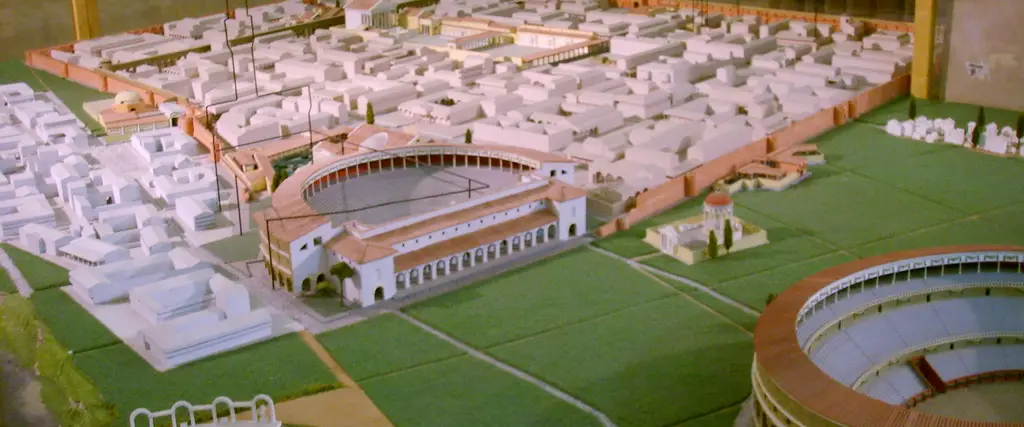
The Roman colonial city was organised on the standard grid of two principal axes, the cardo maximus running north to south and the decumanus maximus running east to west, intersecting at right angles at the centre of the settlement to define the location of the forum and the principal public buildings. In the case of Florentia, the decumanus maximus corresponds with remarkable precision to the modern Via degli Strozzi and Via del Corso, while the cardo maximus follows the line of the modern Via Roma and Via Calimala. The intersection of these two ancient arteries falls in the area of the Piazza della Repubblica, the large nineteenth-century piazza that replaced the medieval market at the heart of the historic centre and was explicitly designed, when the unified Italian state chose Florence as its first capital in the 1860s, to occupy the site of the ancient forum. The decision to redevelop this area in the late nineteenth century was controversial and destructive of important medieval fabric, but it was premised on a correct historical intuition: the centre of ancient Florentia was, indeed, precisely there.
The persistence of the Roman street grid in the modern city is not accidental but reflects a continuity of land use and property boundaries that has operated, with interruptions but without complete severance, from the Roman period to the present day. Medieval Florence built on Roman foundations, literally and figuratively: the walls of Roman buildings provided ready-made building platforms and boundary markers for the structures that replaced them, and the property lines established in the Roman colonial land division have in many cases survived through the entire sequence of medieval, Renaissance and modern development. The result is a city in which a map of the Roman street plan laid over a modern map of the historic centre produces a coincidence of alignment so precise that the two become difficult to distinguish. Florence is, in its bones, a Roman city, and the theatre now emerging beneath the municipal buildings is the most spectacular single demonstration of this fact yet produced.
The surviving traces of Roman Florence: Several elements of the Roman colony are visible above ground in the modern city, though they require a degree of archaeological literacy to recognise. The regular rectangular blocks of the historic centre between the Piazza della Repubblica and the Via Tornabuoni preserve the Roman street grid with remarkable fidelity. The Church of Santa Reparata, excavated beneath the nave of the Cathedral of Santa Maria del Fiore, preserves the remains of an early Christian basilica that itself replaced a Roman building, and its archaeological area is open to visitors beneath the cathedral floor. The Museo Archeologico Nazionale on the Via della Colonna holds the most important collection of objects from Roman Florentia, including inscriptions, architectural fragments and everyday objects from the period of the colony. The recent excavations have also uncovered sections of the Roman city wall and drainage system, further confirming the sophistication of the original urban infrastructure.
The Discovery: What the Excavations Revealed
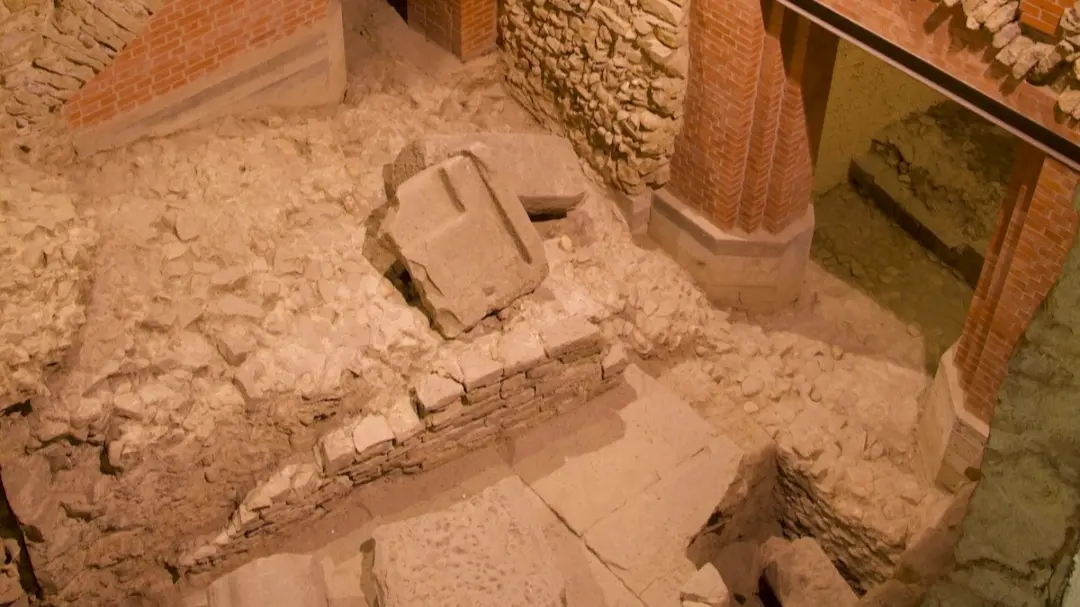
The archaeological excavations that have brought the Roman Theatre of Florentia into the light were conducted in the area of the Palazzo del Comune, the seat of the municipal government of Florence, in a campaign of investigation that began as an assessment of the building's structural condition and developed, as such investigations in Italian historic centres frequently do, into something considerably more significant than its original mandate suggested. The discovery that the floors and cellars of the municipal buildings concealed the structural remains of an ancient theatre did not arrive as a single dramatic revelation but through the progressive accumulation of evidence from a series of exploratory trenches and core samples that, taken together, began to define the outline and the scale of a structure far larger than any previous investigation of the area had proposed.
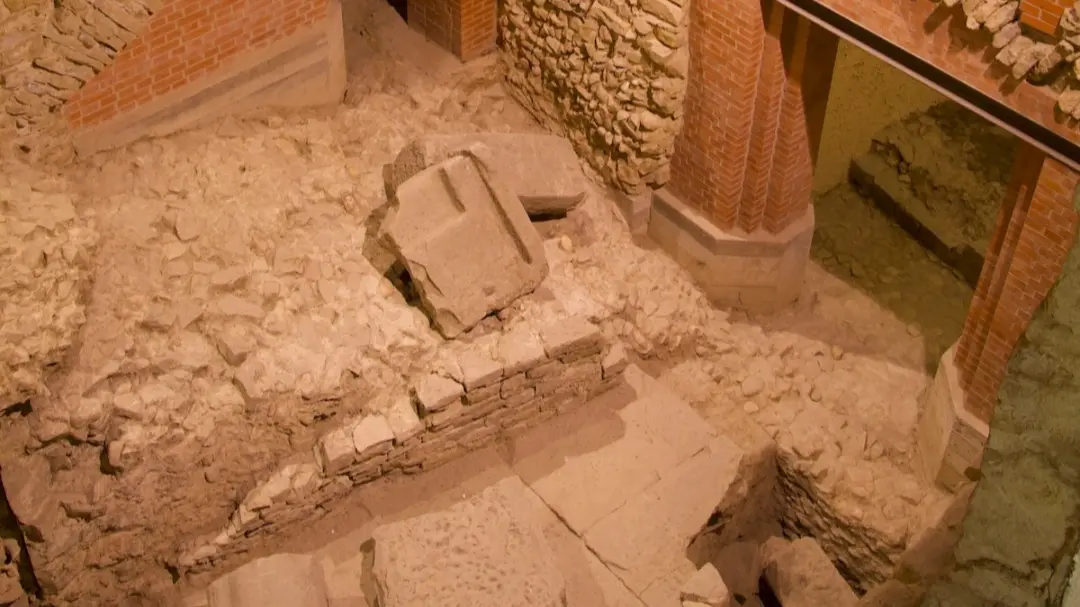
What the excavations revealed, as the layers of medieval construction fill and post-antique debris were carefully removed, were the remains of a theatre of substantial dimensions, preserved with a completeness that reflects the fortunate circumstance of its burial history. The theatre had not been deliberately demolished in the way that many Roman structures were destroyed in the post-antique period, with the systematic removal of stone for reuse as building material. Instead, it had been buried progressively by the accumulation of occupation debris, the gradual rise of the ground level that characterises any intensively occupied urban site over centuries, and the construction of successive buildings above it that used its surviving walls as convenient foundations without removing the material between them. This burial, while it ended the theatre's use as a functioning performance space at some point in the late Imperial or early medieval period, preserved the lower structural elements with a degree of completeness that would not have survived above-ground exposure.
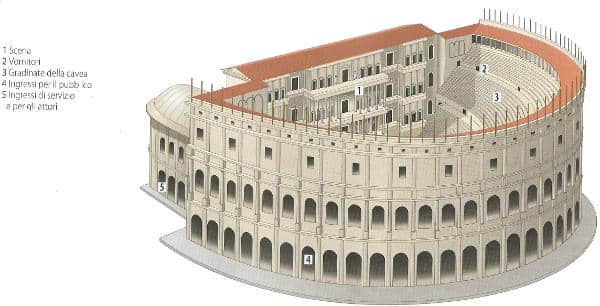
The remains that have been uncovered include sections of the massive concrete and stone substructure that supported the cavea, the semicircular bank of seating, a construction of considerable engineering sophistication whose survival in the confined and structurally complex environment of a medieval urban basement is little short of extraordinary. The radial walls that divided the substructure into compartments, the vaulted corridors of the vomitoria that penetrated these walls to provide access from the exterior of the building to the interior seating, and the foundations of the scaena frons, the elaborate architectural backdrop that formed the permanent stage setting of a Roman theatre, are all represented in the excavated remains, in a state of preservation that allows the original form of the building to be reconstructed with a confidence that more fragmentary survivals would not support.
The dating of the theatre's construction, established through the analysis of the building materials and techniques employed, through the study of the stratigraphic sequence of the deposits associated with its various phases, and through the examination of the coins and ceramics recovered from the fill layers, places its original construction in the first century AD, with a substantial phase of reconstruction and enlargement in the second century. This chronology is consistent with what is known of the development of Florentia in the Imperial period, when the city grew from its Republican colonial origins into a more substantial urban centre of regional importance, and when the investment in monumental public buildings that we associate with the cultural ambition of the high empire would have extended naturally to the construction of a theatre commensurate with the city's increased status.
One of the most exciting recent discoveries, which the current excavation campaign has only just begun to explore, is the presence of a series of service corridors beneath the stage area, including what appears to be a mechanical lift system for raising scenery and possibly even wild animals into the performance space. If confirmed, this would rank the Florentia theatre among the most technologically sophisticated Roman theatres ever excavated in Italy, comparable in its stage engineering to the great theatres of Rome and Pompeii.
The Theatre in Roman Civic Life: Architecture as Ideology
To understand the significance of the Roman Theatre of Florentia, it is necessary to understand what a theatre meant in the context of Roman colonial urban culture, and what the decision to build one of this scale represented in terms of the ambitions and the resources of the community that commissioned it. The Roman theatre was not, or not primarily, a building for the passive enjoyment of dramatic entertainment in the modern sense. It was a civic institution of the first importance, a space in which the values, the hierarchies and the collective identity of Roman urban society were enacted, displayed and reinforced through a combination of physical arrangement, theatrical performance and public ceremony that had no exact equivalent in any other building type.
The physical arrangement of the Roman theatre expressed the social hierarchy of the community with a precision that was both deliberate and, to its original users, entirely natural. The front rows of the orchestra, the flat semicircular area at the base of the seating, were reserved by law for senators and decurions, the members of the local governing class. Behind them, in the lower tiers of the cavea, sat the equestrian order, the upper middle class of Roman society. The higher tiers were occupied by the general male citizenry, arranged by tribe and by the social distinctions of free birth versus freedman status. Women were restricted, in the Augustan legislation that codified these arrangements, to the uppermost and most remote sections of the seating. Slaves had no assigned place at all, which is to say they could attend only if their masters permitted it and only in whatever marginal spaces were left unoccupied by the citizen body below.
The result of these arrangements was that every performance at the Roman theatre was simultaneously an enactment of the social order: fifteen thousand people seated in visible, publicly legible gradations of status, their physical position in the semicircle of the cavea declaring to their neighbours and to themselves exactly where they stood in the community whose collective life the theatre was designed to celebrate. This was not an accident of seating logistics but a stated imperial policy, and the architectural requirement that the seating of a Roman theatre be arranged in this manner was written into the regulations that governed the building's design with as much authority as the specifications for the dimensions of the stage or the orientation of the building on its site.
The performances themselves were equally complex in their social function. Roman theatrical productions in the period of the high empire included not only the comedies and tragedies of the classical repertoire, whose texts survive in the works of Plautus, Terence and Seneca, but also the mime and the pantomime, popular entertainment forms of considerable vitality and occasional obscenity, and the public ceremonies and religious festivals for which the theatre served as the most prestigious available venue. The dedication of a new temple, the celebration of an imperial birthday, the commemoration of a military victory: all of these public occasions might take place at least in part within the theatre, using its architectural authority and its capacity for large audiences to amplify the ideological significance of the event. A theatre of fifteen thousand seats was not a luxury in a colonial city. It was an instrument of government.
The Vomitoria: Walking the Corridors of a Vanished Audience
Of all the elements of the Roman Theatre of Florentia that the excavations have brought to light, none speaks more directly to the human reality of the ancient building than the vomitoria: the radial access corridors, vaulted in stone and concrete, that penetrated the substructure of the cavea to allow the audience to move between the exterior of the theatre and the interior seating tiers. The word vomitorium, which has attracted a considerable quantity of popular misattribution in modern usage, most of it centred on a colourful but entirely unhistorical association with Roman dining habits, derives simply from the Latin verb vomere, to disgorge or to pour forth, and refers in its architectural application to the capacity of these passages to discharge the contents of the seating rapidly into the surrounding streets at the conclusion of a performance.
The vomitoria of the Florentia theatre are vaulted passages of modest width, sufficient for two or three persons abreast, that penetrate the thick walls of the substructure at regular intervals around the circumference of the building. Their floors slope gently upward from the exterior entrance, where the audience arrived from the streets of the city, to the interior opening onto the seating tier, which was elevated above street level by the mass of the substructure beneath it. The walls of the passages are built in the standard Roman opus incertum or opus reticulatum, the irregular or net-patterned facing of small tuff blocks set in a mortar matrix, and their ceilings carry the remains of the plaster coating that once covered the entire interior surface of the building. In some sections, traces of painted decoration survive, enough to indicate that the vomitoria were not merely functional passages but finished spaces whose decorative treatment reflected, in modest form, the visual ambition of the building as a whole.
To walk through a vomitorium of the Florentia theatre is to perform an act that fifteen thousand Romans performed, in the same space, on every day that the theatre was in use across perhaps two centuries of its active life. The physical experience of the passage, the weight of the vault above, the gentle slope of the floor underfoot, the narrowing of the space as it rises toward the interior opening, is unchanged from the experience of the Roman colonist or freedman who walked it on a festival afternoon in the reign of Trajan or Hadrian. The scale of the passage was calibrated for the human body of the first century, and the human body of the twenty-first century fits it with precisely the same degree of comfort or constraint. There are not many places in the world where you can say this with such directness, and the saying of it is not a rhetorical flourish but a statement of fact that the archaeology supports with complete rigour.
A thought for the visitor: When you walk through the surviving sections of the vomitoria beneath the Palazzo del Comune, consider the arithmetic of the building you are standing in. Fifteen thousand people. If the theatre held performances on a hundred days a year, which is a conservative estimate for a major Roman city in the Imperial period, and if it operated for two centuries, then the passages through which you are walking were used by approximately three hundred million individual visits over the life of the building. Each one of those visitors was a person with a name, a family, an opinion about the play they were about to see, and a hope for their evening. Not one of their names survives. The corridor survives.
The Medieval Fortress Above: Layers of Power on a Single Site
The contrast between the Roman theatre below and the medieval structure above it is one of the most dramatically instructive examples in Italian archaeology of what scholars refer to as the lunga durata, the long duration of a site's significance: the tendency for places that were important in one period of a city's history to remain important across successive and apparently discontinuous phases of occupation, not because later communities were always aware of what had preceded them, but because the physical advantages of a particular location, its topographical prominence, its proximity to water, its defensibility, its centrality within the urban fabric, persist across political and cultural discontinuities and continue to attract the exercise of power regardless of what form that exercise takes.
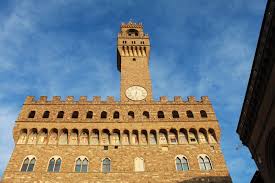
The Palazzo del Comune, the seat of the municipal government of Florence, occupies a position that has been a centre of public authority in the city for an unbroken sequence that now extends, thanks to the archaeological discoveries beneath its floor, from the Roman colonial period to the present day. The Roman theatre was a building of civic authority in the specific sense already described: a space in which the community gathered to enact its collective identity and submit to the social order inscribed in its architecture. When the theatre fell out of use and was gradually buried by the accumulation of centuries, the site was not abandoned but continued to serve as a focus of community activity. The medieval commune that governed Florence from the twelfth century onward chose this same general area as the location of its administrative centre, constructing the Palazzo del Comune on a site whose ancient significance had been obscured by time but whose central position in the urban fabric made it, quite independently of its archaeological content, the natural choice for a government building.
The medieval structure that rose above the buried theatre was, in its original form, a fortified palazzo of the type that Italian communes built throughout the thirteenth century to house the offices of government in conditions robust enough to resist the factional violence that was the normal accompaniment of communal politics. Its towers, its crenellations, its massive stone walls: all of these features belong to a language of architecture whose primary message is not civic invitation but institutional force. Where the Roman theatre opened toward the city in a great semicircular embrace, gathering the population into itself and distributing them in a legible social order, the medieval palazzo turned toward the city with walls and a restricted entrance, manifesting a conception of government as something that required protection from the governed. The contrast between the two structures, separated by no more than a few metres of vertical distance and perhaps eight centuries of time, is a contrast between two entirely different theories of the relationship between power and the people over whom it is exercised.
What Else Lies Beneath Florence
The Roman Theatre of Florentia is the most spectacular recent discovery in the underground archaeology of Florence, but it is far from the only one, and the broader picture of what lies beneath the city's streets is one that has been assembled, piece by piece, through two centuries of investigation and that continues to be revised by every new excavation that the renovation of an existing building or the construction of a new infrastructure project necessitates. What that picture shows is a city whose subsurface is, like that of Rome, a palimpsest of successive phases of occupation in which the Roman foundation, the medieval commune, the Renaissance city and the modern metropolis are all present simultaneously, their remains interleaved in a stratigraphic sequence whose complexity continues to defeat any summary account.
Beneath the Cathedral of Santa Maria del Fiore, the Duomo whose dome is the defining image of the Florentine skyline, the excavations conducted between 1966 and 1971 revealed the remains of the early Christian basilica of Santa Reparata, which preceded the present cathedral on the same site and whose construction itself overlay the remains of Roman buildings of the first through third centuries. The archaeological area beneath the cathedral floor is accessible to visitors through a separate entrance, and the descent through its successive layers from the medieval crypt of Santa Reparata to the earliest Roman levels visible at the base of the excavation is among the most concentrated experiences of deep urban time available anywhere in Florence.
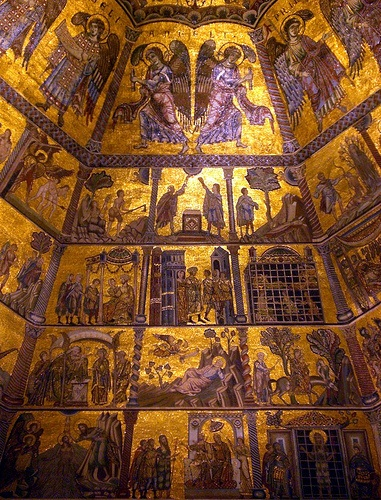
Beneath the Baptistery of San Giovanni, the oldest standing building in the historic centre and one of the most intensely studied monuments in Tuscany, excavations have identified Roman mosaic floors and structural remains that have fuelled a long-running debate about the origin of the building itself: whether it is, as some scholars have proposed, a direct transformation of a Roman structure, and if so what that structure was, whether a temple, a bath or some other building type entirely. The debate remains unresolved, which is to say it remains alive, which is to say that the Baptistery is more interesting than it would be if the question had been settled.
The medieval centre of the city, beneath the Mercato Vecchio and the surrounding streets that were demolished in the nineteenth-century urban renewal that created the Piazza della Repubblica, contained one of the densest concentrations of medieval archaeology in Tuscany, much of it destroyed by the clearances of the 1880s but partially documented before and during the demolition. The records produced by that documentation, incomplete and inconsistent as they are, provide important evidence for the character of the medieval city and constitute one of the great cautionary tales in the history of Italian urban heritage management: a reminder that archaeological evidence, once destroyed, cannot be recovered, and that the consequences of its destruction are permanent.
More recently, ground-penetrating radar surveys conducted in the Piazza della Signoria have suggested the presence of substantial Roman structures beneath the Renaissance paving, possibly the remains of the city's forum complex and its associated temples. If these surveys are confirmed by future excavation, they would establish that the Roman centre of Florentia was even more extensive and more richly appointed than the theatre discovery alone has led scholars to suspect.
How to Visit: Practical Information for the Archaeological Florence
Florence rewards the visitor who approaches it with historical curiosity at least as generously as it rewards the visitor who approaches it with aesthetic appreciation, and the two forms of engagement are, in this city more than almost any other, not alternatives but aspects of a single, necessary attention. The surface of Florence is magnificent. The depth of it is no less so. What follows is a practical guide to the underground and archaeological Florence as it is currently accessible.
The archaeological area beneath the Cathedral of Santa Maria del Fiore, the remains of Santa Reparata and the underlying Roman structures, is accessible through the cathedral entrance on a separate ticket. It is open during cathedral visiting hours, though specific access times vary seasonally and should be confirmed in advance. The site is not large, but it is extraordinarily concentrated in its significance, and the forty-five minutes that a careful visit requires are among the most densely informative that the city provides.
The Museo Archeologico Nazionale di Firenze, on the Via della Colonna in the Santissima Annunziata district, holds the most comprehensive collection of material from ancient Florentia and the surrounding Etruscan and Roman territory of Tuscany. Its galleries on the Roman period are particularly relevant to anyone who has visited the theatre excavations, providing context for the architectural remains in the form of the portable objects, the inscriptions, the coins and the everyday items that give the structural archaeology its human dimension. The museum is often overlooked by visitors whose itinerary is dominated by the Uffizi and the Accademia, and the oversight is one they will regret if they discover too late what they have missed.
Access to the Roman Theatre excavations beneath the Palazzo del Comune is subject to the ongoing progress of the archaeological campaign and the conservation work that accompanies it. Specific guided visits are organised periodically by the municipal cultural heritage services and the archaeological superintendency; information on current access arrangements should be sought through the official website of the Comune di Firenze or the Soprintendenza Archeologia Belle Arti e Paesaggio per la città metropolitana di Firenze. Demand for these visits consistently exceeds availability, and advance booking through whatever mechanism is in operation at the time of your visit is strongly recommended.
For visitors who wish to explore the Roman remains that are still hidden beneath the streets and who cannot access the active excavations, the Istituto di Etruscologia e Archeologia Nazionale at the University of Florence occasionally offers guided walks through the archaeological traces visible in the modern city fabric. These walks, led by graduate students and early-career researchers, provide an excellent introduction to the Roman city and its relationship to the Florence that stands above it.
Florence is served by the Amerigo Vespucci Airport, known locally as Peretola, approximately six kilometres from the historic centre, with a wide range of European connections. A private airport transfer to the historic centre takes approximately fifteen to twenty minutes with a fixed price and door-to-door service. For visitors arriving at Pisa International Airport, which offers a broader range of long-haul connections, the journey to Florence by private transfer takes approximately seventy-five to ninety minutes, or approximately the same time by the direct rail service between Pisa Centrale and Florence Santa Maria Novella. The transfer is the most comfortable option, especially for families or for travellers who wish to begin their archaeological exploration without the fatigue of navigating public transport with luggage.
Comments
No comments yet. Be the first to share your thoughts!
Leave a Comment
Your comment will appear after moderation.