 Michelle
 There is a particular kind of miracle that belongs only to the oldest cities. It occurs when the modern world, in its restless pursuit of progress, digs a hole for a pipe or a foundation for a building and, in doing so, tears open a seam in the fabric of time. The past does not simply emerge from such wounds. It pours forth. It insists on being seen, on being touched, on being mourned. In the winter of 2025 and the spring of 2026, the city of Florence experienced such a miracle. The excavation for a new tramline, a project of ordinary municipal ambition, became an archaeological campaign of extraordinary emotional and historical resonance. In the Piazza Beccaria, a bustling roundabout on the eastern edge of the historic centre, the earth gave up its secrets. A vast Roman necropolis, a medieval fortress, and the tiny, perfect skeleton of a two year old girl were pulled from the darkness into the light. This is the story of those discoveries. It is a story of death, of love, of the inexorable passage of time, and of the strange, humbling intimacy that archaeology forces upon the living.
Emergency Urban Archaeology: The Tramway as a Tool of Discovery
The discoveries in Piazza Beccaria were not the result of a planned academic excavation. They were, in the terminology of the profession, emergency archaeology, or rescue archaeology, conducted under the pressure of a construction schedule and the constraints of public safety. The tramline in question is Line 3.2.1, a project funded by Italy's National Recovery and Resilience Plan, which will connect Piazza della Libertà to the suburban district of Bagno a Ripoli. The work in Piazza Beccaria involved the installation of a large diameter aqueduct pipe, a necessary but unglamorous infrastructure project that required digging a deep trench across the square [citation:1].
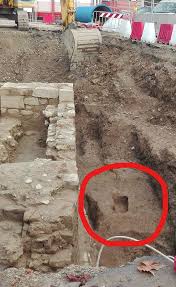
The first signs of trouble, or of wonder, depending on one's perspective, appeared in December 2025. Workers excavating near the side of Via Gioberti encountered a well preserved section of ancient pavement and a low masonry wall. The archaeologists who were called to the site immediately recognized the significance of the find. The wall was not an isolated structure. It was part of a larger complex, a system of fortifications that had once guarded the eastern approach to the city [citation:7].
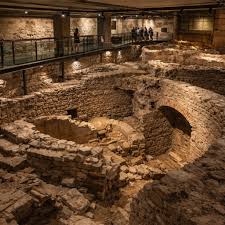
The Superintendency of Archaeology, Fine Arts and Landscape for the city of Florence, under the direction of Antonella Ranaldi, ordered a halt to the excavation. A period of intense study followed, during which the archaeologists expanded the trench, documented every stone, and began to understand the stratigraphy of the site. What they found was a palimpsest of history, a layer cake of occupation and abandonment that spanned nearly two thousand years [citation:5].
The ethics of emergency archaeology: Emergency excavations are always a compromise. The archaeologist works not at their own pace but at the pace of the construction crew that waits behind them. There is never enough time. There is never enough funding. Decisions must be made about what to document and what to sacrifice. The discovery in Piazza Beccaria was handled with exemplary care, but the Superintendency was forced to approve the partial dismantling of some of the medieval structures to allow the tramline to proceed. This is the reality of urban archaeology. It is not a science of discovery. It is a science of loss management.
The Roman Necropolis of Florentia: A City of the Dead on the Road to Fiesole
The deepest layer of the excavation, the one that lay closest to the bedrock and furthest from the modern pavement, belonged to the Roman period. Here, the archaeologists found evidence of a necropolis, a city of the dead, that had been established outside the walls of the Roman colony of Florentia in the first century BC and continued in use until the first century AD [citation:8].
The location of the necropolis was not accidental. Roman law, embodied in the Twelve Tables and later codified by Cicero, forbade the burial of the dead within the city walls. The reasons were both religious and sanitary: the dead were considered polluting, and their proximity to the living was thought to invite disease and divine disfavour. The dead were therefore consigned to the roads that led out of the city, where their tombs would be seen by every traveller and their memory would be preserved in the public gaze.
The necropolis discovered in Piazza Beccaria lies along the ancient road that led north from Florentia toward Fiesole and, ultimately, to Bologna and the Roman road network of the Po Valley. It is not the first such discovery in Florence. Between 2015 and 2018, during the construction of the first tramline, archaeologists uncovered a vast cemetery in the area between the Santa Maria Novella station and Viale Belfiore. That necropolis, which extended for hundreds of metres, contained hundreds of burials, both cremations and inhumations, accompanied by grave goods of remarkable richness and variety: oil lamps, perfume bottles, mirrors, and pottery vessels [citation:6]. The Piazza Beccaria find appears to be an eastern extension of that same burial ground, confirming that the area outside the Roman walls was given over almost entirely to the dead.
The Roman dead of Florentia were not buried without distinction. The excavations near the station revealed evidence of the bustum, a form of cremation in which the body was placed on a wooden pyre and incinerated on the spot. After the fire had done its work, the remaining bones and ashes were collected and placed in an urn or directly in the ground, often accompanied by grave goods and offerings of food and wine. In Viale Belfiore and Viale Redi, the archaeologists found thirteen such busta, along with a fifty precious grave goods. An additional bustum, discovered in Via Valfonda, contained thirty vessels of exceptional quality, suggesting that the deceased was a person of considerable wealth and status [citation:6].
The Rite of the Bustum: Cremation and the Journey of the Soul
The bustum rite, which was practised in Florentia during the first century AD, is a particularly evocative form of cremation. The word itself, bustum, is derived from the Latin verb urere, to burn, and it refers specifically to the place where the pyre was constructed and the body was consumed. Unlike a ustrinum, which was a communal cremation site where bodies were burned and the ashes later collected for burial elsewhere, the bustum was a private, individual affair. The family of the deceased built a pyre in a designated plot of land, laid the body upon it, and set it alight. After the fire had burned itself out, the family would collect the remaining bones, wash them with wine, and place them in an urn or, in the case of the poorer members of society, directly into a pit in the ground. The same plot of land then became the tomb, and it was marked with a stone, a monument, or a simple inscription.
The discovery of multiple busta in the Florence tramway excavations is of exceptional importance because the bustum rite is relatively rare in the Roman world. It was more expensive than simple interment, requiring a substantial quantity of wood and the dedication of a plot of land that could not be used for any other purpose. Its practice in Florentia suggests that the colony was, from its earliest days, a community of significant wealth and social aspiration. The families who buried their dead in this manner were not the poorest of the poor. They were the middle class, the artisans, the merchants, the veterans who had been granted land in the colony and who wished to display their status even in death.
The Skeleton of the Roman Child: Tenderness from the Abyss of Time
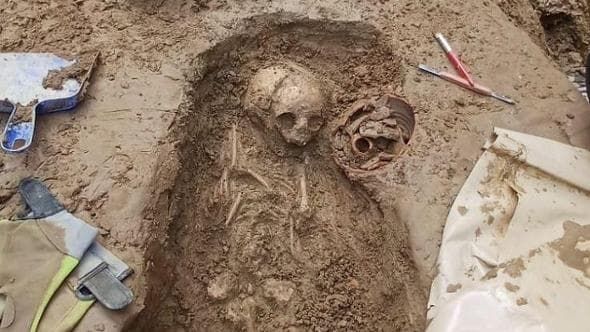
Of all the discoveries made in Piazza Beccaria, none has captured the public imagination with the force of the small skeleton found in January 2026. The bones were first uncovered during the digging for the aqueduct pipe, not far from the medieval walls. The initial hypothesis of the excavators was that the remains belonged to a medieval child, perhaps abandoned or buried hastily in a time of plague [citation:4]. It was only after a more thorough examination by the archaeological team that the true age and origin of the skeleton became clear.
The child was a girl, approximately two years old, and she had died more than two thousand years ago, in the Roman period. The date, established through a combination of stratigraphic context and the analysis of associated artefacts, placed her death at around 2,050 years before the present day, making her a contemporary of the first generation of Roman colonists who built the city of Florentia [citation:3][citation:4].
Her bones were found intact, a rarity in urban archaeology, where the weight of centuries and the intrusions of later construction have typically reduced skeletal remains to fragments. She had been laid in a simple grave, cut into the earth. Her body had been positioned on its back, with the arms at the sides, in the standard Roman burial posture. And she had been wrapped in a shroud.
The evidence for the shroud was a small fibula, a bronze brooch, found near her chest. The fibula would have been used to pin the fabric of the shroud closed, and its presence told the archaeologists that the child had been buried with care, with tenderness, with an attention to the rituals of death that speaks across the centuries with undiminished eloquence. She had not been thrown into a pit or left to rot. She had been dressed, wrapped, and laid to rest by hands that loved her [citation:3].
No other grave goods were found with the child. There were no oil lamps to light her way to the underworld, no perfume bottles to anoint her passage, no coins to pay the ferryman Charon. Her family, it seems, was too poor to provide such luxuries. They gave her what they could: a shroud, a fibula, a grave dug with care, and the silent testimony of their grief. It is this poverty, this simplicity, that makes the discovery so moving. The child was not a princess or a priestess. She was an ordinary girl, born to an ordinary family, and she died before she could learn to speak in full sentences. Her life was brief, her death unremarkable by the standards of her time. And yet, two thousand years later, her bones have the power to stop a city in its tracks.
A meditation on the child: She was born in a world that no living person remembers. The Roman Empire was still young. The Colosseum had not yet been built. Christianity was a minor sect from a distant province. She would have known the smell of woodsmoke, the taste of bread, the feel of her mother's hand. She would have been afraid of the dark and comforted by a song. She died, and the earth closed over her. For two thousand years, she lay beneath the feet of the city, undisturbed, unknown. Now she is found. Now she is seen. Now she is mourned by strangers who never knew her name. There is no greater testament to the power of archaeology to bridge the abyss of time.
The Arnolfian Walls: A Medieval Defence System Revealed
Above the Roman necropolis, separated from it by a layer of sterile soil that represented centuries of abandonment, the archaeologists encountered a second horizon of discovery: the remains of the Arnolfian walls, the defensive circuit built for the city of Florence at the end of the 13th century. The walls were named for Arnolfo di Cambio, the great architect and sculptor who designed them, and they were the most ambitious fortification project undertaken in Florence since the Roman period [citation:1][citation:5].
The section of the walls uncovered in Piazza Beccaria is adjacent to the site of Porta alla Croce, one of the principal gates in the Arnolfian circuit. The gate was oriented to the east, toward the road that led to Arezzo and Rome, and it was a point of intense traffic and commercial activity. The excavation revealed portions of the external fortifications that had protected the gate, including a paved courtyard that would have been used by those waiting to enter the city, and a massive masonry structure that the archaeologists initially interpreted as the abutment of a bridge crossing the moat.
The discovery of the walls was not entirely unexpected. The project documents for the tramline, approved in 2018, had noted that the route of the track would partially overlap the line of the ancient fortifications and that excavations at a depth of approximately one metre would likely encounter the remains of the walls and the paving of an associated road [citation:1]. What was unexpected was the state of preservation of the structures and the new information they provided about the design and function of the gate complex.
The Blind Arch of Porta alla Croce: A Mystery Still Unresolved
One of the most intriguing features of the medieval discoveries was an arched structure that the archaeologists found in front of the gate. The arch was blind, meaning that it was solid rather than open, and it was not a bridge abutment. It did not cross a watercourse or provide passage for pedestrians. It stood alone, a monumental architectural gesture whose purpose was not immediately apparent [citation:3].
The Superintendent, Antonella Ranaldi, described the structure as an antiporta, a kind of outer defensive work that would have preceded the main gate and channeled approaching travellers through a controlled entryway. The blind arch, she suggested, might have been part of a larger system of fortifications that included a drawbridge over a moat. However, the excavation was too limited in extent to confirm this hypothesis. The archaeologists could only document what was there and speculate about what was not [citation:3].
The blind arch of Porta alla Croce remains a mystery. It was built in the 13th century, used for several decades, and then, at some point in the 14th or 15th century, it was demolished. The demolition was not haphazard. The stones were carefully removed, probably for reuse in other buildings, and the site was levelled to create an open square. The purpose of the levelling, according to the archaeologists, was to create a market for livestock, a cattle market that would have been held outside the gates of the city [citation:3]. The arch was erased. The cattle market thrived. And the memory of the arch faded from the collective consciousness of Florence, until the tramway excavations brought it back to light.
What Lies Beneath: The City as a Living Palimpsest
The discoveries in Piazza Beccaria are a powerful reminder that Florence is not merely a city of the Renaissance. It is a city of all the centuries that preceded the Renaissance, and of all the centuries that have followed. The ground beneath the paving stones is a palimpsest, a parchment that has been written upon, erased, and written upon again, each generation leaving its mark and then burying it beneath the next.
The Roman city of Florentia was a modest but prosperous colony, its streets laid out in a neat grid, its public buildings adorned with marble and mosaic. The medieval city that grew on top of the Roman ruins was a commune of merchants and bankers, a republic that fought wars and built walls. The modern city that replaced the medieval walls in the 19th century was a capital of a unified Italy, a laboratory of urban planning that swept away entire neighbourhoods to make room for wide boulevards and elegant piazzas. All of these cities are still present, somewhere beneath the surface. The tramway excavations have opened a window into their world.
The excavation also revealed hints of an earlier, more ancient history. In the area of the excavation, archaeologists found traces of pile foundations, wooden posts driven deep into the earth, that seemed to indicate the presence of a river port or a waterfront structure. The investigators hypothesised that the area of Piazza Beccaria might have been, in the pre Roman period, part of a watercourse, a branch of the Arno or one of its tributaries that had been diverted or buried to allow the expansion of the city [citation:2]. If confirmed, this would push the history of human activity at the site back many centuries before the foundation of the Roman colony.
The archaeology of the invisible: Not everything that is found is visible to the naked eye. The archaeologists working in Piazza Beccaria used a range of scientific techniques to investigate the site, including ground-penetrating radar and soil micromorphology. The radar allowed them to see structures that were still buried beyond the limits of the excavation trench. The micromorphology allowed them to analyse the microscopic components of the soil, identifying traces of human activity, from the smoke of a cremation fire to the remains of a meal eaten two thousand years ago. The past is not always visible. But it is almost never entirely absent.
How the Discoveries Are Being Preserved and Studied
The future of the archaeological remains discovered in Piazza Beccaria is a subject of ongoing negotiation between the municipality of Florence, the Superintendency, and the companies responsible for the tramway construction. The medieval walls, which were found at a relatively shallow depth, could not be preserved in situ. The trench for the aqueduct pipe had to be dug, and the walls would have been destroyed by the excavation. The compromise that was reached allowed for the careful documentation and dismantling of the affected portions of the walls, while the remaining sections were left undisturbed beneath the adjacent areas of the square [citation:1].
The Roman necropolis, which lies at a greater depth, was not directly impacted by the aqueduct work. The trenches that were dug for the pipe did not penetrate deep enough to reach the Roman burials, except in a few limited areas. The discovery of the child's skeleton was made in one of those deeper contexts. The skeleton has been removed from the ground and transferred to the laboratories of the Superintendency for cleaning, conservation, and analysis. The bones will be studied by physical anthropologists, who can determine the child's age, sex, health, and diet. The fibula will be cleaned and conserved, and it will be studied by specialists in Roman metalwork, who can determine its date and place of manufacture.
The Superintendency has announced that the results of the excavation will be presented at an academic conference and will be the subject of a future exhibition. The exhibition, which is tentatively scheduled to open in 2027, will feature the most important finds from the site, including the skeleton of the child and the grave goods from the Roman burials. The location of the exhibition has not yet been announced, but it will likely be held in one of the city's archaeological museums, such as the Museo Archeologico Nazionale or the Museo di Firenze com'era [citation:3].
Florence is served by the Amerigo Vespucci Airport, also known as Peretola, which is approximately six kilometres from the historic centre. A private airport transfer from the airport to the city centre takes approximately twenty minutes with a fixed price and door to door service. For visitors arriving at Pisa International Airport, which offers a wider range of international connections, a private transfer to Florence takes approximately seventy-five to ninety minutes. The transfer is the most comfortable option for travellers who wish to begin their exploration of Florence's archaeological wonders without the fatigue of navigating public transport with luggage.
Comments
No comments yet. Be the first to share your thoughts!
Leave a Comment
Your comment will appear after moderation.