 Michelle
 Florence is a city of open secrets. For every monument that the guidebooks describe, there is a detail that the guidebooks omit, a shadow in the corner of a fresco, an inscription on a wall that no one has translated, a window that never quite closes. It is to this last category that we now turn our attention. In the Piazza della Santissima Annunziata, one of the most beautiful and architecturally harmonious squares in Italy, there stands a palace of imposing dignity and quiet grandeur. Its name is Palazzo Budini Gattai, though older Florentines still call it by its former name, Palazzo Grifoni. And on its second floor, at the level of the piano nobile, there is a window whose wooden shutter has remained slightly open, perpetually ajar, for more than four hundred years. No one knows precisely when the shutter was last fully closed. No one alive has ever seen it closed. And if the legend is to be believed, no one will ever dare to close it again.
Piazza della Santissima Annunziata: The Most Harmonious Square in Florence
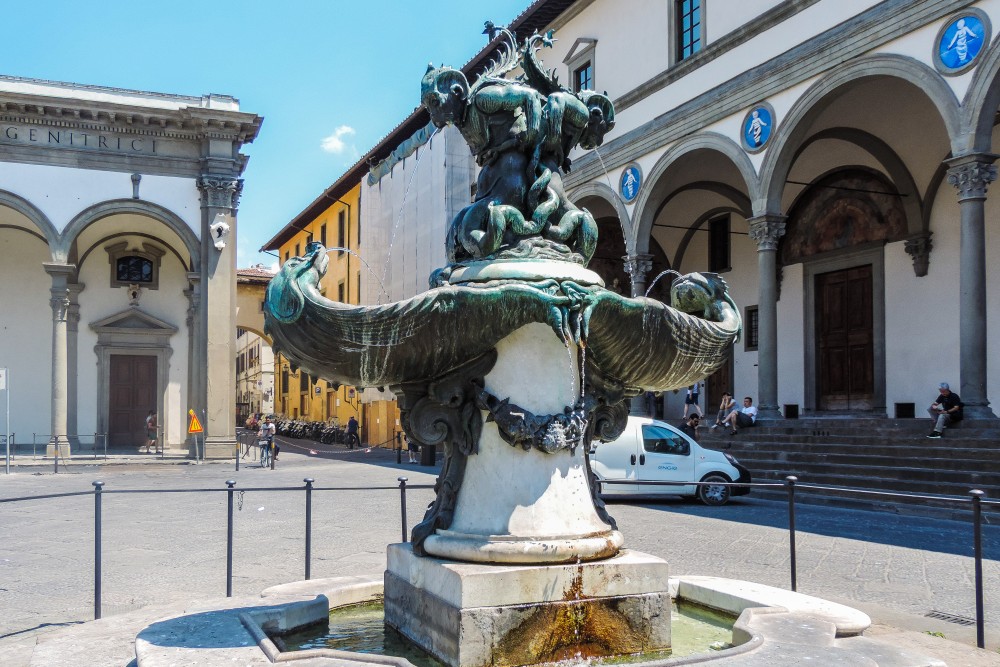
Before we speak of the palace and its restless spirit, we must first understand the square in which it stands. The Piazza della Santissima Annunziata is a masterpiece of Renaissance urban planning, a space of such perfect proportion and architectural coherence that it has been described, by those who know such things, as the most beautiful square in Florence, and perhaps in all of Italy. The square was laid out in the early 15th century under the direction of Brunelleschi, the same architect who gave the city its celebrated dome, and it was completed over the following century by his successors. The porticoes that line three sides of the square are identical in their design, a continuous arcade of graceful arches supported by slender columns, creating a sense of enclosure and protection that is rare in Italian civic spaces.
At the northern end of the square stands the Basilica della Santissima Annunziata, the Church of the Most Holy Annunciation, a shrine of considerable importance in Florentine religious life. At the southern end, the Palazzo della Confraternita dei Servi di Maria completes the composition. And on the eastern side, facing the basilica across the expanse of the piazza, stands Palazzo Budini Gattai, a building whose facade is as restrained and elegant as its neighbours, and whose secret is visible only to those who know precisely where to look.
Palazzo Budini Gattai: A History of Two Noble Families
The palace that now bears the name Budini Gattai was originally built for the Grifoni family, one of the most prominent Florentine noble houses of the 16th century. The Grifoni were bankers, merchants, and patrons of the arts, and their palace was designed to reflect their status and ambition. The architect is believed to have been Bartolomeo Ammannati, a pupil of Michelangelo and the designer of the Ponte Santa Trinita and the courtyard of the Palazzo Pitti. The construction was completed in the late 1560s, and the Grifoni family resided there for generations, accumulating paintings, sculptures, and the other accoutrements of aristocratic life.
In the 19th century, the palace passed to the Budini Gattai family, who undertook a significant renovation of the interiors while preserving the exterior facade. The building is still privately owned, and it is not generally open to the public. But the exterior, and in particular the window on the second floor, can be admired by anyone who takes the time to look up from the square.
A note on the architecture: The facade of Palazzo Budini Gattai is characteristic of the late Renaissance style, with rusticated stonework on the ground floor, elegant windows framed by classical pediments on the upper floors, and a crowning cornice that runs the entire length of the building. The shutters are of painted wood, and they are generally kept closed to protect the interiors from the sun and the dust of the city. All of them, that is, except one.
The Legend of the Bride and the Departing Husband
The legend that attaches itself to that single open window is a story of love, war, grief, and a ghost that refuses to be pacified. According to the oral tradition of Florence, which has preserved the tale for more than four centuries, the window was opened by a young bride of the Grifoni family in the late 16th century. Her husband, a military officer in the service of the Medici, had been called away to fight in one of the innumerable wars that afflicted the Italian peninsula during that turbulent century. On the morning of his departure, she went to the window on the second floor, pushed open the wooden shutter, and leaned out to wave farewell to him as he rode across the square. He saw her. He waved back. Then he turned his horse and disappeared down the Via dei Servi, heading south toward Rome and the war.
The husband never returned. Whether he fell in battle, died of disease, or was captured and imprisoned in some distant fortress, the legend does not specify. The bride waited. Days became weeks. Weeks became months. Months became years. She refused to believe that he was dead, or perhaps she could not bear to accept the uncertainty of not knowing. Every day, she returned to the window, pushed open the shutter, and gazed out at the square, hoping to see his figure appear at the end of the street. Every evening, she closed the shutter and retreated into the darkness of the palace.
She filled the long hours of waiting with embroidery. The legend describes her as constantly at work with needle and thread, creating intricate patterns that covered the walls of her apartments. The embroidery was her distraction, her meditation, her substitute for the conversation and companionship that had been taken from her. But the embroidery did not bring her husband back. Nothing brought her husband back. She grew old in the palace, still watching, still hoping, still embroidering. And then she died.
The Chaos That Followed the Closing of the Shutter
After the death of the bride, the legend continues, her relatives gathered to settle her affairs and to close the rooms that she had occupied for so many years. A servant was instructed to close the window, to pull the shutter tight, and to lock it in place so that the weather and the dust of the city would not damage the interior. The servant obeyed. The shutter was closed. And then, almost immediately, the palace descended into chaos.
The accounts of what followed are consistent across the many retellings of the legend. Furniture began to tremble and shake, as if moved by an invisible hand. Books flew from the shelves of the library, landing in heaps on the floor. Paintings crashed from the walls, their frames splintering on the marble. Doors opened and closed of their own accord. The servants, terrified, fled the rooms. The relatives, no less terrified, gathered in the courtyard to decide what to do.
Someone, perhaps the oldest and wisest of the family, remembered the widow and her constant vigil at the window. Someone suggested that the chaos had begun only after the shutter was closed. Someone proposed that they reopen the window, just to see what would happen. The shutter was unlatched. The window was pushed open. And immediately, the trembling ceased. The books stopped falling. The paintings stayed on their walls. The doors remained still. The palace was silent again, as silent as it had been when the bride was alive and watching.
The family drew the only conclusion that the evidence permitted: the spirit of the bride was still present in the palace, still waiting, still watching, still hoping for the return of her husband. She could not bear to have the window closed. It was her only connection to the outside world, her only means of continuing the vigil that had defined her life. The window had to remain open. And so it has remained open, ajar, perpetually ajar, for more than four centuries.
A thought for the visitor: When you stand in the Piazza della Santissima Annunziata and look up at that single open shutter, consider the arithmetic of the vigil that it represents. Four centuries. Sixteen generations. Countless wars, famines, floods, and political upheavals. Through all of it, the shutter has remained open. No one has dared to close it. The fear that was kindled in the 16th century has never entirely died. It is a testament to the power of stories, and of the emotions that stories carry, that a piece of wood and a length of iron can hold an entire city under their spell for so long.
The Window That No One Dares to Close: Four Centuries of Uninterrupted Openness
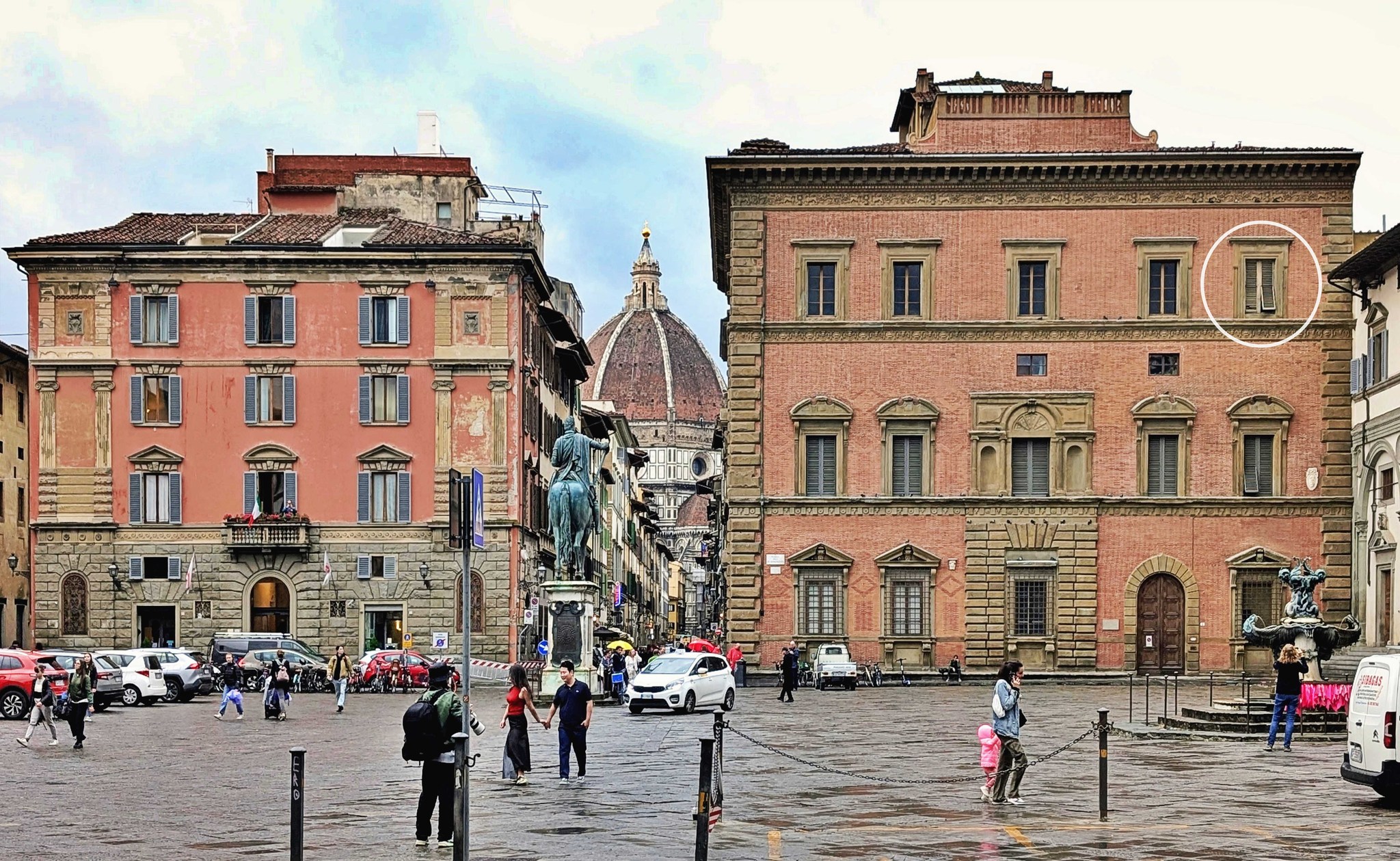
The historical record does not tell us when the shutter was last fully closed. The archives of the Budini Gattai family, if they contain any reference to the incident, are not accessible to the public. But the visual evidence is incontrovertible. In every photograph of the Piazza della Santissima Annunziata taken in the last hundred and fifty years, the window on the second floor of Palazzo Budini Gattai is shown with its shutter slightly open. The other windows on the same floor, and on the floors above and below, have their shutters properly closed. Only that one window, at that one location, remains perpetually ajar.
Visitors to the square who do not know the legend sometimes assume that the open shutter is the result of a broken hinge or a careless servant. But the shutter has been inspected by the owners of the palace, and the mechanism is in perfect working order. It can be closed. It has simply not been closed. The current owners, like their predecessors, have chosen to respect the tradition. They do not claim to believe in ghosts. But they do not claim to disbelieve in them either. They have their reasons for leaving the shutter open. They do not discuss them with strangers.
Historical Fact Versus Oral Tradition
A responsible guide must distinguish between what is documented and what is merely believed. The Grifoni family were real. Their palace, now known as Palazzo Budini Gattai, is real. The window, with its perpetually open shutter, is real. But the bride who waved farewell to her departing husband, the years of embroidered waiting, the supernatural chaos that followed the closing of the shutter, and the restless spirit that continues to haunt the building: these belong to the realm of legend, not to the realm of documented history. The archives of Florence contain no record of a Grifoni bride who died of a broken heart. The name of the husband is not preserved. The date of the supposed departure is not given.
And yet, the persistence of the legend is itself a historical fact. The story has been told and retold for four centuries. It has been printed in guidebooks, repeated by tour guides, whispered by Florentine mothers to their children. It has shaped the way that generations of visitors have experienced the Piazza della Santissima Annunziata. It has given meaning to a detail that would otherwise be dismissed as a maintenance issue. The truth of the legend does not reside in the correspondence of its details to some lost original event. The truth of the legend resides in its endurance, in its capacity to move and to frighten and to console. A story that has survived for four hundred years is a story that addresses something real in the human condition, regardless of whether the events it narrates actually occurred.
How to Visit and What to Look For
Palazzo Budini Gattai is not open to the public, but the exterior can be admired from the square at any hour of the day or night. The Piazza della Santissima Annunziata is located in the historic centre of Florence, a short walk from the Duomo and the Accademia. To reach it, follow the Via dei Servi north from the Piazza del Duomo until you emerge into the square. The palace will be on your left, on the eastern side of the piazza, facing the basilica.
Look up to the second floor. The windows of the piano nobile are larger than those of the floors above and below, and they are framed by classical pediments. Count from the left, or from the right, until you find the one whose shutter is not flush with the wall. It will be slightly open, angled outward, as if someone had just pushed it from inside and then forgotten to close it. That is the window. That is the shutter that has not been closed since the 16th century.
Visit the square at different times of day to see the window in different lights. In the morning, the sun strikes the facade directly, and the shadow of the open shutter falls across the wall in a sharp diagonal. In the afternoon, the shadow softens and lengthens. At sunset, the warm golden light of Florence makes the palace glow, and the open shutter seems to hover between the interior and the exterior, between the world of the living and the world of the dead. It is a haunting image, and it is not easily forgotten.
Florence is served by the Amerigo Vespucci Airport, known locally as Peretola, approximately 6 kilometres from the historic centre. A private airport transfer to the Piazza della Santissima Annunziata takes approximately 20 minutes with a fixed price and door to door service. For visitors arriving at Pisa International Airport, which offers a wider range of international connections, a private transfer to Florence takes approximately 75 to 90 minutes. The transfer is the most comfortable option, especially for those who wish to begin their exploration of Florentine legends without the fatigue of navigating public transport with luggage.
A note for photographers: The best time to photograph the window is in the late afternoon, when the light is golden and the square is less crowded. Stand near the centre of the piazza, directly in line with the basilica, and use a telephoto lens to isolate the window from its surroundings. The contrast between the open shutter and the closed shutters of the neighbouring windows is most visible from this vantage point. Do not use flash. The distance is too great for flash to be effective, and the ambient light is sufficient.

Comments
No comments yet. Be the first to share your thoughts!
Leave a Comment
Your comment will appear after moderation.