 Michelle
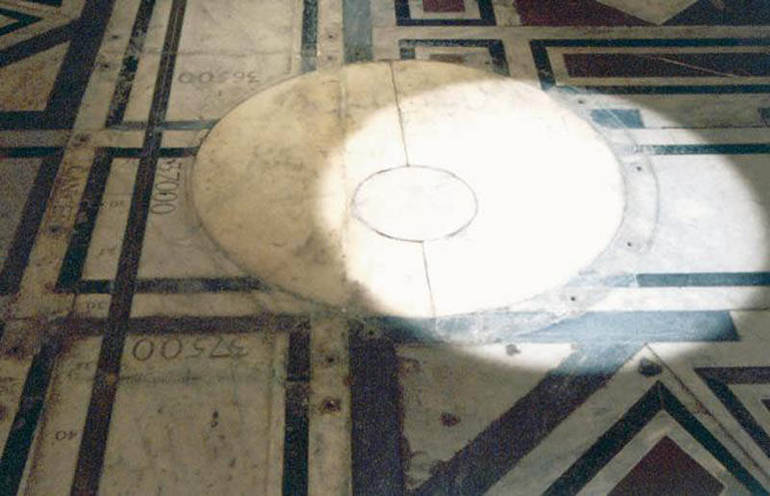
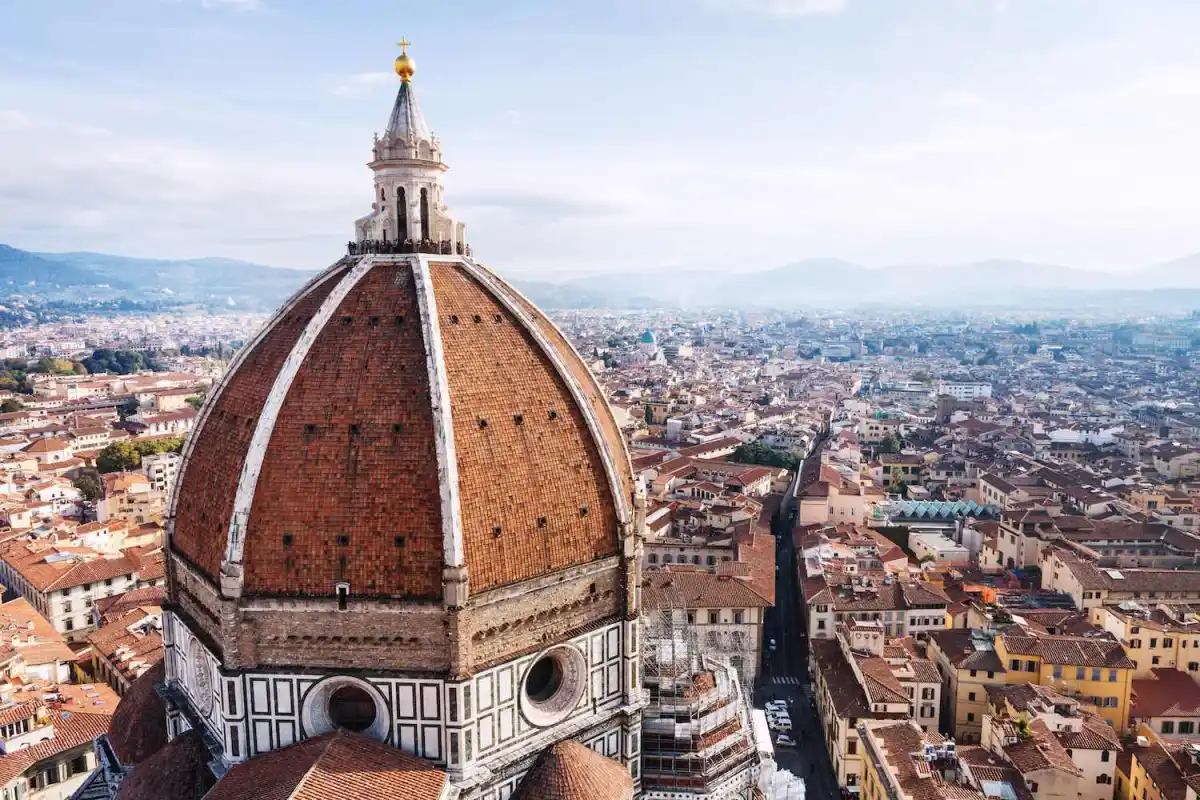
 When we think of the Duomo of Florence, we think first of its dome, Filippo Brunelleschi's masterpiece of engineering that dominates the city skyline and has become the symbol of Renaissance Florence itself. We think of its facade, a triumph of polychrome marble, and of its interior, vast and echoing, where the faithful have gathered for seven centuries. We do not, as a rule, think of it as a scientific instrument. And yet, hidden within the cathedral, at a height of ninety metres, precisely where the lantern rises from the summit of the dome, there is a small bronze plate pierced with a hole. It is the gnomon of Santa Maria del Fiore, the largest sundial ever constructed, and for more than five hundred years it has been measuring the passage of the sun with a precision that continues to astonish astronomers and visitors alike. The hole is scarcely larger than a coin, but the light that passes through it travels ninety metres to the floor of the Cappella della Croce, where it forms a disc of sunlight of extraordinary clarity. Twice a year, at the summer solstice, that disc aligns perfectly with a white marble marker of identical diameter. The cathedral becomes a camera obscura, a pinhole camera of monumental scale, and the heavens are brought down to earth with an exactness that seems almost miraculous.
A Celestial Instrument Hidden in Brunelleschi's Dome
The gnomon of Santa Maria del Fiore is not, like the sundials that decorate the gardens of villas and the facades of public buildings, an instrument that announces its purpose to the casual observer. It is hidden. It is discrete. It requires knowledge to be seen and understanding to be appreciated. The bronze plate, called the bronzina, is set into the masonry at the base of the lantern, the structure that crowns the dome and allows light to enter the cathedral from above [citation:2][citation:5]. From the floor of the cathedral, ninety metres below, it is invisible to the naked eye. The visitor who stands in the nave and looks up sees only the lantern, a distant architectural detail, and has no reason to suspect that a scientific instrument of the first importance is concealed within it.
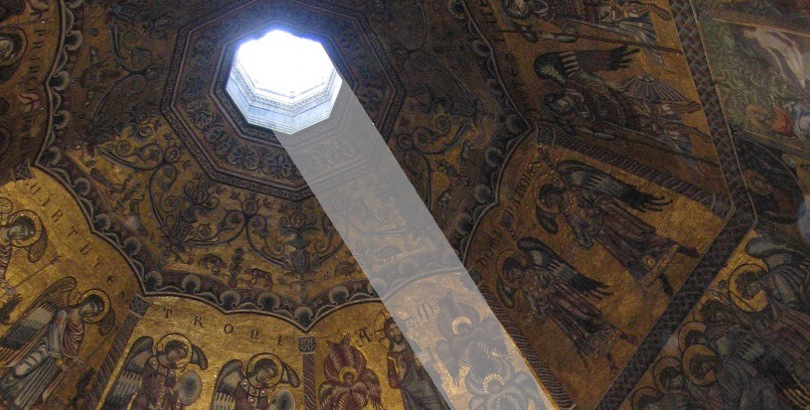
The principle of the gnomon is simple, as all great scientific principles are. A small hole admits a beam of sunlight. That beam, travelling in a straight line, projects an image of the solar disc onto a surface below. As the sun moves across the sky, the projected image moves across the surface. By marking the positions of the image at different times of the day and different seasons of the year, the astronomer can measure the altitude of the sun, determine the moment of the solstice, and calculate the length of the solar year with an accuracy that would have been impossible with the naked eye alone [citation:6]. The cathedral itself becomes the body of the instrument, a vast camera obscura in which the bronzina is the lens and the pavement is the film.
The principle of the camera obscura: The gnomon of Santa Maria del Fiore operates on the same optical principle as a pinhole camera. Light entering through a small aperture projects an inverted image of the scene outside onto the opposite surface. In this case, the bronzina is the aperture, and the cathedral floor is the surface. The effect is most dramatic on bright, clear days, when the image of the sun is sharp and well defined. The phenomenon is visible from approximately 20 May to 20 July, between 12:30 PM and 1:30 PM local time, when the sun is at its highest point in the sky [citation:5].
Paolo dal Pozzo Toscanelli: The Mathematician Who Measured the Heavens
The creator of this extraordinary instrument was Paolo dal Pozzo Toscanelli, a Florentine mathematician, astronomer, cartographer and physician who was one of the most brilliant minds of the 15th century. Born in 1397, Toscanelli was a friend and collaborator of Filippo Brunelleschi, the architect of the dome, and he is believed to have assisted Brunelleschi with the mathematical calculations necessary for the dome's construction [citation:6][citation:7]. He was also a correspondent of Christopher Columbus, and his letters to the explorer, in which he argued for the feasibility of reaching Asia by sailing west across the Atlantic, are among the most intriguing documents of the Age of Discovery.
Toscanelli conceived the gnomon not as a curiosity or a decoration but as a serious scientific instrument. His goal was to measure the precise position of the sun in the sky, to determine the length of the solar year, and to correct the astronomical tables of the period, which had accumulated significant errors over the centuries [citation:4][citation:6]. The tables in question were the Alfonsine Tables, compiled in Toledo in the 13th century, and the Toledan Tables, which were even older. By the 15th century, these tables were no longer accurate enough for the needs of astronomers, and Toscanelli believed that direct observation could provide the data needed to correct them.
The gnomon was installed in 1475. The documentation of its construction is preserved in the archives of the Opera del Duomo, and it is a document of remarkable specificity and charm. On 16 August 1475, the administrator of the Opera recorded an expenditure of five lire and fifteen soldi paid to Bartolomeo di Fruosino, a goldsmith, for the creation of a bronze model weighing 23 pounds and 4 ounces, made at the request of maestro Paolo Medicho to be placed on the lantern, so that the sun could be observed on certain days of the year [citation:2]. The entry is brief, almost casual, but it records the birth of an instrument that would be used for astronomical observation for the next five hundred years.
The Bronzina: A Small Bronze Plate with a Hole of Cosmic Significance
The bronzina itself is a modest object. It is a small bronze plate, pierced with a perfectly circular hole, set into the masonry at the base of the lantern. Its dimensions are unremarkable, and its appearance, to the untrained eye, is that of a routine architectural fitting. But its function transforms it into an object of extraordinary significance. The hole is the aperture through which the light of the sun enters the cathedral. Its position was calculated by Toscanelli with the utmost precision, taking into account the latitude of Florence, the orientation of the cathedral, and the height of the dome [citation:6].
The light that passes through the bronzina travels ninety metres before it reaches the floor of the Cappella della Croce, the chapel on the north side of the cathedral. Over that distance, the image of the sun is magnified, and a disc of light of considerable size is projected onto the pavement. The disc is sharp and well defined on clear days, and its edges are crisp enough to allow precise measurement of its position. The marble floor beneath the disc is marked with a graduated line, the meridian line, and with a series of inlaid markers that indicate the positions of the sun at different times of the year [citation:1][citation:4].
The most important of these markers is the solstice marker, a white marble disc of exactly the same diameter as the image of the sun projected by the gnomon. On the day of the summer solstice, around 21 June, the solar disc aligns perfectly with this marble disc, covering it completely. The moment of alignment is the moment of the astronomical solstice, the precise instant when the sun reaches its highest point in the sky for the year. For the astronomers of the Renaissance, this was the most important measurement of the entire calendar, and Toscanelli's gnomon provided it with an accuracy that had never before been achieved [citation:6].
The Summer Solstice Phenomenon: When Light Meets Marble
The summer solstice phenomenon is the most dramatic and the most beautiful manifestation of the gnomon's function. For several days before and after the solstice, the projected disc of sunlight can be seen moving along the meridian line, approaching the marble marker, aligning with it, and then receding. But on the day of the solstice itself, the alignment is perfect. The disc of light, sharp and bright, covers the white marble disc exactly, and for a brief moment, the sun and the stone are one [citation:5][citation:6].
The event attracts scientists, historians, and curious visitors from around the world. The Opera del Duomo organises public observations of the phenomenon, with access from the Porta dei Canonici, the door on the north side of the cathedral [citation:5][citation:8]. The cathedral is dim, and the beam of light descending from the lantern is visible as a column of brilliance in the semi darkness. The disc on the floor glows with an intensity that seems almost supernatural, and the visitors, gathered in a semicircle around the marker, watch in silence as the light moves, slowly, inexorably, toward the moment of alignment.
There is something profoundly moving about this spectacle. It is not merely a demonstration of scientific precision, though it is certainly that. It is also a meditation on time, on the passage of the seasons, on the relationship between the human and the cosmic. The same sun that warmed the fields of Tuscany in 1475 warms them still. The same mathematics that guided Toscanelli's calculations guides the astronomers of the 21st century. And the same cathedral that has served as a place of worship for seven centuries also serves, in its silent, hidden way, as an instrument of measurement, a bridge between the earth and the heavens.
The 18th Century Restoration by Leonardo Ximenes
For nearly three centuries, Toscanelli's gnomon served the purpose for which it had been designed. Then, in the early 18th century, it fell into disuse. The reasons are not entirely clear, but it seems that the bronze plate was removed, or that the aperture became obstructed, and the instrument ceased to function [citation:6]. The memory of its existence, however, was preserved in the archives of the Opera del Duomo, and when the Jesuit astronomer Leonardo Ximenes arrived in Florence in the mid-18th century, he resolved to restore it.
Ximenes was a figure of considerable learning and energy. Born in Trapani in 1716, he entered the Society of Jesus and was appointed professor of mathematics at the University of Florence. He was also the director of the Florentine observatory, and he had a keen interest in practical astronomy. Between 1754 and 1757, he undertook a comprehensive restoration of Toscanelli's gnomon, repairing the bronzina, adding a new meridian line of bronze, and improving the precision of the instrument [citation:2][citation:6]. He also used the gnomon to make a series of observations that demonstrated, for the first time, that the inclination of the Earth's axis changes over time, a phenomenon known as the obliquity of the ecliptic [citation:6].
Ximenes's work on the gnomon was part of a broader effort to modernise the scientific instruments of Florence. He also constructed a new meridian line in the cathedral, which is still visible today, and he published his observations in a series of scholarly papers that were widely read throughout Europe. After his death in 1786, however, the gnomon was again neglected, and it was not until the late 19th century that it was brought back into service.
The reverse clock of Paolo Uccello: While the gnomon measures solar time, the facade of the cathedral also contains a remarkable mechanical clock painted by Paolo Uccello in 1443. The clock is unusual in that it runs counter clockwise, with the hours marked from right to left, and the numbers begin at the bottom rather than the top. This arrangement, which seems strange to modern eyes, reflects the design of the sundials of the period, on which Uccello's clock was modelled [citation:3][citation:7]. The clock is still in working order and is one of the most curious and delightful features of the cathedral's interior.
From Astronomy to Engineering: Monitoring the Dome
The history of the gnomon in the 19th and early 20th centuries takes an unexpected turn. Between 1865 and 1927, the instrument was not used for astronomical observation at all. Instead, it was employed by engineers to monitor the structural stability of Brunelleschi's dome [citation:6][citation:9]. The concern was understandable. The dome was the largest masonry structure ever built, and the passage of centuries had inevitably taken its toll. Engineers worried about settling, about cracking, about the slow deformation of the masonry under its own immense weight.
The gnomon provided a sensitive indicator of any movement. The projected image of the sun was so precisely calibrated to the markers on the floor that any shift in the position of the bronzina, or any deformation of the structure to which it was attached, would have been immediately apparent. For sixty two years, the instrument served as a sentinel, watching for signs of distress that might have endangered the cathedral. Fortunately, none were detected. The dome was stable, and the gnomon continued to function without interruption.
In 1997, the seven hundredth anniversary of the Opera del Duomo, the gnomon was returned to its original purpose. The Opera began organising public observations of the summer solstice phenomenon, and the event has since become a cherished tradition, attracting scientists and tourists from around the world [citation:6]. The bronzina is now a protected heritage object, and the meridian line is carefully maintained.
How to Witness the Gnomon in Action
If you wish to see the gnomon in action, you must plan your visit carefully. The phenomenon is visible only during a limited period, from approximately 20 May to 20 July, when the sun is at the correct altitude and the beam of light descends to the floor of the Cappella della Croce. The optimal time for observation is between 12:30 PM and 1:30 PM local time, when the sun is at its highest point in the sky [citation:5][citation:6].
The Opera del Duomo organises guided observations of the event on specific dates, which are announced on its website. Access to the Cappella della Croce is via the Porta dei Canonici, the door on the north side of the cathedral. The observation is free, but seating is limited, and early arrival is recommended.
Even if you cannot visit during the solstice period, the gnomon is still worth seeking out. The marble markers on the floor of the Cappella della Croce are visible year round, and the visitor with a good imagination can picture the beam of light descending from the lantern, ninety metres above, to touch the stone at the appointed hour. A knowledgeable guide can explain the history and the science of the instrument, and the experience of standing in the quiet of the cathedral, looking up at the distant lantern, is one of the most contemplative that Florence offers.
Florence is served by the Amerigo Vespucci Airport, also known as Peretola, which is approximately six kilometres from the historic centre. A private airport transfer from the airport to the Piazza del Duomo takes approximately twenty minutes with a fixed price and door to door service. For visitors arriving at Pisa International Airport, which offers a wider range of international connections, a private transfer to Florence takes approximately seventy-five to ninety minutes. The transfer is the most comfortable option for travellers who wish to begin their exploration of Florence's scientific heritage without the fatigue of navigating public transport with luggage.

Comments
No comments yet. Be the first to share your thoughts!
Leave a Comment
Your comment will appear after moderation.