 Michelle
 Pompeii has been excavated, documented, catalogued and described for nearly three centuries. More ink has been devoted to it than to almost any other archaeological site on Earth. The number of scholars who have walked its streets, measured its houses and interpreted its walls runs into the thousands. And yet the city continues, year after year, to produce discoveries that no one anticipated, objects and images and spaces that force a revision of assumptions held with considerable confidence until the moment the earth gave them up. In 2024, it produced two such discoveries in rapid succession, and both of them speak, in their very different registers, of the same essential truth: that Pompeii is not finished. That the city buried by Vesuvius in 79 AD is still, in the most precise and literal sense, in the process of being revealed.
Pompeii in 2024: Why the Excavations Never Stop Surprising
The Great Pompeii Project, known in Italian as the Grande Progetto Pompei, was launched in 2012 with a budget of 105 million euros drawn from Italian government funds and the European Regional Development Fund. Its initial mandate was not primarily archaeological: the programme was created in response to a conservation crisis of considerable severity, in which sections of the unexcavated portions of the site were collapsing, poorly maintained areas were deteriorating beyond recovery, and the overall structural integrity of Europe's most visited archaeological park was in question. The first years of the Great Project were devoted to stabilisation, drainage, the reinforcement of ancient walls, the restoration of frescoes, and the establishment of the monitoring and maintenance systems that a site of this scale requires as a matter of permanent institutional commitment.
What no one had entirely predicted was the extent to which conservation work, pursued with the rigour and the documentation standards of modern archaeology, would produce discoveries of the first order. The paradox is entirely logical in retrospect: approximately a third of the ancient city of Pompeii, corresponding to the area known as the Regio V and parts of other regiones, had never been excavated. These areas had been left untouched partly by deliberate policy, in the recognition that future generations would possess more sophisticated analytical tools than those available to any given present, and partly by the sheer logistical impossibility of maintaining and studying everything uncovered simultaneously. The Great Project's conservation and drainage work necessarily involved opening ground in these previously untouched areas, and in doing so it has encountered, with a regularity that has now passed beyond the realm of surprise and into that of reasonable expectation, contexts of outstanding archaeological richness.
The discoveries announced in 2024 are, by the standards of what the Great Project has produced in the preceding decade, exceptional even within an exceptional sequence. They include the sanctuary with the blue walls and the children's charcoal drawings of the Insula dei Casti Amanti, and both of them reward not merely the quick attention of the news cycle but the more sustained and more searching attention that objects of this quality genuinely require.
The Great Pompeii Project in numbers: Since 2012, the programme has restored more than three kilometres of ancient walls, secured over one hundred previously inaccessible structures, and produced more than one hundred and fifty significant archaeological discoveries, including complete skeletons, painted rooms, organic materials preserved in carbonised form, and objects of unprecedented rarity. The project is funded until 2027, and the excavation of the remaining unexcavated third of the ancient city is expected to continue for decades beyond that date.
The Blue Walls Sanctuary: A Room Built for the Divine
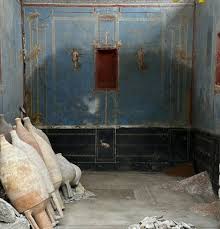
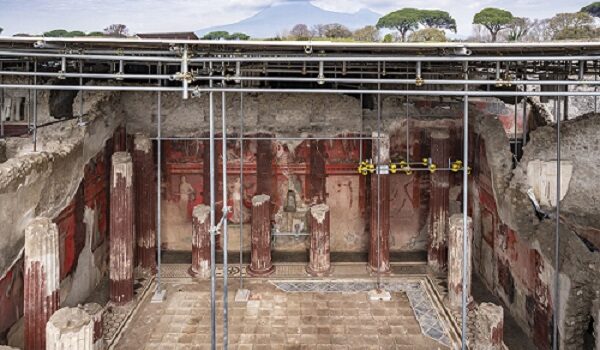
The sanctuary, or sacrarium, was discovered during excavation work in an area of Pompeii's Regio IX, a district of the ancient city that has yielded several of the most significant finds of the entire Great Project. A sacrarium was a standard feature of the more prosperous Roman house: a dedicated room, typically small, set apart from the domestic and commercial functions of the building and reserved for the veneration of the household gods, the Lares and the Penates, whose presence and protection were understood to be the foundation of the family's wellbeing. The Roman household was a religious unit as much as a social one, and the sacrarium was its most intimate sacred space, the room where the daily acts of domestic piety, the offerings of incense and wine and small cakes, the lighting of lamps before the images of the protecting deities, took place with the regularity and the seriousness that the Romans reserved for their religious obligations.
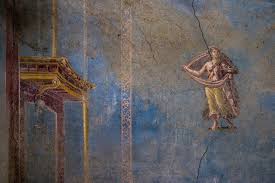
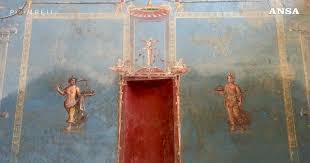
What makes the sanctuary discovered in 2024 categorically unlike any previously documented sacrarium at Pompeii is the colour of its walls. Every surface of the room, from floor to ceiling, from the plain dado at the base to the decorative zones above, is painted in Egyptian blue. Not as an accent within a larger decorative scheme. Not as a border or a panel element. As the primary and indeed the exclusive colour of the room's decoration, an immersive, enveloping field of intense, saturated blue that would have greeted the worshipper at the threshold and surrounded them entirely upon entering. No comparably preserved sacrarium with this character of decoration has been documented anywhere in the Roman world. The room is unique.
The physical condition of the discovery is, by any standard, extraordinary. The walls retain the blue pigment with a vividness that suggests conditions of exceptional preservation: the rapid burial by volcanic material in 79 AD, combined with the stable micro-climate maintained within the sealed room over nearly two thousand years, has protected the painted surface from the deterioration that has affected so many of Pompeii's frescoes. The blue is not faded. It is not cracked beyond legibility. In the photographs released by the Archaeological Park and the Parco Archeologico di Pompei, it appears with an intensity that makes it difficult, at first glance, to accept that one is looking at something two thousand years old rather than painted last week.
Within the sanctuary, the excavators found evidence of the ritual use for which it was designed: traces of organic material consistent with the burning of incense or aromatic substances, fragments of small ceramic vessels of the kind used for votive offerings, and, most compellingly, the remains of what appears to be a painted image on the rear wall, partially obscured by accumulated material but sufficiently legible in its preliminary documentation to suggest a figured scene, most likely a representation of the Lares themselves or of a deity associated with the household's particular devotion. The full investigation and conservation of this painted surface is ongoing, and its publication in a form accessible to the scholarly community will represent one of the most significant documents of Roman domestic religion yet produced.
Egyptian Blue: The Most Expensive Colour in the Ancient World
To understand why the blue walls are significant beyond their visual beauty, it is necessary to understand what Egyptian blue actually was, and what it cost to produce and to purchase in the first century AD. The pigment known to the Romans as caeruleum aegyptium, and to modern scholars as Egyptian blue, is the oldest synthetic pigment in the history of human art-making. Its manufacture was developed in Egypt, in a form closely associated with the production of faience and blue-glazed ceramics, at some point during the fourth millennium BC, and the technical knowledge required to produce it was among the most jealously guarded industrial secrets of the ancient Mediterranean world.
The production process is precise, demanding and admits of very little error. Sand and limestone are combined with a copper compound, typically malachite or azurite, and a calcium compound derived from either limestone or shell, in carefully calibrated proportions. This mixture is then heated in a kiln to temperatures between 850 and 1000 degrees Celsius for a sustained period, typically many hours. At the correct temperature and with the correct proportions, the mixture vitrifies into a glass-ceramic material of a particular crystalline structure, cuprorivaite, whose optical properties produce the intense, stable blue that has not faded in the specimens preserved since antiquity. If the temperature is too low or too high, if the proportions are incorrect, if the firing time is insufficient, the result is not blue but a dull, undifferentiated grey or green, and the entire preparation is wasted.
The raw materials, the fuel, the kiln, the skilled labour required to operate it and to judge the progress of the firing by observation alone, the distribution network required to move the finished pigment from the production centres, concentrated in Egypt and later in certain areas of the Italian peninsula, to the customers who required it: each of these elements added to a cost structure that made Egyptian blue, by the first century AD, one of the most expensive materials available to a Roman patron of the arts. Pliny the Elder, writing in his Naturalis Historia in approximately 77 AD, two years before the eruption of Vesuvius, described the production of caeruleum with evident fascination and noted its considerable cost. He was aware that the finest qualities came from Alexandria and that inferior imitations existed, and his account suggests that distinguishing the genuine article from its substitutes was already, in his time, a matter requiring some expertise.
In the decorative programs of Pompeian houses, Egyptian blue appears with a frequency that archaeologists have systematically documented and correlated, as well as such correlations can be established in the absence of price records, with the economic status of the house's owner. It is found in the grandest spaces of the grandest houses: in the large reception rooms, the triclinia where guests were received and the owner's social position publicly displayed, and in the most prominent decorative panels of the most ambitious fresco cycles. It is not, as a rule, found covering every surface of a small, dedicated religious room in a house of middle rank. The sacrarium of the 2024 discovery is, in this respect, remarkable: the resources invested in its decoration are disproportionate to what might be expected from the size of the room and the general character of the house in which it sits, and this disproportionality is itself a historical document of the first importance.
When a Roman family chose to paint their sanctuary in the most expensive colour available, they were not merely decorating a room. They were making a theological statement about the value of what the room contained, and an economic statement about what they were prepared to sacrifice in order to honour it. The blue walls are not background. They are the offering itself.
What the Blue Walls Tell Us About the Family Who Lived There
Roman society in the first century AD was not a simple binary of rich and poor. It was a nuanced hierarchy of status, wealth, legal condition and social aspiration in which the distinctions that mattered were often finer and more contested than the crude categories of ancient or modern sociology suggest. Pompeii, because it preserves the physical fabric of an entire city at a single moment, offers more direct evidence of this complexity than almost any other archaeological site. The houses of Pompeii range from the palatial residences of the great landowning families, with their peristyle gardens and their elaborate mosaic floors and their collections of bronze sculpture, to the single-room lodgings of freedmen and artisans, with their sleeping benches and their cooking hearths and their scratched graffiti on the whitewashed walls.
The house that contains the blue sanctuary appears, on the basis of the preliminary reports available at the time of writing, to belong to the prosperous but not aristocratic middle of this hierarchy: a family of means, almost certainly engaged in trade or a skilled craft, in possession of sufficient resources to invest in the construction and decoration of a dedicated sacred space but not of the kind of wealth that built the House of the Vettii or the House of the Faun. This makes the decision to use Egyptian blue for the sanctuary's walls the more striking. It was not, for this family, an incidental expense. It was a significant commitment of resources to a room that no guest would ordinarily see, that served no commercial or social display function, that existed entirely for the private practice of devotion.
What this tells us, with a directness that no literary source from the period quite achieves, is something about the quality of Roman domestic religious feeling. The sacrarium was not decorated for show. The household gods had no need of social display. The blue was put on those walls for the gods themselves, or for the family in the gods' presence, and the extravagance of the gesture speaks of a relationship between this particular family and its divine protectors that was, by any measure, intense and seriously held. Piety, in the Roman domestic tradition, was not a performance. The blue walls are evidence of its private and costly reality.
The fluorescence of Egyptian blue: One of the most remarkable properties of Egyptian blue is its behaviour under near-infrared light: the pigment fluoresces intensely, emitting a luminescence that is invisible to the naked eye in normal conditions but dramatically apparent under scientific imaging. This property has allowed researchers to detect the presence of Egyptian blue in contexts where the pigment is no longer visible on the surface, either because it has faded, been overpainted or been incorporated into a plaster layer. The fluorescence of the blue walls of the 2024 sanctuary under scientific lighting provided one of the first confirmations that the colour was indeed Egyptian blue and not a later imitation or a mineral substitute.
The Insula dei Casti Amanti: Where Children Left Their Mark
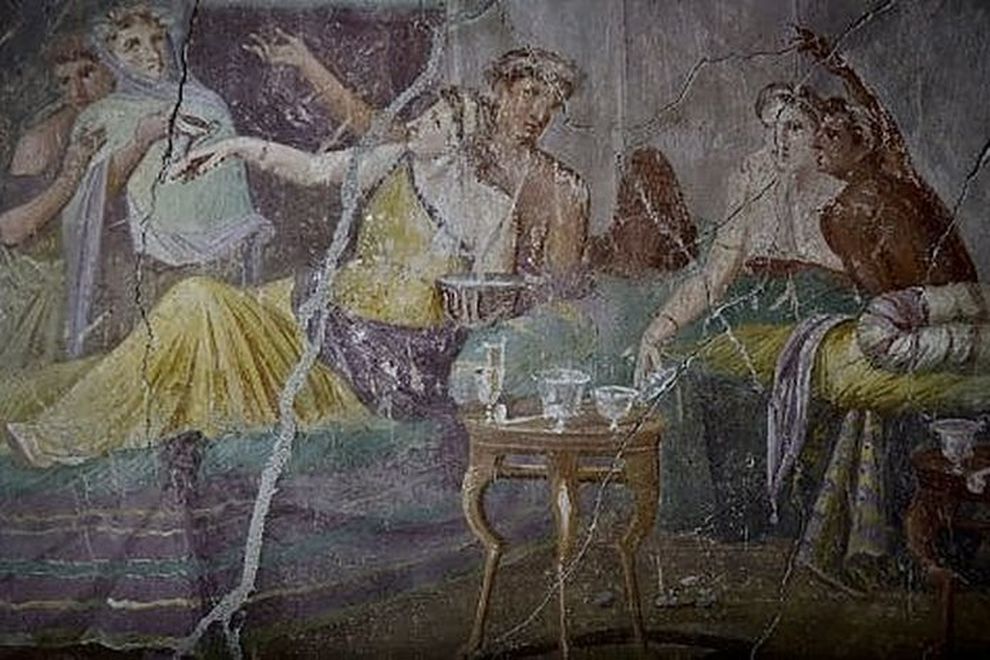
The Insula dei Casti Amanti, the Block of the Chaste Lovers, takes its name from one of the most celebrated frescoes in Pompeii: a dining room painting depicting a couple in a tender embrace, their heads inclined toward each other with a restraint and a gentleness that contrasts sharply with the more explicitly erotic imagery found elsewhere in the city, and that has charmed every visitor since its discovery. The insula is a complex of interconnected structures occupying an entire city block in Regio IX, comprising a bakery with its large millstones still in situ, a series of residential spaces of different sizes and appointments, and a number of rooms whose function has been the subject of ongoing investigation.
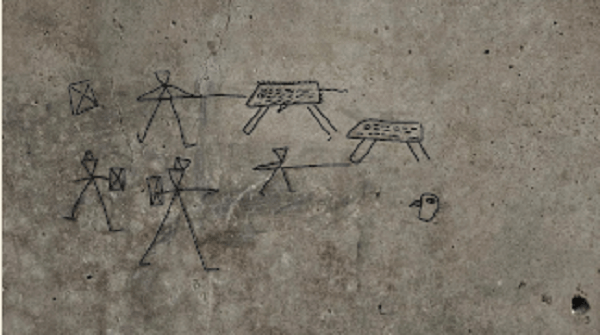
The complex was partially excavated in the nineteenth century, substantially investigated in the early twenty-first century as part of a long-term project directed by the University of Rome La Sapienza, and has been at the centre of some of the most productive excavation work of the Great Pompeii Project in recent years. The discoveries it has produced are remarkable in their diversity: intact organic materials including food remains, textiles and wooden objects; the skeletal remains of individuals who did not survive the eruption; wall paintings of extraordinary quality; and now, announced in 2024, the charcoal drawings of children on the plaster of a corridor wall, at a height that places them definitively within the reach of young children rather than adults, and with a character that is unmistakably, movingly, the work of young hands.
The drawings were made in charcoal on a section of wall whose plaster surface was still fresh enough, at the time of the eruption, to have received and retained the marks of the charcoal with exceptional fidelity. The volcanic material that covered them on the night of 24 August 79 AD sealed them within hours of their creation, in a preservation event of such completeness that the drawings are, in a very real sense, still wet: fixed at the moment of their making in a permanence that their creators, children amusing themselves on a wall in a Roman house on an August afternoon nearly two thousand years ago, could not possibly have imagined.
The Gladiator Drawings: Innocence and Violence on the Same Wall
What the children drew, with their pieces of charcoal and the freedom of the young in the presence of an unmarked surface, were scenes of gladiatorial combat. The figures are rendered with the economy and the confidence of children who have looked carefully at something they found compelling and are reproducing what they saw as directly and as accurately as their hands allow. Some of the gladiators are shown in fighting stances, their bodies turned toward an opponent, their arms raised in postures of attack or defence, their weapons and shields delineated with a specificity that speaks of careful observation rather than generic symbol-making. The figures are not stick-men. They have weight and mass and intention. They are the work of children who knew what gladiators looked like, from direct experience or from the abundant visual representations of gladiatorial combat that saturated Roman public and private culture, and who were drawing from that knowledge with considerable seriousness.
The gladiator occupied a complex and deeply contested position in Roman culture. He was simultaneously despised and celebrated, legally a person of the lowest social status, an infamis, a person stripped of civic standing by virtue of his profession, and the subject of a popular adulation that expressed itself in graffiti, in paintings, in terracotta figurines, in oil lamps and in tableware across the entire social spectrum of the Roman world. Children played gladiators in the street, as the Roman physician Galen noted with disapproval; children collected images of gladiators; children drew gladiators on walls. The drawings in the Insula dei Casti Amanti are therefore not surprising in what they depict. What makes them extraordinary is the directness of their survival and the completeness of the imaginative access they provide to the interior life of children in a Roman city on the eve of one of the most catastrophic natural disasters in human history.
There is something in the juxtaposition of these two discoveries, the costly blue devotion of the adults and the charcoal play of the children, that seems almost too perfectly expressive to be accidental. In one house, a family invests in a colour of extraordinary expense to honour its gods in private. In another, children reach up to an available surface and draw the heroes of the arena with the unselfconscious confidence of those who have no idea that what they are making will outlast everything they know. Both acts are entirely ordinary within their own context. Both are entirely irreplaceable within ours. This is the paradox at the heart of Pompeii, and it is the paradox that ensures the city's continuing power to move and to instruct those who come to it with open eyes.
Graffiti and children at Pompeii: The walls of Pompeii are among the richest repositories of informal writing and drawing from the ancient world. More than eleven thousand graffiti have been recorded, ranging from electoral endorsements and commercial announcements to declarations of love, insults, quotations from Virgil, and the kind of reflexive self-documentation that every literate culture produces on available surfaces. Evidence of children's writing and drawing at Pompeii is not new: alphabets scratched in plaster by children learning their letters have been found in several locations, and finger tracings in fresh plaster attributed to children have been documented in certain domestic contexts. The 2024 discovery of a concentrated group of charcoal drawings of identifiable subject matter, at a height consistent with childhood authorship, is nonetheless unprecedented in its specificity and its state of preservation.
The Great Pompeii Project: What Remains to Be Found
The approximately one third of Pompeii that has never been excavated is not a uniform or undifferentiated expanse of unbroken soil. It includes areas of the city that ancient literary and epigraphic sources, as well as the patterns of the excavated sectors, suggest were among the most densely and elaborately built parts of the ancient city: entire city blocks, temple precincts, commercial districts and residential quarters whose contents can only be inferred from what surrounds them and from the scattered surface evidence visible before excavation begins. The expectation, reasonably held on the basis of what the past decade of the Great Project has produced, is that the uninvestigated areas will yield discoveries commensurate with the richness of what has already been found.
The methodological framework within which this future excavation will take place is considerably more sophisticated than anything available to the excavators of previous centuries. Ground-penetrating radar and other non-invasive geophysical survey techniques can now produce three-dimensional maps of sub-surface features with a resolution that allows individual walls, floors and large objects to be identified before any earth is moved. Drone photogrammetry provides centimetre-accurate three-dimensional records of every exposed surface as excavation progresses. Portable X-ray fluorescence spectrometers allow pigments to be identified in situ without the removal of samples. Micro-CT scanning of sealed vessels and consolidated organic materials reveals their contents without opening or disturbing them. The Pompeii of the next generation of archaeologists will be excavated with tools that their predecessors could not have imagined, and the record it produces will be of a completeness and a precision without precedent in the history of the discipline.
What remains to be found, in the most literal sense, is most of a Roman city. The discoveries of 2024, extraordinary as they are within the standards of any individual year's archaeological production, are a small instalment in a much larger account. The blue sanctuary and the children's drawings will take their place, in the history of Pompeii's rediscovery, alongside the House of the Vettii and the Garden of the Fugitives and the Thermopolium of Regio V: as moments in a narrative whose ending cannot yet be written, because the city has not yet finished speaking.
How to Visit Pompeii: Practical Guide
Pompeii is the most visited archaeological site in Italy and among the most visited in the world. The volume of visitors, which exceeded four million in recent years, makes planning essential: an unplanned arrival on a summer morning can mean queues of several hours at the main entrance, a degree of crowding on the principal streets of the ancient city that makes thoughtful engagement difficult, and an experience that, however extraordinary the site itself, can feel more like a managed spectacle than the encounter with a real place that it deserves to be. With the right preparation, none of this need be the case.
Book your ticket online, well in advance, through the official website of the Parco Archeologico di Pompei. Timed entry slots are available and allow you to bypass the ticket queue entirely. Arrive at your allocated time and enter immediately. The most important strategic decision you will then make is your route through the site: the majority of visitors move along the main axes of the Via dell'Abbondanza and the Via di Nola toward the Forum, creating a pattern of crowd concentration on these streets that makes certain areas intensely busy while leaving others, equally remarkable, in relative quiet. A good map and a willingness to turn away from the crowd will bring you, within fifteen minutes of entering, to spaces that you can have almost entirely to yourself.
Plan to spend a minimum of four hours, and preferably a full day, in the archaeological park. The site covers 44 hectares and encompasses not only the famous landmarks but hundreds of individual houses, workshops, gardens, temples and public buildings, many of them containing original paintings and mosaics of extraordinary quality. The Antiquarium, the site museum reopened in 2021 after extensive renovation, houses a selection of the most significant portable finds and provides essential context for what you see in the streets.
From Naples, the most practical means of reaching Pompeii is the Circumvesuviana railway, which departs from Porta Nolana station in the city centre and reaches the Pompeii Scavi stop in approximately 35 minutes. Trains run frequently throughout the day. From Naples International Airport, a private transfer to Pompeii takes approximately 30 to 45 minutes depending on traffic and offers the most comfortable and most flexible option for visitors arriving directly from the airport with luggage.
Best time to visit Pompeii: The spring months of April and May, and the autumn months of September and October, offer the finest conditions: moderate temperatures, manageable crowds, and the quality of light that the site's extraordinary scale and the presence of Vesuvius on the horizon genuinely reward. July and August are the most crowded and the most punishing in terms of heat: the site offers little shade, temperatures regularly exceed 35 degrees Celsius, and the combination of physical discomfort and crowd pressure makes a long, contemplative visit difficult to sustain. If summer is your only option, arrive at opening time, carry plenty of water, and retreat by early afternoon.
Comments
No comments yet. Be the first to share your thoughts!
Leave a Comment
Your comment will appear after moderation.