 Michelle
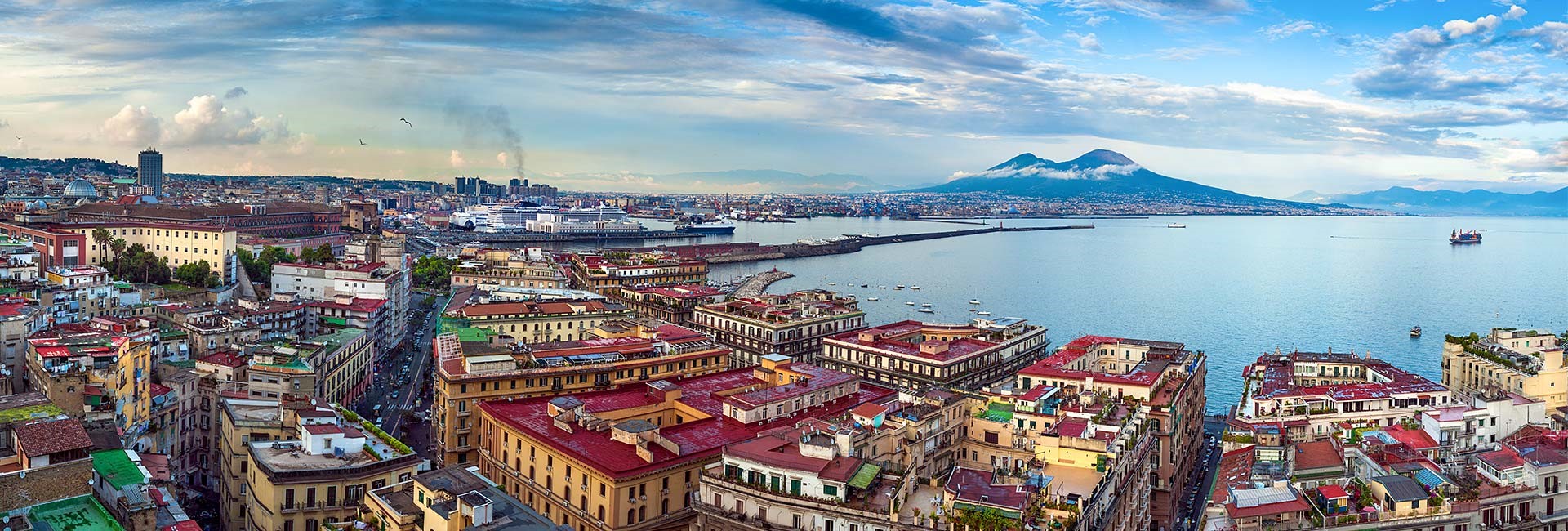
 There is a moment, usually at dusk, when you stand on one of Sorrento's clifftop terraces and the whole Bay of Naples spreads out before you in shades of gold and deep violet. The islands of Capri and Ischia float in the haze. The cone of Vesuvius glows on the far shore. The smell of lemon blossoms drifts up from the orchards below. In that moment, you understand why people have been coming here for centuries. Sorrento does not try to impress you. It simply is. And that, in the end, is more than enough.
When Is the Best Time to Visit Sorrento?
Sorrento is beautiful in every season, but the timing of your visit will shape your experience considerably. The town sits on the Sorrentine Peninsula, sheltered from the worst of the northern winds, which gives it a gentler climate than much of mainland Italy. Even in winter, temperatures rarely drop below 10 degrees Celsius, and the light is extraordinary.
That said, the finest windows for a first visit are April through June and September through October. In late spring, the lemon and orange groves that terrace the hillsides above the town are in full bloom, filling the air with a fragrance that is, quite simply, one of the most intoxicating things you will ever encounter. The sea is still too cool for most swimmers in April, but warm enough to enjoy by late May. The summer months of July and August bring intense heat, full hotels, and prices that reflect the peak demand. If summer is your only option, book everything months in advance and plan your outdoor activities for early morning and early evening.
Best kept secret: November in Sorrento is deeply underrated. The tourists have gone, the restaurants are back to serving their best food at their own pace, the light over the bay is extraordinary for photography, and you can walk the clifftop paths in complete peace. A warm jacket and waterproof shoes are all you need.
1. Getting to Sorrento: Plan Your Arrival Carefully
Sorrento is served by no airport of its own. The nearest international airport is Naples International Airport (NAP), known as Capodichino, located approximately 55 kilometres to the north. From the airport, you have two realistic options for reaching Sorrento.
The most comfortable and direct is a private transfer from Naples Airport to Sorrento, which takes you door to door in approximately 50 to 60 minutes, depending on traffic on the A3 motorway. There is no luggage handling, no connections, no navigating an unfamiliar city at the end of a long flight. Your driver is waiting for you at arrivals, and your hotel is the next stop. For families, groups, or anyone arriving late in the evening, this is by far the most stress-free option.
The public transport alternative is the Circumvesuviana railway: take the Metro Line 2 from Naples Airport to Napoli Garibaldi station, then the Circumvesuviana train towards Sorrento. The total journey takes approximately 90 minutes and is an adventure in itself. The train winds along the foot of Vesuvius through Pompeii and Herculaneum, and the views of the bay that open up as you approach Sorrento are remarkable. The Circumvesuviana is not the most modern or air-conditioned of services, but it is cheap, frequent and perfectly safe.
Once in Sorrento, the town itself is extremely walkable. The historic centre, Piazza Tasso, the clifftop gardens, and the descent to Marina Grande are all accessible on foot. For reaching more distant points along the coast, local SITA buses and private boat hire are your main options.
2. Piazza Tasso and the Historic Centre
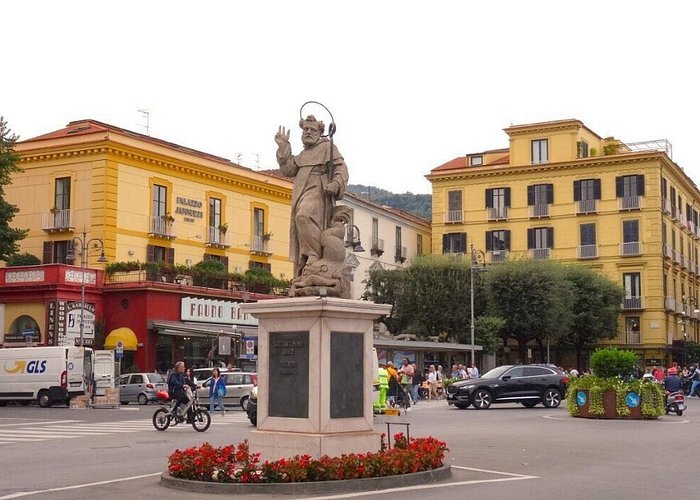
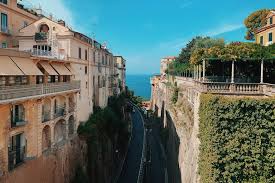
Every visit to Sorrento begins and ends at Piazza Tasso, the town's main square, named after the Renaissance poet Torquato Tasso who was born here in 1544. It is the living room of Sorrento: a broad, animated piazza where locals and visitors mingle at the outdoor tables of the bars and cafes, where the passeggiata unfolds every evening, and where the energy of the place is most immediately felt. The square opens at its northern edge to a breathtaking view over the gorge of the Valle dei Mulini and, beyond it, to the bay.
From Piazza Tasso, the medieval grid of the historic centre radiates in every direction. The main pedestrian axis is Corso Italia, lined with shops selling ceramics, hand-embroidered linens, inlaid woodwork, and the town's most famous export: limoncello. Push deeper into the narrow lanes and you find a Sorrento that tourism has not entirely reached: small family-run restaurants with hand-written menus, artisan workshops where wood inlay marquetry is still produced by hand, and the occasional courtyard church with a floor of painted majolica tiles.
Do not miss the Sedile Dominova, a fifteenth-century loggia tucked into a corner just off the main street, its interior completely covered with extraordinary frescoes. It is now used as a social club by the local retired men of Sorrento, who play cards there each morning. It is one of the most atmospheric and entirely un-touristy corners of the whole peninsula.
Do not rush past the Cathedral. The Duomo di Sorrento, on Corso Italia, contains some of the finest examples of the town's traditional intarsia (wood inlay) art, and its carved marble episcopal throne is one of the most beautiful pieces of Renaissance stonework in the region. Entry is free and it is almost always peaceful inside.
3. The Sea: Marina Grande, Marina Piccola and the Cliffs
Sorrento is not a beach town in the conventional sense. The cliffs on which the town sits rise sheer from the sea, which means that reaching the water requires either a steep descent on foot or a lift in some of the grander hotels. But this, paradoxically, is part of what makes the sea here so magnificent. It feels earned.
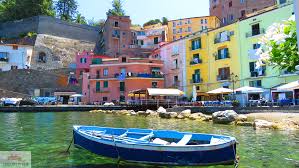
Marina Grande is Sorrento's ancient fishing harbour, tucked into a small inlet on the western side of the promontory and accessible by a steep lane that descends from the edge of the historic centre. It is the most authentic corner of town: a cluster of brightly painted fishermen's houses, a pebble beach, a handful of excellent seafood restaurants with tables literally at the water's edge, and the colourful wooden boats of the local fishermen drawn up on the shore. Come here in the morning, when the fishermen are still sorting their nets and the light on the water is extraordinary. Come back in the evening for dinner.
Marina Piccola, on the eastern side, is where the ferries leave for Capri, Ischia and Positano, and where the main bathing platforms and lido establishments are concentrated. Most are carved directly into the rock face, or built on wooden platforms that extend over the sea. The water here is crystalline, protected from the open swell, and a remarkable shade of blue-green that seems almost too vivid to be real.
The Villa Comunale, the clifftop public garden above Marina Piccola, is the finest free viewpoint in Sorrento. Arrive at sunset. The views of the bay, Vesuvius and the islands are staggering, and the garden is filled with the fragrance of jasmine and bougainvillea. The lift from the garden down to the bathing platforms below costs a small fee.
Avoid the crowds at the lidos: Most of the paid bathing establishments get very busy between 11 am and 4 pm in summer. Go early in the morning, before 9 am, or late afternoon after 5 pm. The water is calmer, the light is more beautiful for photographs, and you will have the platforms almost to yourself.
4. Day Trips: Capri, the Amalfi Coast and Pompeii
This is where Sorrento truly reveals its worth as a base. Nowhere in southern Italy sits at the centre of so many extraordinary destinations, all reachable without a car, most within an hour.
Capri
The ferry from Marina Piccola to Capri takes just 25 minutes by hydrofoil, and the island is one of the most celebrated and visually spectacular places in the Mediterranean. The town of Capri and the village of Anacapri have a character all their own: a labyrinth of white-washed lanes, bougainvillea-draped terraces, jewellery shops and perfumeries, with views at every turn that make you stop and stare. The Blue Grotto (Grotta Azzurra), a sea cave where the light enters through an underwater opening and turns the water an unearthly luminous blue, is one of the great natural spectacles of Italy. Book the boat excursion early in the morning, before the queues build. The chairlift up to Monte Solaro for the panoramic views is not to be missed.
Make sure you take the first or second ferry of the morning, around 7 am or 8 am. By 11 am, Capri in summer is overwhelmed by day-trippers arriving on large tour boats from Naples and the Amalfi Coast, and the lanes of the town become almost impassable. The island is a completely different and far more enjoyable place in the early morning and late afternoon.
The Amalfi Coast
The Amalfi Coast, a UNESCO World Heritage Site, is perhaps the most photographed stretch of coastline in Europe: a succession of vertiginous cliffs plunging into the deep blue sea, punctuated by the pastel-coloured villages of Positano, Praiano, Ravello and Amalfi itself. From Sorrento, you can reach the coast by ferry (the most comfortable option in summer, avoiding the traffic on the mountain road), by SITA bus (the most economical option, but not recommended if you suffer from motion sickness on winding roads), or by private transfer.
Positano, with its dramatically stacked houses cascading down to a small beach, is the most iconic stop and justifiably the most visited. Ravello, perched 350 metres above the sea, is quieter and in many ways more beautiful, with the extraordinary gardens of Villa Rufolo and Villa Cimbrone offering views that D.H. Lawrence described as the most beautiful in the world. Amalfi itself, the medieval maritime republic that once rivalled Venice and Genoa, has a magnificent Arab-Norman cathedral and a characterful old town that rewards wandering.
Pompeii and Herculaneum
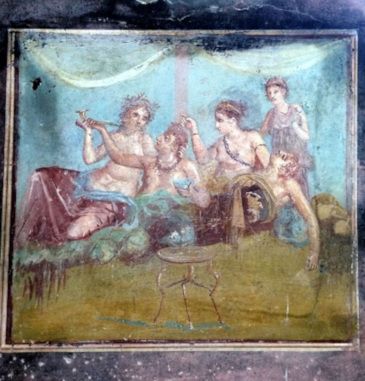
The ancient Roman city of Pompeii, preserved in extraordinary detail by the eruption of Vesuvius in 79 AD, is a 25-minute Circumvesuviana train ride from Sorrento, and is one of the most viscerally moving archaeological sites in the world. The scale is staggering: entire streets, houses, shops, temples, baths, theatres and gardens, all frozen at the moment of destruction. Allow a minimum of three to four hours, bring water and wear comfortable shoes. The site is enormous and entirely outdoors.
The less-visited but arguably more impressive Herculaneum (Ercolano), also on the Circumvesuviana line, was buried in a different way by the same eruption, and the preservation of its wooden structures, painted walls, food shops and upper floors is even more astonishing than Pompeii. There are far fewer visitors. If you have time for only one, Herculaneum is the more intimate, better-preserved and more emotionally powerful experience.
Sorrento has always attracted artists, poets and grand tourists because of something that is easier to feel than to explain: a quality of light, a gentleness of atmosphere, a sense that beauty here is not a performance but simply a condition of existence. Henry Wadsworth Longfellow wrote of it. Ibsen wrote part of Peer Gynt here. Wagner visited and was overwhelmed. And visitors today feel the same pull, even if they cannot quite say why.
Food in Sorrento: What to Eat, Where to Eat and What to Avoid
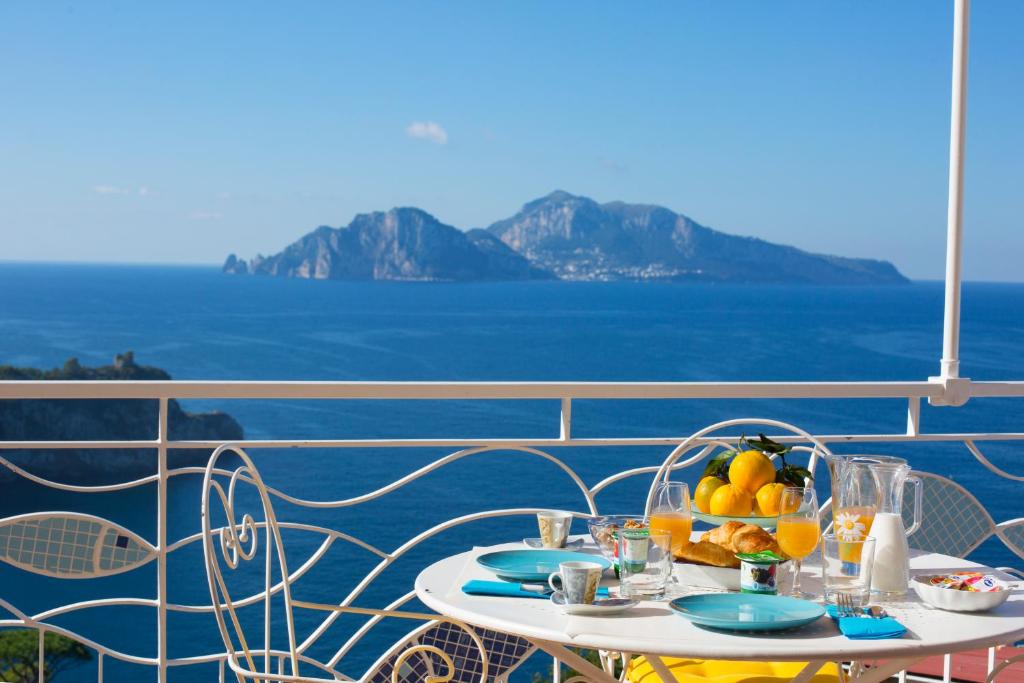
The food of Sorrento and the Sorrentine Peninsula is one of the great pleasures of southern Italy, built on the same foundations as the Neapolitan cuisine it closely resembles but with a character distinctly its own. The proximity of the sea, the extraordinary fertility of the volcanic soil, and the centuries-old tradition of growing the Sorrento lemon (protected by IGP status) all shape a cuisine that is simple, seasonal, intensely flavoured and deeply satisfying.
Gnocchi alla Sorrentina is the dish you must order at least once: pillowy potato gnocchi baked in a terracotta pot with fresh tomato sauce, fior di latte mozzarella and basil, bubbling hot from the oven. It is one of the most comforting and completely delicious things you will eat anywhere in Italy. Spaghetti alle vongole, made with the clams harvested daily from the local waters, is another essential. And for pizza, Sorrento's proximity to Naples means the standard is extraordinarily high: look for a wood-fired pizza with a properly charred, chewy crust and the finest San Marzano tomatoes.
For seafood, the restaurants along the waterfront at Marina Grande are the most atmospheric and, if you choose carefully, among the best. The closer to the water, the more likely you are to be eating fish landed that morning. Ask what is fresh that day rather than ordering from the menu, and you will rarely be disappointed.
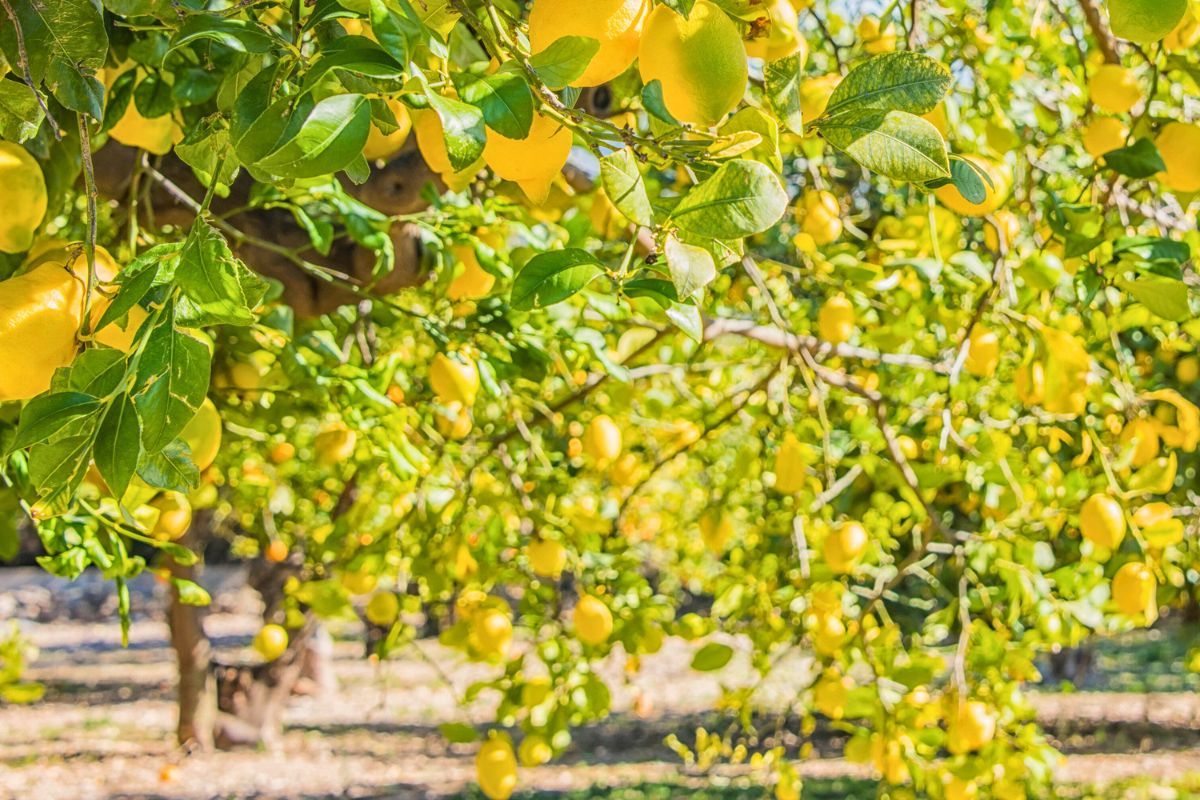
The lemon culture of Sorrento deserves a section of its own. The Sorrento lemon is a variety unlike any other: large, intensely fragrant, with a thick rind and sweet flesh that produces a juice and an essential oil of extraordinary quality. The limoncello made from these lemons in family kitchens and small artisan distilleries across the peninsula is in a completely different category from the factory-produced versions you find elsewhere. Visit one of the family-run limoncello producers in the hillside villages above town to understand the difference. Many offer free tastings.
Food tips: Avoid any restaurant on Piazza Tasso itself. They exist almost entirely for tourists and charge significantly more for significantly less. Walk two or three streets away from the main square and you will find the same quality at half the price. Look for places where the menu is written on a chalkboard rather than printed with photographs, and where you hear Italian being spoken at more than half the tables.
Common Tourist Mistakes in Sorrento
Sorrento is experienced by millions of visitors each year, and a handful of very common errors can significantly reduce the quality of your visit. Here is what to watch out for.
Treating Sorrento only as a base, not a destination. The single most common mistake is spending all of your time on day trips to Capri and the Amalfi Coast, and never truly experiencing Sorrento itself. The historic centre, Marina Grande, the cliff walks, the food scene and the evening passeggiata all deserve unhurried attention. Give the town at least one full day where you go nowhere else.
Arriving without booking the ferry to Capri in advance. In July and August, the morning ferries from Marina Piccola to Capri sell out days in advance. Book online before you arrive, or go to the ferry office the evening before you want to travel. Turning up on the day in summer and expecting to get a ticket is a gamble you will very likely lose.
Taking the coast road bus in summer without preparation. The SITA bus along the Amalfi Coast road is one of the most dramatic and terrifying road journeys in Italy, on a road barely wide enough for two vehicles passing in opposite directions, above sheer drops to the sea. If you suffer from motion sickness or heights, the ferry is a far better option. If you do take the bus, sit on the left-hand side going towards Amalfi for the sea views.
Underestimating the hills. Sorrento is built on a series of cliffs and terraces connected by steep staircases and narrow lanes. If you have mobility limitations or are travelling with a pushchair, plan your routes carefully in advance. Many of the most atmospheric streets and viewpoints involve significant steps.
Tips to avoid queues: For the Blue Grotto on Capri, join the first boat excursion of the morning, around 9 am. For Pompeii, book your timed entry ticket online in advance and arrive at opening time (9 am). For the Circumvesuviana train during school holidays, validate your ticket before boarding and do not leave valuables in outside pockets.
Practical Information for Your Visit
Getting around: Sorrento's historic centre and waterfront are best explored on foot. For longer distances, the SITA bus network covers the peninsula and the Amalfi Coast road. Taxis are plentiful but negotiate the fare in advance or insist on the meter. Renting a scooter is popular but only recommended for experienced riders comfortable with narrow mountain roads.
Money: The euro is the currency. Credit cards are accepted widely in hotels, restaurants and shops in the centre, but carry some cash for smaller cafes, markets and the Circumvesuviana ticket offices. ATMs are located along Corso Italia and on Piazza Tasso.
Language: Italian is spoken everywhere. In tourist-facing businesses, English is widely understood. Learning a few words of Italian, beginning with the basics, is warmly appreciated and will open doors that remain closed to those who simply speak English more slowly and loudly.
What to pack: Comfortable walking shoes with grip (for the steep lanes and uneven surfaces of the historic centre), a swimsuit for the bathing platforms, a light layer for evenings (even in summer, a sea breeze can arrive after dark), and a sun hat and high-SPF sunscreen for days on the water. If you plan to visit churches, cover shoulders and knees.
Safety: Sorrento is an extremely safe destination. The usual precautions apply: keep an eye on your belongings on the Circumvesuviana train, avoid leaving valuables visible in a parked car, and be aware of your surroundings in busy areas. The town itself has a very low crime rate and a strong tradition of hospitality towards visitors.

Comments
No comments yet. Be the first to share your thoughts!
Leave a Comment
Your comment will appear after moderation.