 Michelle
 Every year, millions of travellers descend the gangways of aeroplanes at Rome Fiumicino Airport, gather their luggage, board a train or a taxi, and speed toward the centre of the Eternal City. They pass through Fiumicino without seeing it, without tasting it, without knowing that beneath the roar of the jets and the rumble of the motorways lies one of the most evocative landscapes in Italy. This is the coast of the emperors, the shore where the Tiber meets the Tyrrhenian Sea, where the Romans built their great harbour and the Etruscans buried their kings in tombs carved from living rock. I was born here, in a white house that faces the sea, and I have spent my life exploring the ruins, the castles and the fishing ports that most visitors never see. Stay with me for five days. You will discover that the true gateway to ancient Rome is not in the city centre but at the mouth of the river.
Day 1, Ostia Antica, The City of the Roman Harbour
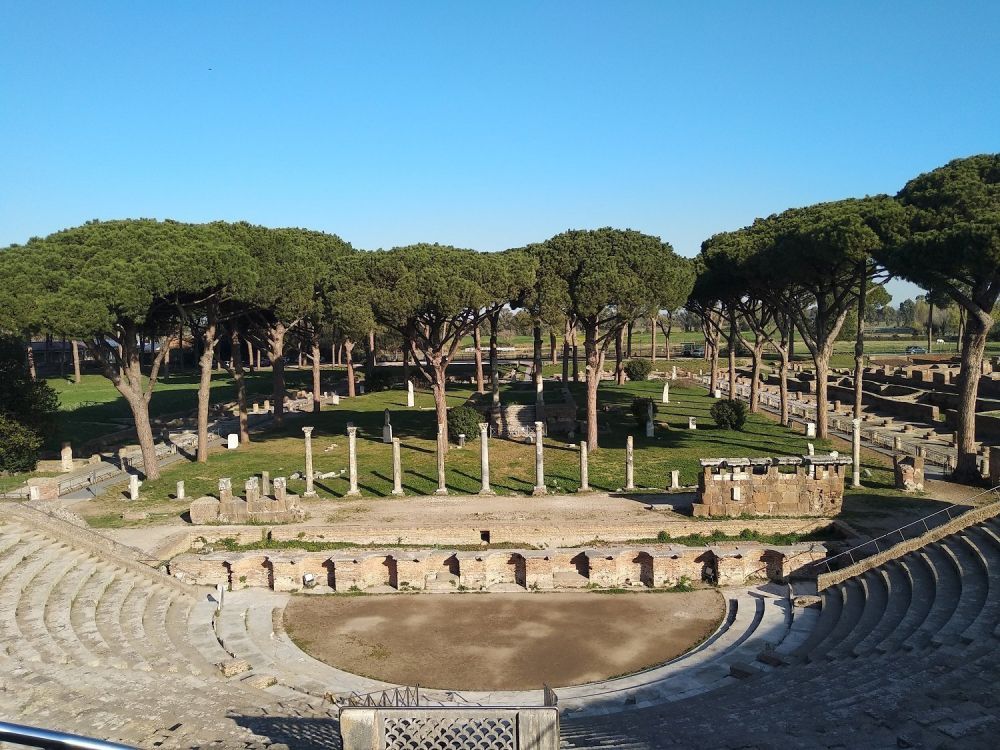
The modern town of Ostia, which lies immediately south of Fiumicino, is a bustling residential and commercial centre. But beneath its streets and just beyond its western edge lies Ostia Antica, one of the best preserved Roman cities in the world and, in my opinion, a site that rivals Pompeii in its power to move the visitor. The name Ostia derives from the Latin word ostium, meaning mouth, a reference to the city's position at the estuary of the Tiber. The city was founded in the 4th century BC, probably during the reign of King Ancus Marcius, as a military colony intended to protect the mouth of the river from pirates and foreign invaders. But it was not until the late Republican and early Imperial periods that Ostia grew into the great commercial harbour of Rome, a bustling, multicultural city of warehouses, offices, taverns, temples, bath complexes and multi storey apartment buildings.
The archaeological park of Ostia Antica covers approximately 150 hectares, of which about 50 hectares have been excavated. You enter through the Porta Romana, the Roman gate, and find yourself on the Decumanus Maximus, the main east west thoroughfare of the city, still paved with the original basalt blocks worn smooth by two thousand years of feet and cartwheels. The first building you encounter is the Terme di Nettuno, the Baths of Neptune, named for the magnificent black and white mosaic that decorates the floor of the frigidarium, the cold room. The mosaic shows Neptune, the god of the sea, riding a chariot drawn by four seahorses, surrounded by dolphins, tritons and a vast procession of marine creatures. The craftsmanship is extraordinary, and the preservation is almost complete.
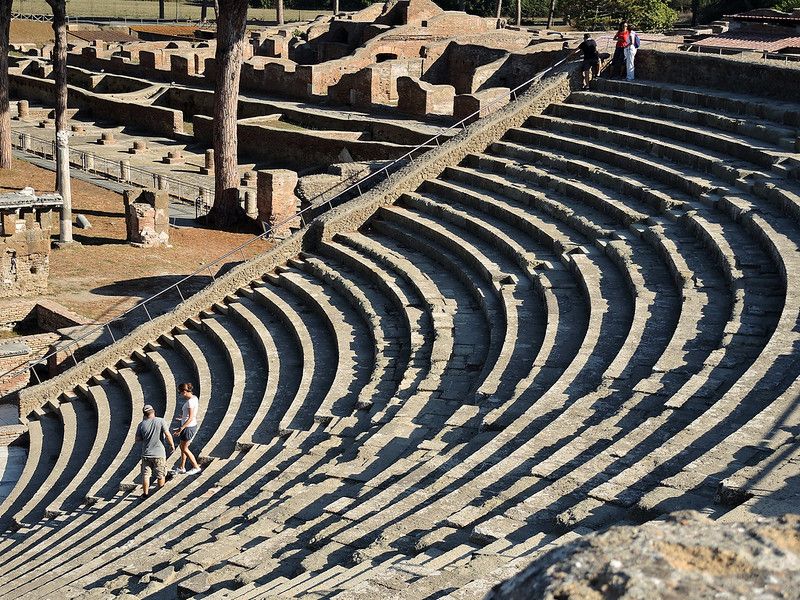
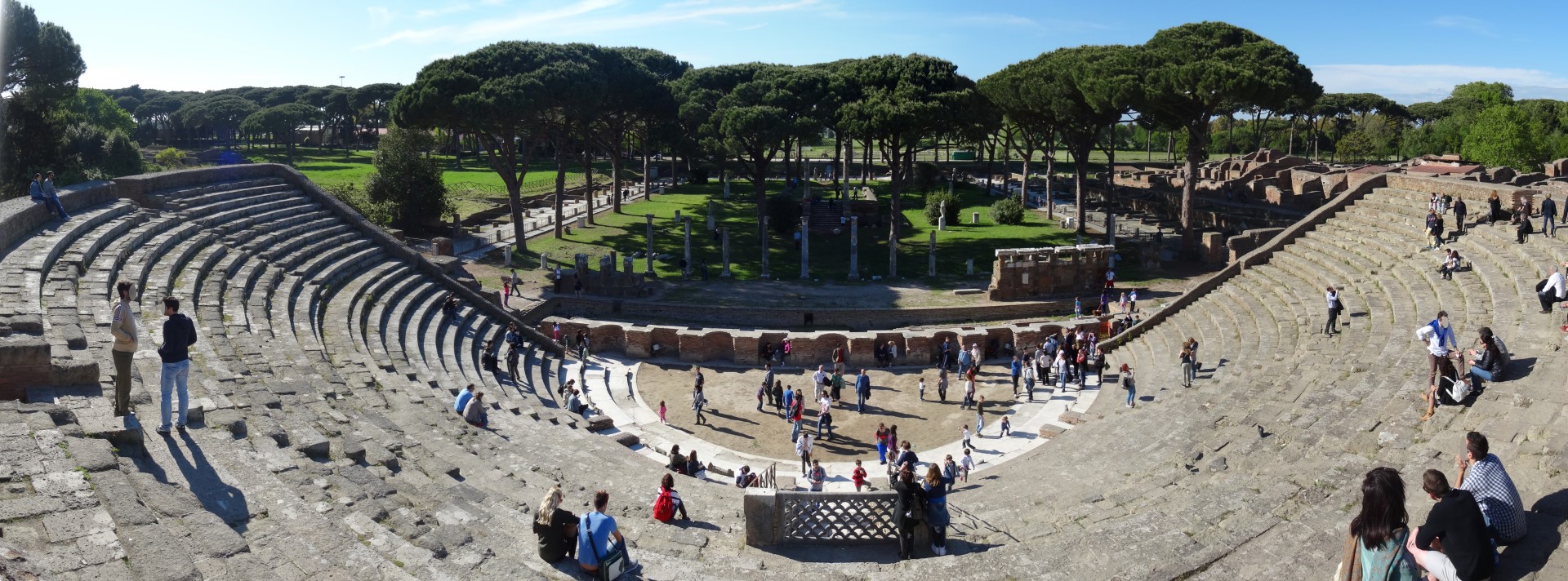
From the baths, walk west along the Decumanus toward the river. You will pass the Teatro Romano, the Roman theatre, a structure that originally seated 4,000 spectators and is still used for summer performances. Behind the theatre, the Piazzale delle Corporazioni, the Square of the Corporations, contains the remains of more than seventy small offices, each with a mosaic floor depicting the trade or service offered within. The mosaics are the advertisements of the ancient world: ships, lighthouses, grain measures, elephants, dolphins, all rendered in black and white tesserae with a liveliness that has not faded in two millennia. You are standing in the commercial heart of the harbour city, where ship owners, grain merchants and traders from every corner of the Mediterranean conducted their business.
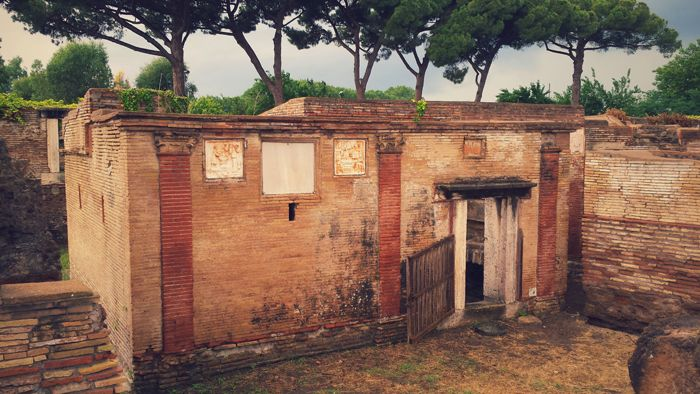
One of the most evocative buildings in Ostia is the Insula del Serapide, a four storey apartment building from the 2nd century AD, complete with internal courtyard, stairwells and the remains of the original wooden balconies. The building was named for a small statue of the Egyptian god Serapis found in one of the rooms, evidence of the international character of the port city, where merchants from Alexandria, Carthage and Antioch lived and worshipped alongside their Roman neighbours. The insula offers a rare glimpse into the daily life of the Roman working class, the ordinary citizens who lived in cramped quarters, carried their water from public fountains and cooked their meals on portable braziers.
Do not miss the Mitreo delle Terme del Mitra, one of the best preserved mithraea in the Roman world. The cult of Mithras, a mystery religion popular among Roman soldiers and merchants, was celebrated in small, subterranean chambers designed to resemble caves. The mithraeum at Ostia retains its original stone benches, its central aisle and the altar niche at the far end, where an image of Mithras slaying the cosmic bull once stood. The atmosphere is cool, dark and profoundly still. You will understand, standing there, why the initiates of the cult felt that they had descended into the underworld and emerged reborn.
The site is vast, and you cannot see everything in a single visit. The best strategy is to walk the Decumanus from the Porta Romana to the Porta Marina, the gate that once opened onto the seashore, and to allow yourself to wander into the side streets without a fixed plan. You will discover hidden courtyards, forgotten temples, mosaic floors partially covered by wildflowers, and the silence of a city that has been waiting, patiently, for two thousand years for someone to walk its streets again.
Practical advice for visiting Ostia Antica. Wear comfortable walking shoes. The site is extensive, and the ancient basalt paving is uneven. Bring water, especially in the summer months, as there are few fountains within the park. A hat and sunscreen are essential. The ticket office closes one hour before the site, so arrive early. The best months for visiting are April, May, September and October, when the weather is mild and the wildflowers are in bloom. Allow at least three hours for a thorough visit, and consider bringing a picnic to eat in the shadow of a Roman wall.
Day 2, The Porto di Traiano and the Museo delle Navi
By the 1st century AD, the original harbour of Ostia had become inadequate for the volume of shipping that supplied the city of Rome. The river mouth silted up, the largest grain ships from Egypt and Africa could not navigate the shallow channel, and the emperors recognised that a new, artificial harbour was needed. The emperor Claudius began the work, constructing a vast hexagonal basin, but it was his successor, Trajan, who completed the project in the early 2nd century AD. The Porto di Traiano, Trajan's Port, was an engineering marvel of the ancient world: a hexagon shaped basin, each side 357 metres long, connected to the Tiber by a canal and to the open sea by a navigable channel. The harbour was capable of accommodating more than 200 ships at once, and its warehouses, known as the horrea, stored the grain that fed a million Romans.
Today, the hexagonal basin still exists, and it is still filled with water. It is now the centre of the modern tourist port of Rome, the Porto Turistico di Roma, where yachts and pleasure boats anchor in the shadow of the ancient Roman warehouses. The contrast is extraordinary. On one side of the basin, the sleek white hulls of the 21st century. On the other, the massive brick walls of the horrea, their arches still intact, their bricks stamped with the mark of the emperor Trajan. You can walk around the entire perimeter of the hexagon, a distance of just over two kilometres, and imagine the scene two thousand years ago: the forest of masts, the shouts of the longshoremen, the smell of grain and wine and olive oil, the creak of the cranes lifting amphorae from the holds of the ships.
Adjacent to the harbour, in the area known as the Isola Sacra, the Sacred Island, lies the Museo delle Navi, the Museum of the Ships. The museum was built to house the remains of five Roman ships discovered during the construction of the airport in the 1950s. The ships were cargo vessels, dating to the 2nd and 3rd centuries AD, and they were found buried in the mud of the ancient harbour, preserved by the anoxic conditions of the sediment. The largest of the ships, the Fiumicino 1, measures approximately 18 metres in length and was used to transport grain and wine between the harbour and the port of Rome. The hull is still intact, the wooden planks still visible, the internal structure still legible. Standing beside it, you feel the presence of the men who sailed it, the captains, the sailors, the merchants who crossed the Mediterranean to feed the appetite of the imperial city.
In 2022, after years of restoration, a second ship, the Fiumicino 2, was added to the museum's displays. This vessel, smaller but more complete, offers a detailed view of Roman shipbuilding techniques, including the mortise and tenon joinery, the lead sheathing that protected the hull from marine borers, and the reconstruction of the rigging and the sails. The museum also contains a collection of amphorae, anchors, tools, personal objects and a section of the ancient quay, all recovered from the harbour excavations. The museum is small, it can be visited in an hour or two, but it is one of the most evocative maritime museums in Italy, and it is almost entirely unknown to foreign tourists.
Day 3, Cerveteri and the Etruscan Necropolis of the Banditaccia
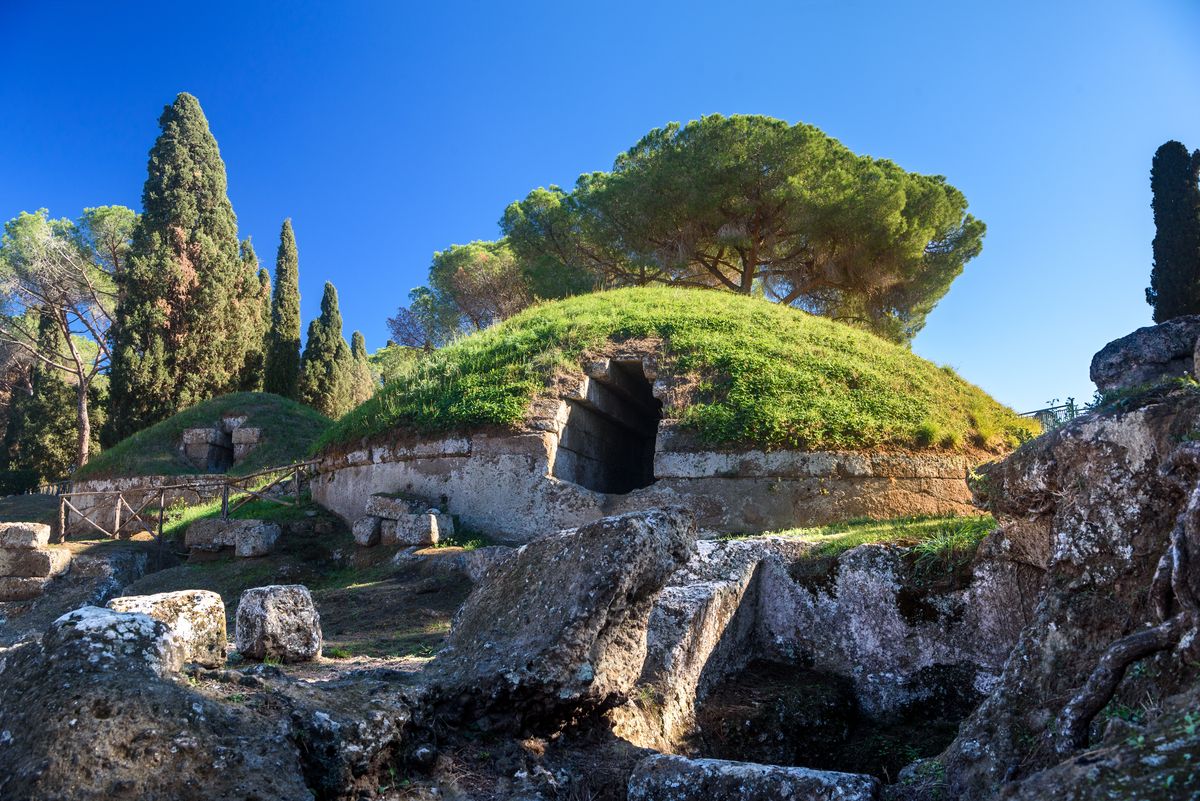
On your third day, you will leave the Roman world behind and travel north into the territory of the Etruscans, the mysterious people who dominated central Italy before the rise of Rome. Cerveteri, known to the Etruscans as Cisra and to the Romans as Caere, was one of the twelve cities of the Etruscan League, a wealthy and powerful metropolis that controlled the Tyrrhenian coast from the 8th to the 3rd century BC. The modern town is pleasant but unremarkable. The treasure lies to the north, on a hill of volcanic tufa known as the Banditaccia, where the Etruscans carved their necropolis, the city of the dead.
The Necropoli della Banditaccia is a UNESCO World Heritage site, and it is one of the most extraordinary archaeological landscapes in Europe. More than a thousand tombs are scattered across the hill, some of them simple pits cut into the rock, others vast, elaborate structures carved to resemble the houses of the living. The Etruscans believed that death was a continuation of life, and they built their tombs accordingly. The dead were buried with their possessions, their jewellery, their mirrors, their pottery, their weapons, and the tomb itself was designed as a home for eternity.
The most celebrated tomb in the necropolis is the Tomba dei Rilievi, the Tomb of the Reliefs, discovered in 1963. The tomb is carved from the tufa and decorated with stucco reliefs that depict the possessions of the deceased family: cushions, mirrors, drinking cups, pitchers, axes, shields, helmets, and even the family dog, curled at the foot of a couch. The reliefs are painted in bright colours, red and yellow and blue, and the effect is warm, domestic, almost cosy. This is not a cold sepulchre; it is a home, furnished for the comfort of the dead.
Other tombs to seek out include the Tomba dei Capitelli, with its Ionic columns carved from the rock; the Tomba delle Colonne, which mimics the facade of a palace; the Tomba della Capanna, a reconstruction of an Etruscan hut; and the Tomba dei Dolii, which contains enormous storage jars, the dolia, carved directly into the walls of the burial chamber. The necropolis extends over 400 hectares, but the excavated area open to visitors is manageable. Allow at least two hours for a walk among the tombs, and do not rush. The silence of the Banditaccia is profound, broken only by the wind and the birds, and it is the perfect setting for contemplating a people who have left us so much and yet remain so mysterious.
A short walk from the necropolis, the Museo Nazionale Cerite in the centre of Cerveteri houses the finest finds from the excavations, including the famous Sarcophagus of the Married Couple, a terracotta funeral monument depicting a man and a woman reclining on a couch, their arms around each other, their faces serene. The sarcophagus, dating to the 6th century BC, is the most iconic image of Etruscan art, and it is worth the visit to Cerveteri for this object alone.
A curious legend of the Etruscans. The Etruscans were known to the Romans as a people of great religious devotion, skilled in interpreting the will of the gods through the flight of birds, the patterns of lightning and the examination of the entrails of sacrificed animals. The Romans believed that the Etruscans possessed a secret knowledge, the disciplina etrusca, that could not be learned but only inherited. The Etruscan language, which is not related to any other known language, remains largely undeciphered, and the books of the Etruscan religion have been lost. The tombs of Cerveteri are silent witnesses to a civilisation that the Romans absorbed, conquered and ultimately forgot. Walking among them, you feel the weight of that forgetting.
Day 4, Santa Severa, Santa Marinella and the Medieval Castles of the Coast
Your fourth day is dedicated to the medieval and Renaissance history of the Roman coast. Drive north from Cerveteri along the Via Aurelia, the ancient consular road that follows the curve of the Tyrrhenian shore. After approximately fifteen minutes, you will see the Castello di Santa Severa rising on a promontory directly above the sea. The castle was built in the 11th century by the monks of San Paolo Fuori le Mura, who sought to defend the coast from Saracen raids. The site, however, is much older. Beneath the castle, excavations have revealed a Pyrgi, the port of the Etruscan city of Cerveteri, a settlement that flourished in the 6th century BC. The famous Pyrgi Tablets, gold plaques inscribed in Etruscan and Phoenician, were discovered here in 1964, providing the first bilingual text that allowed scholars to make significant progress in deciphering the Etruscan language.
The castle itself is a magnificent example of medieval military architecture, with its massive tower, its crenellated walls and its internal courtyard. The rooms of the castle have been restored and now house a museum dedicated to the history of the site, from the Etruscans to the 19th century. But the true glory of Santa Severa is the view. From the battlements of the castle, you can see the entire sweep of the Tyrrhenian coast, from the headland of Santa Marinella in the north to the mouth of the Tiber in the south. On a clear day, you can see the islands of the Tuscan archipelago, Elba and Giglio and Montecristo, floating on the horizon.
A few kilometres north of Santa Severa, the town of Santa Marinella offers a different kind of attraction: the Castello Odescalchi, a magnificent Renaissance fortress built by the Orsini family and later acquired by the Odescalchi, who still own it. The castle is not a museum; it is a private residence, but it can be visited on guided tours on certain days of the week. The gardens, the frescoed halls and the view from the tower are well worth the effort of arranging a visit. The town itself, with its elegant villas and its long, sandy beach, was a favourite summer destination of the Roman aristocracy in the 19th century, and it still retains an air of faded grandeur.
For lunch in this area, I recommend La Torretta, a restaurant perched on the cliffs of Santa Marinella, overlooking the sea. Order the spaghetti ai ricci di mare, pasta with fresh sea urchins, a dish that divides opinions but that I consider the most intense expression of the Tyrrhenian coast. The sea urchins are opened with scissors, the orange tongues are scooped out and tossed with al dente spaghetti, olive oil, garlic and parsley. The taste is briny, creamy, and oceanic, and it is not for the faint of heart. A glass of Frascati Superiore, the classic white wine of the Roman hills, is the only appropriate accompaniment.
Day 5, The Foce del Tevere, the Fishing Port and the Seafood of Fiumicino
Your final day is reserved for the place that gives the region its name: the mouth of the Tiber, the foce del Tevere. The river that passes through the heart of Rome, that witnessed the birth of the Republic and the death of the Empire, that carried the grain ships of Egypt and the marble vessels of Greece, finally meets the sea at Fiumicino. The Riserva Naturale della Foce del Tevere is a protected area of wetlands, dunes and salt marshes, home to more than 200 species of birds, including flamingos, herons, egrets and kingfishers. You can walk the trails of the reserve, climb the observation towers and watch the birds as they feed in the shallow lagoons. The reserve is at its best in the early morning or at sunset, when the light is soft and the birds are most active.
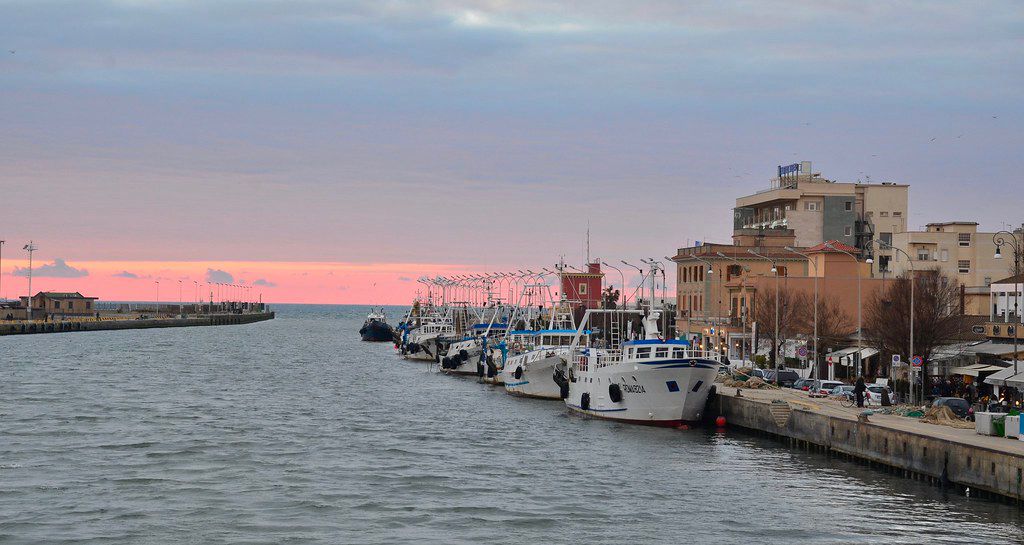
In the afternoon, walk to the Porto Peschereccio di Fiumicino, the fishing port, where the boats of the local fleet unload their catch every day at around 4:00 PM. The port is not a tourist attraction; it is a working harbour, filled with the smell of diesel and seawater and fish. The fish market, the Mercato Ittico, is open to the public, and you can buy the catch of the day directly from the fishermen: sea bass, sea bream, red mullet, squid, octopus, shrimp and the tiny, sweet clams known as vongole veraci. If you are staying in an apartment with a kitchen, buy a few kilos of clams, a bag of spaghetti, a bottle of white wine, and cook yourself a meal that will be the equal of any restaurant in the region.
For your final dinner, I will send you to Ristorante da Ciro e Maria, a family run institution that has been serving the best seafood on the Roman coast since 1968. The restaurant is located on the canal that connects the harbour to the sea, and the tables are set so close to the water that you can see the boats reflected in the plates. Order the antipasto di mare crudo e cotto, a platter of raw and cooked seafood: raw shrimp, marinated anchovies, octopus salad, smoked swordfish and a small portion of the famous frittura di paranza. Then order the spaghetti alle vongole veraci, the signature dish of Fiumicino: the clams are opened in a pan with olive oil, garlic, parsley and a splash of white wine, then tossed with the pasta, and the resulting sauce is the colour of the sea at dawn. For dessert, do not miss the tiramisù della casa, made not with mascarpone but with ricotta di pecora, the sheep's milk ricotta of the Roman countryside, which gives the dessert a lighter, tangier flavour than the classic version. It is the perfect end to five days on the coast of the emperors.
The legend of the vongole veraci. The small, sweet clams of the Fiumicino lagoon are known as vongole veraci, true clams, to distinguish them from the larger, less flavourful clams imported from other regions of Italy. The fishermen of Fiumicino say that the clams are sweet because the water of the Tiber, before it reaches the sea, has passed through the city of Rome and been enriched by the sediment of two thousand years of history. Whether this is scientifically accurate, I cannot say. But the clams are very sweet, and the story is very old, and I choose to believe it.
Where to Eat, The Best Seafood Restaurants of the Roman Coast
Fiumicino is a destination for seafood lovers. The town is dotted with restaurants, ranging from humble fry shops to elegant establishments with Michelin stars. The following are my personal recommendations, tested over decades of eating.
Ristorante da Ciro e Maria, on the canal, is the classic choice: excellent quality, reasonable prices, and a view of the boats. The spaghetti alle vongole veraci is the dish to order. Reserve in advance, especially on weekends.
Pesceria da Claudio is not a restaurant but a fishmonger that also prepares plates to eat on the spot, standing at the counter or at a plastic table outside. The frittura di paranza, mixed fried small fish, is the best in Fiumicino, and the price is a fraction of what you would pay in a restaurant. Eat with your fingers. Drink a cold beer. Do not ask for a plate. This is how the fishermen eat.
Ristorante Il Gambero, on the Lungomare della Salute, offers a more refined experience, with a terrace overlooking the sea. The raw seafood platter is exceptional, and the wine list includes some of the finest whites of the Lazio coast, including the excellent Falesco Est! Est!! Est!!! from Montefiascone. The prices are higher than at Ciro e Maria, but the quality justifies them.
La Vecchia Pineta, on the beach of Focene, just south of Fiumicino, is a historic establishment that has been serving seafood since the 1930s. The setting is informal, the service is slow (it is not slow, it is relaxed), and the grilled fish, chosen from the display at the entrance, is cooked over a wood fire and served with nothing more than olive oil, lemon and rosemary. It is the purest expression of the Roman coast.
Common Tourist Mistakes in Fiumicino and the Surroundings
Rushing directly from the airport to Rome. The most common mistake, and the most regrettable, is to treat Fiumicino as a transit point rather than a destination. The archaeological sites and the seafood restaurants of the coast are easily accessible from the airport, and a day or two spent exploring them will enrich your understanding of ancient Rome more than another hour in the queues of the Vatican Museums.
Visiting Ostia Antica without a hat or water. The site has almost no shade, and the Roman sun is brutal even in May and September. A hat, sunscreen and at least two litres of water per person are essential. The café at the entrance is overpriced and the fountains are infrequent. Come prepared.
Skipping the Museo delle Navi because you are tired of museums. The Museum of the Ships is small, focused and extraordinarily evocative. The preserved Roman vessels are unique in the world, and the museum is rarely crowded. Do not miss it.
Eating in the tourist restaurants near the airport. The restaurants in the immediate vicinity of the airport terminal are overpriced and indifferent. Drive fifteen minutes into the town of Fiumicino, follow the canal to the port, and eat where the locals eat. The difference is dramatic, and the prices are lower.
Forgetting that many sites are closed on Mondays. Ostia Antica, the Museo delle Navi and the Necropoli della Banditaccia are closed on Mondays, as are most of the state museums of Italy. Plan your itinerary accordingly.
The Best Time to Visit Fiumicino and the Roman Coast
The ideal seasons for visiting the Roman coast are spring from April to June and autumn from September to October. The weather in April and May is mild and sunny, perfect for walking the extensive sites of Ostia Antica and Cerveteri. The wildflowers are in bloom, and the birds are active in the Foce del Tevere reserve. June is warmer but still comfortable, and the sea begins to warm enough for swimming. September and October offer the best of both worlds: warm days, cool evenings, fewer tourists and the food of the harvest season, including the first olives and the new wine. July and August are very hot, with temperatures often exceeding 32 degrees Celsius, but the sea offers relief, and the long evenings are perfect for dining al fresco on the canal. Winter from November to February is mild by northern European standards, but many restaurants close for the season, and the ferry service to the islands is reduced. The best months, in my opinion, are May and October.
Essential Practical Information
Getting to Fiumicino. Fiumicino is served by Leonardo da Vinci International Airport (FCO), the main airport of Rome. If you are arriving by air, you are already here. A private transfer from the airport to your hotel in Fiumicino town takes approximately 10 minutes. From central Rome, take the FL1 regional train from Roma Termini, Roma Ostiense or Roma Trastevere to Fiumicino Aeroporto station. The journey takes 30 minutes from Termini, 15 minutes from Trastevere. The train continues to the town of Fiumicino itself, which is one stop beyond the airport. A private transfer from Rome to Fiumicino takes approximately 45 minutes and is the most comfortable option, especially with luggage.
Getting around Fiumicino and the surroundings. The archaeological sites are scattered along the coast, and the best way to explore them is by car. Rental cars are available at the airport. If you do not wish to drive, private transfers can be arranged for day trips to Cerveteri, Santa Severa and the other sites. The train connects Fiumicino to Ostia Antica, which is one stop to the south, and to Rome. For the Porto di Traiano, the Museo delle Navi and the Foce del Tevere reserve, a bicycle is a pleasant option; the terrain is flat, and the distances are short.
Safety. Fiumicino is a safe town, quieter and less chaotic than Rome. Exercise normal caution, keep your bag closed in crowded areas, and do not leave valuables visible in a parked car. The greatest risk you face is sunburn or dehydration at Ostia Antica. Take the warnings seriously.
Language. English is spoken in the hotels and the larger restaurants, but it is less common in the fishing port and the smaller trattorias. Learn a few words of Italian: buongiorno, grazie, un bicchiere di vino bianco, per favore. Your effort will be rewarded with warmer service and, often, an extra course that does not appear on the bill.
Comments
No comments yet. Be the first to share your thoughts!
Leave a Comment
Your comment will appear after moderation.