
Airport to City Centre, Getting to Verona & Getting Around, Connectivity and Tips About Verona
What's in this guide
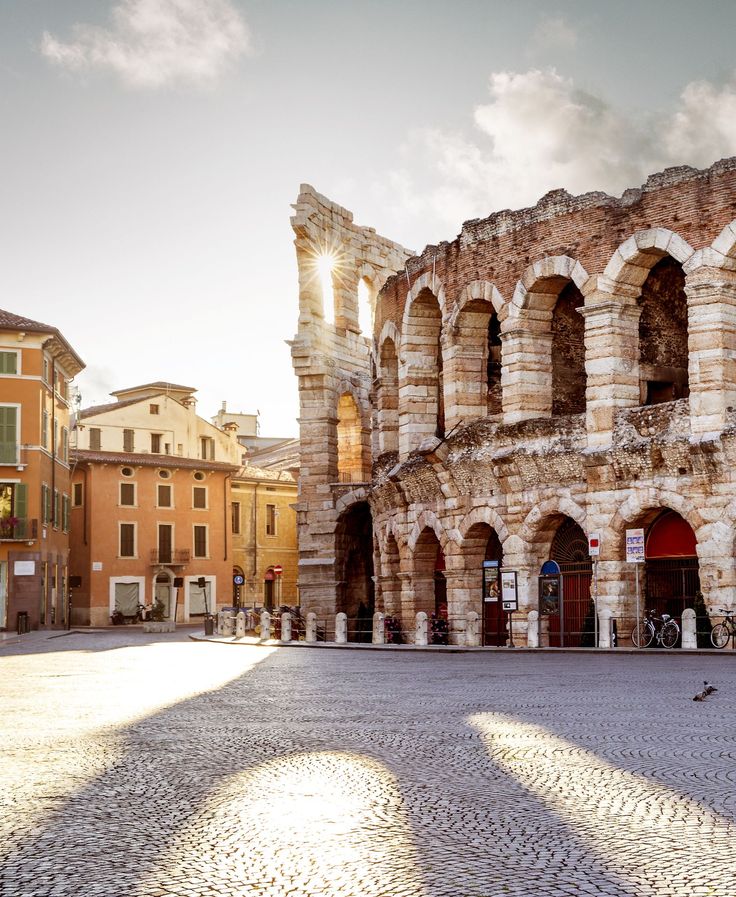
Verona is the city Shakespeare chose for his two greatest love stories — Romeo and Juliet, and The Two Gentlemen of Verona — and while neither Juliet nor Romeo existed, the choice was not arbitrary. There is something about Verona that demands a love story. The pink Verona marble of its Roman Arena glowing at dusk. The medieval towers of the Scaligeri family above the bend of the Adige. The impossible density of beautiful buildings in a walkable historic centre. And the wine — Amarone, the great red of the Valpolicella hills, drunk by candlelight in a 15th-century cellar.
Shakespeare knew what he was doing. Verona is the most romantically complete city in Italy — not because of the Juliet mythology, which is enjoyable fiction, but because it is a place of genuine and compounded beauty where the Roman, the medieval, the Renaissance and the Baroque coexist with extraordinary grace. A two-thousand-year-old amphitheatre hosts opera performances attended by fifteen thousand people on summer evenings. A Romanesque church begun in the 5th century contains one of Mantegna’s finest altarpieces. The finest wine in the Veneto is grown on hills visible from the city’s rooftops. Verona does not try to be romantic. It simply is.
“Two households, both alike in dignity, in fair Verona, where we lay our scene.” — William Shakespeare, Romeo and Juliet, Prologue, 1597
When Is the Best Time to Visit Verona?
Verona has a continental climate — hot summers, cold winters, springs and autumns of exceptional quality. The city’s defining event — the Arena Opera Festival — runs from June to September, which makes summer the most theatrical time to visit, despite the heat and the crowds.
Summer — Jun–Sept
- Arena Opera Festival in full swing
- Long warm evenings on the piazzas
- Temperatures 26–32°C (warm)
- Valpolicella cellars open for tastings
- Book opera tickets months ahead
Spring & Autumn
- Temperatures 15–24°C (perfect)
- No opera but no crowds
- Valpolicella harvest (Oct)
- Christmas markets (Dec) — superb
- Best light for photography
Winter — Nov–Mar
- Temperatures 2–10°C
- Christmas market in Piazza delle Erbe
- Arena in atmospheric silence
- Museums quiet and accessible
- Lowest prices of the year
Easter & April
- Vinitaly wine fair (April)
- City crowded during Vinitaly week
- Spring blossoms across the hills
- Book early if visiting during the fair
- Valpolicella cellars at their finest
The Vinitaly week: Held each April, Vinitaly is the world’s most important wine trade fair, held at the Veronafiere exhibition centre. The city fills with wine professionals from 140 countries. Hotels sell out immediately — book months ahead if visiting during this week. Consumer days are available on the final Sunday; tickets at vinitaly.com.
Getting to Verona & Getting Around
Verona Villafranca Airport (VRN)
Verona’s airport is 12 km southwest of the city centre. It is a medium-sized regional airport serving a growing number of European routes. From the airport, the city centre is easily accessible by private transfer, bus or taxi. Verona is also extremely well served by train — the high-speed rail junction makes it one of the best-connected cities in northern Italy.
Getting to Verona — your options in 2026
| Option | Time | Cost | Best for |
|---|---|---|---|
| Private Transfer (from VRN) Airport → Verona centre Recommended |
~15–20 min | Fixed | Families, groups, luggage |
| Aerobus Shuttle Airport → Verona Porta Nuova station |
~20 min | €6 | Budget, light luggage |
| From Milan by high-speed train Milano Centrale → Verona P.ta Nuova |
1h 15min | From €14 | From Milan, very fast |
| From Venice by train Venezia Santa Lucia → Verona |
~1h 10min | From €10 | Milan–Venice circuit |
| Official Taxi Airport → city centre |
~15–20 min | ~€25–30 | Late night, quick departure |
Verona on the Milan–Venice high-speed route: Verona Porta Nuova is a stop on the main Milan–Venice high-speed rail corridor. This makes Verona an exceptionally natural addition to a northern Italy circuit: Milan (1h 15min) — Verona (1h 10min) — Venice (1h 15min). A private transfer between any two cities on this route is also very comfortable and competitive in price for groups of two or more.
Getting around Verona
Verona’s historic centre is entirely walkable. The Arena, Piazza delle Erbe, Juliet’s House, the Scaligeri Tombs, Castelvecchio and the Cathedral are all within a 20-minute walk of each other. For San Zeno Maggiore (15 minutes west of the Arena) and Castel San Pietro (15 minutes east over the river), walking is the most rewarding option. The city bus network covers the outer areas; a single ticket costs €1.30. For Castel San Pietro there is also a historic funicular (€2).
The Essential Verona — What You Cannot Miss
Verona’s historic centre is so compact and so dense with extraordinary buildings that navigation is simply a matter of walking and looking. The monuments below form the irreducible minimum — but allow yourself to get lost between them, because the streets of Verona are as beautiful as the buildings they connect.
Arena di Verona
Built in approximately 30 AD, the Arena is the third-largest Roman amphitheatre in existence — after Rome’s Colosseum and the amphitheatre at Capua — and one of the best preserved. It originally held 30,000 spectators. Today, in its capacity as the world’s premier open-air opera venue, it holds 15,000 — including some 6,000 seated on the original Roman stone tiers (gradinate). The experience of watching Verdi’s Aida performed in a Roman amphitheatre, with the flame of ten thousand small candles lighting the audience at dusk, is among the most extraordinary evenings available anywhere in Europe. As a daytime museum, the Arena is equally impressive — walk the corridors, climb the tiers, stand in the arena floor and look up.
Piazza delle Erbe & Piazza dei Signori
Two extraordinary squares connected by a passageway so narrow it almost touches both sides. Piazza delle Erbe — the daily market square — is built directly over the Roman forum, its medieval and Renaissance palaces leaning over market stalls that have occupied the same ground for 2,000 years. The column with the Lion of St Mark at its centre marked the western limit of Venetian rule. Piazza dei Signori — the aristocratic square — is quieter, colder and more beautiful: Dante’s statue faces the Palazzo del Comune, the Loggia del Consiglio closes the north side in late-Gothic perfection, and the whole is framed by the Torre dei Lamberti (climb it for the finest view of the city from above).
Castelvecchio & Ponte Scaligero
Built by Cangrande II della Scala in 1354–1375 as a fortress, palace and escape route, the Castelvecchio is one of the finest medieval military complexes in Italy. The Carlo Scarpa-designed museum inside — a masterpiece of 20th-century exhibition architecture, completed in 1964 — is itself a work of art, its sequence of bridges, ramps and split levels creating a dialogue between medieval structure and modern intervention that has influenced museum design worldwide. The permanent collection includes Pisanello’s Madonna della Quaglia, equestrian statues of the Scaligeri dynasty, and a remarkable collection of medieval Veronese art. The adjacent Ponte Scaligero — a fortified bridge over the Adige, rebuilt stone by stone after Allied bombing in 1945 — is one of the most beautiful bridges in Italy.
Juliet’s House (Casa di Giulietta)
The medieval house associated with Shakespeare’s Juliet is, let us be honest, a construction — Romeo and Juliet are fictional characters, the balcony was added in 1936, and the bronze statue of Juliet (whose right breast is rubbed smooth by the hands of millions of visitors seeking good luck in love) was installed in 1969. None of this matters. The courtyard is alive with human emotion — love letters pinned to the walls, couples photographing themselves, the statue in its corner — and there is something genuinely moving about a place so saturated with the projection of hope. The house museum is modest but pleasant; the courtyard is free.
San Zeno Maggiore
The greatest Romanesque church in northern Italy — begun in the 5th century on the site of the martyrdom of San Zeno, the first Bishop of Verona, and rebuilt in its current form between the 12th and 14th centuries. The façade is a masterpiece of Veronese Romanesque: a rose window of extraordinary delicacy, a carved porch of scenes from the Old and New Testaments, and 48 bronze door panels (12th century) depicting Biblical scenes with a vivid, almost violent energy. Inside: the crypt of San Zeno, and Mantegna’s triptych altarpiece (1456–1459) — the Madonna Enthroned with Saints — one of the supreme achievements of Italian Renaissance painting, still in the location for which it was created.
Castel San Pietro & the Panorama
On the far bank of the Adige, the hill of San Pietro rises above the city. The current building — an Austrian military barracks from the 19th century — is unremarkable, but the terrace in front of it (Piazzale Castel San Pietro) commands the finest panoramic view of Verona: the complete arc of the Adige bend, the orange and rose-pink rooftops tumbling down to the water, the Arena, the two medieval bridges, the city’s towers, and the Valpolicella hills behind. Reach it by the funicular from Via dei Colli (€2, runs until late evening) or by a 30-minute walk up the Roman-era stone staircase. Come at sunset. Stay for the lights.
The Scaligeri tombs & the rest of the city
Adjacent to Sant’Anastasia church, the Arche Scaligere are the outdoor Gothic mausoleums of the Scaligeri dynasty — extraordinary pinnacled tombs with equestrian statues of the lords of Verona rising above the surrounding medieval streets. Free to view from outside (€1 to enter the enclosure). The Roman Theatre on the hill above the Adige — older than the Arena, smaller and less visited — hosts the Teatro Romano summer festival and has an excellent museum above it. The Cathedral of Verona contains Titian’s Assumption (c. 1530) in the first chapel on the left — one of his most underrated altarpieces.
Opera at the Arena di Verona — Everything You Need to Know
The Arena Opera Festival is one of the great cultural experiences of European summer: opera performed in a Roman amphitheatre, outdoors, in the Italian night, with an audience of fifteen thousand. It runs from late June to early September and presents four to six productions per season — typically Verdi’s Aida, Nabucco, Rigoletto; Puccini’s Tosca and La Traviata; occasionally Mozart and Bizet. Each production is mounted with spectacular stagings: horses, elephants (in the historical Aida productions), massive sets and an orchestra of international quality.
Tickets and seating
The seating at the Arena divides into two fundamentally different experiences:
- Gradinate (stone tiers) — from €28–58. The original Roman stone seats. Unreserved, open to the sky, the authentic way to experience the Arena. Bring a cushion (sold outside), layers for cool evenings, and arrive early to secure a good position. The view from the upper tiers — the entire bowl of the amphitheatre below, the city lights beyond — is spectacular.
- Platea (orchestra level) — from €80–200. Numbered seats on the arena floor. Closer to the stage and orchestra, more comfortable, less dramatic in terms of view. The best platea seats are in the central rows, stalls C–F.
Practical notes: Performances start at 9pm and last 3–4 hours. Dress code is smart casual (no shorts or beachwear). Bags larger than 30x20cm are not admitted. Bring a small torch for the stone tiers. Rain can delay or cancel performances — your ticket is valid for the rescheduled date. In the case of cancellation due to rain, partial refunds apply if less than one act was performed.
Booking
Book at arena.it. The most popular productions — Aida in particular — sell out months ahead. The 2026 season programme is published in December 2025. Book immediately when it is announced if you want premium platea seats for Aida or Nabucco. Stone seats are generally available closer to the date but the best positions go early.
The candle moment: At the start of every Arena performance, as the lights dim, the audience lights small candles — ten thousand flames appearing simultaneously across the stone tiers of a two-thousand-year-old amphitheatre. It is one of the most beautiful things that happens regularly in Italy. Candles are sold at the entrance for €1.
What to Eat in Verona — and Drink
Verona is positioned between Venetian and Lombard culinary traditions, with its own distinctive character: more meat-centric than Venice, richer than the Veneto plain, shaped by the hunting culture of the surrounding hills and the extraordinary wine of the Valpolicella. The Veronese eat well and drink seriously — and the combination, in a medieval cellar with a glass of Amarone, is one of the finest dining experiences in northern Italy.
Amarone della Valpolicella
Italy’s most powerful dry red wine — DOCG, made from Corvina, Rondinella and Molinara grapes partially dried on straw mats (appassimento) for 90–120 days before pressing, producing a wine of extraordinary concentration, 15–17% alcohol and a complexity that requires years of ageing. A bottle in a Veronese enoteca: €25–60. A single glass: €8–15. Worth every cent.
Pastissada de Caval
The defining Veronese dish — a slow-braised horse meat stew with red wine, spices, onions and herbs, served on gnocchi di patate. The recipe dates to 489 AD when the Ostrogoth King Theodoric, having just defeated Odoacer outside Verona, ordered the fallen horses to be cooked and distributed to the people. Order it at Trattoria al Pompiere and understand what city pride in a dish looks like.
Risotto all’Amarone
Vialone Nano rice from the Veronese plain, slow-cooked in Amarone wine until the grains absorb the deep colour and tannin of the wine, finished with aged Monte Veronese cheese and butter. A dish of monumental richness — and the correct use of a bottle of wine that costs €25 in the production. Found at every serious restaurant in the city.
Gnocchi di Patate
Verona’s greatest contribution to pasta: soft potato gnocchi, made daily, served with ragù di carne, butter and sage, or as the accompaniment to pastissada. The Veronese are so serious about gnocchi that the last Friday of Carnival is called Bacanal del Gnoco — the city’s oldest festival, in which the King of Gnocchi distributes them to the crowd from a cart in Piazza San Zeno.
Sopressa Veronese
A large, soft, mildly spiced salami — the defining charcuterie of the Veneto — made from the entire pig including the fat, seasoned with pepper, cinnamon and nutmeg, aged for 3–12 months. Eaten on local bread with a glass of Valpolicella. One of the great aperitivo accompaniments in northern Italy.
Pearoni con la Pearà
A medieval sauce of bone marrow, stale bread, black pepper and beef broth — traditionally served with boiled meats at Sunday lunch. Pearà means “peppered” in Veronese dialect. One of those deeply unfashionable dishes of extraordinary depth that Veronese grandmothers still make better than any restaurant and that serious osterie keep on the winter menu.
Soave Classico
The great white wine of the Verona area — made from Garganega grapes on the volcanic hills east of the city. Soave Classico DOC (the smaller, hillside zone) is one of Italy’s finest whites: mineral, floral, with a honeyed almond finish. Drink it young with local cheeses and raw ham. A glass in Verona costs €3–5. A bottle from a top producer (Pieropan, Prà): €12–18.
Mandorle del Baldo
Sugared almonds from the Monte Baldo — the mountain that rises above the eastern shore of Lake Garda. The confectionery tradition of Verona includes some of the finest confetti (sugar-coated almonds) in Italy, made in the historic pasticcerie of the city centre. A small bag from Pasticceria Flego or Pasticceria Cordioli: €4–6. Eat them on the Arena steps.
Where to eat and drink
The best Veronese eating is in the streets between Piazza delle Erbe and the Adige river — particularly in the medieval arcaded streets of Via Sottoriva and around Corso Porta Borsari. For Amarone, the historic enoteche of the old city are the correct venue.
- Osteria del Bugiardo — Corso Porto Borsari 17
The finest wine bar in Verona’s historic centre. Outstanding Amarone selection from small Valpolicella producers, superb cicchetti. Stand at the counter, drink slowly, talk to the owner about the vintage. - Bottega Vini — Via Scudo di Francia 3
An enoteca-restaurant dating to 1890 with one of the most comprehensive Valpolicella and Amarone wine lists in existence. The food — gnocchi, pastissada, risotto all’Amarone — is excellent. Book ahead for dinner. - Trattoria al Pompiere — Vicolo Regina d’Ungheria 5
The most celebrated traditional restaurant in Verona since 1910. Outstanding pastissada de caval and risotto all’Amarone. Excellent wine list. Book well ahead — it is always full.
For more casual eating and the local experience:
- Osteria Sottoriva — Via Sottoriva 9
Traditional Veronese cooking under the medieval porticoes along the Adige. Outstanding gnocchi al ragù and Soave by the carafe. The most authentically local atmosphere in the city. - Osteria al Duca — Via Arche Scaligere 2
Next to the Scaligeri tombs. Simple Veronese cooking at honest prices. The sarde in saor (Venetian sweet-sour sardines) and the house Valpolicella are both excellent.
The tourist trap test: Any restaurant directly facing the Arena or in Piazza Bra with a greeter at the door and photographs on the menu is charging for the Arena view, not the food. Walk one street back from the piazza — the quality of Veronese cooking at a third of the price begins immediately.
Mistakes to Avoid in Verona
Verona rewards the visitor who looks beyond the obvious. Here is how to get the most from it.
- Don’t eat at the Arena-facing restaurants. Piazza Bra is magnificent; the restaurants facing it are not. Walk to Via Sottoriva, Corso Porta Borsari or the streets around San Zeno for the real Veronese kitchen.
- Don’t skip San Zeno Maggiore. Most visitors spend their entire time in the Arena – Piazza delle Erbe – Juliet’s House triangle and never reach the greatest Romanesque church in northern Italy, 15 minutes’ walk west. Mantegna’s altarpiece alone justifies the detour.
- Don’t book opera tickets through resellers. Buy directly at arena.it. Third-party sellers offer the same tickets at significant premiums, and the booking process is straightforward enough to do yourself.
- Don’t forget a cushion for the Arena stone seats. Three hours on 2,000-year-old Roman marble is a physically demanding way to experience Aida, however beautiful the setting. Cushions are sold at the entrance for €1–2.
- Don’t take Romeo and Juliet too seriously — or not seriously enough. Romeo and Juliet are fictional. But the city’s embrace of the story is genuine and the emotional atmosphere around Juliet’s House is real. Enjoy it for what it is.
- Don’t miss the Castel San Pietro sunset. The funicular from Via dei Colli runs until late evening. The view at golden hour and after dark is the finest in Verona and almost no one makes the journey. Take it on your last evening.
- Don’t leave without visiting the Valpolicella. The wine hills that produce Amarone, Valpolicella Classico and Ripasso are 15 km north of the city — 20 minutes by private transfer. Cellars at Masi, Allegrini, Bertani and dozens of smaller producers offer tastings and tours. One of the finest wine experiences in Italy.
- Don’t visit Verona only during Vinitaly week without booking hotels months ahead. The wine trade fair in April fills the entire city and surrounding area. If you visit during this period intentionally — consumer tickets are available for the final Sunday — book hotel and transfers simultaneously and immediately.
Practical Information for Verona 2026
Money & payments
Verona is largely cashless. Keep €15–20 for the Piazza delle Erbe market, smaller osterie and the funicular. ATMs are widely available throughout the historic centre.
The Verona Card
The Verona Card covers free or discounted entry to the Arena, the Castelvecchio Museum, the Roman Theatre, the Torre dei Lamberti, San Zeno, the Cathedral and many other monuments — plus unlimited city bus and funicular travel. 24-hour version: €20. 48-hour version: €25. Buy at any of the covered monuments or online at turismoverona.eu. Worth buying if you plan to visit four or more monuments.
Dress code
Verona’s churches — San Zeno, the Cathedral, Sant’Anastasia — require covered shoulders and knees. The Arena opera has a smart casual dress code: no shorts, no beach footwear. Light layers are advisable for summer evening performances.
Safety
Verona is a very safe city for tourists. Standard precautions apply in the crowded areas around Piazza Bra and Juliet’s House during peak hours. The city is lively and comfortable at all hours in the historic centre.
Emergency numbers
Day trips from Verona
Lake Garda — 30–55 km west. Sirmione (35 km, 30 min transfer), Bardolino (25 km), Malcesine (55 km, cable car up Monte Baldo). Valpolicella wine route — 15–30 km north. Cellars at Sant’Ambrogio, Fumane, Negrar — all accessible by private transfer. Soave — 23 km east, 25 min by train. The medieval castle and wine village. Venice — 115 km east, 1h 10min by high-speed train. Milan — 160 km west, 1h 15min by high-speed train. Mantova — 45 km south, 35 min by train — a UNESCO-listed Renaissance city of extraordinary ambition on the Mincio river.