
Airport to City Centre, Getting to Venice & Getting Around, Connectivity and Tips About Venice
What's in this guide
Venice does not make sense. It should not exist — 118 islands in a lagoon, connected by 400 bridges, with no roads, no cars, no foundations in any ordinary meaning of the word, built over fifteen centuries by a republic of merchants who somehow turned the most hostile environment in Italy into the most beautiful city in the world.
And yet here it is. The Grand Canal curves through it like a backwards S, lined with Gothic and Renaissance palazzi whose reflections dissolve and reform with every passing boat. St Mark’s Basilica glitters at one end of the most theatrical public square ever designed. Tintoretto’s canvases fill churches that themselves stand ankle-deep in history. And in the early morning, before the vaporetti begin their runs and the day-trippers arrive from the mainland, Venice gives you something impossibly rare: a great city in near-silence, its stones pink in the dawn light, its water barely moving, completely and entirely itself.
“Venice is like eating an entire box of chocolate liqueurs in one go.” — Truman Capote
When Is the Best Time to Visit Venice?
Venice is the most over-visited city in Italy and one of the most over-visited in Europe. In July and August, Piazza San Marco holds more tourists than residents — the city’s permanent population has fallen below 50,000 while visitor numbers can exceed 100,000 on a single summer day. Timing your visit is not a preference; it is a necessity.
February — Carnival
- Masked balls and processions
- Cold but theatrical (2–8°C)
- Book accommodation months ahead
- The city at its most theatrical
- Worth it for the experience
Spring — Mar–May
- Temperatures 12–22°C
- Manageable crowds until May
- Long evenings on the canals
- Biennale opens in odd years
- Best light for photography
Autumn — Sept–Nov
- Temperatures 15–24°C (Sept)
- Film Festival in September
- Acqua alta begins in October
- Misty, melancholy November
- Significantly fewer tourists
Summer — July & August
- 100,000+ day-trippers daily
- Temperatures 30–34°C
- Humidity is oppressive
- Queues of 2–3 hours everywhere
- Highest prices of the year
The overnight advantage: Day-trippers transform Venice between 10am and 6pm. Overnight guests inherit a completely different city — quieter canals, open restaurants, a passeggiata that actually belongs to you. If you visit during peak season, staying overnight changes everything. The city after 8pm is worth the hotel premium.
Acqua alta — high water: From October to January, Venice regularly floods at high tide. In 2026 the MOSE flood barrier mitigates the worst events, but minor flooding around Piazza San Marco still occurs. Pack waterproof boots or be prepared to use the raised wooden walkways (passerelle) and buy disposable boot covers for €2 from local shops.
Getting to Venice & Getting Around
Venice Marco Polo Airport (VCE)
Venice Marco Polo Airport sits on the edge of the lagoon, 12 km north of Venice on the mainland. It serves most major European carriers and connects to the city by road (to Piazzale Roma, the only point where cars can enter Venice), by water bus, or by the spectacular private water taxi directly to your hotel’s canal.
Airport to Venice — your options in 2026
| Option | Time | Cost | Best for |
|---|---|---|---|
| Private Transfer to Piazzale Roma Door-to-door by road, fixed price Recommended |
~20–30 min | Fixed | Families, groups, heavy luggage |
| ATVO Airport Bus Airport → Piazzale Roma |
~25 min | €10 | Budget, light luggage |
| Public Transportation Water Bus Murano → Cannaregio → San Marco |
~75 min | €15 | Scenic arrival, no luggage stress |
| Water Taxi Direct to your hotel canal |
~30–40 min | €160–180 | Unforgettable first impression |
| Treviso Airport (TSF) Used by Ryanair — 30 km from Venice |
~60–75 min | Bus €12 / Transfer fixed | Budget flights only |
Important: Cars cannot enter Venice. All roads end at Piazzale Roma, where you continue on foot or by vaporetto. Book luggage-forward services or travel light — there are no taxis, no trolley services and no escalators between bridges. Every suitcase must be carried over every bridge you cross.
Getting around Venice — the vaporetto
Venice’s water bus network (vaporetto, operated by ACTV) is its public transport. A single ticket costs €9.50. The 24-hour pass (€20), 48-hour pass (€30) and 72-hour pass (€40) are worth buying if you plan to take more than two or three journeys. The most useful lines:
- Line 1 — The Grand Canal slow route. Stops at every landing stage from Piazzale Roma to the Lido. The best way to see the palazzi. Sit at the front if possible.
- Line 2 — The Grand Canal fast route. Fewer stops, reaches San Marco in half the time. Use it when you need to get somewhere quickly.
- Line 4.1 — Murano. From Fondamente Nove to Murano Colonna (15 min). The direct route to the glass island.
- Line 12 — Burano & Torcello. From Fondamente Nove to Burano (45 min) and Torcello. The lagoon island line.
Walk everywhere you can: Venice’s greatest secret is that it is a walking city. The vaporetto is for longer distances and the islands — but between nearly any two points in the historic centre, walking through the calli (alleys) is faster, cheaper and infinitely more rewarding. Get lost deliberately. The city always brings you back to a canal.
The Essential Venice — What You Cannot Miss
Venice’s attractions are so numerous and so extraordinary that the challenge is not finding things to see, but deciding what to prioritise. The monuments below are genuinely unmissable — but leave time to simply walk, to sit by a canal with a glass of Prosecco, and to allow the city to work on you at its own pace.
St Mark’s Basilica (Basilica di San Marco)
The most opulent church in Italy and the supreme expression of Byzantine art in the western world. Five gilded domes, 8,000 square metres of mosaic covering every surface in gold and lapis lazuli, the Pala d’Oro — a golden altarpiece studded with 2,000 precious stones — and the four bronze horses looted from Constantinople in 1204. Free entry, but the queues in summer reach 90 minutes. The skip-the-line ticket (€3) is among the best investments in Venice.
Doge’s Palace (Palazzo Ducale)
For a thousand years, the most powerful republic in the Mediterranean was governed from this extraordinary Gothic building on the edge of the lagoon. Inside: Tintoretto’s Paradise — the largest oil painting in the world (22 metres wide) — the Secret Itinerary through the hidden rooms of power, the Bridge of Sighs through which convicted prisoners glimpsed the lagoon for the last time, and a suite of ceremonial chambers that remains the most jaw-dropping secular interior in Italy.
The Grand Canal by Vaporetto Line 1
Take Line 1 from Piazzale Roma to San Marco and sit at the front. The journey takes 45 minutes and passes, in continuous procession, the great Gothic and Renaissance palazzi of the Venetian Republic — Ca’ d’Oro, Ca’ Foscari, Ca’ Rezzonico, the Rialto Bridge — in a sequence that is one of the great experiences of European travel. Your vaporetto ticket covers the journey. There is nothing more expensive or more organised you can do on the Grand Canal that equals it.
Gallerie dell’Accademia
The greatest collection of Venetian painting ever assembled, housed in a former monastery and scuola on the south side of the Grand Canal. Bellini’s luminous altarpieces, Carpaccio’s narrative cycles, Giorgione’s mysterious Tempest, Titian’s late masterworks, Tintoretto’s vast canvases, Veronese’s theatrical compositions — five centuries of the most brilliant school of painting in Italy, and it receives a fraction of the visitors it deserves.
Murano & Burano
Two islands, two completely different experiences. Murano: 15 minutes from Fondamente Nove, the island of glass-blowers whose craft has been practised here since 1291. Watch a master at work for free at any furnace that admits visitors — the glass-blowing demonstration is genuinely extraordinary. Burano: 45 minutes further, a village of painted fishermen’s houses in shades of ochre, crimson, cobalt and sage, with a leaning campanile and the finest lace tradition in Italy. Go to both.
Rialto Market & the Frari Church
The Rialto Market has been selling the catch of the Adriatic every morning since the 11th century — visit before 11am Tuesday to Saturday, when the fish market (pescheria) is in full operation. A ten-minute walk brings you to the Basilica dei Frari, home to Titian’s Assunta — the greatest altarpiece in Venice — and his own tomb, requested because he believed it was where his greatest work hung. One of the underrated churches of Italy.
A gondola ride — is it worth it?
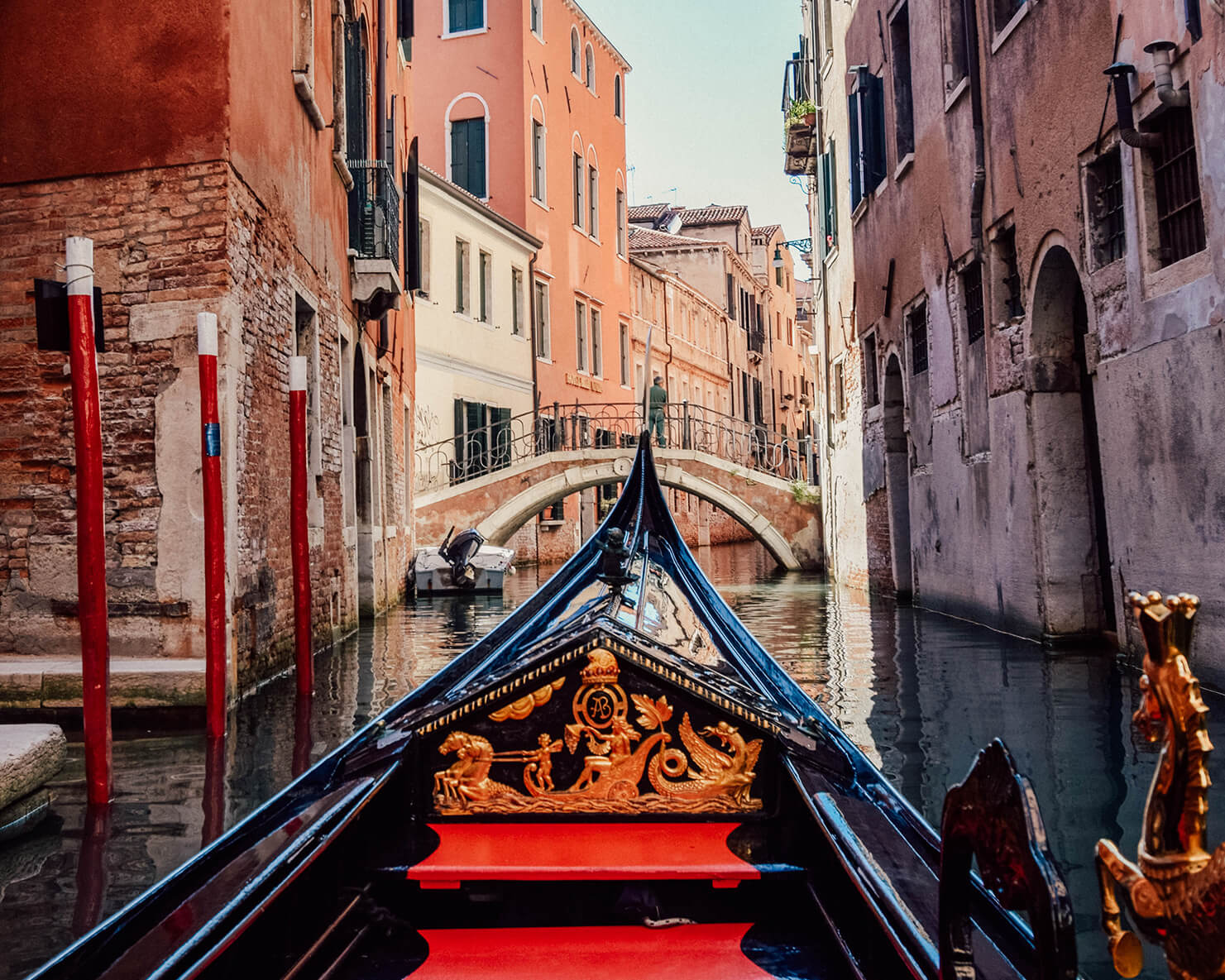
The official tariff in 2026 is €90 for 30 minutes (€120 after 7pm). It is expensive. It is also genuinely unlike anything else — the smaller inner canals, the silence, the height of the palazzi, the angle of view from water level — and one experience that every visitor to Venice remembers. If you go, request the calli and inner canals rather than the Grand Canal (where motor traffic makes it less magical), take it at dusk, and agree the route and price before you board.
The free alternative: The traghetto — a standing gondola ferry that crosses the Grand Canal at six points — costs €2 and gives you two minutes on a gondola, standing, with Venetians on their daily commute. It is not the same experience, but it is the most Venetian one. Look for traghetto signs at Santa Sofia, San Tomà and San Samuel crossings.
How to Skip the Queues
Venice’s queues are formidable — particularly at St Mark’s Basilica, which can have a 90-minute free-entry queue in July. The good news: nearly every queue in Venice is avoidable with a small amount of advance planning.
The Venice Connected system: The city’s official pre-booking platform at veniceconnected.com covers skip-the-line entry to the Basilica (€3), public transport passes, parking and more. Book before you leave home. The €3 Basilica booking is the single best-value tourism purchase in Italy.
- St Mark’s Basilica: Book the €3 skip-the-line ticket at veniceconnected.com or arrive before 9:30am on weekday mornings. Dress code (covered shoulders, no bare legs) is strictly enforced — carry a scarf.
- Doge’s Palace: Book at visitmuve.it. The Secret Itinerary — a guided tour through the hidden rooms of the palace — requires advance booking and runs at 9:55am, 10:45am and 11:35am only. Worth booking separately.
- Gallerie dell’Accademia: Book at gallerieaccademia.it. It is closed on Mondays. Despite being one of Italy’s great museums, queues are rarely severe — the main benefit of booking is securing your preferred time slot.
- Murano & Burano: No booking required — just take the vaporetto. The islands are significantly less crowded before 10am and after 4pm. Avoid weekend afternoons in summer entirely.
What to Eat in Venice — and Where
Venice has a serious food culture that is almost entirely invisible to the tourist who stays within 200 metres of the Rialto Bridge. The bacaro — a Venetian wine bar serving small bites called cicchetti — is the city’s great contribution to Italian food culture: casual, convivial, extraordinarily good value, and found on every street outside the tourist zone.
Cicchetti
Small rounds of bread or polenta topped with baccalà mantecato (whipped salt cod), sarde in saor (sweet-sour sardines), mozzarella, or local vegetables. Eaten standing at a bacaro with a glass of local wine. The correct lunch in Venice: three bacari, six cicchetti, two glasses of wine. €10 total.
Sarde in Saor
Fried sardines marinated in sweet-sour onions, vinegar, pine nuts and raisins — a medieval Venetian recipe that has barely changed in 700 years. Served cold as a cicchetto or a starter. The most distinctively Venetian dish in existence.
Baccalà Mantecato
Salt cod whipped with olive oil and garlic until it becomes a smooth, almost fluffy cream. Served on grilled polenta or white bread. Found in every bacaro worth its name. The texture is unlike anything in Italian cooking elsewhere.
Risotto al Nero di Seppia
Risotto made with cuttlefish and its ink — black, glossy, deeply savoury, with a faint brininess that tastes exactly of the lagoon. One of the most visually dramatic dishes in Italy and one of the most delicious. Order it at any serious Venetian trattoria.
Bigoli in Salsa
Thick whole-wheat pasta in a sauce of slow-cooked onions and anchovies — deep, savoury, almost sweet from the long cooking. A cucina povera dish of extraordinary sophistication. Found at traditional trattorias in the quieter sestieri.
Fritto Misto dell’Adriatico
A mixed fry of the day’s catch — tiny shrimp, soft-shell crabs, squid rings, whitebait — lightly battered and served in a paper cone. The freshest expression of Adriatic seafood. Best eaten on a canal-side step at midday.
Ombra & Spritz
An ombra — a small glass of local wine, typically Soave, Prosecco or a Veneto red — costs €1–2 at a bacaro and is the unit of Venetian social life. The Aperol Spritz was invented in Veneto. Order it as the locals do: with Campari instead of Aperol, and a large green olive.
Bussolai Buranelli
The butter biscuits of Burano — S-shaped or ring-shaped, flavoured with Marsala and vanilla, with a texture somewhere between shortbread and polenta. Buy a bag directly from one of the old pasticcerie on Burano’s main street. They last for weeks.
Where to eat — the bacari circuit
The best cicchetti bars are concentrated in the Rialto market area (San Polo sestiere) and along the Fondamenta della Misericordia in Cannaregio — the stretch of canal where young Venetians actually drink.
- All’Arco — Calle dell’Ochialer 436, San Polo
Opens at 8am and sells out by noon. The best cicchetti in Venice — extraordinary ingredients, extraordinary craft. Run by a father and son. Arrive early. - Do Mori — Calle Do Mori 429, San Polo
Venice’s oldest bacaro (1462). Dark, narrow, copper pans on the ceiling, locals standing shoulder to shoulder. Order the francobolli (tiny tramezzini sandwiches). - Cantina Do Spade — Calle Do Spade 859, San Polo
Another Rialto classic. The baccalà mantecato is the best in the city. Good local wines by the glass. No sitting, no waiting — just eating.
For sit-down Venetian seafood cooking:
- Osteria alle Testiere — Calle del Mondo Novo 5801, Castello
Eight tables. The best seafood restaurant in Venice. Book at least two weeks ahead. The daily menu changes with the market. No pizza, no pasta with tomato. Just the lagoon, perfectly cooked. - Trattoria Corte Sconta — Calle del Pestrin 3886, Castello
A hidden courtyard in Castello. Extraordinary antipasto di mare, serious risotto, local wines. Beloved by Venetians and food writers for three decades. Book ahead. - Osteria da Rioba — Fondamenta della Misericordia 2553, Cannaregio
Canal-side tables, excellent cicchetti and a full menu of Venetian classics. One of the few restaurants in the city where you can eat well and watch the city go by at a reasonable price.
The tourist trap warning: Any restaurant on or immediately adjacent to Piazza San Marco, the Rialto Bridge or the Riva degli Schiavoni is charging for the view. A pizza near St Mark’s costs €22–28; the same pizza four streets away costs €9–12. Venice’s quality restaurants are always found in the side calli of Dorsoduro, Cannaregio and Castello — the three sestieri where Venetians actually live.
Mistakes to Avoid in Venice
Venice has been receiving tourists for three centuries and has refined the art of extracting money from them to a fine point. Here is how to navigate it like someone who has read this guide.
- Don’t visit in July or August. The city holds 100,000 day-trippers daily in peak summer. Queues, heat, humidity and prices all reach their annual peaks simultaneously. September, October, March and April are dramatically better in every respect.
- Don’t come for a single day. Day-trippers experience the worst of Venice — peak-hour crowds, no evening, no morning. Staying overnight transforms the city. The real Venice appears after 7pm, when the day-trippers return to the mainland and the city breathes again.
- Don’t eat near the main sights. Restaurants around St Mark’s, the Rialto and the Riva charge triple for half the quality. Walk ten minutes in any direction and the price-quality ratio reverses completely.
- Don’t buy a gondola ride at the Rialto or San Marco. The most competitive (and occasionally aggressive) gondoliers operate at these spots. Book through your hotel or use a gondola station in a quieter sestiere — same price, better experience.
- Don’t drag heavy luggage. Every bridge in Venice has steps. A city built on water has no ramps, no escalators, no trolley services between bridges. Pack light or arrange luggage forwarding (Venezia Unica offers a service). Your shoulders will thank you.
- Don’t ignore Cannaregio and Castello. These two sestieri — Cannaregio to the north, Castello to the east — are where Venetians actually live and where the city’s best neighbourhood restaurants, bacari and daily life are found. Most tourists never leave the San Marco–Rialto corridor.
- Don’t skip the Venice day-tripper fee check. Venice’s access fee for day visitors applies on designated peak days (check cda.ve.it before travelling). Overnight guests are exempt. Register online before arriving to avoid the on-site surcharge.
- Don’t sit down for coffee in Piazza San Marco without checking the price. A coffee with waiter service in the square — with the orchestra — costs €10–15 plus a €6 music surcharge. If you know and you want the experience, go ahead. If you don’t, walk one street back.
Practical Information for Venice 2026
The day-tripper access fee
Since 2024, Venice charges day visitors €5 on designated peak days (generally spring and summer weekends and public holidays). Overnight guests, residents, students and workers are exempt. Register and pay online at cda.ve.it — failing to register carries a fine of €50–300. Check the calendar of peak days before travelling.
Money & payments
Venice is largely cashless, but keep €20–30 for bacari (many are cash-only), water taxi tips, church entry and market stalls. ATMs throughout the city. Avoid those immediately adjacent to St Mark’s Square, which charge commission.
Acqua alta — high water
From October to January, high tides periodically flood the lower-lying parts of the city, particularly Piazza San Marco (which sits at the lowest point). The MOSE barrier, operational since 2020, prevents the worst events but minor flooding still occurs. Elevated walkways (passerelle) are deployed automatically. Waterproof boots or disposable boot covers (€2 from local shops) are useful from October onwards.
Connectivity
EU visitors use domestic plans. Non-EU visitors: SIM cards from TIM, Vodafone or WindTre are available at the airport and at shops around the city. WiFi is available in most hotels and throughout the tourist areas.
Safety
Venice is one of Italy’s safest cities for tourists. There are essentially no cars and therefore no road accidents. The main risks are vaporetto pickpockets in crowded conditions and overcharging by unlicensed gondoliers. Violent crime against tourists is extremely rare.
Emergency numbers
Day trips from Venice
Verona — 1h 15min by regional train; Shakespeare’s city, a Roman arena, outstanding wine bars, and the Veneto’s finest aperitivo culture. Padua — 25min by train; Giotto’s Scrovegni Chapel (book months ahead) and one of Europe’s oldest universities. Vicenza — 50min by train; the city of Palladio, whose villas defined Western architecture. Treviso — 30min by train; a quiet, beautiful medieval city on canals where tiramisù was invented and where Prosecco is drunk at its source.