
Airport to City Centre, Getting to Palermo & Getting Around, Connectivity and Tips About Palermo
What's in this guide
To understand Palermo you need to understand what Sicily has always been: not a place at the edge of things, but a place at the centre of everything. For three millennia, every great Mediterranean civilisation passed through this island and left its mark — the Greeks, the Romans, the Arabs, the Normans, the Spanish — and Palermo absorbed them all, layer upon layer, until the city became something that belongs to no single culture and yet contains all of them at once.
The result is a city of extraordinary and sometimes violent beauty: Arab-Norman churches with Byzantine gold mosaics rising above streets where the best street food in Italy is sold from ancient carts at any hour of the day or night; baroque piazzas that open unexpectedly from narrow alleys; a Cathedral that carries the architectural memory of twelve centuries on its façade; and markets — Ballarò, Vucciria, Capo — that operate with an energy and generosity that makes you wonder why you ever ate anywhere else.
“Palermo is like a beautiful, complicated person — the more you know them, the more you find to love.” — Goethe, Italian Journey, 1787
When Is the Best Time to Visit Palermo?
Palermo is a year-round destination, but the city’s character shifts dramatically between seasons. The markets, the outdoor life, the evening passeggiata — all are better understood in the warmth. And warmth here is something you can count on for roughly nine months of the year.
Spring — April & May
- Temperatures 18–25°C
- Easter processions (extraordinary)
- Almond blossom in the countryside
- Beaches not yet crowded
- Best conditions for day trips
Autumn — Sept & Oct
- Temperatures 22–28°C
- Sea still warm (26°C)
- Grape harvest across Sicily
- Summer tourists have left
- Food festivals and sagre
Winter — Nov–Mar
- Temperatures 10–17°C
- Very few tourists
- Lowest hotel prices
- Citrus harvest (December)
- Occasional rain, but mild
Summer — July & August
- Temperatures 35–40°C+
- Sirocco wind from Africa
- Beach crowds at Mondello
- Highest prices of the year
- Ferragosto (Aug 15): everything closes
The Easter secret: Palermo’s Holy Week processions — particularly those of the Misteri on Good Friday — are among the most dramatic and visually extraordinary religious events in Italy. The city fills with visitors, so book accommodation months ahead, but the experience is genuinely unforgettable.
Getting to Palermo & Getting Around
Falcone Borsellino Airport (PMO)
Palermo’s international airport — named in honour of the anti-Mafia judges Giovanni Falcone and Paolo Borsellino — is located at Punta Raisi, 35 km west of the city centre on the coast. Flight time from London is approximately 2h 45min; from Amsterdam 3h.
Airport to city centre — your options in 2026
| Option | Time | Cost | Best for |
|---|---|---|---|
| Private Transfer Door-to-door, fixed price Recommended |
~35–45 min | Fixed | Families, groups, first-timers |
| Trinacria Express Train PMO → Palermo Centrale |
~45 min | €5.90 | Solo travellers, light luggage |
| AMAT Bus Public Transportation Airport → Piazza Ruggero Settimo |
~50–60 min | €1.40 | Budget, city-centre drop-off |
| Official Taxi White cabs only |
35–55 min | ~€45 metered | Late night, small groups |
Train timing note: The Trinacria Express runs roughly every 30–60 minutes and does not operate on all days at all hours. Check the Trenitalia schedule before relying on it for early-morning or late-night flights. For reliability at unsociable hours, a private transfer is the better choice.
Getting around Palermo
The historic centre is compact and best explored entirely on foot — the distances between the Palatine Chapel, the Cathedral, Ballarò, Quattro Canti and the waterfront are all walkable within 20–30 minutes. For the Capuchin Catacombs (slightly west of centre) and the Vomero equivalent — Mondello beach — the city bus network covers both. A single ticket costs €1.40.
Walk everything in the historic centre: Palermo’s old city is one of the densest and most rewarding walking environments in Italy. Every alley conceals a baroque church or a Norman arch or a street food vendor. Resist the urge to take taxis between sights — the walk between them is half the experience.
The Essential Palermo — What You Cannot Miss
Palermo’s UNESCO Arab-Norman monuments form the core of any visit — but the city rewards wandering far beyond them. Its markets, its baroque churches, its Capuchin catacombs and its surrounding countryside all demand attention.
Palatine Chapel (Cappella Palatina)
Built by Roger II between 1130 and 1140 inside the Palazzo dei Normanni, the Palatine Chapel is the supreme expression of Arab-Norman art — a small, perfect room in which Arab craftsmen carved stalactite ceilings, Greek Byzantine mosaicists covered every wall in gold, and Norman builders provided the structural architecture. The effect is of three civilisations making peace in gold and marble. No single room in Sicily — and few in the world — can match it.
Palermo Cathedral
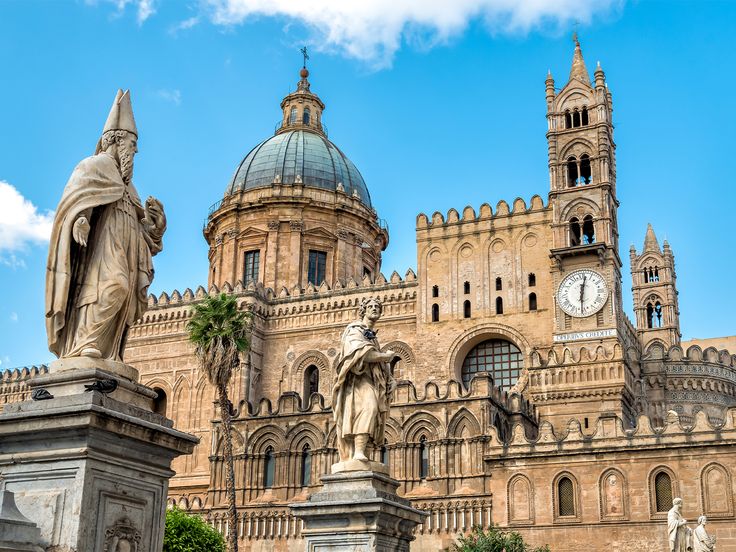
Unlike most Italian cathedrals, Palermo’s is not a single architectural statement but an entire civilisation’s autobiography written in stone over nine centuries — Norman arches, Arabic geometric carving, Gothic spires, a baroque dome added in the 18th century, and royal tombs inside containing the remains of Roger II, Frederick II and Henry VI. The exterior, seen from the south flank, is one of the most extraordinary façades in Italy.
Ballarò Market
The oldest and most authentic market in Palermo, operating continuously since the Arab period and still set in the same streets of the Albergheria quarter. It is an experience of overwhelming sensory intensity — vendors chanting their prices in Sicilian dialect, pyramids of blood oranges and artichokes, fresh tuna and swordfish on ice, arancine frying in enormous pans, the smell of fresh herbs and old stone. Arrive early for produce, later for street food.
Capuchin Catacombs (Catacombe dei Cappuccini)
Between 1599 and 1871, the Capuchin monks of Palermo mummified and displayed nearly 8,000 bodies of citizens who had paid for the privilege of being preserved in corridors arranged by social class and gender — priests, professionals, virgins, children. The most famous resident is Rosalia Lombardo, a two-year-old girl who died in 1920 and whose preservation is so perfect she appears to be sleeping. One of the most unsettling and extraordinary sites in all of Italy.
Church of San Giovanni degli Eremiti
Five terracotta-red Norman domes rising above a former Arab mosque, surrounded by a garden of orange trees, palms and subtropical plants that feels like an enclosure outside time. Built in 1136 by Roger II, it is one of the defining images of Palermo — the meeting point of Islam and Christianity expressed in domes and cloisters — and far less visited than it deserves to be.
Quattro Canti, Fontana Pretoria & Piazza Bellini
The baroque crossroads of Palermo: the Quattro Canti is an octagonal piazza where the two main streets of the historic centre intersect, lined with four identical baroque facades. Nearby, the Fontana Pretoria — known to Palermitans as the “Fountain of Shame” for its abundance of nude figures — sits in a piazza of extraordinary theatrical power. A two-minute walk brings you to Piazza Bellini, where a Norman church and an Arab-Norman church face each other across a quiet square.
Monreale Cathedral — the essential half-day trip
Thirty minutes from Palermo by bus (Line 389 from Piazza dell’Indipendenza), the Cathedral of Monreale contains the largest and most complete cycle of Byzantine mosaics in existence — 6,340 square metres of gold mosaic covering the entire interior with scenes from the Old and New Testaments. Built by William II in 1174, it is UNESCO-listed and arguably the single most important monument in Sicily. Do not leave Palermo without seeing it.
Monreale strategy: Take the first Bus 389 of the morning from Piazza dell’Indipendenza (departures from 7am). Arrive at the Cathedral by 8am when it opens. In the empty morning light, with the gold mosaics catching the sun through the apse windows, it is one of the great travel experiences in Italy. By 10am the tour buses arrive. Entry €4.
How to Plan Your Palermo Visit
Palermo is less frenetically over-touristed than Rome or Florence, which is both a pleasure and a warning — the city’s opening hours, ticket systems and booking infrastructure are less standardised. Planning ahead removes the friction.
The Palatine Chapel rule: The Chapel is closed on religious holidays and during official ceremonies without notice. Book online at federicosecondo.org and confirm your date. If the Chapel is closed on your chosen day, the cathedral and San Giovanni degli Eremiti provide extraordinary alternatives of nearly equal importance.
- Palatine Chapel: Book online. Arrive at 8:30am opening. The chapel receives group tours from 10am onwards — morning visits are significantly more intimate and allow proper contemplation of the mosaics.
- Ballarò and Capo Markets: Both operate Monday to Saturday, morning until early afternoon. Sunday is quiet — plan accordingly. The Vucciria is best after dark, as a street-food and social hub rather than a daytime market.
- Capuchin Catacombs: No booking required but note the lunchtime closure (1–3pm). Allow 45–60 minutes. Photography is permitted but tripods are not. The site is not recommended for very young children.
- Monreale: Bus 389 from Piazza dell’Indipendenza. Buy a return ticket before boarding — €1.40 each way. The journey is 30 minutes. Return buses run until late afternoon. Alternatively, a private transfer allows you to combine Monreale with Segesta on the same day.
What to Eat in Palermo — and Where
Palermo’s street food is not a tourist attraction. It is a living practice, unchanged in substance for centuries, that the Palermitani pursue with absolute seriousness. Anthony Bourdain called it the greatest street food city in the world. He was not wrong.
Arancine
Note the feminine plural — in Palermo they are arancine, not arancini. Saffron-gold fried rice balls stuffed with ragù and peas or butter and mozzarella. The definitive Sicilian street food. The ones at Ballarò market are the standard everything else is measured against.
Pani ca’ Meusa
A sesame-seeded roll filled with chopped veal spleen and lung, braised in lard and topped with ricotta or caciocavallo cheese. The most Palermitan of all foods — sold from carts near the Vucciria since at least the 15th century. Order it maritata (married) with cheese.
Sfincione
Palermo’s answer to pizza — thicker, squarer, topped with tomato, onion, anchovies, caciocavallo and breadcrumbs. Sold by the slice from bakeries and market stalls throughout the city. Eaten warm or at room temperature, it is one of the great casual eating experiences in Italy.
Panelle
Thin, crisp fritters made from chickpea flour, fried in olive oil and served in a soft roll with a squeeze of lemon. Deceptively simple, completely addictive. Often sold alongside crocchè (potato croquettes) from the same fryer. The default mid-morning snack of Palermo.
Stigghiole
Skewered and grilled goat or lamb intestines, seasoned with parsley and lemon. Cooked on charcoal grills at the Ballarò and Vucciria markets after dark, filling the surrounding streets with smoke. A test of adventurousness that almost everyone passes once they try it.
Pasta con le Sarde
The defining pasta of Palermo — bucatini with fresh sardines, wild fennel, pine nuts, raisins, saffron and toasted breadcrumbs. A dish that reads as an inventory of every civilisation that has touched this island: Arab spices, Norman wheat, Greek olive oil, Sicilian sea. Order it at any serious trattoria.
Caponata
Sweet-sour aubergine stew with celery, capers, olives and tomato. Served cold as an antipasto or side dish. Every family has their version; every version is slightly different; all of them are better than anything calling itself caponata outside Sicily.
Cannolo Siciliano
The cannolo must be filled to order — never pre-filled, which makes the shell go soft. Crisp fried pastry, fresh sheep’s ricotta sweetened with sugar and candied citrus. At Pasticceria Cappello they are filled in front of you. Eat immediately.
Where to eat
The Ballarò and Vucciria markets are the epicentres of street food. For serious sit-down Sicilian cooking, the streets around the Piazza Marina and the Kalsa neighbourhood are the best hunting ground.
- Antica Focacceria San Francesco — Via Alessandro Paternostro 58
Since 1834. The most historic restaurant in Palermo. Order the pani ca’ meusa and a glass of local white wine. This is where the dish was codified. - Trattoria Ai Cascinari — Via d’Ossuna 43
Old-school neighbourhood trattoria with an outstanding pasta con le sarde and a kitchen that takes seasonal ingredients seriously. Book ahead. - Trattoria Biondo — Via Carducci 15
Three generations of the same family. The fritto misto and pasta ‘ncasciata are the things to order. Unpretentious, local, consistently excellent.
For pastry and cannoli:
- Pasticceria Cappello — Via Colonna Rotta 68
Palermo’s most celebrated pasticceria. The setteveli chocolate cake is famous across Sicily. Cannoli filled to order. Queue early — the best things sell out. - Pasticceria Scimone — Various locations
For iris — a fried brioche filled with ricotta — and brioche col tuppo with pistachio gelato for breakfast. Quintessentially Palermitan.
The tourist trap test: Any restaurant on the main tourist circuit around Via Vittorio Emanuele with a menu in English, German and Japanese on a stand outside is coasting on location. Walk two streets in any direction into the quartieri and the food doubles in quality and halves in price. The Palermitani do not eat in the tourist zone — follow them.
Mistakes to Avoid in Palermo
Palermo rewards the curious and the open-minded. It does not forgive the impatient or the squeamish about food.
- Don’t skip the street food. The pani ca’ meusa, the stigghiole, the panelle — these are the authentic food culture of Palermo, not a sanitised tourist version of it. If you eat only in restaurants you will miss the best of the city.
- Don’t confuse the markets’ hours. Ballarò and Capo close early afternoon and are closed on Sundays. Vucciria is dead during the day and alive after 9pm. Knowing which market to visit at which hour is essential.
- Don’t skip Monreale. Most visitors to Palermo are within 30 minutes of one of the greatest buildings in the world and never go. Bus 389, €1.40, 30 minutes. No excuse.
- Don’t visit the Palatine Chapel without checking opening hours. The chapel closes without notice for official ceremonies. Check federicosecondo.org before you go, particularly if you are visiting on a weekday morning.
- Don’t rent a car to explore the city itself. Palermo’s traffic and parking make driving within the historic centre an exercise in frustration. Use your feet for the city and book a private transfer for day trips to Agrigento, Segesta or Cefalù.
- Don’t order a cannolo pre-filled. If the cannolo shells are already filled with ricotta when you order, the shell is already soft. Find a pasticceria that fills them to order. The crisp-to-cream ratio is the entire point.
- Don’t underestimate the heat in July and August. The African sirocco pushes temperatures above 40°C for days at a time. The Arab-Norman churches become refuges. Plan morning sightseeing and siesta afternoons.
- Don’t miss the evening passeggiata. Between 6pm and 9pm, Palermitani take to the streets — Via Maqueda, the Quattro Canti, the lungomare at Mondello — in a nightly ritual of strolling and socialising. Join it. This is city life as it was always meant to be.
Practical Information for Palermo 2026
Money & payments
Palermo’s street food vendors, market stalls and many smaller trattorias are cash only. Keep €30–50 in cash at all times. ATMs are widely available in the centre but avoid those in tourist areas that charge commission.
Dress code
The Palatine Chapel, the Cathedral, San Giovanni degli Eremiti and Monreale all require covered shoulders and knees. Carry a light scarf or shawl. Some churches refuse entry without it — these are not suggestions.
Connectivity
EU visitors use domestic plans. Non-EU visitors: SIM cards from TIM, Vodafone or WindTre available at the airport and throughout the centre. Coverage is good throughout Palermo and the main tourist sites.
Safety
Palermo is safe for tourists. Take standard precautions in crowded market areas (Ballarò, Vucciria) — bag in front, no ostentatious jewellery. Around the Stazione Centrale after dark, apply the same common sense you would in any large Italian city. The historic centre, Mondello and the tourist quarter are comfortable at all hours.
Emergency numbers
Day trips from Palermo
Monreale — 30 min by bus (Line 389), unmissable Byzantine mosaics. Cefalù — 1h by train, beautiful Norman cathedral and beach town. Segesta — 1h by car or transfer, a solitary Greek temple of extraordinary beauty in open countryside. Agrigento — Valley of the Temples — 2h by train or transfer, the largest and best-preserved group of Greek temples outside Greece. Erice — 1h 15min by car, a medieval hilltop town above Trapani with extraordinary views over the western coast of Sicily. Trapani salt flats — 1h 30min by transfer, one of the most photogenic landscapes in Italy.