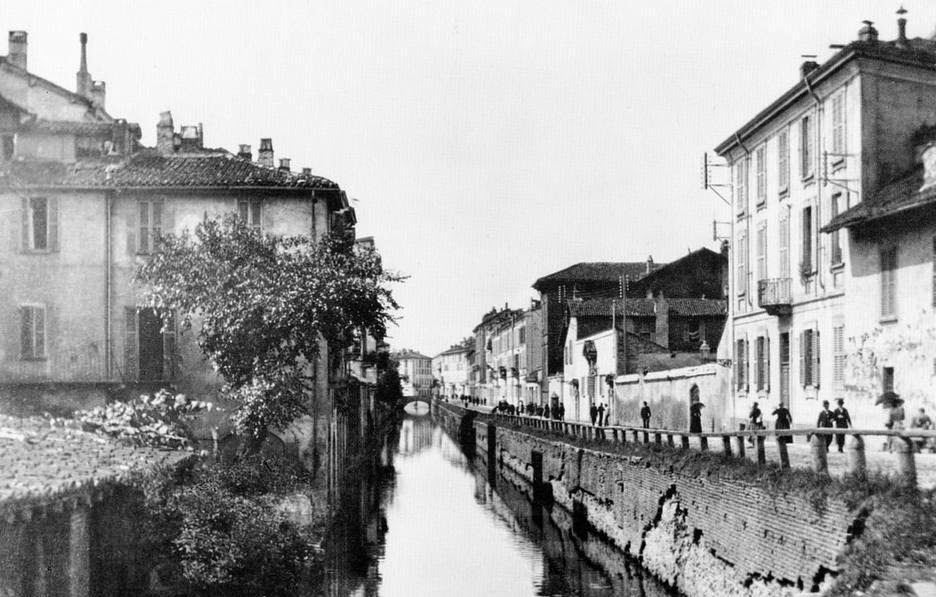
Historic photograph of the Navigli canals of Milan — boats moored along the Naviglio Grande in the early twentieth century
Milan — The Navigli canals in the early 20th century  |  45° 27’ N  ·  9° 10’ E

Milan Was Once a City of Water Like Venice and Amsterdam

A thousand years before the Duomo was finished, Milan was already one of the great water cities of Europe — a labyrinth of navigable canals connecting the city to the Alps, to the Po Valley and to the Adriatic Sea. This is the story of what was built, what was lost, and what still flows beneath the streets today.

Milan is a city of waterways which have been conquered, celebrated — and lost. When Milan had its full network of canals, it was possible to step into a boat at the centre of the city and sail, without once leaving navigable water, all the way to Venice via the river port of Pavia. The marble for the Duomo arrived this way. So did the coal that heated the city, the timber that built its palaces, and the wine that filled its taverns. For six hundred years, the Navigli — Milan’s extraordinary system of artificial waterways — were the engine of the city’s economy, its primary means of heavy transport and one of the greatest feats of hydraulic engineering in medieval Europe.

Today, almost all of it is gone. The canals that once defined the city’s character were covered over between 1929 and 1930, buried beneath the roads and buildings of a modernising metropolis that had decided the future lay with the automobile. What remains — the Naviglio Grande, the Naviglio Pavese, and the neighbourhood built along their banks — is beautiful, lively, and a fraction of what once existed.

But not all of the water city died. Parts of the Navigli still flow underground, in the dark, carrying the memory of the city that was.

1179
First Naviglio Grande dug
150 km
Total canal network at peak
500 tons
Max cargo per barge
1929
Inner canals covered over
✦ ✦ ✦

Mediolanum: The City Built in the Midst of Many Waters

Long before Rome arrived, long before the Lombards and the Visconti and the Sforzas, the ancient Insubri people had understood something fundamental about this particular piece of the Po Valley: the ground here was extraordinary. In the 4th century BC, the Insubri chose the location for their principal city with the precision of engineers — a site where the water table was close to the surface, where natural springs fed into a network of streams, where the flat alluvial plain offered both fertile farmland and defensible approaches from every direction.

They called the city Medhelan — or Medhelanion — a name of Celtic origin whose exact meaning is disputed but which most scholars interpret as “the middle of the plain” or, more poetically, “the middle of many waters.” When the Romans arrived in the 2nd century BC and renamed it Mediolanum, they preserved the essential meaning: a city positioned between water courses, drawing its identity from its relationship with the water around and beneath it.

The barbarian kingdoms that swept south across the Alps after the fall of Rome discovered that the Insubri had been right. The plain of Milan was among the most fertile in the world — watered by underground streams, dotted with springs that maintained temperatures above 10°C even in winter, allowing crops to grow in months when everywhere else in northern Europe lay dormant. The water meadows around the city — the marcite — were irrigated by this groundwater and remained green all year round, feeding livestock through the coldest months of the Lombard winter.

“Milan stood in the midst, in many waters — and the name Mediolanum indicated its intermediate position between the streams.”— From the ancient description of the Lombard capital

It was this relationship with water — the deep understanding of the landscape’s hydraulic possibilities — that made Milan what it became. Not a river city like Paris or Florence, with a single dominant watercourse determining the city’s layout, but something more complex and more ambitious: a city that decided to reshape its water geography entirely, cutting canals through the clay and limestone of the plain to connect itself to the lakes, the rivers and the sea.

✦ ✦ ✦

The Naviglio Grande: The Great Canal That Changed Everything

In 1179, the city of Milan began cutting a channel westward from the Ticino river. The project was unprecedented in medieval Italy in its scale and ambition: a man-made waterway 50 kilometres long, wide enough for heavy barges, designed to connect the city to the lake system of the Alps and, through the Ticino and the Po, to the Adriatic Sea and the entire trade network of northern Europe.

The work took nearly a century to complete. The Naviglio Grande — the Great Canal — was fully navigable by 1269, and it changed Milan fundamentally. Within a generation, the city had access to building materials, fuel and food that had previously been impossibly expensive to transport over land. The marble quarries of Candoglia on Lake Maggiore — the source of the distinctive pink-white stone of the Duomo, begun in 1386 — were connected to Milan by the Naviglio Grande. Every block of marble for the cathedral arrived by barge, unloaded at the dockyard that stood where the dock of Porta Ticinese now stands, dry and melancholy, in the middle of the city.

The marble miracle of the Duomo: Construction of the Milan Cathedral began in 1386 and required millions of blocks of Candoglia marble quarried on Lake Maggiore, 80 km to the north. The Naviglio Grande made this possible — the barges loaded at Candoglia descended the Toce river to Lake Maggiore, crossed the lake, entered the Naviglio Grande at Tornavento and arrived at the Laghetto di Sant'Eustorgio in the heart of Milan. The church of Sant'Eustorgio still marks the approximate site of this medieval dock. Without the canal, the Duomo as we know it could not have been built.
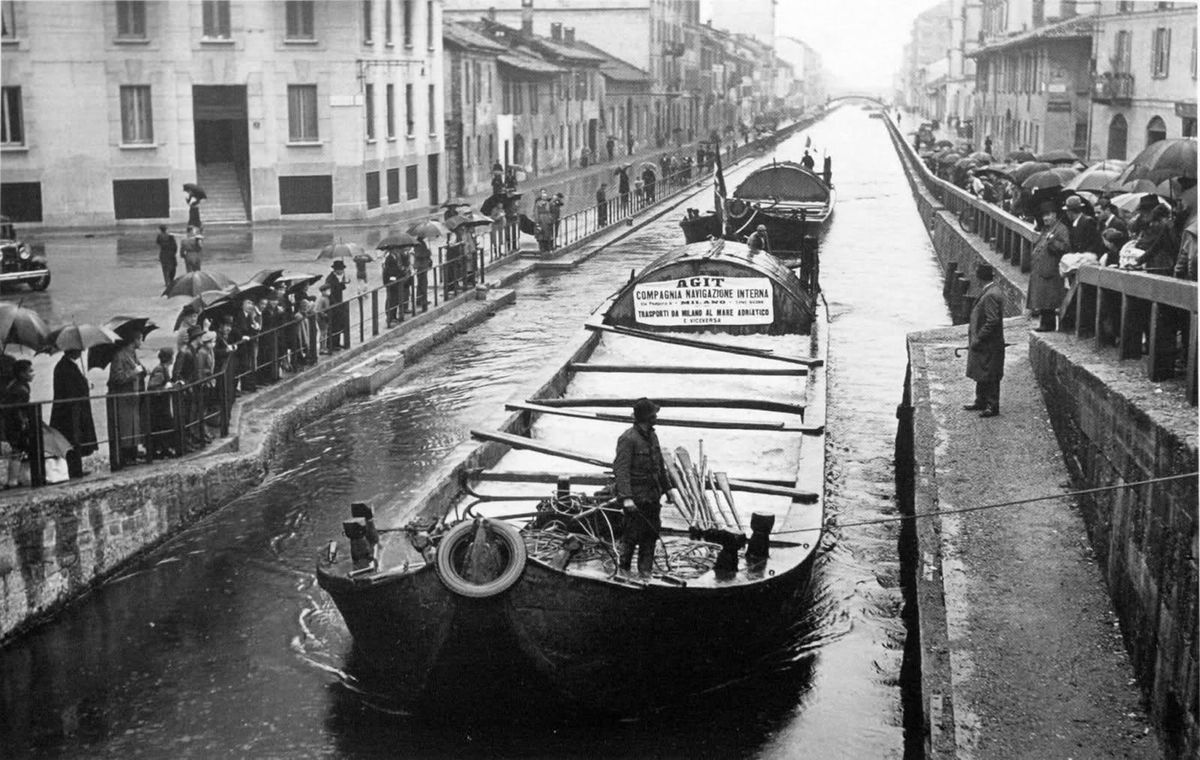
The Naviglio Grande carried coal and timber from the Alpine forests, stone and sand for construction, hay and livestock for the city’s growing population. And it carried the city’s produce outward: wine from the Milanese countryside, wheat from the Po Valley, salt, silk and the handicrafts of a city that was becoming, by the 13th century, one of the most productive manufacturing centres in Europe.

The boats themselves were extraordinary machines of their time: flat-bottomed barconi carrying up to 500 tons of cargo, hauled upstream by teams of horses or oxen walking the towpaths — the flat roads that ran alongside the canals — and drifting downstream with the current. A single horse could haul a barge carrying four tons of material: the equivalent of twenty oxcarts on the road. The economic logic was overwhelming.

✦ ✦ ✦

Leonardo da Vinci and the Engineering of Water

In 1482, a thirty-year-old painter and engineer from Florence arrived in Milan with a letter of introduction to Ludovico Sforza, Duke of Milan. The letter — written by Leonardo da Vinci himself — described in ten detailed points his abilities as a military engineer, an architect and a designer of weapons. Almost as an afterthought, in point nine, he mentioned that he could “carry out sculpture in marble, bronze and clay” and that in painting he could “do as much as any other, whoever he may be.”

Leonardo stayed in Milan for seventeen years. During this period he painted the Last Supper and the first version of the Virgin of the Rocks, but he also spent an extraordinary amount of time thinking about, studying and redesigning the city’s canal system. His notebooks from the Milan years contain hundreds of drawings related to hydraulics: lock designs, water wheels, dredging machines, canal profiles, maps of the existing network and proposals for extensions.

The Lock System

Milan’s canals faced an engineering problem that no flat-water canal system in Italy had solved: the city sat on a plain with subtle but significant altitude differences between its various canal levels. Boats needed to move between channels at different heights. Leonardo’s solution — or rather, his refinement of an existing solution — was the mitre lock: a chamber with two sets of angled gates that could be opened and closed to raise or lower the water level within, allowing a boat to ascend or descend between canal levels without a portage. The mitre lock he designed for the Naviglio della Martesana was so efficient that locks built to essentially the same principle are still used on canals worldwide today.

The Canal Map

Leonardo produced what may be the first systematic hydrographic survey of the Milan area — a series of maps in his notebooks showing the existing canal network, the natural watercourses, the altitude relationships between different channels and the proposed extensions. These maps, compiled in the 1490s, are among the finest technical documents of the Italian Renaissance and provided the basis for the canal engineering of the following two centuries.

The Conca dell'Incoronata

The only surviving lock from Leonardo’s Milan remains partially visible at the Conca dell’Incoronata — a 15th-century lock chamber near Corso Garibaldi in the north of Milan’s historic centre. The structure, now dry, gives the clearest impression of how the lock system worked and of the scale of the engineering that the canal system required. It is one of the most undervisited historical sites in the city.

Leonardo left Milan in 1499 when the French invaded and Ludovico Sforza fled. But his contribution to the city’s hydraulic infrastructure outlasted him by centuries. The Milan canal system at its fullest extent — achieved in the 16th and 17th centuries, building on Leonardo’s foundations — comprised over 150 kilometres of navigable waterways, serving a city that had become one of the most productive industrial and commercial centres in Europe.

“Water is the driving force of all nature.”— Leonardo da Vinci, Notebooks, c. 1490s
✦ ✦ ✦

A City Afloat: Commerce, Locks and the Life of the Canals

By the late 18th century, the Navigli network connected Milan to almost every major city and town in the Po Valley. From the dock of Porta Ticinese, a merchant could dispatch a barge carrying silk, ironwork, cotton textiles or printed books northward to the Alpine lakes, eastward to Bergamo, south through Pavia to the Po and then east to Venice — a journey of several days, covering hundreds of kilometres without unloading.

The towpaths — the flat roads running alongside the canal banks — were among the most important infrastructure in Lombardy. Teams of horses and oxen walked them constantly, hauling barges upstream against the current. The towpath along the Naviglio Grande from Milan to Tornavento was maintained and widened repeatedly over the centuries precisely because it was the main artery of Lombard heavy transport. Even in 1929, when the decision was made to cover the inner canals, the Naviglio Grande and the Naviglio Pavese remained open precisely because they still carried more goods than the roads could handle.

The efficiency of water transport: A single horse pulling a barge on a canal could move up to four tons of cargo — the equivalent of what twenty-seven horses could carry on the road simultaneously. This astonishing efficiency advantage was the fundamental reason the Navigli remained economically relevant well into the industrial era, and why their coverage was genuinely controversial. As late as 1929, more goods moved through Milan by water than by road.

The passenger boats — the barcacce — added another dimension to the canal’s social life. Regular services connected Milan to Pavia, to Lodi, to Vigevano and to dozens of smaller towns. The boats were covered, provided seats, and operated on regular schedules. For centuries, the canal was not just a commercial artery but a public transport system — the way ordinary Milanese and Lombard citizens moved between cities before the railway arrived.

And then there were the fishermen. The Navigli were extraordinarily productive fishing waters — the artificial canals and their connected streams teemed with pike, perch, carp, eels and crayfish. Before the 20th century, Milanese fishing was a genuine occupation and a significant source of food for the city’s working population. The complete disappearance of the fishing culture — of the fishermen known as the piscinari — is one of the least remembered consequences of the canals’ decline.

The Naviglio Grande canal in Milan — barges moored along the historic waterway
Milan — The Naviglio Grande, the oldest and longest surviving canal of the network
✦ ✦ ✦

The Slow Disappearance: How a City Lost Its Water

The decline of the Navigli was not an event but a process — a long, gradual erosion of relevance that accelerated catastrophically in the early 20th century. It was driven by three forces: the railway, the automobile and the growing crisis of urban hygiene.

The railways arrived in Lombardy in the 1840s and immediately began to siphon off the canal’s most valuable cargo — goods that needed speed and reliability rather than bulk capacity. Silk, finished textiles, perishable foods and passengers all migrated to rail within a generation. What the canals retained — coal, sand, gravel, timber, agricultural products — was important but not the high-value trade that justified major investment in canal maintenance.

The hygiene crisis was more visceral. By the late 19th century, the inner canals of Milan — the ring of waterways that circled the historic centre — had become severely polluted. Industrial effluent, domestic waste and the ordinary run-off of an expanding industrial city had turned what had once been navigable waterways into open sewers. The stench in summer was a constant subject of public complaint. The canals that had fed the city’s medieval growth now threatened its public health.

The great covering of 1929: The decision to fill and cover the inner ring of Milan’s Navigli was taken by the Fascist administration of the city in the late 1920s. Work began in 1929, and within a year the Naviglio Interno — the canal that had encircled the historic centre since the medieval period — had been converted into the roads that are now called Corso di Porta Ticinese, Via Molino delle Armi, Via Arena and Via Circo. The covering destroyed what had been one of the most extraordinary urban waterscapes in Europe and replaced it with arterial roads that are now permanently congested.

The automobile was the final argument. As motor vehicles multiplied through the 1920s, the canal towpaths and watercourses occupied precisely the land most needed for road widening. The choice — presented as a modernisation rather than a destruction — was between the water and the car. The car won, everywhere in Europe, and nowhere more comprehensively than in Milan, which by mid-century had built one of the highest concentrations of motor vehicles per capita of any city in the world.

The decision was not without opposition. Even in 1929, voices argued that the economic case for the canals was stronger than the road lobby admitted — that a horsepower on water could move four tons while the same horsepower on road could carry 150 kg, and that no amount of road-widening would overcome this fundamental physics. The argument was correct but lost. Nostalgia, when it arrived, came too late.

Milan's waterway network — historical view of the canal system that connected the city to the Adriatic
Milan — The historical waterway network at its greatest extent
✦ ✦ ✦

Underground Milan: What Flows Beneath the Streets

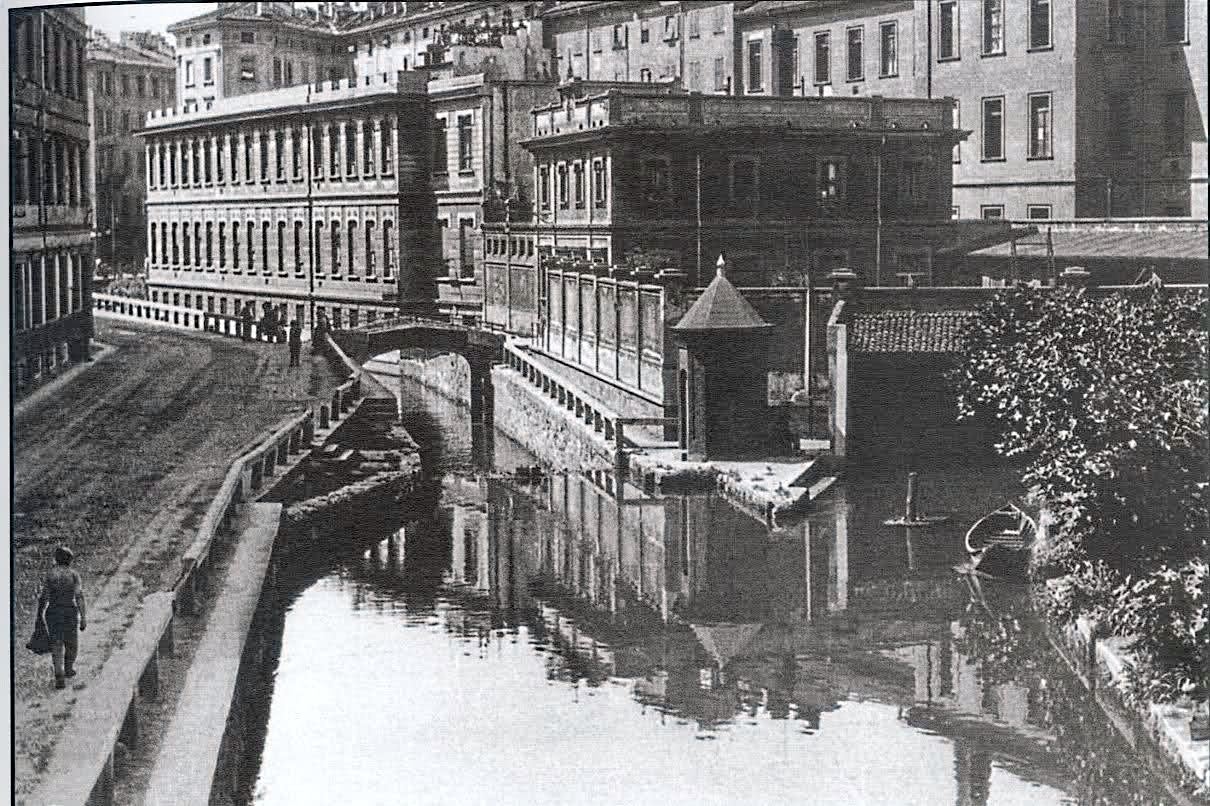
When the Navigli were covered, they were not demolished. They were buried. The canal beds were paved over, the walls remained in place, and the water — where it still flowed — was redirected into the sewer system or allowed to continue through the covered channels underground.

A significant portion of the original Navigli network still exists beneath the streets of central Milan. The Naviglio della Martesana, which once entered the city from the northeast, can still be partially followed underground from the Incoronata lock. The cerchia dei Navigli — the inner ring canal — exists largely intact beneath the roads that replaced it, incorporated into the drainage and sewer infrastructure but physically unchanged. The brick vaults and stone walls that the Visconti engineers built in the 14th and 15th centuries remain precisely where they have always been, carrying water in the dark beneath the traffic above.

This underground reality generates one of the most remarkable episodes in Milan’s history — the story of the smugglers who understood the underground network better than anyone.

The Underground Smugglers of 1868

In the mid-19th century, Milan’s customs authorities noticed an anomaly. The volume of goods traffic on the canals remained unchanged, but the customs duties collected at the city’s entry points were inexplicably declining. The goods were arriving, but somehow avoiding the tolls. The investigation that followed, documented by the authors Ippolito Ferraio and Gianluca Padovan in their book Milan Underground, reached its conclusion on a night in July 1868, when customs officers slipped beneath a large stone slab in the street and descended into the covered section of the canal network. There they found a fully operational smuggling operation: a secret boat, hauled through the underground waterways by a rope, carrying meat, alcohol, poultry and other dutiable goods directly into the city centre, bypassing every customs checkpoint. The rope used to drag the boat was still there when they arrived, still attached to the stone quay.
The Open Navigli Project

The possibility of restoring at least part of the inner ring of the Navigli has been discussed in Milan for decades. A feasibility study completed in the 2010s concluded that approximately 2.8 km of the historical inner canal could be restored — reopened to the surface, cleaned, and integrated into the city’s public space as a waterway with cultural and environmental value. The project faces enormous obstacles: utility networks, metro tunnels, the cost of relocating underground infrastructure and the loss of road capacity. As of 2026, it remains an aspiration rather than a plan, but it is an aspiration that never entirely disappears from Milan’s urban conversation.

The Laghetto di Sant'Eustorgio — the ancient dock of Milan where the marble for the Duomo was unloaded
Milan — The site of the ancient Laghetto di Sant’Eustorgio, where marble for the Duomo was unloaded from barges
✦ ✦ ✦

Porta Ticinese and What Remains of the Water City

The most powerful reminder of Milan’s water identity is found at Porta Ticinese — the ancient southern gate of the medieval city, which once stood at the junction of two canals: the Naviglio Grande arriving from the west and the Naviglio Pavese departing south toward Pavia. The name itself is a water name: the Ticino river, which the canals connected Milan to.

Today, if you stand at the dock of Porta Ticinese — the flat, paved area beside the Ripa di Porta Ticinese — you are standing in what was once one of the busiest inland ports in northern Italy. The dock is always dry now, the stone quay cracked by decades of foot traffic, sometimes littered with the debris of the street market that operates nearby. It does not look like a port. But the physical structure is there: the width of the dock, the alignment of the stonework, the relationship between the dock and the canal that still passes beside it — the surviving section of the Naviglio Grande that feeds into it from the west.

If you walk the Ripa di Porta Ticinese on a foggy November morning — when the outlines of the canal blur and the traffic noise recedes and the medieval church of San Lorenzo behind you disappears into the mist — it is genuinely not difficult to imagine the boats moored there: the smell of coal and wet rope and river mud, the shouts of the barcaroli as they navigated the final lock before the city dock, the sound of hooves on stone as the towpath horses were unharnessed for the last time on that day’s journey.

“Even today, Milan retains that special and unique quality, justifying the feelings of profound nostalgia which pervade the city. The water is gone but the city still knows it was once something else.”

The Naviglio Grande and the Naviglio Pavese — the two canals that survived 1929 intact — remain navigable and fully visible. The Naviglio Grande, running 50 km from the Ticino river to the Porta Ticinese dock, is still used by small pleasure boats. Its banks — the Alzaia Naviglio Grande on the north and the Ripa di Porta Ticinese on the east — have been transformed into one of Milan’s most vibrant cultural and nightlife districts, lined with restaurants, galleries, wine bars and the studios of artists and designers who have colonised the old canal-side warehouses.

Every last Sunday of the month, the Alzaia Naviglio Grande hosts the Mercatone dell’Antiquariato — a famous antiques market stretching for hundreds of metres along the canal bank, with over 400 dealers selling furniture, paintings, books and objects from every period of Italian history. It is, in its own way, a form of historical memory: commerce along the canal bank, as there has been for seven hundred years.

✦ ✦ ✦

The Springs, the Meadows and the Song from Via Gluck

Milan’s relationship with water was not limited to its canals. The groundwater of the Po Valley plain was, in the ancient and medieval city, close to the surface — feeding natural springs (fontanili) that emerged from the ground throughout the urban area and the surrounding countryside, maintaining temperatures above 10°C year-round regardless of season.

These springs fed into the network of irrigation channels that watered the marcite — the water meadows that ringed the medieval city. In the marcite, the groundwater was distributed across low fields through a system of small channels, keeping the grass permanently irrigated and the temperature consistently mild. Even in January and February, when the rest of northern Italy lay frozen, the marcite were green — producing fodder that sustained the city’s livestock and, indirectly, its entire food economy.

The springs are almost all gone now. The industrial and agricultural extraction of groundwater through the 20th century lowered the water table dramatically, and the natural fontanili that once dotted the city’s periphery dried up one by one. A handful survive in the protected areas south of Milan, in the Parco Agricolo Sud, where the water table remains high enough to support the traditional spring ecology. They are recoverable — hydrologists have confirmed that restoring some of the fontanili would be technically feasible — and their restoration would create habitats for species under severe pressure elsewhere in the Po Valley: Italian amphibians, freshwater molluscs, water-dependent insects that have lost almost all of their natural habitat to urban and agricultural development.

"Il Ragazzo della Via Gluck" — the song about the meadows: In 1966, the Milanese singer-songwriter Adriano Celentano released what became one of the most famous Italian pop songs of the century — Il Ragazzo della Via Gluck (The Boy from Gluck Street). The song tells of a boy who grew up in the countryside on the edge of the city, where there were green fields and streams, and returns to find it all built over. It became the anthem of a generation that had watched the marcite — the last green water meadows of the old Milan — disappear under concrete in the postwar urban expansion. Celentano was singing about a real place and a real loss, and the song resonated precisely because millions of Milanese had witnessed the same disappearance in their own lifetimes.

✦ ✦ ✦

Could Milan Recover Its Water? The Case for the Navigli

The argument for restoring Milan’s inner Navigli is not purely nostalgic — though nostalgia is a powerful force in any city’s relationship with its own history. There is a practical case, and it has been made repeatedly by urban planners, environmental scientists and transport economists.

The efficiency argument that was dismissed in 1929 has not gone away: a canal boat carrying four tons of material still consumes a fraction of the energy of the equivalent truck journey. In a city permanently choked by traffic and consistently failing its air quality targets, a restored canal that could carry bulk construction materials — aggregate, sand, demolition waste — by water rather than by road would remove thousands of heavy vehicle movements from the city’s arteries every year. Amsterdam and Hamburg have demonstrated that this is not a romantic fantasy but a functional reality in a modern European city.

The environmental case is equally strong. A restored water system — even a partial one — would improve Milan’s urban climate by moderating the heat island effect, create linear green corridors through the most densely built part of the city, provide habitats for urban biodiversity and, crucially, improve the city’s resilience to the increasingly frequent extreme rainfall events that overwhelm its drainage system.

The cultural case is perhaps the most intuitive: cities that have preserved or restored their historic water heritage — Amsterdam, Bruges, Lyon, Stockholm — have found that the water itself becomes a primary economic driver, attracting visitors, residents and investment in ways that roads simply do not. The surviving Naviglio Grande district already demonstrates this principle on a small scale. A restored inner ring would multiply it dramatically.

The obstacles are real — the underground utility networks, the metro tunnels, the political will required, the cost. The feasibility study estimated the restoration of 2.8 km of the inner ring at several hundred million euros. It is expensive. But the city that built the original network in the 13th century was also working within severe resource constraints — and it built something that lasted 700 years.

Milan is a city that still knows it was once something else. The fog that settles over the Naviglio Grande on winter evenings, the stone dock at Porta Ticinese, the covered arc of the inner ring beneath the traffic noise — these are not mere historical curiosities. They are the residue of one of the greatest urban water systems ever built, and the argument for recovering some part of it grows stronger, not weaker, with every year that passes.

Frequently Asked Questions

Did Milan really have canals like Venice?
Yes — at its peak Milan had over 150 km of navigable canals connecting the city to the Alps, the Po Valley and the Adriatic Sea. The network included multiple artificial waterways, passenger services and a busy inland port at Porta Ticinese. Most of the inner ring was covered over in 1929–1930; the Naviglio Grande and Naviglio Pavese survive and are still visible today.
What role did Leonardo da Vinci play in Milan's canals?
Leonardo lived in Milan from 1482 to 1499 under the patronage of Ludovico Sforza. During this period he designed and improved the mitre lock system that allowed boats to navigate between different water levels — a critical engineering innovation. His notebooks contain hundreds of hydraulic drawings. The Conca dell’Incoronata, near Corso Garibaldi, is the last surviving lock from this period.
What is the Naviglio Grande?
The Naviglio Grande is the oldest and longest surviving canal in Milan — 50 km, begun in 1179 and fully navigable by 1269. It connected Milan to the Ticino river and brought the marble for the Duomo into the city. Today it is the backbone of the surviving Navigli district, one of Milan’s most vibrant nightlife and cultural areas, lined with restaurants, bars and galleries.
Are there still canals underground in Milan?
Yes. When the inner ring of the Navigli was covered in 1929–1930, the physical canal structure was preserved underground — the brick walls and vaulted chambers still exist beneath the roads. Parts of the Naviglio della Martesana and the inner ring (cerchia dei Navigli) still carry water underground as part of the drainage system. Occasional guided tours access parts of this underground network.
Why were Milan's canals covered over?
Three forces drove the decision: hygiene (the inner canals had become severely polluted by the early 20th century), the rise of the automobile (the canal towpaths occupied land needed for road widening), and the modernisation programme of the Fascist period. Work began in 1929 and most inner-ring canals were covered by 1930.
What is the Navigli district like today?
The Navigli district, centred on the surviving Naviglio Grande and Naviglio Pavese, is one of Milan’s most vibrant neighbourhoods — canal-side restaurants, bars, galleries and studios in converted warehouses. The Mercatone dell’Antiquariato (last Sunday of each month) is a famous antiques market along the Alzaia Naviglio Grande. The evening aperitivo scene is among the finest in Milan.
Could Milan's canals be restored?
A feasibility study concluded that restoring approximately 2.8 km of the historical inner canal ring is technically possible. The project faces significant obstacles — underground utilities, metro tunnels, cost — and as of 2026 remains in discussion. The practical, environmental and cultural arguments for restoration are strong and the conversation never disappears from Milan’s urban planning debate.