
Airport to City Centre, Getting to Milan & Getting Around, Connectivity and Tips About Milan
What's in this guide
Most visitors arrive in Milan expecting a pit stop — a fashion show, a business meeting, a connection to somewhere else — and leave having discovered something they hadn’t anticipated: a city that gets under your skin. Not with the overpowering grandeur of Rome, nor the postcard perfection of Florence, but with something quieter and arguably more seductive — the energy of a place that genuinely matters.
Milan is Italy’s engine. Its stock exchange, its design studios, its publishing houses, its fashion houses, its finest restaurants — all here. And beneath the glossy surface is a city of canal-side aperitivi at dusk, cathedrals of extraordinary ambition, a Leonardo da Vinci masterpiece in a former convent refectory, and neighbourhoods — Brera, Isola, Navigli — where Milanese life unfolds with an elegant, unfussy rhythm that rewards those who slow down enough to notice it.
“Milan is not a city for tourists. It is a city for people who know what they want.” — Giorgio Armani
When Is the Best Time to Visit Milan?
Milan’s climate is more continental than Mediterranean — summers can be genuinely hot and humid, winters grey and cold. Timing your visit around the fashion and design calendars also matters: the city transforms during Milan Fashion Week and the Salone del Mobile.
Spring — April & May
- Temperatures 14–23°C
- Salone del Mobile in April
- Outdoor aperitivo begins
- Excellent photography light
- Book early for design week
Autumn — Sept & Oct
- Temperatures 15–24°C
- Fashion Week (Sept)
- Summer heat fully gone
- Vibrant cultural calendar
- Crisp, photogenic days
Winter — Nov–Mar
- Temperatures 2–10°C
- Milan’s best restaurant season
- Museo season in full swing
- Frequent fog (la nebbia)
- Lowest hotel prices
Summer — July & August
- Temperatures 30–36°C+
- High humidity makes heat oppressive
- Many restaurants close in August
- The city empties (locals leave)
- Less authentic atmosphere
The Salone del Mobile window: Held each April, Milan’s design week transforms the entire city into an open exhibition. Hotels fill up completely — book months ahead — but the energy and creativity on display is unlike any other week in any other European city.
Getting to Milan & Getting Around
Milan’s three airports
Milan is served by three airports. Malpensa (MXP) is the main international hub, 50 km northwest of the city. Linate (LIN) is the city airport, just 7 km east of the centre, handling mostly European routes. Bergamo Orio al Serio (BGY), technically a Bergamo airport, is used by Ryanair and is 45 km from Milan.
Airport to city centre — your options in 2026
| Option | Time | Cost | Best for |
|---|---|---|---|
| Private Transfer Door-to-door, fixed price Recommended |
~50 min | Fixed | Families, groups, first-timers |
| Malpensa Express MXP → Cadorna or Porta Garibaldi |
29–52 min | €13 per adult | Solo travellers, light luggage |
| Airport Bus MXP → Centrale (Terravision / Flixbus) |
50–75 min | €8–10 | Budget travellers |
| Linate → City (Metro M4) Direct metro link since 2023 |
12 min | €1.50 | Linate passengers only |
| Taxi (official) White or yellow cabs only |
50–80 min | ~€90–110 from MXP | Late night, small groups |
Malpensa Express tip: There are two Malpensa Express routes — one to Milano Cadorna and one to Milano Porta Garibaldi. Check your destination carefully. Both run every 30 minutes. Buy tickets at the station or official Trenord app before boarding.
Getting around the city
Milan’s public transport network is excellent. The metro has four lines (M1–M4). A single ticket costs €2.20 (2026) and is valid for 90 minutes on all buses, trams and metro. The ATM Day Pass costs €7.60 and is worth it if you plan to make more than four journeys.
Walk the centre: The Duomo, Galleria, La Scala, Brera and Castello Sforzesco are all within a 20-minute walk of each other. Use the metro for Navigli (M2 to Porta Genova) or the outer neighbourhoods like Isola (M2 Garibaldi).
The Essential Milan — What You Cannot Miss
Milan rewards those who go beyond the Duomo. The city’s greatest treasure is hidden in a former convent, its finest gallery is half-forgotten, and its most Milanese experience happens every evening at sundown in a canal-side bar.
Duomo di Milano & Rooftop
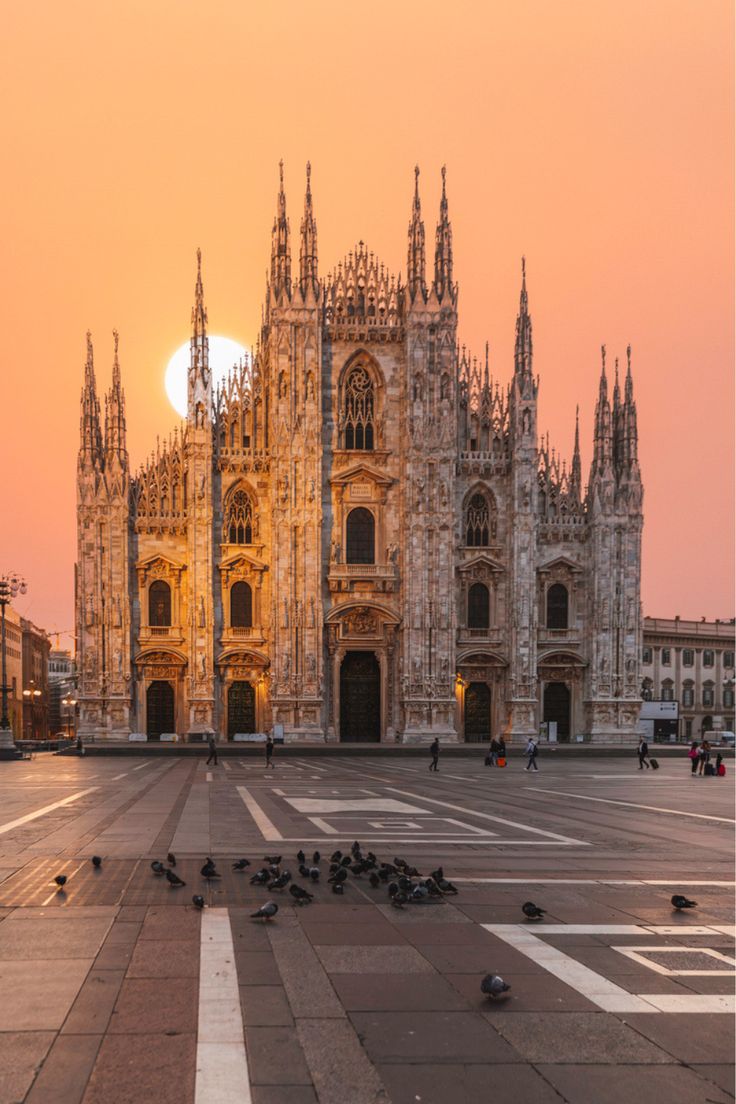
Over 600 years in the making, Milan’s Gothic cathedral is one of the most ambitious structures ever built. Its rooftop terrace — a forest of 135 marble spires, each crowned with a golden statue — offers one of Italy’s great urban panoramas. On clear days, the Alps are visible on the horizon. Take the stairs for a better experience.
The Last Supper (Cenacolo Vinciano)
Leonardo da Vinci painted this mural directly onto the refectory wall of Santa Maria delle Grazie between 1495 and 1497. It is not in a gallery — it is in the room for which it was created, at the scale it was intended, in the light it was designed for. Twenty-five visitors. Fifteen minutes. An experience that is almost impossible to describe to someone who hasn’t seen it.
Galleria Vittorio Emanuele II
Built in 1877, this iron-and-glass arcade connecting the Duomo to La Scala is arguably the most beautiful shopping mall ever constructed. Gucci, Prada, Louis Vuitton and Versace flank a domed central octagon with a mosaic floor. Entrance is free — find the bull mosaic and spin your right heel for luck, as Milanese tradition demands.
Castello Sforzesco & Parco Sempione
A 15th-century fortified castle that once housed Leonardo da Vinci’s studio. Nine museums inside include Michelangelo’s final, unfinished sculpture — the Rondanini Pietà — a haunting masterpiece of late genius. Behind the castle, Parco Sempione is Milan’s central green lung — perfect for a morning walk.
Pinacoteca di Brera
Milan’s finest art gallery — and one of Italy’s most underrated — occupies a 17th-century Baroque palace in the Brera neighbourhood. Raphael’s Marriage of the Virgin, Mantegna’s Dead Christ, Caravaggio, Tintoretto and Piero della Francesca, arranged with space and intelligence. Rarely crowded even in peak season.
Navigli — Milan’s Canal Quarter
Milan’s 15th-century canal system — once used to transport the marble for the Duomo — now forms the city’s most atmospheric quarter. Come for the aperitivo hour (6–9pm), when canal-side bars set out generous spreads of food with every drink. On the last Sunday of the month, the Mercatone Antiquariato fills the canal banks with antique dealers.
Teatro alla Scala — the world’s greatest opera house
La Scala is not merely an opera house — it is the benchmark against which all other opera houses measure themselves. The opera season runs from December to July. Museum tickets give access to the auditorium and a remarkable collection of operatic history.
La Scala strategy: If opera seats are beyond your budget or fully booked, the museum ticket (€9) gives you access to the auditorium itself — the same red velvet boxes, the same chandelier, the same stage — with far less competition. Book at teatroallascala.org.
How to Avoid the Queues
The Last Supper is the hardest ticket in Italy. The Duomo rooftop queues can stretch for 40 minutes in summer. A little planning eliminates both problems entirely.
The golden rule: Book The Last Supper the moment you confirm your travel dates. This is not an exaggeration — in April and May, available slots sell out within minutes of the booking window opening each morning. Set an alarm for 9am Italian time.
- The Last Supper: Book at cenacolovinciano.vivaticket.com. If sold out, check daily for cancellations — they appear most often 2–3 days before the date. Third-party “tours” that include entry are often legitimate but charge significant premiums.
- Duomo: Book at duomomilano.it. Arrive at 9am opening. The rooftop by stairs always has shorter queues than the lift line — and a better experience.
- Pinacoteca di Brera: Virtually no queues on weekday mornings. Book online to guarantee entry during peak season. One of Milan’s best-kept secrets.
- Galleria Vittorio Emanuele II: Visit before 9am or after 8pm to photograph the extraordinary glass ceiling without crowds. Free, no ticket needed, open always.
What to Eat in Milan — and Where
Milanese cuisine is not Rome’s. It is richer, more alpine in character, shaped by proximity to the Po Valley’s dairy farms, its rice paddies and its livestock. Butter replaces olive oil. Risotto replaces pasta. The aperitivo is not an accompaniment to a drink — it is a meal.
Risotto alla Milanese
Saffron-gold, buttery, slow-stirred for 20 minutes. Often served with ossobuco. The definitive Milanese dish and the one most difficult to find made properly in tourist restaurants.
Cotoletta alla Milanese
A bone-in veal chop, pounded thin, breaded and pan-fried in clarified butter until golden. Larger than your plate. Crunchier than anything you’ve eaten. The original — Wiener Schnitzel came later.
Ossobuco
Braised veal shank, served with gremolata (lemon zest, garlic, parsley) and almost always with risotto alla milanese. A Sunday lunch in a bowl. Order it anywhere that still makes it properly.
Panzerotti Luini
Fried dough pockets filled with mozzarella and tomato. Sold hot from the window on Via Santa Radegonda. Queue for them. They are worth it. Milan’s greatest street food secret since 1888.
Aperitivo
Order a Campari soda, Aperol Spritz or Negroni in any Navigli bar between 6 and 9pm and receive a spread of food: bruschette, arancini, cheeses, cold cuts. Milan invented this tradition. Honour it.
Cassoeula
A winter stew of pork and Savoy cabbage — rich, porky, deeply Lombard. The kind of dish that requires a cold day, a full carafe of house red and absolutely no plans for the afternoon.
Colomba & Panettone
Milan gave the world panettone. Buy a serious one — Vergani, Tre Marie or Paolo Atti — not the supermarket version. A good Milanese panettone is a genuinely extraordinary thing to eat.
Campari at the Bar
Campari was invented in Milan in 1860 at Café Campari on the Galleria. A Campari soda at the bar costs €3–4 standing. Order one. Stand at the zinc counter. Watch Milan go by.
Where to eat
Navigli is the city’s most vibrant evening quarter. For lunch, the side streets around Brera have some of Milan’s best trattorias. Isola is where Milanese under 40 eat — creative, affordable, authentic.
- Trattoria del Nuovo Macello — Via Cesare Lombroso 20
The gold standard for ossobuco and risotto alla milanese. Book ahead. Authentic, serious, worth every cent. - Osteria dell’Acquabella — Via San Rocco 11
A neighbourhood gem for Lombard classics. Seasonal ingredients, warm room, no airs. - Luini — Via Santa Radegonda 16
Queue at the window near the Duomo. Order a panzerotto fritto. Eat it standing up. Repeat.
Brera — charming cobbled streets with trattorias beloved by gallery-goers and local professionals.
- Trattoria da Pino — Via Cerva 14
Cash only, no-frills, lunch only. The kind of place journalists and lawyers eat shoulder-to-shoulder. Outstanding. - Ugo — Via Formentini 6
The cotoletta alla milanese here is the definitive version. Serious wine list. Book ahead.
The tourist trap test: Any restaurant with photographs on the menu within 100 metres of the Duomo is almost certainly a trap. Walk two streets in any direction. Price halves, quality doubles. The Milanese never eat in Piazza del Duomo itself.
Mistakes to Avoid in Milan
Milan’s sophistication can be intimidating. Here’s how to navigate it like someone who knows the city.
- Don’t underestimate The Last Supper booking. Every year, hundreds of visitors arrive in Milan without a ticket and cannot get in. Book months ahead — not days.
- Don’t eat on or immediately around Piazza del Duomo. Tourist pricing, mediocre quality. Walk five minutes and the city changes completely.
- Don’t skip the aperitivo. Milan’s aperitivo culture is an institution — and a genuinely efficient way to eat well and cheaply. One drink, one plate, full evening of canal-side life.
- Don’t visit only in August. Many of the best restaurants close for the entire month. The city feels emptied. July is already hot and humid. September is far better in every respect.
- Don’t ignore Brera and Isola. The Duomo area is magnificent but not where the city lives. Walk 15 minutes north and discover the Milan that Milanese actually inhabit.
- Don’t assume Bergamo Orio is “close.” Budget airlines market BGY as “Milan Bergamo.” It is 45 km away. Factor in the bus journey or arrange a transfer before you book.
- Don’t dress down. Milan is Italy’s fashion capital. The Milanese care deeply about how they present themselves — and notice. A well-chosen outfit opens doors, conversations and occasionally menus.
- Don’t forget Lake Como is 45 minutes away. The Malpensa Express to Cadorna, then a Trenord regional train to Varenna or Bellagio — a full-day detour that feels like another world.
Practical Information for Milan 2026
Money & payments
Milan is almost entirely cashless. Keep €20–30 for markets, vintage shops in Navigli, and the occasional cash-only trattoria (like da Pino). ATMs are widely available throughout the city centre.
Public drinking water
Milan’s tap water is excellent — among the cleanest in Italy, sourced from Alpine springs. Carry a refillable bottle. Drinking fountains (fontanelle) are common throughout the city.
Connectivity
EU visitors use domestic plans without roaming charges. Non-EU visitors: buy a local SIM (TIM, Vodafone, WindTre) at the airport or at any phone shop in the city centre.
Safety
Milan is a safe city. Main risk is pickpockets on metro Line 1 (red) at Duomo and Centrale stations and in crowds around the Galleria. Keep bags in front and valuables in an inner pocket or money belt.
Emergency numbers
Day trips from Milan
Lake Como (45 min by train) — the most beautiful lake in Europe. Bergamo Alta (1h by train) — a perfectly preserved medieval upper city. Certosa di Pavia (30 min by bus) — a Renaissance monastery of extraordinary richness. Verona (1h by high-speed train) — Shakespeare’s city, gladiatorial arena, outstanding wine bars.