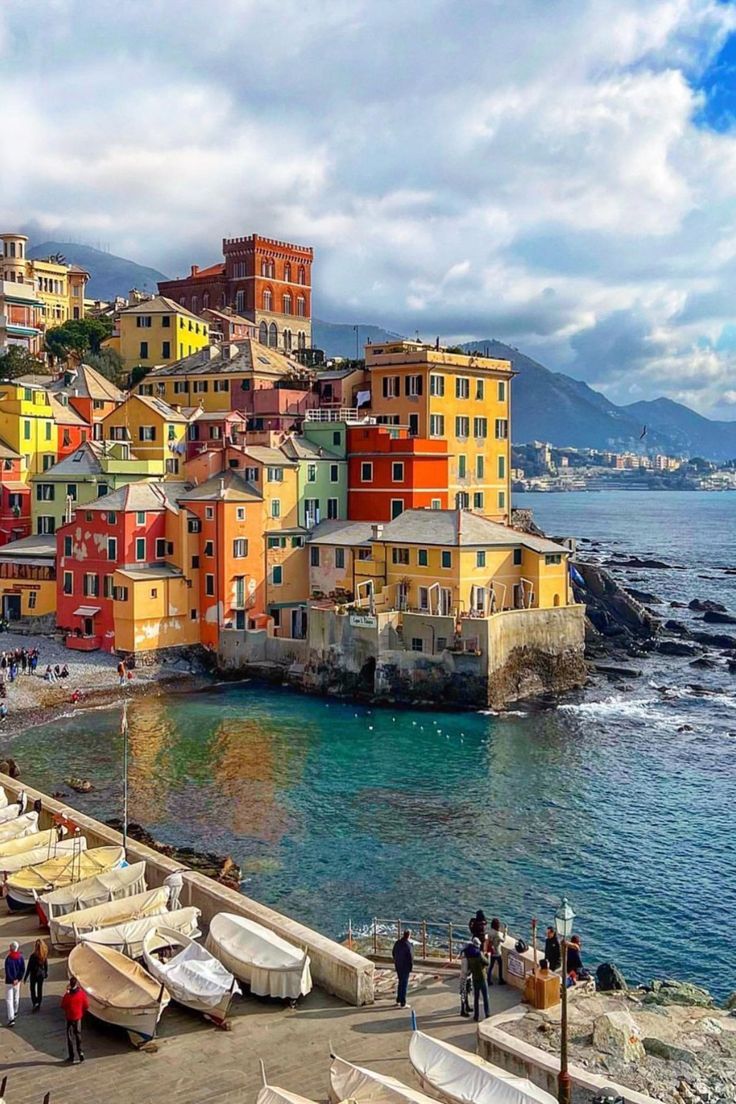

Airport to City Centre, Getting to Genoa & Getting Around, Connectivity and Tips About Genoa
What's in this guide
Italy’s most underrated city is not a matter of opinion — it is a matter of arithmetic. Genoa gave the world Christopher Columbus, pesto, focaccia, maritime insurance and the concept of the bank. It was, for two centuries, the most powerful trading republic in the Mediterranean. And almost nobody visits it.
This is Genoa’s gift to the traveller who finds it: a UNESCO World Heritage historic centre that is the largest medieval urban fabric in Europe, a labyrinth of alleys — the caruggi — between Renaissance palaces of staggering grandeur, all inhabited, all alive, none of them performing for tourists. A port redesigned by Renzo Piano that is the finest waterfront in northern Italy. An aquarium that is among the best in Europe. And a food culture — the pesto, the focaccia, the farinata — that is as specific and as excellent as any in the country, served in bakeries and street stalls for prices that feel absurdly low given the quality.
Come to Genoa expecting to be surprised. You will be.
“Genoa is the most labyrinthine of all cities — you turn into a street and find it becoming a staircase, and the staircase leading into a palace, and the palace opening into a garden, and the garden dropping back into a street again.” — Charles Dickens, Pictures from Italy, 1846
When Is the Best Time to Visit Genoa?
Genoa’s climate is the mildest in northern Italy, protected from cold northern winds by the Apennine mountains. It is, in short, remarkably good weather for a city this far north — and this makes it an attractive destination across nearly the entire year.
Spring — April & May
- Temperatures 16–22°C
- Ligurian Riviera in bloom
- Sea beginning to warm
- Light perfect for photography
- Far fewer tourists than summer
Autumn — Sept & Oct
- Temperatures 18–26°C
- Sea still warm (24–26°C in Sept)
- Harvest season across Liguria
- Basil at peak for pesto
- Very manageable crowds
Winter — Nov–Mar
- Temperatures 8–14°C
- The most authentic Genoa
- Lowest prices of the year
- Caruggi entirely to yourself
- Christmas markets at Porto Antico
Summer — Jun–Aug
- Temperatures 25–30°C
- Riviera beaches in full swing
- Occasional summer thunderstorms
- Busiest at the port and Aquarium
- Evenings cool and pleasant
The winter advantage: Genoa in November and December is one of Italy’s great travel secrets. The caruggi are almost empty, the bakeries and friggitorie are doing their best business of the year, the Palazzi dei Rolli are quiet, and the city reveals its real character — not a performance for visitors, but a working port city going about its daily life with the same energy it has had for 800 years.
Getting to Genoa & Getting Around
Genoa Cristoforo Colombo Airport (GOA)
Genoa’s airport is named for the city’s most famous son and is built on a platform extended over the sea, 6 km west of the city centre. It is a compact, manageable airport served by a growing number of European carriers. The setting — landing with the Ligurian sea on both sides of the runway — is among the most dramatic airport approaches in Italy.
Airport to city centre — your options in 2026
| Option | Time | Cost | Best for |
|---|---|---|---|
| Private Transfer Door-to-door, fixed price Recommended |
~15–20 min | Fixed | Families, groups, heavy luggage |
| Public Transportation Airport → Piazza de Ferrari (centre) |
~30 min | €6 | Budget, light luggage |
| AMT Bus Line 100 Local city bus → Brignole station |
~30–40 min | €2 | Lightest luggage, budget only |
| Official Taxi White cabs only, metered |
~15–20 min | ~€20–25 | Quick, no booking needed |
| From Milan by train Milano Centrale → Genova Piazza Principe |
1h 25min | From €14 | From Milan, very convenient |
Genoa from Milan by train: The Milan–Genoa high-speed service takes 1h 25min and departs from Milano Centrale every 30–60 minutes. It arrives at Genova Piazza Principe station, which is within walking distance of Via Garibaldi and the old port. This is one of the most convenient city pairs in northern Italy for a weekend visit.
Getting around Genoa
The historic centre is best explored entirely on foot — and really only navigable on foot, given the narrowness of the caruggi. For vertical distances (the city climbs steeply from the port to the hilltop neighbourhoods), Genoa has a network of funiculars, lifts and cremagliere (rack railways) that are among the most characterful urban transport systems in Italy. The Zecca-Righi funicular, the Sant’Anna funicular, the Castelletto Levante lift and the Granarolo rack railway all operate on standard AMT city tickets (€2 single, €4.50 day pass).
Driving in Genoa: The city’s geography — steep hills, narrow medieval streets, limited parking — makes driving in the historic centre extremely difficult and largely pointless. Most hotels in the centre have no parking. Use the park-and-ride facilities at the city entrances or arrive by train and taxi. Never attempt to drive through the caruggi.
The Essential Genoa — What You Cannot Miss
Genoa is not a city of single monuments. It is a city of atmospheres, layers and unexpected discoveries. The UNESCO World Heritage designation covers not just the monuments but the entire urban fabric — the way the city is built, lived in and navigated. Give it time.
The Caruggi — UNESCO Historic Centre
The caruggi are the defining experience of Genoa: a 1.3 square kilometre labyrinth of medieval alleys, some less than a metre wide, running between palaces whose upper floors stretch so high they block the sky, opening unexpectedly into small piazzas and then closing again. Built continuously from the 12th century, they are the largest medieval urban fabric in Europe — and entirely alive. Fishmongers, goldsmiths, street food stalls, churches, perfumers, notaries — all operating in the same streets where they have operated for 800 years. Do not navigate them by app. Get lost. The city always finds you.
Via Garibaldi & the Palazzi dei Rolli
Built in the 16th century as the official residence street of the Genoese nobility, Via Garibaldi — formerly the Strada Nuova — is one of the finest Renaissance streets in Europe. Forty-two palaces along this and neighbouring streets were inscribed on the UNESCO World Heritage List as the Palazzi dei Rolli — the official list of residences used to host visiting European royalty, maintained by lottery (“rollo”) among the noble families. Three of them — Palazzo Rosso, Palazzo Bianco and Palazzo Tursi — are now the Musei di Strada Nuova, housing paintings by van Dyck, Rubens, Caravaggio and the Genoese school, plus the violin of Nicolò Paganini.
Porto Antico & the Acquario di Genova
In 1992, for the 500th anniversary of Columbus’s voyage, Renzo Piano redesigned Genoa’s historic port into one of the finest urban waterfronts in Europe. The Porto Antico is now home to the Acquario di Genova — the largest aquarium in Italy, with 70 tanks, 12,000 animals and an extraordinary open-sea shark tank — the glass Biosphere tropical greenhouse designed by Piano, the rotating Bigo panoramic lift (€5, best view in the port), and the vast Magazzini del Cotone converted into exhibition spaces and a cinema. Walk the Calata Catena promenade at sunset, when the old port fills with golden light and the Lanterna lighthouse blinks on across the water.
Cathedral of San Lorenzo
Genoa’s Cathedral is immediately recognisable by its black-and-white striped marble façade — a French Gothic anomaly in a city of Italian Renaissance and Baroque — rising above a small piazza in the heart of the caruggi. Inside: a nave of quiet dignity and a Treasury of extraordinary richness, including the sacro catino (allegedly the dish from which Christ ate at the Last Supper), a Roman glass plate, a 15th-century golden chest, and silverwork of the finest medieval craftsmanship. The treasury is one of the most underrated museum collections in Italy.
Spianata Castelletto
Take the Zecca-Righi funicular from Largo della Zecca — 4 minutes, €2, running since 1901 — and emerge on the Spianata Castelletto, a wide terrace on the hillside above the city. The view is the finest in Genoa: the entire historic centre tumbling toward the port, the Lanterna lighthouse to the west, the Ligurian sea beyond, and the ring of Apennine hills behind. Come at golden hour when the light turns the terracotta and ochre buildings into something extraordinary, and stay until the port lights come on.
Cimitero Monumentale di Staglieno
One of the most extraordinary cemeteries in the world — a 160-hectare hillside covered in neoclassical and Art Nouveau sculpture, mausoleums of marble and granite, avenues of cypress trees and family chapels of operatic grandeur. Oscar Wilde called it the most beautiful cemetery he had ever seen. Mark Twain described it. Ernest Hemingway used it as a backdrop. It is extraordinary, free, and visited by almost no tourists. Take bus 34 from Piazza della Vittoria.
Beyond the obvious — Genoa’s hidden monuments
The Palazzo Ducale — the former seat of the Doge of Genoa, now one of Italy’s finest exhibition spaces — hosts major international shows year-round and is always worth checking for current exhibitions. The Galata Museo del Mare (Museum of the Sea) is the finest maritime museum in the Mediterranean, telling Genoa’s extraordinary nautical history in an immersive space that includes a replica 17th-century galleon. And the house of Christopher Columbus — or rather, the house believed to be near the site of his birthplace, adjacent to the Porta Soprana — is a modest but moving stop for anyone interested in one of history’s greatest voyages.
The Palazzi dei Rolli Open Days: Twice a year (typically in May and October), Genoa opens the doors of the Palazzi dei Rolli — normally private or institutional — to the public for free. Visiting the interior courtyards, frescoed halls and hanging gardens of these 16th-century palaces during Open Days is one of the great cultural experiences in northern Italy. Check discovergenova.com for the 2026 dates.
How to Plan Your Genoa Visit
Genoa is blessedly free of the booking infrastructure that makes Rome and Florence feel like logistics exercises. Most of its greatest experiences require no advance booking whatsoever. The two exceptions are the Acquario — which can have long queues in summer — and the Palazzi dei Rolli Open Days, which fill up quickly.
The Genova Turistica Card: The city’s tourist card (from €25 for 24 hours, €35 for 48 hours) includes free entry to the Musei di Strada Nuova (Palazzo Rosso, Palazzo Bianco, Palazzo Tursi), the Galata Museo del Mare, the Bigo lift, unlimited funicular and public transport travel, and discounts at the Aquarium. Excellent value if you plan to use it fully.
- Acquario di Genova: Book at acquariodigenova.it — particularly in July and August when queues can reach 60–90 minutes. Allow 3–4 hours for a complete visit. First slot (9am) is the quietest.
- Musei di Strada Nuova: No advance booking required. Weekday mornings are quietest. The three palaces are best visited in sequence: Palazzo Rosso first (Flemish paintings, Genoese portraits, rooftop terrace), then Palazzo Bianco (Italian Renaissance), then Palazzo Tursi (Paganini’s violin).
- Palazzi dei Rolli Open Days: Check dates at discovergenova.com and book your slots as soon as registration opens. The most extraordinary palaces — Palazzo Lomellino, Palazzo Grimaldi, Villa del Principe — have the longest queues and the most limited capacity.
- Cathedral treasury: No booking required. The treasury of San Lorenzo is open mornings only (9am–12pm, 3–6pm). Entry €6. Entirely worth it — one of the most undervisited treasures in Italy.
What to Eat in Genoa — and Where
Genoa’s food culture is one of the most specific and most excellent in Italy — and one of the least known outside the country. The Genoese are proud of their cuisine to a degree that borders on philosophical conviction, and they are right to be. Every dish comes from the same logic: take extraordinary ingredients from the Ligurian hills and sea, treat them with restraint and intelligence, and let the quality of the raw material speak for itself.
Pesto alla Genovese
The original, the only, the one from which everything else claiming the name is a diminished copy. Ligurian basil (smaller, sweeter, lighter than any other), Ligurian DOP extra-virgin olive oil, Parmigiano Reggiano, Pecorino Sardo, pine nuts, garlic and sea salt — blended cold in a marble mortar until smooth. Served on trofie with green beans and potato. In Genoa, served everywhere. Nowhere else in Italy is it the same thing.
Focaccia Genovese
Not the soft, oily Apulian focaccia. Genoa’s fugassa is thinner, crispier at the edges, dimpled with olive oil pockets, and eaten for breakfast or as an afternoon snack. A sheet costs €1.50–2 from any focacceria. The version with onion (focaccia con le cipolle) and with cheese (focaccia di Recco) are equally essential.
Focaccia di Recco
A different thing entirely: two paper-thin layers of unleavened dough enclosing fresh Ligurian cheese (crescenza), baked in a very hot oven until the cheese melts completely and the dough blisters. Made in the nearby town of Recco, where it has PGI protected status. The best version in Genoa is at Manuelina (in Recco itself, 30 minutes away) or at several focaccerie in the city.
Farinata
A thin flatbread of chickpea flour, water, olive oil and black pepper, baked in a large copper pan in a wood-burning oven at intense heat. Eaten hot, cut in wedges. The Genoese version is thinner and crispier than the Tuscan or Niçard equivalents. Sa Pesta in the caruggi has been making it since 1900. Order at the counter, eat standing up.
Trofie al Pesto
Short, twisted pasta (hand-rolled from flour and water, slightly chewy) served with pesto alla Genovese, boiled green beans and diced potato — the potato and beans are not garnish, they are part of the dish. The carbohydrate-on-carbohydrate combination was designed for the energy needs of sailors and dockworkers. It is also transcendent.
Pandolce Genovese
The traditional Genoese Christmas cake — a rich, dense sweet bread of flour, butter, sugar, candied fruits, pine nuts, fennel seeds and orange water, leavened naturally over 48 hours. Lighter than panettone, more complex than panforte. Available in pasticcerie year-round, not just at Christmas. Buy a small one from Pietro Romanengo — the oldest sweet shop in Genoa, founded in 1780.
Stoccafisso & Baccalà
Dried and salt cod have been the staple protein of Genoese sailors since the medieval trade routes to Norway and Portugal. The Genoese stoccafisso accomodato — stockfish braised with potatoes, olives, pine nuts and herbs — is one of the great cucina povera dishes of the Ligurian coast. Found at any serious traditional restaurant in the caruggi.
Vermentino & Pigato
Liguria produces small quantities of white wine from the slopes above the coast — Vermentino and Pigato from the western Riviera, Bianchetta Genovese from the hills east of the city. Crisp, mineral, with a slight saline note that tastes exactly of the coast they overlook. A glass in any osteria in the caruggi costs €3–4. Drink it with farinata or seafood.
Where to eat
The best eating in Genoa is in the caruggi — particularly around the Mercato Orientale (the city’s covered market), in the streets of the Maddalena neighbourhood and along Via San Luca. The Porto Antico area has restaurants but they are priced for tourists rather than Genoese.
- Trattoria da Maria — Vico Testadoro 14
The most legendary cheap lunch in Genoa since 1945. Cash only, communal tables, daily changing menu at fixed prices. Arrive before noon or you won’t get in. The pesto trofie is essential. - Sa Pesta — Via dei Giustiniani 16
The city’s most historic friggitoria and farinata specialist, in the same location since 1900. Order the farinata and the panissa (fried polenta) at the counter. Eat standing. Perfect. - Il Genovese — Via Galata 35
The most celebrated trattoria for traditional Genoese cooking. The pesto trofie, the stoccafisso and the stuffed vegetables are all outstanding. Book ahead.
For focaccia and street food:
- Antico Forno della Casana — Vico Casana 4
The best focaccia in the caruggi. Opens at 7am. The focaccia col formaggio is sold by the slice and eaten on the street. Arrive early — it sells out. - Pietro Romanengo fu Stefano — Via Soziglia 74
Founded in 1780. The oldest confectionery in Genoa. Candied fruits, pandolce, rose water and violet sweets. A living piece of Genoese history and one of the most beautiful shop interiors in Italy.
The tourist trap test: Any restaurant on the Porto Antico waterfront with a photo menu and a greeter at the door is pricing for cruise ship passengers, not for Genoese. Walk five minutes into the caruggi and the difference is complete. The best pesto in Genoa is never served within sight of the water.
Mistakes to Avoid in Genoa
Genoa is a city that rewards the attentive and occasionally confounds the hasty. Here is how to avoid the most common errors.
- Don’t use a navigation app in the caruggi. The alleys of the old city are so narrow and so frequently unlabelled that GPS is not only useless but actively counterproductive. Carry a paper map, note a few landmarks, and accept that getting lost is the correct way to navigate Genoa’s historic centre.
- Don’t underestimate the city’s verticality. Genoa rises steeply from the sea. The funiculars and lifts exist for a reason — use them. Walking from the port to the Castelletto takes 35 minutes uphill. The funicular takes 4 minutes. The view is the same at the top.
- Don’t eat at the Porto Antico restaurants. The waterfront is beautiful; the restaurants facing it are not. Walk into the caruggi for every meal.
- Don’t skip Staglieno cemetery. Most visitors treat it as an eccentric side note. It is one of the most extraordinary artistic environments in Italy — 160 hectares of neoclassical and Art Nouveau sculpture that would be world-famous if it were not a cemetery. Bus 34, free, allow 2 hours.
- Don’t miss the Mercato Orientale. Genoa’s covered market (Via XX Settembre) is one of the finest food markets in northern Italy — fresh fish, Ligurian vegetables, local cheese, herbs. Open every morning except Sunday. The best place to buy pesto ingredients and focaccia.
- Don’t assume the caruggi are dangerous. They have a historical reputation that no longer reflects reality. They are lively, inhabited, working streets — not threatening ones. Take standard urban precautions and explore them freely at all hours.
- Don’t treat Genoa as a day trip from Milan. One day gives you the port and a fraction of the caruggi. Two days begins to do justice to Via Garibaldi, the Cathedral, Staglieno and a proper meal. Three days reveals the city’s real character. Stay overnight.
- Don’t leave without going to Camogli or Portofino. Both are 30–45 minutes from Genoa by train or private transfer. Camogli is the more authentic — a real fishing village of painted houses and extraordinary focaccia. Portofino is one of the most beautiful (and most expensive) places in Italy. Both are unmissable with a day to spare.
Practical Information for Genoa 2026
Money & payments
Genoa is largely cashless, but keep €20–30 for friggitorie, market stalls, the funiculars (some still prefer coins) and the smaller osterie. ATMs are widely available throughout the city centre.
The Genova Turistica Card
Available from €25 (24h) to €35 (48h). Covers the Musei di Strada Nuova, the Galata Museo del Mare, the Bigo lift, unlimited public transport (including all funiculars and lifts), and discounts at the Aquarium and other attractions. Buy at the tourist office at Porto Antico or online at visitgenoa.it.
Connectivity
EU visitors use domestic plans. Non-EU visitors: SIM cards from TIM, Vodafone or WindTre available at the airport and throughout the centre. Free WiFi throughout the Porto Antico area and in many cafes.
Safety
Genoa is a safe city for tourists. The caruggi’s reputation for danger is outdated — they are working streets, not threatening ones. Take standard urban precautions (bag in front, no ostentatious displays of valuables) particularly in crowded areas. The Porto Antico and Via Garibaldi areas are comfortable at all hours.
Emergency numbers
Day trips from Genoa
Portofino — 35 km southeast by private transfer or 1h 15min by train + local bus. The most glamorous village on the Ligurian coast. Camogli — 25 km east, 30 min by train from Brignole. A real fishing village of extraordinary beauty, outstanding focaccia. Cinque Terre — 90 km southeast. Train to La Spezia (1h 10min), then Cinque Terre Express. Santa Margherita Ligure — 30 km, 40 min by train. The most elegant town of the eastern Riviera. Recco — 20 km east, 20 min by train. One purpose: the original focaccia di Recco at Manuelina. Worth the trip.