
Airport to City Centre, Getting to Florence & Getting Around, Connectivity and Tips About Florence
What's in this guide
There is a moment that happens to almost every first-time visitor to Florence — usually around the second or third day, usually in a church or a gallery or simply at a corner where a medieval street opens unexpectedly onto a piazza — when the sheer density of beauty becomes genuinely overwhelming. Not metaphorically. Physically. There is a medical term for it: Stendhal Syndrome. It was named here, in Florence, because this is the city where it happens most.
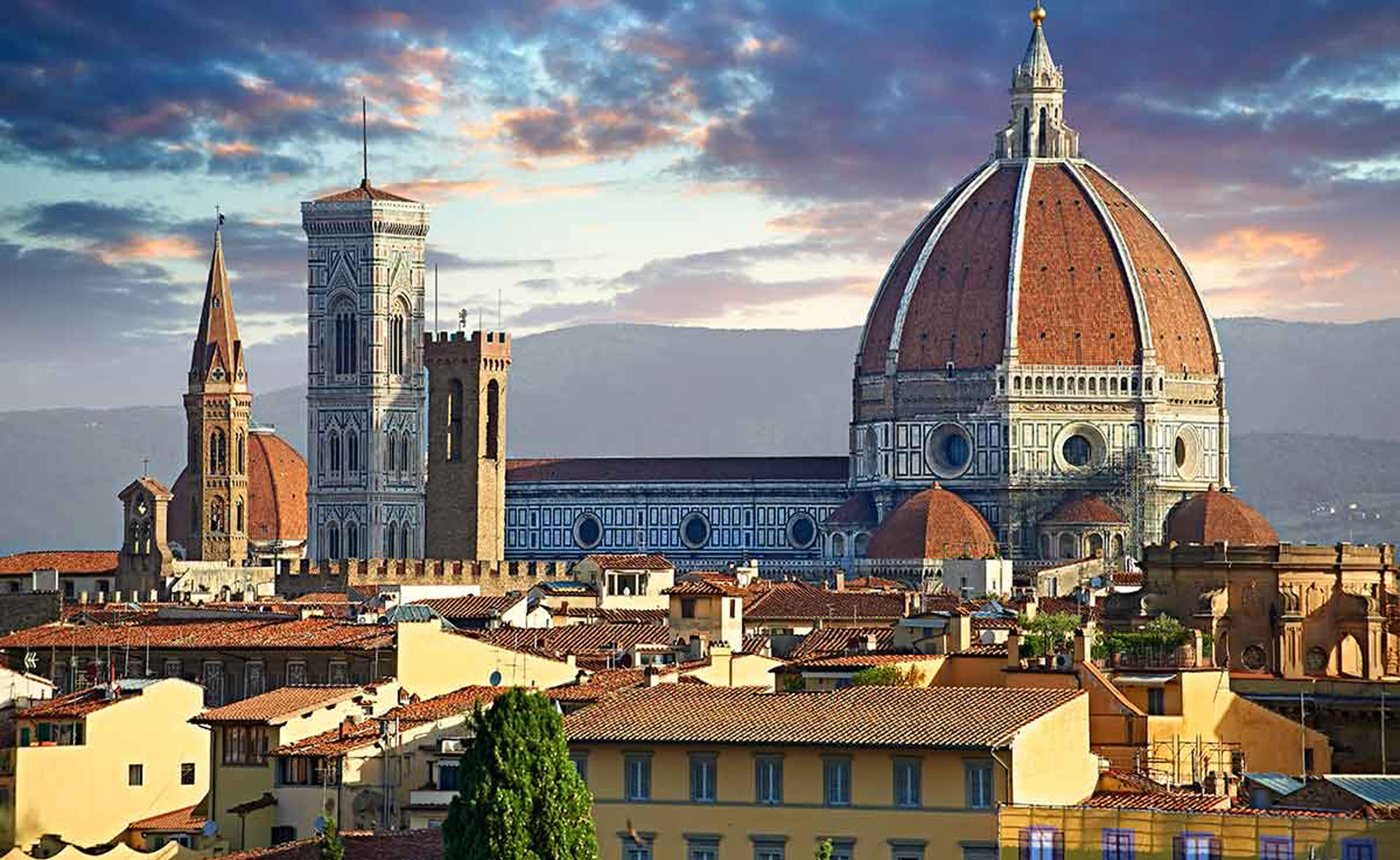
In roughly one square kilometre of the historic centre, Florence contains more masterpieces of Western art and architecture than any other city on earth. The Uffizi alone holds Botticelli’s Birth of Venus, Leonardo’s Annunciation, Michelangelo’s Doni Tondo and a hundred other paintings that in any other museum would be the centrepiece of the entire collection. Around the corner, Michelangelo’s David stands in a room designed specifically for him. Ten minutes’ walk away, Brunelleschi’s dome — the engineering marvel that changed Western architecture — rises above the terracotta rooftops of a city that has barely changed its outline in five hundred years.
“Florence is a place of beauty, but its beauty does not age and cannot be consumed. It feeds and renews itself from within.” — Henry James
When Is the Best Time to Visit Florence?
Florence sits in the Arno valley, ringed by hills that trap heat in summer and channel cold winds in winter. The city is one of the hottest in Italy during July and August — temperatures regularly exceed 38°C and the heat radiates from the stone streets with punishing intensity. Spring and autumn are a different world entirely.
Spring — April & May
- Temperatures 18–25°C
- Tuscany in full bloom
- Manageable museum queues
- Easter (book months ahead)
- Long evenings on the Arno
Autumn — Sept & Oct
- Temperatures 18–27°C
- Grape harvest across Chianti
- Summer crowds have left
- Truffle season begins (Oct)
- Golden light, warm colours
Winter — Nov–Mar
- Temperatures 5–13°C
- Museum queues almost absent
- Lowest hotel prices
- Occasional cold and fog
- Authentic, local atmosphere
Summer — July & August
- Temperatures 35–40°C+
- Uffizi queues: 2–3 hours
- The city feels like an oven
- Highest prices of the year
- Book everything months ahead
The October window: The last two weeks of October are Florence’s best-kept secret. The summer crowds are entirely gone, the Chianti harvest fills the countryside with activity and colour, truffle season has begun in the Mugello hills, and the afternoon light on the Arno turns the city into something that Botticelli would have recognised. Hotel prices are 30–40% lower than August.
Getting to Florence & Getting Around
Florence’s two airports
Florence is served by two airports. Amerigo Vespucci Airport (FLR) is just 4 km northwest of the city centre — the closest major airport to any Italian city centre. Pisa Galileo Galilei Airport (PSA) is 85 km west and handles more routes, particularly low-cost carriers. Many travellers flying into Pisa take the train or a private transfer directly to Florence.
Airport to city centre — your options in 2026
| Option | Time | Cost | Best for |
|---|---|---|---|
| Private Transfer (FLR) Door-to-door, fixed price Recommended |
~15–20 min | Fixed | Families, groups, heavy luggage |
| Official Taxi (FLR) White cabs — flat rate to centre |
~15–20 min | ~€22–25 | Quick, no booking needed |
| Vola in Bus Shuttle (FLR) Airport → Santa Maria Novella |
~20 min | €6 | Budget, light luggage |
| Private Transfer (PSA) Pisa Airport → Florence |
~60–75 min | Fixed | Direct, comfortable, no train change |
| Train from Pisa (PSA) Pisa Centrale → Florence SMN |
~1h 20min | €9–15 | Budget (requires shuttle + train) |
Pisa Airport to Florence by train: From Pisa Airport you first take the Pisa Mover shuttle (€2.70, 5 min) to Pisa Centrale station, then a regional or Frecciabianca train to Florence Santa Maria Novella. Total journey including connection: 1h 20min to 1h 45min. A private transfer from PSA to Florence is significantly more comfortable with luggage and takes about the same time.
Getting around Florence
Florence’s historic centre is compact, flat and almost entirely pedestrianised. Walking is the only serious way to experience the city — the Uffizi, the Duomo, the Accademia, the Ponte Vecchio and the Oltrarno neighbourhood are all within 20 minutes of each other on foot. For the hills (Piazzale Michelangelo, Fiesole) and outer neighbourhoods, the ATAF bus network covers the city. A single ticket costs €1.50, valid 90 minutes.
The ZTL zone: The historic centre of Florence is a Zona a Traffico Limitato — a restricted traffic zone monitored by cameras. Driving into it without a permit triggers an automatic fine of €164. If you arrive by private transfer, your driver will know the permitted routes to your hotel. Do not attempt to drive in the centre yourself.
The Essential Florence — What You Cannot Miss
The challenge in Florence is not finding things to see — it is accepting that you cannot see everything and choosing deliberately. The monuments below are the irreducible minimum of a first visit. Give each one the time it deserves, and resist the urge to race between them.
Uffizi Gallery
There is no way to prepare yourself for the Uffizi. You know the paintings intellectually — you have seen reproductions a hundred times — and then you walk into the Botticelli rooms and the originals are there, at full scale, in the natural light they were painted for, and the reproductions simply cease to exist. The Birth of Venus. The Primavera. Leonardo’s Annunciation. Michelangelo’s Doni Tondo. Raphael. Titian. Caravaggio. Allow a minimum of three hours — most serious visitors spend five or six.
Galleria dell’Accademia & Michelangelo’s David
The David is 5.17 metres tall, carved from a single block of Carrara marble between 1501 and 1504 by a 26-year-old sculptor who had never attempted anything at this scale. It stands in a purpose-built rotunda designed by Emilio De Fabris in 1882, in natural light, and its effect on people who see it for the first time is consistently one of stupefaction. The physical perfection of the carving — the veins on the hands, the tension in the neck, the focused expression of a boy about to become a man about to change everything — is simply beyond what marble has any right to do.
Florence Cathedral & Brunelleschi’s Dome
Filippo Brunelleschi solved in 1420 a problem that had defeated every architect in Europe for 140 years: how to build a dome over a 42-metre-wide octagonal drum with no centering — no wooden framework to support the rising brick during construction. His solution, still not entirely understood, produced the largest masonry dome ever built — 114 metres high, visible from everywhere in Florence, the first great engineering triumph of the Renaissance. Climbing the 463 steps between the inner and outer shells, through Vasari’s Last Judgement frescoes, to emerge on the lantern above the city, is one of Italy’s great physical experiences.
Palazzo Pitti & Boboli Gardens
The Medici’s second palace — larger than the Palazzo Vecchio, more extravagant, more private — today houses six separate museums, of which the Palatine Gallery is the most extraordinary: 500 paintings displayed as the Medici displayed them, floor to ceiling, without the respectful spacing of the modern museum, in rooms where Raphael, Titian and Rubens are stacked four high. Behind the palace, the Boboli Gardens — the Medici’s private park of terraces, grottos, statues and citrus trees — offer the best elevated views of the Oltrarno and a welcome hour of quiet away from the crowds.
Ponte Vecchio & the Oltrarno
The 14th-century bridge of goldsmiths and jewellers is one of the defining images of Florence — and the only bridge in the city to survive the German retreat of 1944, spared (according to legend) on direct orders from Hitler, who had crossed it during his 1938 state visit to Mussolini. The real pleasure is crossing it and entering the Oltrarno — the “other side of the Arno” — the south bank neighbourhood of artisan workshops, local restaurants and the Palazzo Pitti, where Florence actually lives rather than performing itself for tourists.
Piazzale Michelangelo & San Miniato al Monte
The hilltop terrace above the Oltrarno, a 30-minute walk or short bus ride from the centre, offers the most celebrated panorama in Tuscany — the Arno curving through the city, the Ponte Vecchio, the Duomo, Giotto’s Campanile and the hills of Fiesole beyond. Come at sunrise for near-solitude. Five minutes further up the hill, San Miniato al Monte — an 11th-century Romanesque church of extraordinary beauty — is one of the most underrated buildings in Italy and is almost always quiet.
The Bargello, San Marco & the lesser-known masterpieces
Beyond the headline attractions, Florence contains several museums that would be the finest in any other Italian city. The Bargello holds Donatello’s bronze David — the first freestanding nude sculpture since antiquity — and Michelangelo’s early works. The Museo di San Marco contains Fra Angelico’s cell frescoes, painted in the monks’ private rooms, quietly revolutionary. The Cappelle Medicee hold Michelangelo’s tombs of Lorenzo and Giuliano de’ Medici. None of the three ever has a serious queue.
The Bargello secret: On any given Tuesday morning, the Bargello — which contains some of the greatest sculpture in Italy — receives a fraction of the visitors crowding the Uffizi 300 metres away. Entry costs €10. If you care about Renaissance sculpture, it is arguably the more important museum of the two.
How to Skip the Queues
Florence has two queuing problems: the Uffizi and the Accademia. Both are entirely solvable with advance booking. Every other museum in the city — the Bargello, the Bargello, San Marco, Palazzo Pitti, the Cappelle Medicee — requires no advance planning and rarely has significant queues.
The absolute rule: Book the Uffizi, the Accademia and the Dome climb before you leave home. All three sell out during peak season. The Dome’s 8:15am slot is the best — morning light through the lantern, almost no one on the staircase, the city below in quiet gold. Book at operaduomo.firenze.it, uffizi.it and gallerieaccademia.firenze.it.
- Uffizi: Book at uffizi.it (€4 booking fee). First slot (8:15am) and last slot are the quietest. Avoid the 10am–noon window, which is when cruise ship groups concentrate. Allow a minimum of three hours; the collection requires five.
- Accademia (David): Book at gallerieaccademia.firenze.it (€4 booking fee). In summer, book 3–4 weeks ahead. Arrive at the 8:15am slot: the David at opening, in natural light, with a handful of other visitors, is a completely different experience from noon with two hundred people.
- Brunelleschi’s Dome: Book at operaduomo.firenze.it. The €30 Brunelleschi Pass covers all the Duomo complex monuments and is valid 72 hours. The Dome climb timed slots go quickly — book the earliest available. The Baptistery doors and Campanile can be visited without pre-booking.
- Piazzale Michelangelo: No booking, no ticket, always free. Go at 5:30–7am in summer and you will have one of the most beautiful views in Italy almost entirely to yourself. Bus 13 runs from the centre.
What to Eat in Florence — and Where
Florentine cuisine is the food of a confident civilisation — bold, unfussy, rooted in the land. It is not trying to impress you. It is simply telling you the truth about Tuscan cattle, Chianti grapes, fresh pasta and wood fire. The bistecca alla Fiorentina is the most honest statement of this philosophy: a T-bone from a Chianina cow, two fingers thick, cooked rare over embers, seasoned with salt and Tuscan olive oil, and absolutely nothing else.
Bistecca alla Fiorentina
The defining dish of Tuscan cooking: a T-bone steak from a Chianina cow, at least 600g, grilled over oak or olive wood embers, served blood-rare. Ordering it “well-done” is refused in most serious restaurants. Sold by weight (€50–70 per kg). Split between two. Order it at Buca Mario or Il Latini.
Lampredotto
Florence’s great street food — the fourth stomach of a cow, slow-braised in herbs and tomato, sliced and served in a soft roll with salsa verde. Sold from trippaio carts throughout the city since the 15th century. Da Nerbone in the Mercato Centrale is the most beloved address.
Ribollita
A thick soup of cannellini beans, black kale (cavolo nero), stale bread, carrot and celery — cooked slowly, then “reboiled” the next day until it becomes almost a solid. A cucina povera dish of extraordinary depth. Every good trattoria in Florence makes it from November to March.
Pappa al Pomodoro
Stale Tuscan bread dissolved into a soup of San Marzano tomatoes, garlic and basil, finished with Tuscan olive oil. One of the simplest and most satisfying dishes in Italy — proof that Florentine cooking does more with less than almost anywhere else.
Pappardelle al Cinghiale
Wide, silky pasta ribbons with a slow-cooked wild boar ragù — deep, slightly gamey, scented with rosemary and red wine. The most Tuscan of all pasta dishes. Found at every serious trattoria in autumn, when the hunting season opens and fresh cinghiale is available.
Schiacciata
Florence’s answer to focaccia — a flat, olive-oil-rich bread, dimpled and salted, eaten as a snack or sandwich carrier throughout the day. In autumn, schiacciata all’uva — with fresh grape must baked into the dough — appears briefly in bakeries and is one of the great seasonal treats of Tuscan food.
Chianti Classico
The DOCG wine of the hills between Florence and Siena — Sangiovese-dominant, dry, structured, made to be drunk with bistecca and wild boar. A glass in a Florentine osteria costs €4–6. A bottle from a good producer in the Enoteca Italiana costs €18–30 and is worth every cent.
Gelato Artigianale
Look for small metal tubs with lids and natural colours — pistachio should be grey-green, not vivid. Gelateria dei Neri (Via dei Neri) and Gelateria della Passera in the Oltrarno are two of the city’s most reliably excellent. Avoid any gelateria with gelato piled in skyscrapers near the Duomo.
Where to eat
The best Florentine cooking is in the Oltrarno (south of the Arno), in the streets around Sant’Ambrogio market and in the San Frediano neighbourhood. The worst is within 150 metres of the Duomo.
- Trattoria Mario — Via Rosina 2 (near Mercato Centrale)
Open since 1953. Cash only, communal tables, no reservations, daily-changing menu at fixed prices. Arrive before noon or join the queue. The most authentically Florentine lunch experience in the city. - Il Latini — Via dei Palchetti 6
Communal tables under hanging prosciutti, no-choice set menus, carafes of Chianti, theatrical waiters. Loud, exuberant, excellent. The bistecca is the thing to order. - Buca Mario — Piazza Ottaviani 16
Florence’s oldest restaurant, open since 1886. Classic Tuscan cooking in a beautiful historic cellar. The ribollita and bistecca are both outstanding.
In the Oltrarno — the neighbourhood where Florentines actually eat:
- Trattoria Sabatino — Via Pisana 2
A workers’ trattoria open since 1956, lunch only, absurdly cheap, always full of Florentines. The kind of place that feels like it belongs to you after one visit. - Buca dell’Orafo — Volta dei Girolami 28
On the Arno steps beside the Ponte Vecchio. Outstanding bistecca, exceptional wine list, summer tables overlooking the river. Book ahead.
The tourist trap test: Any restaurant within 100 metres of the Duomo, the Uffizi or the Ponte Vecchio that displays a menu in six languages and photographs of food is not a Florentine restaurant. It is a proposition. Walk to the Oltrarno or the Sant’Ambrogio area and the difference is immediate, total and delicious.
Mistakes to Avoid in Florence
Florence is a city of extraordinary rewards for those who know how to approach it — and of expensive disappointments for those who don’t.
- Don’t arrive at the Uffizi or Accademia without a ticket. Walk-up queues in summer exceed two hours at both museums. Book online before you leave home. The €4 booking fee is the best-spent €4 in Italy.
- Don’t skip the Oltrarno. Most visitors spend their entire time on the north bank of the Arno. The south bank — artisan workshops, Palazzo Pitti, San Miniato, real restaurants — is where Florence breathes. Cross the Ponte Vecchio and stay there for a half-day at minimum.
- Don’t drive into the ZTL zone. The historic centre’s restricted traffic area is monitored by cameras 24/7. Driving in without a permit costs €164 per infraction — and the fine arrives at your home address months later via the rental company.
- Don’t try to see everything in the Uffizi. The gallery has 90+ rooms and over 3,000 works. On a first visit, go to the Botticelli rooms, the Leonardo room and the Michelangelo room first. Everything else is a bonus. Racing through all 90 rooms produces exhaustion, not enlightenment.
- Don’t order a bistecca well-done. Florentine restaurants take this seriously and will refuse, or comply with visible regret. The Chianina breed and the wood-fire technique produce a steak that is designed to be eaten rare. Trust the process.
- Don’t eat gelato that is piled in towers. Real gelato is kept in covered metal containers and has natural, muted colours. Towers of brilliantly coloured gelato contain air, stabilisers and food colouring. Walk to the Oltrarno and find the real thing.
- Don’t miss San Miniato al Monte. Five minutes above Piazzale Michelangelo, this 11th-century Romanesque basilica is one of the finest medieval buildings in Tuscany and is almost always empty. The inlaid marble floor, the painted wooden ceiling and the crypt are extraordinary. Entry is free.
- Don’t limit yourself to Florence alone. Siena is 75 minutes away by bus or transfer. San Gimignano is 90 minutes. The Chianti wine route runs between the two cities. Pisa is 1h 20min by train. The Mugello valley and Fiesole are 30 minutes. Florence is the finest base for Tuscany in general — use it as one.
Practical Information for Florence 2026
Money & payments
Florence is largely cashless, but keep €20–30 for street food carts (lampredotto vendors are often cash-only), market stalls and smaller bacari. ATMs are widely available throughout the centre.
Dress code
Florence’s major churches — Santa Croce, Santa Maria Novella, the Cathedral, San Lorenzo — all require covered shoulders and knees. The dress code is enforced. Carry a light scarf or shawl, particularly in summer when shorts and sleeveless tops are the default.
The Firenze Card
The Firenze Card (€85, 72 hours) gives skip-the-line access to 72 museums including the Uffizi, Accademia, Bargello, Palazzo Pitti and San Marco, with fast-track entry. Worth buying if you plan to visit four or more museums in three days. Book online at firenzecard.it.
Connectivity
EU visitors use domestic plans. Non-EU visitors: SIM cards from TIM, Vodafone or WindTre available at the airport and throughout the centre. Free WiFi in many cafes and throughout the historic centre (WiFi Firenze network).
Safety
Florence is a very safe city for tourists. The main risk is pickpockets around the Uffizi queue, the Piazza del Duomo and on crowded bus lines. Keep bags in front and valuables in an inner pocket. The Oltrarno and outer neighbourhoods are comfortable at all hours.
Emergency numbers
Day trips from Florence — the best of Tuscany
Siena — 75 min by bus (SITA) or transfer. A medieval city of extraordinary Gothic beauty, the Palio horse race, and the finest piazza in Italy. San Gimignano — 90 min by bus via Poggibonsi. A hilltop town of 14 medieval towers. Chianti region — 30–60 min by transfer. Castellina, Greve, Panzano: wine cellars, olive oil tastings, hilltop villages. Pisa — 1h 20min by train. The Leaning Tower and Piazza dei Miracoli. Combine with Lucca (45 min from Pisa) for a full day. Cortona — 1h 30min by train. The hill town of Under the Tuscan Sun, with extraordinary Etruscan and Renaissance art. Fiesole — 30 min by bus (no. 7). A hilltop town above Florence with Roman ruins, an Etruscan museum and the finest aerial view of the city.