
Airport to City Centre, Getting to Bologna & Getting Around, Connectivity and Tips About Bologna
What's in this guide
Bologna has three names — and all three are true. La Grassa — the fat — for a cuisine so celebrated that its recipes have been legally registered to prevent corruption. La Dotta — the learned — for a university founded in 1088, the oldest in the Western world, which has given the city an intellectual energy and a youthful street life unlike anywhere else in Italy. La Rossa — the red — for the terracotta colour of the medieval towers and porticoes that turn the city warm even on the greyest February afternoon.
Bologna is the great Italian city that international tourism has not yet overwhelmed — which means you eat better, pay less, and encounter a population that is living its city rather than performing it. The porticoes, which cover 38 kilometres of pavements (and which in 2021 were inscribed on the UNESCO World Heritage List), mean you can walk the entire historic centre in the rain without getting wet. The Quadrilatero market is the finest concentration of Italian food shops in the world. The ragù — the real one, on hand-rolled tagliatelle — is something that every other city’s imitation acknowledges it cannot reach.
“Bologna is the most civilised city in Italy — the only place where the good life and the life of the mind have been made genuinely available to everyone.”
When Is the Best Time to Visit Bologna?
Bologna’s climate is continental — cold, sometimes foggy winters and hot, humid summers. The city sits in the Po Valley, which traps both heat and cold. But here is the key advantage: the porticoes make weather largely irrelevant for walking the historic centre. Rain in Bologna is an entirely different experience from rain in Florence.
Spring — April & May
- Temperatures 15–23°C
- University in full session — city alive
- Motorshow (Motul MotorExpo) in May
- Markets at their finest
- Long evenings under the porticoes
Autumn — Sept & Oct
- Temperatures 16–24°C
- Truffle season begins (October)
- Wine harvest across Emilia-Romagna
- SANA organic food fair (September)
- The city at its most atmospheric
Winter — Nov–Mar
- Temperatures 1–10°C
- Porticoes protect from rain and cold
- Fog (nebbia) is atmospheric
- Christmas market in Piazza Maggiore
- The most authentic Bologna
Summer — Jun–Aug
- Temperatures 28–34°C
- University quieter (students leave)
- Arena del Sole outdoor theatre
- Estate Bolognese (outdoor events)
- Less crowded museums
The portico advantage: Bologna’s 38 km of porticoes mean that a rainy day in the city is simply a different kind of day — not a worse one. You can walk from the train station to the Two Towers to the Quadrilatero market to San Luca without an umbrella. This makes Bologna arguably the most weather-proof historic city in Italy, and an excellent choice for late autumn and winter when all other Tuscan cities feel exposed and damp.
Getting to Bologna & Getting Around
Bologna Guglielmo Marconi Airport (BLQ)
Bologna’s airport, named for the local-born inventor of radio transmission, is 6 km northwest of the city centre. In 2024 it gained one of the fastest airport-to-centre rail connections in Italy: the Marconi Express, a direct rail link to Bologna Centrale station in just 7 minutes.
Airport to city centre — your options in 2026
| Option | Time | Cost | Best for |
|---|---|---|---|
| Private Transfer Door-to-door, fixed price Recommended |
~15–20 min | Fixed | Families, groups, heavy luggage |
| Marconi Express (rail) Airport → Bologna Centrale (direct) |
7 min | €9.50 | Solo travellers, light luggage |
| Aerobus BLQ Shuttle Airport → Bologna Centrale station |
~30 min | €6 | Budget alternative |
| Official Taxi White cabs only |
~15–20 min | ~€15–20 | Late night, quick |
| From Milan by high-speed train Milano Centrale → Bologna Centrale |
1h | From €12 | From Milan, very convenient |
The Marconi Express: Opened in 2024, this is one of the most impressive airport connections in Italy — 7 minutes, every 15 minutes, €9.50. Buy tickets at the airport machines or via the Trenitalia app. Bologna Centrale is then a 15-minute walk or a 5-minute taxi to the historic centre. For groups or travellers with luggage, a private transfer remains more convenient.
Getting around Bologna
The historic centre is extremely walkable — compact, flat and covered by the porticoes. The Two Towers, Piazza Maggiore, the Quadrilatero market and the Archiginnasio are all within a 10-minute walk of each other. For the San Luca portico walk (30 minutes west of the centre), the city bus network or a taxi are the best options. A single bus ticket costs €1.50. The San Luca funicular departs from Piazza di Porta Saragozza.
The Essential Bologna — What You Cannot Miss
Bologna rewards the visitor who takes the food as seriously as the monuments — which is to say, very seriously indeed. The attractions below form the framework; the Quadrilatero market and a proper ragù lunch are the substance.
The Two Towers (Due Torri) — Asinelli & Garisenda
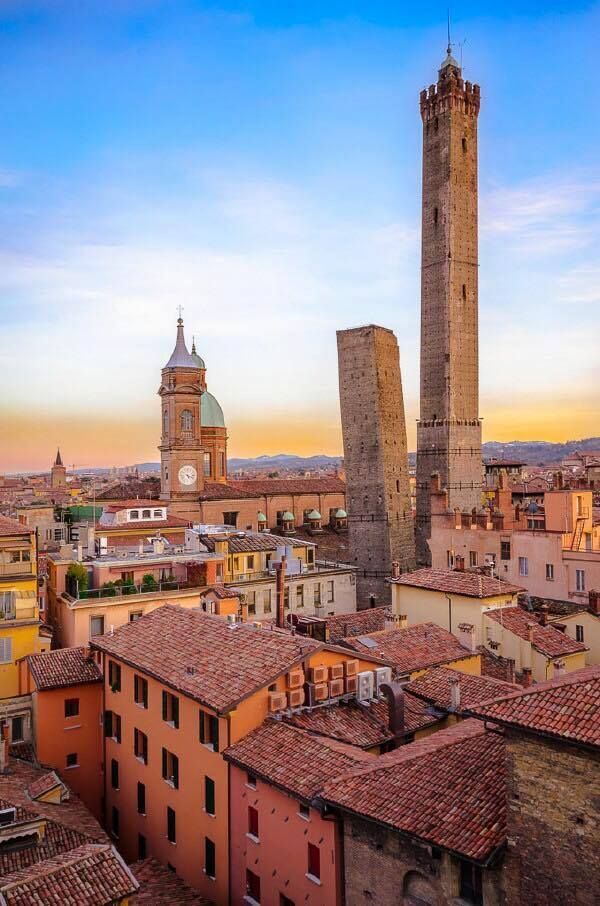
In the 12th and 13th centuries, Bologna’s noble families built more than 180 towers as expressions of wealth, status and military readiness — the medieval equivalent of a skyscraper race. Only twenty survive, of which two are the city’s defining image. Torre degli Asinelli (98 metres, 498 steps) is the tallest medieval tower in Italy. Torre Garisenda (48 metres, never open to the public) leans 3.22 degrees from vertical — more than the Leaning Tower of Pisa in absolute terms — and was so alarming that Dante referenced it in the Inferno. The Asinelli climb is one of the most physically demanding — and most rewarding — tower climbs in Italy. Book at torreasinelli.it.
Piazza Maggiore & Basilica di San Petronio
Bologna’s great main square is one of the finest public spaces in Italy — vast, paved in terracotta, lined with the Palazzo del Podestà, the Palazzo dei Banchi, the Palazzo Comunale (with a Madonna by Giovanni da Modena in its façade) and dominated by the Basilica di San Petronio. Begun in 1390 and never finished — the façade is half marble, half bare brick, one of the most brazenly incomplete buildings in architecture — San Petronio is the sixth largest church in the world and contains a meridian line laid by astronomer Giovanni Cassini in 1655, the most precise sundial ever built, still functional in the nave floor. Entry is free. The inlaid portal sculptures by Jacopo della Quercia (1425–1438) are among the greatest of the Italian Early Renaissance.
The Quadrilatero & Mercato di Mezzo
The ancient market quarter east of Piazza Maggiore — a grid of medieval streets (Via Pescherie Vecchie, Via Clavature, Via Drapperie, Via Caprarie) that has been the commercial heart of Bologna since the Roman period — is the finest concentration of food shops in Italy. Salumerias hung with mortadella and culatello. Fromagerie with Parmigiano-Reggiano aged 36 months. Fresh pasta shops with tagliatelle rolled to the official width. Fishmongers with Adriatic catch. Vegetable stalls with what the season has produced. And above all, the sensory experience of a working food market that has operated on the same ground for 2,000 years. Visit between 8am and noon for the full effect.
Archiginnasio & Teatro Anatomico
Built in 1563 as the central building of the University of Bologna — then the most important university in the world — the Archiginnasio is the most architecturally extraordinary academic building in Italy. Every surface of its two courtyard cloisters is covered in the carved heraldic coats of arms of students and professors from the 13th to 18th centuries — thousands of shields in an overwhelming display of intellectual genealogy. The centrepiece is the Teatro Anatomico — a 17th-century dissection theatre in carved wood, its tiers rising around an operating table beneath a carved wooden baldachin supported by flayed men, its walls decorated with 28 carved figures of historical physicians. It was bombed in 1944 and entirely reconstructed from original fragments. One of the most extraordinary rooms in Italy.
Portico & Sanctuary of Madonna di San Luca
From the Arco del Meloncello at the city edge, a covered portico of 3.8 kilometres and 666 arches climbs continuously to the hilltop Sanctuary of Madonna di San Luca — a baroque oval church begun in 1723 and containing the city’s most venerated icon, a Byzantine Madonna attributed (very optimistically) to St Luke. The portico was built between 1674 and 1739 and is the longest covered walkway in the world, constructed specifically to allow the icon to be carried in procession to the city in times of plague or drought without the clergy getting wet. The walk takes 50–70 minutes uphill; the view from the top terrace is the finest panorama of Bologna in existence. Return by the San Luca funicular (€2 down) if your knees prefer.
The Porticoes of Bologna — UNESCO World Heritage
Inscribed on the UNESCO World Heritage List in 2021, Bologna’s 38 kilometres of covered walkways are the city’s defining urban achievement — a solution to the problem of a growing medieval university city (students needed covered passage between lectures in all weather) that became the city’s architectural identity. The most beautiful sections are: Via dell’Indipendenza (the main thoroughfare, grand and formal), Via Santo Stefano (medieval, atmospheric, leading to the extraordinary Basilica di Santo Stefano complex), Via Saragozza (the beginning of the San Luca portico) and Via Zamboni (the university district, lined with student bars and bookshops).
Bologna’s other essential monuments
The Basilica di Santo Stefano — a complex of seven churches (some dating to the 5th century) built into and over each other in a Romanesque arrangement of extraordinary complexity, centred on a Lombard-Romanesque cloister of great beauty. Entry €2. The Pinacoteca Nazionale holds the finest collection of Bolognese painting — from the Byzantine Madonna panels through Vitale da Bologna, Francia and Guido Reni to the Baroque — in a palazzo near the university quarter. Entry €6. And the Piazza Cavour and Via Farini — the elegant 19th-century neighbourhood east of the centre, its porticoes lined with cafes and the historic Pasticceria Gamberini.
The unofficial must: FICO Eataly World, 3 km from the city centre, is the largest agri-food park in the world — a theme park of Italian food production where you can watch Parmigiano-Reggiano being made, taste aceto balsamico at all ages of ageing, and eat your way through every regional cuisine in Italy. Controversial among food purists, extraordinary in scale and ambition. Entry free; food costs extra. Bus 35 from Via Amendola.
How to Plan Your Bologna Visit
Bologna is blissfully free of the booking-in-advance infrastructure that dominates Rome and Florence. The Two Towers climb benefits from advance booking to guarantee your preferred slot; everything else is walk-in.
The Bologna Welcome Card: Available from €18 (24h) to €25 (48h), the card covers the Torre degli Asinelli, the Archiginnasio, the Pinacoteca Nazionale, the Museo Civico Medievale and several other museums, plus unlimited city bus and funicular travel. Worth buying if you plan to visit three or more museums. Buy online at bolognawelcome.com or at the tourist office in Piazza Maggiore.
- Torre degli Asinelli: Book at torreasinelli.it. No booking required on weekday mornings in low season, but in summer and on weekends slots fill. The early morning visit (opening, 9am) gives the best light over the terracotta rooftops.
- Quadrilatero market: Best Monday–Saturday before noon. Many vendors close from 1pm. Sunday the market is closed or reduced. Plan your morning around the market and have lunch at one of the nearby trattorias immediately after.
- San Luca portico walk: Allow 2–3 hours for the full round trip. The walk is uphill for the entire outward journey (3.8 km, approximately 500 steps built into the portico slope). Go in the morning before heat builds in summer. The San Luca funicular (from Piazza di Porta Saragozza) allows you to take the funicular up and walk down, or vice versa.
- Archiginnasio: No booking required. Opens at 9am and closes at 5pm (Saturday: 1pm). The Teatro Anatomico is included in the €3 entry fee. Weekday mornings are quietest. Allow 45 minutes for the full building including the Teatro.
What to Eat in Bologna — and Where
Bologna’s food culture is not a tourist proposition. It is a civic identity. The Bolognese have been making tagliatelle al ragù, tortellini in brodo and mortadella for centuries, and they have the receipts: in 1972 the Italian Academy of Cuisine registered the official recipe for tortellini with the Bologna Chamber of Commerce. In 1982 they did the same for Bolognese ragù. These are not just dishes. They are legal documents.
Tagliatelle al Ragù
The authentic Bolognese. Beef (and sometimes pork) slow-cooked for hours with soffritto, white wine, whole milk — no cream, very little tomato. Served on hand-rolled tagliatelle 6 millimetres wide (officially 1/12,270th of the height of the Torre degli Asinelli). The pasta must be egg-based, hand-rolled and cut with a knife. Order it only here, and nowhere in the world will it be the same.
Tortellini in Brodo
Small rings of egg pasta filled with a mix of pork loin, prosciutto crudo, mortadella, Parmigiano-Reggiano, egg and nutmeg — served in a clear, deep, long-cooked capon broth. The dish that the Bolognese consider their greatest. Eaten at Sunday lunch in family homes throughout the city. In a restaurant, order it only where they make the tortellini by hand and the brodo from scratch.
Mortadella
The original — the Bologna sausage from which everything else claiming the name descends but none equal. A large, smooth cooked sausage of finely minced pork, studded with whole peppercorns and pistachios, with a texture and flavour that requires no embellishment. Eaten thinly sliced on tigelle (small fried bread rounds) or in a roll. At Tamburini in the Quadrilatero, they slice it to order.
Parmigiano-Reggiano
The finest hard cheese in the world, produced in the provinces of Parma, Reggio Emilia, Modena, Bologna and Mantua, aged minimum 12 months (vacche rosse 24–36 months). In Bologna you eat it fresh-cracked, not grated, with a glass of Lambrusco. The Quadrilatero’s cheese shops sell it by age: 12, 18, 24 and 36 months. Buy a piece to take home if you can.
Tigelle & Crescentine
Tigelle are small, round, flat breads baked in a special press — split open while warm and filled with lard and rosemary, mortadella, or squaquerone cheese and rocket. Crescentine (also called gnocco fritto) are pillows of fried dough, lighter and crisper, eaten with prosciutto crudo. Both are the Bolognese aperitivo snack and found at any piadineria or trattoria worth its name.
Prosciutto di Parma & Culatello
Thirty-eight kilometres west of Bologna, the Po valley produces the finest cured pork in Italy. Prosciutto di Parma DOP (18 months minimum ageing) is the most celebrated. Culatello di Zibello DOP — the “king of salumi”, made only from the rump of the pig, aged in the Po valley fog for 24–36 months — is the rarest and finest. Both are available at the best salumerias in the Quadrilatero.
Lambrusco
The slightly sparkling red wine of Emilia-Romagna — darker than Prosecco, more serious than most people expect, with a lively acidity that cuts through the richness of mortadella and ragù. The finest Lambrusco (Lambrusco di Sorbara DOC, Lambrusco Grasparossa di Castelvetro DOC) bears no resemblance to the sweet, low-quality version exported in the 1970s. Order it by the carafe at any traditional trattoria.
Gramigna con la Salsiccia
A short, curly pasta unique to Bologna, served with a sauce of fresh sausage, onion and tomato. Simpler than the ragù, faster to make, equally beloved. The gramigna pasta — whose name means “weed” for its curled, ground-hugging shape — catches the sauce in its spirals. Found on every serious trattoria menu in the city and rarely seen outside Emilia-Romagna.
Where to eat
The best traditional cooking in Bologna is in the streets around the university quarter (Via Zamboni, Via Belle Arti) and the streets between the Quadrilatero and the Due Torri. The area immediately around Piazza Maggiore has tourist pricing.
- Trattoria Anna Maria — Via Belle Arti 17
The most celebrated traditional trattoria in Bologna. The tagliatelle al ragù is the benchmark against which all others are measured. Book at least one week ahead for dinner, or go for lunch without a reservation on weekdays. - Osteria dell’Orsa — Via Mentana 1
The legendary student osteria open since 1979. Outstanding ragù and tortellini at prices that remain within the university tradition. Long tables, no reservations, always full of people who know what they’re eating. - Al Cambio — Via Stalingrado 150
Bologna’s most historic trattoria for tortellini in brodo and gramigna con salsiccia. Three generations of the same family. Beloved by Bolognese of all ages.
For deli, market eating and aperitivo:
- Tamburini — Via Caprarie 1
The finest salumeria-osteria in the city centre, directly in the Quadrilatero. Outstanding mortadella, Parmigiano-Reggiano, culatello and tigelle. Order at the counter, eat standing or at small tables. - Mercato di Mezzo — Via Clavature
The covered market hall at the heart of the Quadrilatero, with multiple food counters for fresh pasta, cheese, charcuterie, wine and street food. Open daily including evenings — the aperitivo from 6pm is excellent.
The spaghetti Bolognese trap: If you see “spaghetti Bolognese” on a menu in Bologna, leave the restaurant. Authentic Bolognese ragù is served on tagliatelle, never spaghetti — the width of the flat pasta is what catches and carries the sauce correctly. Any restaurant serving ragù on spaghetti in Bologna is either lying about its cooking or has given up on it entirely.
Mistakes to Avoid in Bologna
Bologna is one of the most visitor-friendly cities in Italy — but it has its own specific pitfalls.
- Don’t order spaghetti Bolognese. Ragù is served on tagliatelle in Bologna — always. Any restaurant serving it on spaghetti is not a serious kitchen. The correct pasta is hand-rolled, egg-based tagliatelle, 6mm wide.
- Don’t skip the Quadrilatero. This is the greatest food market experience in Italy and the most authentic expression of what makes Bologna’s food culture extraordinary. Arrive before 10am for the full effect.
- Don’t overlook tortellini in brodo. This is the Bolognese dish that Bolognese themselves consider their greatest achievement — more than the ragù. It requires a perfect broth (at least 4 hours’ cooking) and hand-made tortellini. Order it wherever you see it made fresh.
- Don’t miss the San Luca portico walk. It is 3.8 km uphill and takes an hour. The view from the top is the finest in Bologna and the walk itself — through the world’s longest covered walkway — is a genuinely great urban walking experience.
- Don’t confuse Bolognese ragù with the version you know from home. The recipe registered with the Chamber of Commerce in 1982 uses minced beef (300g), pork belly (150g), carrot, celery, onion, white wine, whole milk and just 1 tablespoon of tomato paste. No cream. No oregano. Very long cooking (3–4 hours minimum). No shortcuts.
- Don’t miss the day trip to Modena. Thirty minutes by train, Modena has the Enzo Ferrari Museum, a UNESCO-listed Romanesque Cathedral, the finest balsamic vinegar in the world, and Osteria Francescana — regularly voted the world’s best restaurant. It is the finest day trip from any Italian city.
- Don’t eat at restaurants directly on Piazza Maggiore. The square is beautiful; the restaurants facing it charge for the view. Walk one street in any direction and the quality immediately improves.
- Don’t ignore Lambrusco. The Emilian wine that most of the world knows as sweet fizzy plonk is, in its serious DOC form (Lambrusco di Sorbara, Lambrusco Grasparossa di Castelvetro), a complex, dry, lively red that is the correct accompaniment to every dish in this guide. Order it by the carafe at a traditional trattoria and reconsider your assumptions.
Practical Information for Bologna 2026
Money & payments
Bologna is largely cashless, but keep €20–30 for market stalls, smaller osterie and street food vendors in the Quadrilatero. ATMs are widely available throughout the historic centre.
Bologna Welcome Card
Available from €18 (24h) to €25 (48h). Covers Torre degli Asinelli, Archiginnasio, Pinacoteca Nazionale, Museo Civico Medievale and several other museums, plus unlimited city bus and San Luca funicular travel. Buy at bolognawelcome.com or at the tourist office in Piazza Maggiore (Palazzo del Podestà).
Connectivity
EU visitors use domestic plans. Non-EU visitors: SIM cards from TIM, Vodafone or WindTre available at the airport and throughout the centre. Free WiFi throughout the historic centre (WiFi Bologna network) and in all university cafes.
Safety
Bologna is a very safe city. The large student population makes the historic centre lively and comfortable at all hours. Standard precautions apply around the train station and in crowded market areas. The historic centre and university quarter are safe day and night.
Emergency numbers
Day trips from Bologna — the food capitals of Emilia-Romagna
Modena — 38 km, 25 min by train (€4). UNESCO Cathedral, Enzo Ferrari Museum, the finest balsamic vinegar in the world, and Osteria Francescana (book years ahead if you want a table). Parma — 95 km, 55 min by train (€9). Prosciutto di Parma, Parmigiano-Reggiano, the finest Baptistery in Italy (13th century) and a Corregio cycle in the Camera di San Paolo. Ferrara — 50 km, 35 min by train. A UNESCO World Heritage Renaissance city of extraordinary completeness, with the Castello Estense and some of the finest bicycle culture in Italy. Ravenna — 75 km, 1h by train. The finest Byzantine mosaics in the western world, in eight UNESCO-listed monuments. Florence — 80 km, 35 min by high-speed train (from €9.90).