
Airport to City Centre, Getting to Aosta & Getting Around, Connectivity and Tips About Aosta
What's in this guide
Most visitors to Italy think of cities — Rome, Florence, Venice. Few think of the mountains. And yet the Aosta Valley is one of the most extraordinary places in the country — a high Alpine region wedged between the French and Swiss borders where Italy’s smallest and wealthiest region has managed to preserve something very rare: an authentic identity that centuries of tourism have not yet erased.
Aosta itself is a revelation. Known for centuries as the “Little Rome of the Alps” — la Petite Rome des Alpes, in the local French — it sits in its valley at 583 metres altitude with a perfectly intact Roman street grid, a triumphal arch from 25 BC still standing at the city entrance, a theatre whose façade walls rise 22 metres above the medieval houses built against them, and a cloister of subtle Romanesque beauty beside the Cathedral. Twenty kilometres west, the highest peak in Western Europe — Mont Blanc, 4,808 metres — closes the valley. Ten kilometres east, the first of thirty medieval castles begins the extraordinary castle road that runs the full length of the valley to the Matterhorn.
“The Aosta Valley is where Rome ends and the Alps begin — and in that collision, something entirely its own was made.”
When Is the Best Time to Visit Aosta?
Unlike most Italian destinations, Aosta has two completely distinct peak seasons determined not by weather but by activity — and both are genuinely excellent. The question is what kind of trip you want.
Winter — Dec–Mar
- Courmayeur & Cervinia fully open
- Christmas-New Year: magical
- Snow guaranteed above 1,800m
- Book accommodation months ahead
- Private transfers essential
Summer — Jun–Sep
- Temperatures 20–28°C in the valley
- All hiking trails open
- Gran Paradiso: ibex & chamois
- Skyway Monte Bianco fully open
- Long days, clear Alpine skies
Spring — Apr–May
- Shoulder season: few tourists
- Lower valley wildflowers
- High passes still closed (snow)
- Some ski lifts operating (Apr)
- Good for Aosta city & castles
Autumn — Oct–Nov
- Larch forests turn gold (October)
- Truffle season in the lower valley
- Hunting season: local restaurants
- High mountain routes closing
- Very few tourists
The October larch secret: In the third week of October, the larch forests of the Aosta Valley — particularly around Gressoney and Cogne — turn from green to vivid gold and amber. For one brief window, the landscape becomes something almost impossibly beautiful: golden larches against white peaks, empty trails, no queues, and the hunting season in full swing at every village restaurant.
Getting to Aosta & Getting Around
Nearest airports
Aosta has no commercial airport. The nearest is Turin Caselle Airport (TRN), 115 km southeast via the A5 motorway — approximately 1h 15min by private transfer. Milan Malpensa (MXP) is 185 km southeast, approximately 2h by private transfer via the A8 and A5 motorways. Geneva Airport (GVA), Switzerland, is 130 km northwest and particularly convenient for visitors arriving from northern Europe, approximately 1h 30min.
Airport to Aosta and the valley — your options in 2026
| Option | Time | Cost | Best for |
|---|---|---|---|
| Private Transfer (from Turin) TRN Airport → Aosta or ski resorts Recommended |
~1h 15min | Fixed | Ski equipment, families, groups |
| Private Transfer (from Milan) MXP / Linate → Aosta / Courmayeur |
~2h–2h 30min | Fixed | Ski groups, families with equipment |
| Train Turin Porta Nuova → Aosta |
~2h | From €12 | Light luggage, city visits only |
| Public Transportatiom Bus Turin / Milan → Aosta / Courmayeur |
2h–3h | €15–25 | Budget, no ski equipment |
| Private Transfer (from Geneva) GVA Airport → Aosta / Courmayeur |
~1h 30min | Fixed | Northern European flights |
Winter driving warning: In winter the A5 motorway and the mountain roads to Courmayeur and Cervinia require snow chains or all-season tyres by law. Road conditions can change rapidly. The Mont Blanc Tunnel may close during severe weather. A private transfer with an experienced Alpine driver eliminates all these concerns — particularly with ski equipment and in dark or icy conditions.
Getting around the valley
A car is by far the most practical way to explore the Aosta Valley beyond the city. The SS26 state road runs the full length of the valley from Pont-Saint-Martin in the east to Courmayeur in the west — 100 km, with the castle road passing through every village. Within Aosta city, everything is walkable. The Public Transportation bus network connects Aosta to most valley villages and to Courmayeur, but services are infrequent outside summer and ski season peaks.
The castle road strategy: Hire a car from Aosta for one full day and drive the valley road east towards Pont-Saint-Martin, stopping at Castello di Fénis (the finest), Castello di Issogne (best interior), and Castello di Verrès (the most dramatic position). The full circuit is 80 km return and takes a comfortable day with stops.
The Essential Aosta Valley — What You Cannot Miss
The Aosta Valley offers a combination found nowhere else in Italy: Roman ruins of the first order, thirty medieval castles along a single valley road, two of the finest ski resorts in the Alps, Italy’s oldest national park, and the foot of Mont Blanc — all within an hour’s drive of each other.
Aosta City — The Roman Circuit
Founded in 25 BC as Augusta Praetoria Salassorum, Aosta preserves its Roman bones with extraordinary completeness. The Arch of Augustus stands at the original eastern gate of the city, still spanning the road to Rome. The Porta Praetoria — the western gate — retains two of its three archways and a guard chamber. The Roman Theatre rises 22 metres above the valley in a façade of blind arcades, its cavea now used for summer performances. The city walls run for over two kilometres and are the best preserved in northern Italy. Walk the full circuit in two hours: it is one of the great Roman experiences in Italy and almost entirely free.
Skyway Monte Bianco
The most extraordinary cable car in the Alps: two rotating gondolas that carry passengers from Courmayeur (1,300m) to Punta Helbronner (3,466m) in 25 minutes, with a 360° panorama that takes in Mont Blanc, the Matterhorn, the Gran Paradiso and the Monte Rosa massif simultaneously. On a clear day the view extends to the Apennines in the south. The upper station has a revolving restaurant, a glacier walking area and a tunnel through the mountain to France. One of the great mountain experiences in Europe.
Castello di Fénis
Twenty kilometres east of Aosta, the Castello di Fénis is the finest medieval castle in the valley and one of the most beautiful in Italy — a double ring of pentagonal battlements around a central keep, its courtyard decorated with extraordinary 15th-century frescoes of saints and courtly scenes that survive in remarkable condition. The silhouette of the castle against the Alpine backdrop is the defining image of the Valle d’Aosta, reproduced on every tourist poster of the region. Guided visits run every 30 minutes; arrive early to avoid the afternoon tour groups.
Gran Paradiso National Park
Italy’s oldest national park, established in 1922 specifically to protect the Alpine ibex — which had been hunted almost to extinction by the House of Savoy’s royal hunting parties — is now home to 7,000 ibex, 9,000 chamois, 300 golden eagles, colonies of marmots and one of Europe’s finest Alpine ecosystems. The park covers 70,000 hectares across the Aosta Valley and Piedmont. The gateway village of Cogne (27 km from Aosta) gives access to the Valnontey valley — a flat 4 km walk with near-guaranteed ibex sightings at any time of year. In summer the meadows are carpeted with Alpine flowers of extraordinary density and variety.
Courmayeur
At the very end of the valley, 10 km from the Mont Blanc Tunnel into France, Courmayeur is Italy’s most celebrated mountain village — a collection of stone chalets and medieval towers around a pedestrian main street (Via Roma) where the après-ski tradition is among the finest in the Alps. In summer it is the base for the Tour du Mont Blanc hiking circuit and the departure point for the Skyway Monte Bianco. In winter the skiing covers 100 km of runs between 1,200 and 2,756 metres, with a ski area that connects to several sectors and a mountain restaurant culture that has no equal in Italy.
Cervinia & the Matterhorn
On the eastern side of the valley, Cervinia looks directly up at the Matterhorn — the most dramatic mountain silhouette in the Alps, 4,478 metres of near-perfect pyramid rising above the Italian resort village. The ski area at Cervinia is one of the highest in Europe, with runs descending from 3,883 metres and the unique possibility of skiing across the Swiss border to Zermatt on a single ski pass. Even in poor weather years, Cervinia maintains skiable snow into May. The resort village is functional rather than beautiful, but the mountain is incomparable.
The valley castles — a complete guide
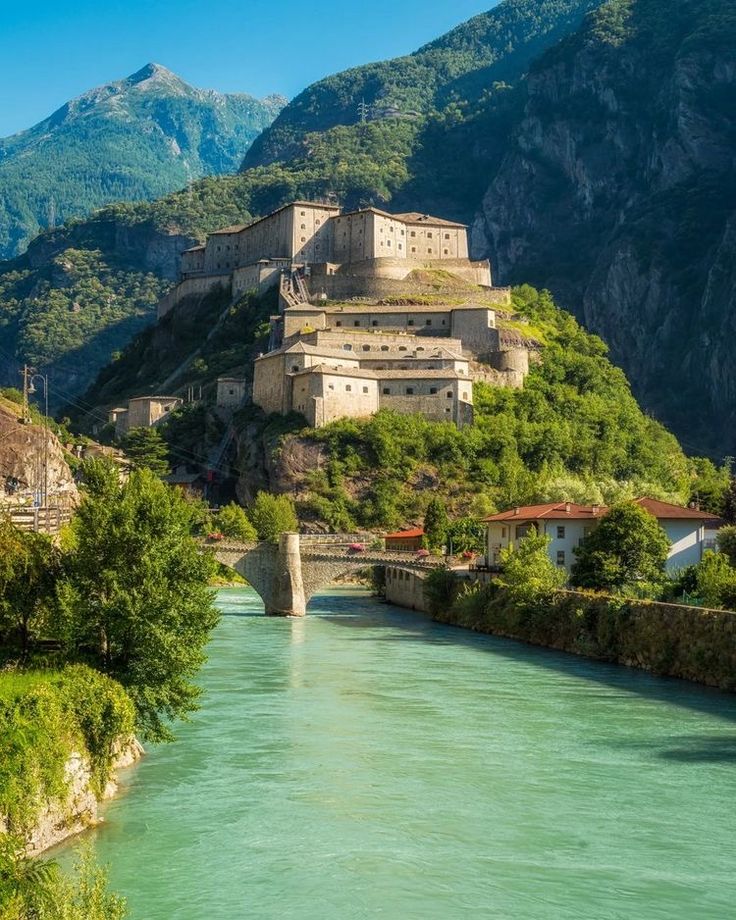
The Aosta Valley has over 30 medieval castles along the SS26 road, built by the local nobility to control the valley route between Italy and France. Beyond Fénis, the most important are: Castello di Issogne (15 km east of Fénis, best preserved interior, with a pomegranate fountain and a painted portico of daily medieval life), Castello di Verrès (the most dramatically positioned, on a rock above the Dora Baltea river), Castello di Sarre (the Savoy hunting lodge, 6 km from Aosta, now a museum of royal hunting culture) and Castello di Aymavilles (circular towers, directly visible from the A5 motorway, undergoing restoration in 2026).
Skiing in the Aosta Valley — Courmayeur & Cervinia
The Aosta Valley contains three world-class ski resorts: Courmayeur, Cervinia and Pila (the resort directly above Aosta city). Together they represent the finest ski offering in Italy — high altitude, reliable snow, extraordinary scenery and a mountain culture that takes both the skiing and the eating seriously.
Courmayeur — Mont Blanc
Italy’s most prestigious ski resort. 100 km of marked runs between 1,200 and 2,756 metres, with excellent off-piste terrain for experts. The ski area divides into three main sectors: Checrouit, Youla and the Val Vény. The mountain restaurants are a genuine destination in themselves — Rifugio Maison Vieille and the restaurants on the Chécrouit plateau are among the finest on-mountain eating experiences in the Alps. The village of Courmayeur is car-free, architecturally beautiful and has the finest après-ski street (Via Roma) in Italy.
The Courmayeur secret: The Skyway Monte Bianco cable car (non-ski, separate ticket) takes you from the bottom of the resort to 3,466 metres and the French border. Even non-skiers staying in Courmayeur should take it on a clear morning. Book the first gondola of the day (8am) and you will share the Punta Helbronner panorama with very few people.
Cervinia — the Matterhorn
The highest ski area in Italy, with runs descending from 3,883 metres. The international ski area connects Cervinia with Valtournenche (a quieter Italian extension) and — with the cross-border ski pass — with Zermatt, Switzerland. Total: over 360 km of marked runs on the combined area. Snow conditions are the most reliable in Italy — the altitude means the season often extends into May. Cervinia is particularly suited to intermediate skiers (long, wide, high-altitude cruising runs) and families.
Pila — Aosta’s local resort
Directly above Aosta city by cable car (10 minutes from the city centre), Pila offers 70 km of runs between 1,450 and 2,700 metres. Less internationally famous than Courmayeur or Cervinia, it is the resort of choice for Aosta residents — excellent value, rarely crowded, and with views down the full length of the valley. A day ski pass costs around €40–45 in 2026. The cable car from Aosta departs from Piazza Plouves in the city centre.
Ski transfer planning: Courmayeur is 35 km from Aosta (40 min by car), Cervinia is 60 km (1h 10min), and Pila is 10 minutes by cable car from the city centre. In winter, private ski transfers from Milan or Turin airports to any of these resorts are significantly more practical than public transport — particularly with ski equipment, boots and poles.
What to Eat in Aosta — and Where
Valle d’Aosta cuisine is Alpine, French-influenced and built for serious cold: rich in dairy, cured meat, game and slow-cooked dishes that warm from the inside. The region produces some of Italy’s finest cheese (Fontina DOP), some of its most interesting charcuterie (Lard d’Arnad, Mocetta, Boudin) and a cuisine of warming depth that is among the most distinctive in the country.
Fontina DOP
The defining cheese of the Aosta Valley — a semi-soft, washed-rind cow’s milk cheese with a nutty, slightly sweet depth that is unlike any other Italian cheese. Made only from the milk of Valdostana cattle in the valley. Eaten as a table cheese, melted into fonduta, or used in polenta concia. The DOP certification guarantees valley origin.
Fonduta Valdostana
Fontina melted slowly in a double boiler with egg yolks, butter and milk until it becomes a rich, silky sauce. Served over bread, polenta or boiled vegetables. The Valle d’Aosta version is significantly different from Swiss fondue — smoother, richer, more intensely flavoured. The defining dish of a cold Aosta evening.
Polenta Concia
Polenta cooked with Fontina (or a mix of Fontina and local butter) until the cheese melts entirely into the grain, creating a molten, extraordinarily rich mass. Served as a side dish with carbonada or braised game. The calories are not accidental: this is food designed to fuel a day in the mountains at –10°C.
Carbonada
A slow-braised beef stew with red wine, spices, onions and sometimes lard — the Valle d’Aosta version of a Flemish carbonnade, carried here centuries ago along the trade routes through the Alpine passes. Dark, deeply flavoured, served on polenta. The most characteristically Valdostano of all dishes.
Lard d’Arnad DOP
Cured fatback from the village of Arnad, aged in brine with rosemary, sage, bay and mountain herbs in wooden containers called doils. Creamy, herby, subtle — nothing like ordinary lard. Sliced thin and served on dark bread with local honey, it is one of the great antipasti of northern Italy and a DOP product found nowhere else.
Mocetta
Cured chamois or ibex leg — the traditional preserved meat of the mountains, made from the very animals that inhabit the Gran Paradiso. Lean, dense, herb-scented. Served thinly sliced as an antipasto. A taste of genuine Alpine hunting culture, now made primarily with goat or beef to protect wildlife.
Genepì
The herbal liqueur of the Aosta Valley, distilled from artemisia genepi — a mountain plant that grows above 2,500 metres and must be harvested by hand. Clear to pale yellow, intensely herbal, drunk as a digestivo after dinner or poured over vanilla ice cream. Every family has its own recipe. Every recipe is slightly different. All of them are good.
Caffè Valdostano
The Valle d’Aosta’s ceremonial coffee: espresso mixed with genepè, grappa, lemon peel and sugar, served in a shared wooden cup (coppa dell’amicizia) passed around the table. A ritual of mountain hospitality that has been performed in this region for at least 200 years. Accept it when it is offered.
Where to eat
Aosta city’s best restaurants are concentrated around Via Sant’Anselmo (the main pedestrian street) and the streets around the Cathedral. In Courmayeur, the mountain restaurants are as important as the village restaurants — book lunch on the mountain at one of the rifugi before you ski down.
- Osteria da Nando — Via Sant’Anselmo 99, Aosta
The most beloved traditional restaurant in the city. Outstanding carbonada, polenta concia and fonduta. Local wines from the Enfer d’Arvier and Torrette appellations. Book ahead in winter. - Trattoria degli Artisti — Via Maillet 5, Aosta
Near the Roman theatre. Reliable, unpretentious Valdostana cooking at fair prices. Excellent Fontina dishes and local charcuterie. Good for lunch after the Roman circuit. - Maison de Filippo — Étroubles (20 km from Aosta)
The legendary Alpine feast: a fixed-price dinner of 45 courses of traditional Valle d’Aosta food in a converted farmhouse. One sitting per evening. Book weeks or months ahead. One of Italy’s great eating experiences.
In Courmayeur — mountain restaurants:
- Rifugio Maison Vieille — Checrouit plateau, 1,956m
The finest on-mountain lunch in the Courmayeur ski area. The polenta concia and grilled meats are exceptional. Reserve a table before you ski up — it is always full in peak season. - Chalet Plan Gorret — Val Vény sector
A proper mountain hut with serious food and serious wine, at the start of the off-piste terrain. The atmosphere is genuinely Alpine.
The tourist trap test: Restaurants immediately around the main ski lifts in Courmayeur and Cervinia tend to charge resort prices for mediocre food. The best eating is always found one or two streets off the main village strip, or on the mountain itself in the proper rifugi that serve locals and ski guides as much as tourists.
Mistakes to Avoid in Aosta
Aosta rewards the well-prepared visitor and the curious one. Here is how to avoid the most common errors.
- Don’t come in winter without a private transfer (if flying). There is no direct public transport from Turin or Milan airports to Courmayeur or Cervinia with ski equipment. Bus services exist but are slow, infrequent and impractical with a full set of ski kit. A private ski transfer is the standard solution for a reason.
- Don’t visit only the city — explore the valley. Aosta city alone takes half a day. The valley — the castles, the national park, Courmayeur, the Skyway — requires three days minimum to appreciate. The city is the starting point, not the destination.
- Don’t skip Fénis for a ski day. Even in winter, one morning at Castello di Fénis gives you the most beautiful medieval castle in the valley. The frescoes, the battlements and the mountain backdrop are worth 3 hours of any itinerary.
- Don’t book the Skyway on a foggy day. At 3,466 metres, the upper station is frequently in cloud when the valley below is sunny. Check the webcam at montebianco.com the morning of your visit before booking. The first gondola on a clear, cold morning is the correct choice.
- Don’t underestimate the cold at altitude. Even in July, the temperature at Punta Helbronner (3,466m) on the Skyway is typically 5–10°C. Take a warm layer and a windproof jacket at all times of year when visiting the high mountain stations.
- Don’t miss the Valnontey ibex walk. Most visitors to the Gran Paradiso drive through it without stopping. The 4 km flat walk from Cogne through the Valnontey valley almost always produces ibex sightings — real wild ibex, at close range, on the valley slopes. No other experience in the Italian Alps compares.
- Don’t refuse the caffè valdostano. When a Valdostano restaurant owner brings the wooden coppa dell’amicizia to your table at the end of dinner, accept it. It is both the best digestivo in the Alps and a genuine expression of local hospitality that you will remember long after the meal.
- Don’t book peak ski week accommodation last minute. Christmas–New Year, the first two weeks of February and Easter are fully booked at Courmayeur and Cervinia months in advance. For these periods, book your accommodation and transfers simultaneously, and as early as possible.
Practical Information for Aosta 2026
Language
The Valle d’Aosta is officially bilingual. Both Italian and French are official languages — all signs, menus and public documents appear in both. Most residents speak both fluently, and many speak the local Franco-Provençal dialect (patois) as well. English is widely spoken in Courmayeur, Cervinia and the main tourist areas.
Money & payments
Larger resorts and restaurants are fully cashless. Keep €20–40 for mountain rifugi (some are cash-only), village markets and the smaller trattorias in valley villages. ATMs in Aosta city and Courmayeur are widely available.
Ski passes 2026
Courmayeur day pass: from €55. Cervinia day pass: from €60. Cervinia + Zermatt cross-border pass: higher (check cervinia.it). Pila (above Aosta): from €40–45. The Skipass Valle d’Aosta covers all resorts in the region including Pila, La Thuile and Gressoney — worth buying if visiting for a week or more.
Safety
Aosta city and the valley are very safe for tourists. On the mountain, follow all piste markings, respect avalanche warning signs, and never ski off-piste without a certified guide. The mountain rescue service (Soccorso Alpino) is excellent but its number — 118 — should be in your phone before you ski.
Emergency numbers
Day trips from Aosta
Courmayeur and the Skyway — 35 km west, a full day. Cervinia and the Matterhorn — 60 km east via Chatillon, a full day in winter. Gran Paradiso from Cogne — 27 km south, a half-day walk. La Thuile — 38 km west, quieter ski resort connected to the French resort of La Rosière. Gressoney-la-Trinité — 65 km east, the Walser (German-speaking) villages of the Monte Rosa valley. Turin — 115 km southeast, easily combined with an Aosta visit over 4–5 days.