
Airport to City Centre, Getting to Alberobello & Getting Around, Connectivity and Tips About Alberobello
What's in this guide
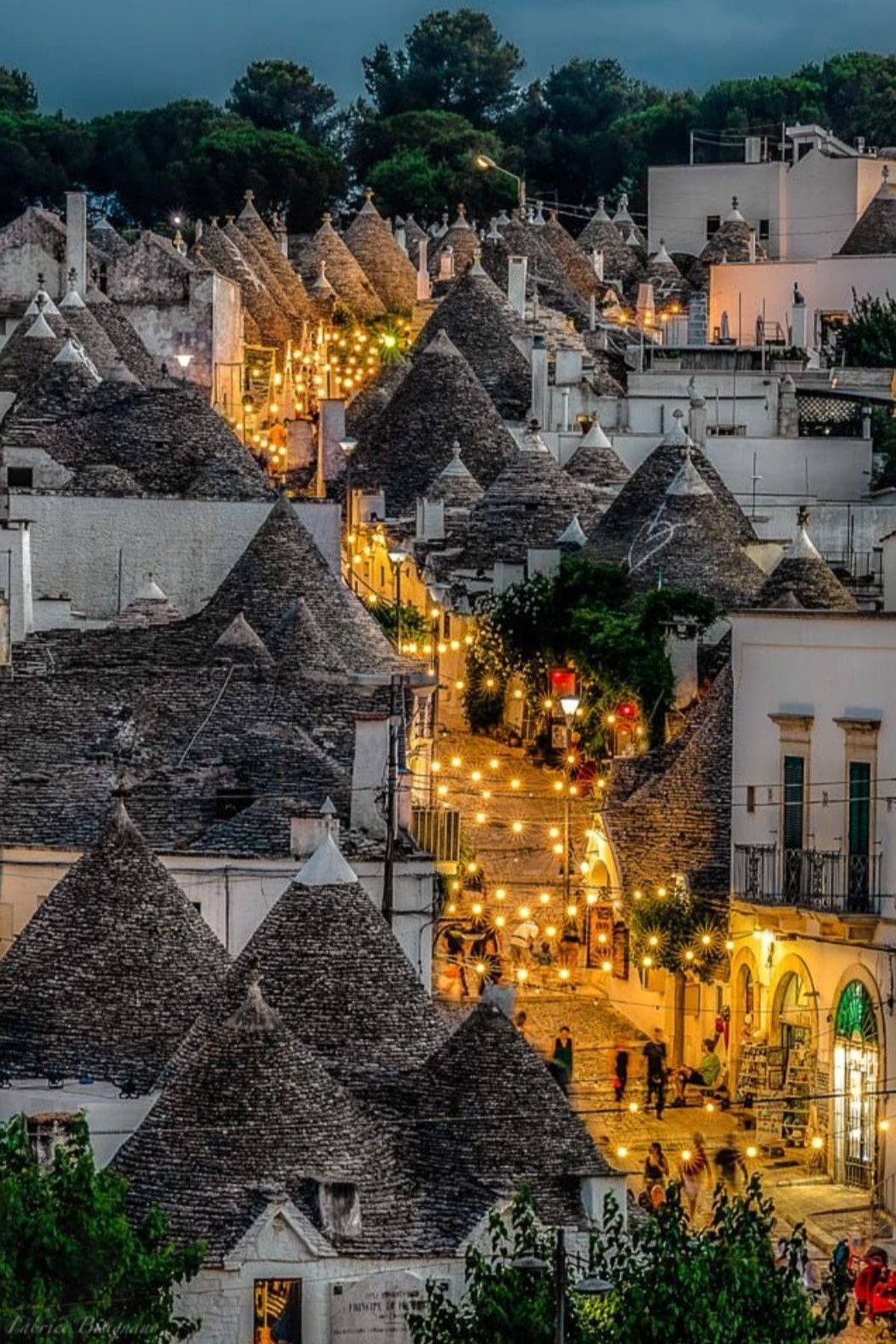
The Valle d’Itria is a limestone plateau in the heart of Puglia where the land does something found nowhere else on earth: it grows houses shaped like pointed stone cones. The trulli, dry-stone dwellings built without mortar from the limestone that covers the valley floor, appear first as individual curiosities and then, in Alberobello’s Rione Monti, as an entire cityscape of 1,500 conical roofs climbing a hillside in formations that seem both ancient and impossible.
But the Valle d’Itria is far more than Alberobello. Within 30 kilometres of the trulli capital: a perfectly circular whitewashed hill town (Locorotondo) producing Puglia’s finest white wine. A baroque city of aristocratic palaces and summer opera (Martina Franca). A dazzling white hilltop city above 25 kilometres of ancient olive groves (Ostuni). A medieval village of butcher-grills serving the finest open-fire meat in southern Italy (Cisternino). And in every direction, the deep green of the Murgia plateau: ancient dry-stone walls, olive trees some of which are 2,000 years old, a landscape that has changed in its fundamentals since the Greeks arrived.
This is the most distinctive corner of southern Italy: a region where the architecture, the food and the wine are entirely specific to this place and this limestone and these people. Come for the trulli. Stay for everything else.
“In the Valle d’Itria the landscape itself seems to have been designed by a dreamer who had never seen a house built anywhere else in the world.”
When Is the Best Time to Visit?
The Valle d’Itria has a warm Mediterranean climate: long, hot, dry summers and mild winters. The trulli, the towns and the olive landscapes are attractive in every season, but the extremes of heat in July–August and the emptiness of January can each require adjustment.
Spring: May & June
- Temperatures 18–28°C: ideal
- Wild flowers across the plateau
- Olive trees in new leaf
- Before peak tourist season
- Festivals in Martina Franca (June)
Autumn: Sept & Oct
- Temperatures 20–28°C
- Primitivo & olive harvest season
- Sagre (harvest festivals) everywhere
- Summer crowds gone
- Best light of the year
Summer: Jul & Aug
- Temperatures 32–40°C
- Italian tourists at peak
- Evening passeggiata superb
- Festival della Valle d’Itria (Jul–Aug)
- Coast accessible from the valley
Winter: Nov–Mar
- Temperatures 8–14°C
- Almost no tourists
- Trulli to yourself
- Olive oil pressing season (Nov–Dec)
- Christmas presepi in the trulli
The harvest advantage: October is arguably the finest month to visit the Valle d’Itria. The Primitivo grape harvest fills the air with fermenting must, the olive trees are laden with fruit, the sagre (harvest festivals) in every village offer food and wine at their most direct and authentic, and the summer heat and crowds are entirely gone. The trulli, the towns and the entire landscape are most beautiful in the October light.
Getting to the Valle d’Itria & Getting Around
Two airports: Bari (BRI) and Brindisi (BDS)
The Valle d’Itria is served by two airports of similar size and distance. Bari Karol Wojtyla Airport (BRI) is 75 km northwest of Alberobello: approximately 1 hour by private transfer or 1h 30min by the FSE (Ferrovie del Sud Est) regional railway. Brindisi Casale Airport (BDS) is 65 km east of Alberobello: approximately 50 minutes by private transfer. Bari has more connections including low-cost carriers from all major European cities; Brindisi is smaller but growing.
Getting to Alberobello and the valley: 2026 options
| Option | Time | Cost | Best for |
|---|---|---|---|
| Private Transfer (from BRI) Bari Airport to Alberobello Recommended |
~1h | Fixed | Families, groups, luggage |
| Private Transfer (from BDS) Brindisi Airport to Alberobello |
~50 min | Fixed | Families, groups, luggage |
| FSE train from Bari Bari Centrale to Alberobello (direct) |
~1h 30min | €4.40 | Budget, light luggage |
| Train from Bari + taxi Bari Centrale to Alberobello station to hotel |
~1h 45min | €10–15 | Budget city centre |
| Rental car (from Bari or Brindisi) | ~1h / 50 min | From €35/day | Valley circuit freedom |
You need wheels in the Valle d’Itria. The five main towns are spread across 50 km of plateau with infrequent and slow public transport. The FSE train connects Bari, Alberobello, Locorotondo and Martina Franca, but trains run every 1–2 hours and Ostuni and Cisternino are off the line. For the full valley experience: especially the masserie, the rural trulli and the smaller villages: a rental car or a private transfer that allows multi-stop itineraries is essential.
Getting around the valley
With a car, the five main towns form a comfortable circuit of about 90 km: Alberobello, Locorotondo (8 km), Cisternino (12 km), Ostuni (22 km), Martina Franca (20 km), then back to Alberobello (15 km). The roads are pleasant secondary routes through olive groves and dry-stone walls. Google Maps works well throughout the valley, though some trullo masserie and agriturismo require a final km on unpaved tracks.
The Five Essential Towns
The Valle d’Itria is a destination of towns rather than single monuments: five hilltop settlements that are each entirely distinct in character, each worth a half-day or more, and all within 30 kilometres of each other. The circuit below is the irreducible minimum; give it three days to do it properly.
Alberobello: The UNESCO Trulli Capital
The trulli of Alberobello are, without question, the most architecturally unique settlement in Europe. Over 1,500 conical dry-stone houses are concentrated in two adjacent hillside districts: the Rione Monti (the large tourist zone, hilly, most dense, most photographed) and the Aia Piccola (the quieter residential area on the opposite hill, far less visited and far more authentic). The UNESCO World Heritage designation covers both.
A trullo is built entirely from the limestone of the valley floor, without mortar, using a technique of dry-stone corbelling that allows the conical roof to be disassembled and rebuilt: a feature that some historians believe was exploited to avoid the feudal tax on permanent dwellings (a temporary roof meant a temporary house, which was taxed differently). The symbols painted on many pinnacles: crosses, planets, arrows, hearts: are a mix of Christian iconography and older folk traditions whose precise meanings are disputed. The Trullo Sovrano, the only two-storey trullo in existence, is now a museum (€3), worth visiting to understand the interior arrangement.
The commercial intensity of the Rione Monti: every ground-floor trullo converted into a souvenir shop or a gelato stall: is real and impossible to miss in the daytime. The correct strategy is to arrive before 9am or after 6pm, or to sleep in a trullo overnight, which transforms the experience completely: the district at dawn, with the mist over the valley and no one on the streets, is one of the most extraordinary urban atmospheres in Italy.
Locorotondo: The Circular White Town
Eight kilometres from Alberobello on the highest point of the valle d’Itria plateau, Locorotondo is exactly what its name promises: a round town. The centro storico is an almost perfect circle of whitewashed houses, flower-filled balconies and covered walkways built along the edge of a hilltop, so that every street curves gently inward and the view from the perimeter wall sweeps over the entire trulli-dotted valley below.
Locorotondo is the wine town of the Valle d’Itria: home of the Locorotondo DOC, a dry white wine made from Verdeca and Bianco d’Alessano grapes that is one of the finest and most characterful whites in Puglia: straw-yellow, floral, with a mineral finish that tastes of limestone. Order it in any bar in the historic centre, ideally with a plate of raw vegetables (crudités) and local olive oil, or with burrata. The evening passeggiata in Locorotondo: the entire town seemingly on the streets between 6pm and 9pm: is one of the finest in Puglia.
Martina Franca: The Baroque Capital
The largest and most architecturally ambitious town of the Valle d’Itria, Martina Franca is a baroque city of aristocratic palaces, arcaded piazzas and an urban elegance that comes as a surprise after the rural intimacy of the surrounding valley. Its historic centre: a web of white alleys between 17th and 18th-century limestone palaces: is one of the finest baroque ensembles in Puglia, with Piazza Plebiscito (dominated by the Basilica di San Martino, its façade a cascade of baroque sculpture) and the Palazzo Ducale (a 17th-century palace of the d’Aquino family, now the town hall, with extraordinary frescoed interior rooms) as its two set pieces.
In July and August, Martina Franca hosts the Festival della Valle d’Itria: one of the most important opera festivals in southern Italy, held in the courtyard of the Palazzo Ducale under the Pugliese stars. Founded in 1975 and committed to rare and lesser-known operas, it attracts singers and audiences from across Europe. Book at festivaldellavalleditria.it.
Ostuni: La Città Bianca (The White City)
Ostuni deserves its epithet. Perched on a 200-metre hill above the immense flat plain of ancient olive groves that runs 25 kilometres to the Adriatic sea, it is entirely whitewashed: every surface of its labyrinthine old city painted brilliant white, the alleys winding between arched passageways and small flower-filled piazzas that catch the southern sun in the afternoon and throw it back doubled. The Cathedral (begun 1469) on the highest point of the town has a rose window of unusual Late Gothic complexity and a terrace that is the finest panoramic viewpoint in the Valle d’Itria: on clear days the sea is visible from it.
Ostuni is also the most cosmopolitan town in the valley: it has been attracting international visitors (and international residents) for 30 years, and its restaurant and wine bar scene reflects this. The new town below the hill has every practical facility; the old town is best explored on foot from the Porta Nova gate upward. Stay for dinner: the concentration of excellent restaurants in the centro storico makes it the finest place to eat in the Valle d’Itria.
Cisternino: The Fornello Town
Cisternino was named one of Italy’s most beautiful villages (I Borghi più belli d’Italia) and it justifies the designation: a compact medieval hilltop town of arched limestone alleys and small piazzas, almost entirely intact, almost entirely unspoiled. But what makes Cisternino extraordinary is not its architecture. It is the fornelli pronti.
Cisternino’s butcher-shops have been operating simultaneously as open-fire grills for generations. You enter, inspect the raw meat on display at the counter, choose what you want: bombette, gnumareddi, involtini, salsicce, costine: and it is cooked immediately over an olive-wood fire while you find a table. The bombetta is the signature: a small roll of pork (or occasionally lamb) filled with Canestrato cheese, pepper and local spices, wrapped and grilled until the outside is crispy and the cheese inside molten. Eat them standing at a paper plate with a glass of Primitivo. This is the most authentic food experience in the Valle d’Itria, and arguably in all of Puglia.
The Trulli: Everything You Need to Know
What are they?
Trulli are dry-stone corbelled huts built from the local calcarenite limestone without mortar: a building technique used in the Valle d’Itria since at least the 14th century and possibly much earlier. The conical roof is built by a method of progressively overlapping flat limestone slabs in diminishing circles until they meet at the pinnacle, which is typically topped with a decorative stone finial (pinnacolo). The walls are double-thickness: an outer wall of large limestone blocks and an inner wall, with rubble fill between them that provides insulation against both summer heat and winter cold.
A trullo is remarkably comfortable for its age: the thick walls keep interior temperatures 8–10°C cooler than outside in summer, and the low doorways (typically 160cm high: you must duck to enter) and small windows minimise heat gain. Many trulli have been converted into accommodation: staying in one is the most direct way to understand the architecture from the inside.
Why are they conical?
The conical roof has been the subject of considerable romantic speculation. The most persistent theory: that the cones could be quickly disassembled to avoid feudal taxation on permanent dwellings: is supported by some historical documentation but disputed by others. What is certain is that the dry-stone corbelled technique is extremely efficient with locally available materials (no mortar, no imported timber) and produces a structurally stable form. The Murge plateau’s limestone outcrops make the raw material free and abundant.
Staying in a trullo
The finest way to experience the Valle d’Itria is to stay overnight inside a converted trullo or a masseria trullo: a farm complex incorporating multiple trulli around a central courtyard. Trullo accommodation ranges from basic agriturismo (€60–90 per night) to luxuriously converted complexes with swimming pools (€200–400+ per night). The most celebrated addresses are in the Alberobello Aia Piccola district and in the countryside between Alberobello, Locorotondo and Cisternino.
Trullo accommodation tip: Book trullo accommodation as far in advance as possible for May–June and September–October: the best properties sell out 3–6 months ahead. The most atmospheric are not in the Rione Monti tourist zone but in the countryside or in the Aia Piccola residential district. Check Airbnb, booking.com and the individual masserie websites. A trullo with a private terrace and a view over the valley is one of the great accommodation experiences in southern Italy.
What to Eat in the Valle d’Itria
Puglian cuisine is one of the great regional kitchens of Italy: shaped by the land’s extraordinary olive oil, ancient wheat varieties, the Adriatic and the livestock of the Murge plateau. In the Valle d’Itria specifically, the cooking has a directness and a confidence that comes from centuries of agricultural self-sufficiency: little imported, much produced locally, everything cooked with the local olive oil that is among the finest in the world.
Bombette di Cisternino
The signature dish of the Valle d’Itria. Small pork rolls filled with Canestrato Pugliese cheese, pepper and local spices, grilled over olive-wood coals at the fornelli pronti butcher-grills of Cisternino. Eaten with rough bread and Primitivo. Nothing else in Puglia tastes quite like them.
Orecchiette con le Cime di Rapa
The defining Puglian pasta: small ear-shaped pasta of semolina and water, hand-rolled, served with blanched turnip tops (cime di rapa) sautéed with garlic, anchovies, chilli and extra-virgin olive oil from the valley’s own trees. This is the most quintessentially Puglian dish in existence: a combination of elements that belong entirely to this land.
Burrata di Andria
The freshest form of the Valle d’Itria’s extraordinary dairy culture: a pouch of fresh mozzarella filled with stracciatella (shredded mozzarella and cream), made daily in Andria and throughout the valley. Eat it at room temperature, torn open with good bread and a drizzle of the local olive oil, within hours of being made. Nothing else should be served before it.
Fave e Cicoria
Dried broad bean purée with wild chicory: the oldest and most fundamental dish of Puglia’s cucina povera. The fave are slow-cooked until they collapse into a dense, earthy purée; the cicoria is blanched and sautéed separately with olive oil and chilli, then laid alongside. Eaten with olive oil, bread and silence.
Gnumareddi
A traditional dish of lamb or kid offal: liver, heart, lung: wrapped in the animal’s own intestine and grilled on a skewer over olive wood. Found at the fornelli pronti of Cisternino and at any sagra in the valley. Acquired taste; extraordinary flavour. The most direct expression of the valley’s pastoral tradition.
Focaccia Barese
Puglia’s answer to pizza: thick, soft, dimpled with olive oil, topped with fresh or semi-dried tomatoes and olives, baked in a very hot oven until the bottom is crispy and the top is caramelised. In Bari they eat it for breakfast. In the valle they eat it at every hour. Buy it at any forno in the valley.
Pasticciotto Leccese
A small, oval shortcrust pastry filled with crema pasticcera (custard cream), baked until the pastry is golden and the cream molten. Originally from Lecce, now found throughout Puglia. The correct Puglian breakfast: a pasticciotto and an espresso, eaten standing at a bar. Order it warm.
Primitivo di Manduria
The great red wine of the Valle d’Itria hinterland: a DOP wine from the Primitivo grape (which is genetically identical to California’s Zinfandel) grown on the Taranto plateau south of the valley. Dense, dark, 14–16% alcohol, with dark fruit, tobacco and a warmth that belongs entirely to this sun-baked landscape. A glass with bombette is the correct combination.
Where to eat
For the authentic experience: the fornelli pronti of Cisternino (any butcher on the main street: Da Zio Rosario, Lo Schitizzo, Il Poeta Contadino are the most celebrated). For the finest sit-down meal: Ostuni’s old town restaurants: Osteria del Tempo Perso and Gia Sò are the benchmarks. For the freshest burrata: any caseificio in the valley, bought directly at 8am.
- Da Zio Rosario in Via Sette Dolori, Cisternino
The most celebrated fornello pronto in the valley. Choose your bombette at the counter, find a table in the courtyard, eat with a carafe of Primitivo. Arrive at 12:30pm: it fills within 20 minutes. - Osteria del Tempo Perso in Via Tanzarella Vitale 47, Ostuni
The finest traditional restaurant in Ostuni, in a former granary in the white city. Outstanding orecchiette, burrata, and a wine list that takes local producers seriously. Book ahead for dinner. - L’Aratro in Via Monte San Michele 25, Alberobello
The best traditional trattoria in Alberobello: reliably good orecchiette and the full Puglian repertoire, without tourist pricing. Avoid the restaurants that line the Rione Monti approach road.
The Rione Monti restaurant trap: Every restaurant on the approach to the UNESCO trulli district is priced for day-tripping tourists and is not representative of Puglian cooking. Walk 10 minutes to the new town or drive to Cisternino, Locorotondo or Ostuni for genuine food at honest prices.
Mistakes to Avoid in the Valle d’Itria
- Don’t visit Alberobello only at midday in summer. The Rione Monti at 11am in August is crowded and commercial. Arrive before 9am or after 6pm, or stay overnight. The trulli at dawn, with mist over the valley and no tour groups, are extraordinary.
- Don’t skip the Aia Piccola district. The Rione Monti (the main tourist zone) gives the best photographs. The Aia Piccola (the smaller residential trulli district across the valley) gives the most authentic atmosphere. Both together give the complete picture.
- Don’t treat the valley as a single-day trip from Bari. Alberobello alone can be done in a day. The valle d’Itria: Alberobello, Locorotondo, Cisternino, Ostuni, Martina Franca: requires at least 3 days to understand what makes it exceptional.
- Don’t miss Cisternino’s fornelli pronti. This is the most authentic food experience in the valley: and one of the most authentic in all of Puglia. Drive to Cisternino for lunch and eat bombette at a butcher-grill. It is irreplaceable.
- Don’t ignore Ostuni. Many visitors to the Valle d’Itria focus entirely on the trulli triangle and never reach Ostuni, 22 km east. La Città Bianca: the white city above the olive groves: is the most visually stunning town in the valley and has the finest restaurants.
- Don’t buy the cheap trulli souvenirs on Via Indipendenza. The approach road to the Rione Monti is lined with shops selling identical miniature trulli made in factories outside Puglia. If you want an authentic trullo piece: local limestone, local craft: look for artisanal workshops in the Aia Piccola or in Locorotondo and Martina Franca.
- Don’t underestimate driving distances. The five main towns appear close on a map but the roads are secondary routes and average 50–60 km/h. Alberobello to Ostuni takes 40 minutes; Alberobello to Martina Franca takes 30 minutes. Plan your itinerary to avoid rushing.
- Don’t order orecchiette Bolognese. The orecchiette of Puglia are served with cime di rapa, with pomodoro fresco, or with local sausage: not with Bolognese ragù. Any menu offering orecchiette Bolognese is not a serious kitchen.
Practical Information for the Valle d’Itria 2026
Money & payments
The valle is largely cashless in restaurants and shops. Keep €20–30 cash for the fornelli pronti (some operate cash-only), farm stalls and smaller bars. ATMs are available in all five towns.
Getting around without a car
The FSE (Ferrovie del Sud Est) regional railway connects Bari, Alberobello, Locorotondo and Martina Franca. Trains run every 1–2 hours; the full Bari–Martina Franca journey takes about 1h 45min. Ostuni is on the main Bari–Brindisi–Lecce line (Trenitalia). Cisternino and many rural masserie are not served by train. A private transfer for multi-stop itineraries is the most practical alternative to a rental car.
The coast from the valley
The Valle d’Itria plateau is 20–40 km from the Adriatic coast. From Ostuni, the beach of Torre Canne is 15 km (20 min by car). From Alberobello, Polignano a Mare is 50 km (50 min). The most celebrated Adriatic town near the valley is Polignano a Mare: a clifftop medieval town with dramatic sea caves, a famous annual diving competition from the clifftops, and some of the finest grilled fish in Puglia. Well worth a day trip.
Safety
The Valle d’Itria is extremely safe. Standard precautions apply in the tourist areas of Alberobello’s Rione Monti in peak season. Drive carefully on rural roads at night: livestock are occasionally on the road.
Emergency numbers
Day trips from the Valle d’Itria
Polignano a Mare: 50 km north, clifftop Adriatic town with sea caves and outstanding fish. Lecce: 90 km south, the Florence of the south: a baroque city of extraordinary exuberance in golden pietra leccese. Matera: 70 km west, the extraordinary sassi cave city and European Capital of Culture 2019. Taranto: 55 km south, a Greek colonial city with a National Archaeological Museum housing the finest collection of Magna Graecia gold jewellery in the world. Fasano: 25 km east, Zoosafari, fine masserie and the Selva di Fasano hill village.